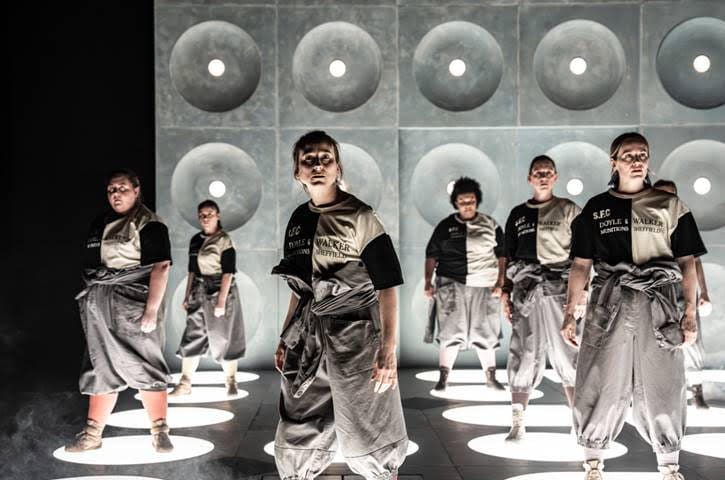
The women factory works – and footballers to boot – in The Ladies Football Club. Picture: Johan Persson
GO Firth and multiply the possibilities. In the wake of BAFTA and Olivier Award winner Tim Firth being asked to write the book for the Madness musical Our House and adapting his Calendar Girls film script for the stage version and subsequently the musical with composer Gary Barlow, now he puts the Sheffield into Stefano Massino’s 2019 Italian play Ladies Football Club, adding “The” to become the definitive version.
One accompanied in the city known as the “Home of Football” by foyer panels of information on the history of the women’s game, from Dick, Kerr’s Ladies FC and legendary gay star winger Lily Parr to Hope Powell and beyond.
Parr’s story, incidentally, has been told theatrically in Benjamin Peel’s Not A Game For Girls and Sabrina Mahfouz and Hollie McNish’s Offside, a play about football, feminism and female empowerment: themes in common with Firth’s premiere.
In the amphitheatre of the Sheffield Crucible, a theatrical sporting venue more associated with the multi-coloured ball-manoeuvring skills of snooker’s world championship, Sheffield Theatres’ artistic director Elizabeth Newman teams up with Frantic Assembly counterpart Scott Graham, whose trademark storytelling through movement was so crucial to the National Theatre’s The Curious Incident Of The Dog In The Night-Time.

Bringing football alive on stage has been expressed in myriad forms, from the game enacted in the heat of Celtic-Rangers sectarianism in avant-garde ballet maverick’s Michael Clark & Company’s punk liaison with Mark E Smith’s The Fall in I Am Curious, Orange, at Sadler’s Wells Theatre in 1988, to the masks and mannequins for the “Dirty Leeds” players in Anders Lustgarten’s Brian Clough psychodrama The Damned United.
More recently, Amanda Whittington turned the spotlight on the early days of women’s football in Mikron Theatre’s four-hander Atalanta Forever in 2021 and James Graham essayed the state-of-the-nation treatise wrapped inside the so-close-but-no-cigar reinvention of England’s football team under thoroughly decent Gareth Southgate, premiered by the National Theatre in 2023 and now being stretched into a four-part BBC One series.
You could argue that theatre’s best evocation of physical combat on the sports field comes in John Godber’s Up’N’Under, wherein Rugby League’s bruising encounters are played out by actors wearing shirts with one team’s colours on the front and the opponent’s strip on the back. So simple, so economical, so effective, so Godber.
Here, in The Ladies Football Club, no football is kicked with a satisfying thud, although we still feel every lunging tackle, every meaty header, as the cut and thrust, the tension and drama, of a game is evoked by Graham through largely balletic movement, sometimes freeze-frame in the manner of Roy Of The Rovers comic strips, sometimes in cartoonish slow motion, other times with sudden circular bursts of energised running.

There are 11 players on the “pitch”, sometimes fewer, depending on factory resources available, but all representing only the one team. Opponents are a ghostly blur, conjured in your imagination, as the Sheffield foundry team go through their motions and emotions.
Just as the opposing teams are absent, so too are the steel city’s men folk, sent to the front in the Great War. The women take over their Doyle & Walker factory labours, making the munitions for all that senseless fighting and bombing.
We see them on the factory floor, with their banter, their sandwiches and their rivalries, and we see them starting up lunchbreak kickabouts, with their banter, their sandwiched tackles and their rivalries, before progressing from playing with prototype explosives for a ball to local pitches and ultimately to famous stadia.
Teamwork is captured in Graham’s ensemble movement; individual stories are played out in Firth’s script, 11 stories in all, one for each player, each with a back story to tell.

That requires Firth to emphasise one trait or trope to encapsulate a character, a device that is at risk of making them 2D, rather than 3D, but aids the humour in the clashes of personality, beliefs and habits, also brought out in the way each plays the game. The fiery Marxist activist of the team plays, where else, but on the left wing.
Firth and director Newman have to squeeze in too much, but the accumulative effect is to bring the speed and momentum of a match into the storytelling, matched by Joe Ransom’s playful video designs, using projections rather than jumpers for goalposts, as the walls and floor come alive, in tandem with the ‘cabinets’ in Grace Smart’s smart set design, from which the factory work stations are pulled out.
United in defiance in the team line-up are Jessica Baglow’s stoical goalkeeper, Rosalyn; Cara Theobold’s workforce leader, Violet; Leah Brotherhead’s idealist militant, Hayley; Lesley Hart’s minister’s daughter, Berenice; Bettrys Jones’s Olivia, first with the news from the family newsagency, Ellie Leach’s Brianna, Claire Norris’s late-blooming outsider, Melanie; Krupa Pattani’s Cheryl, reluctant player-turned-captain; Cheryl Webb’s Abigail; Chanel Waddock’s Penelope, and, most amusing of all, Anne Odeke’s loud and proud Justine, never short of a salty quip.
How rare and exhilarating it is to see an entirely female cast – and of this number too – as they fight to break out of the strictures of prescribed roles for women.

When Red Ladder staged The Damned United, artistic director Rod Dixon summed up the play’s attributes thus: “As a story, it has it all – passion, power struggles, tragedy and a classic anti-hero – which lends itself brilliantly to theatre.” In the case of The Ladies Football Club, passion, power struggles and the tragedy of war play out. As for an anti-hero, the Football Association banned women’s football from 1921 to 1971 on the grounds of safety risks (to their anatomy). In a nutshell, the beautiful game was deemed “quite unsuitable for females and ought not to be encouraged.”
And so, women received the red card from both the post-war factory floor and playing pitch. Amanda Whittington wrote Atalanta Forever as her revenge play; Firth concludes The Ladies Football Club with a triumphant coda, celebrating the Lionesses’ victories and welcoming the next generation of young players on stage in full England kit (in a role shared by Evie-Rose Drake, Cristina La Roca, Bonnie Hill and Sophie tanner).
The audience cheers rise all the louder, honouring the wartime past of the foundry’s first flame of players while holding a torch for the future too. Football is indeed coming home…to Sheffield.
Sheffield Theatres in The Ladies Football Club, Crucible Theatre, Sheffield, today, kick-off at 7.15pm. Box office: 0114 249 6000 or sheffieldtheatres.co.uk.
