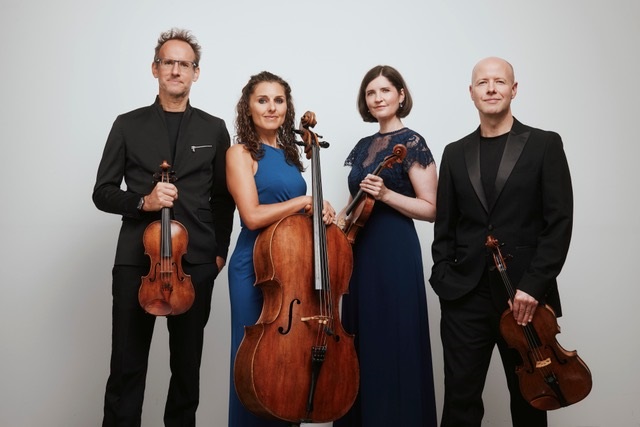
Carducci String Quartet
THE Carducci String Quartet opened their programme with a poised and assured account of Mozart’s String Quartet in C major, K. 465, the ‘Dissonance’.
Despite its nickname, the opening feels less discordant than unsettled, but its harmonic daring is still radical.
As Matthew Denton (first violin) pointed out, one more chromatic note and we would have the serial set: Haydn – Mozart – Schoenberg. Maybe.
Once the Allegro begins, however, the music resolves into clarity: the curtain lifted, the sun came out and Classical balance is restored. The ensemble interplay was lively and finely judged throughout.
The Menuetto – my favourite movement – retained its charm without underplaying the darker, less grounded A minor Trio. The Allegro molto last movement was again notable for the crisp exchanges, but it was the beautiful projection of song in the second movement Andante cantabile which really impressed.
The performance had a real operatic quality. Across the work, the Carduccis conveyed a strong sense of structural coherence.
After this Classical poise, Rebecca Clarke’s one-movement Poem opened up a more elusive, impressionistic sound world. The performance was highly persuasive. Echoes of Ravel and Debussy were clear, yet Clarke’s voice remained distinctive.
Themes seemed to emerge and dissolve rather than assert themselves, creating a continuous unfolding of mood and texture rather than a clearly defined architecture.
The Carducci Quartet clearly understood the music’s melancholic, unsettled character, shaping it with sensitivity and restraint. I admired the piece and the performance, but the impact was fleeting – the work didn’t stay with me, just a lovely impression of it.
From this impressionistic fluidity, the programme returned to firmer ground with Beethoven’s String Quartet in C major, Op. 59 No. 3, often regarded as the most immediately approachable of the Razumovsky quartets.
Its opening Andante shares something of Mozart’s harmonic uncertainty, unfolding with an almost improvisatory quality before the Allegro decisively asserts itself in a burst of C major energy and clarity.
This is a technically demanding movement, particularly for the first violin, and Matthew Denton was pushed to the limits in the frequent upper register passages of the development section. The rapid string crossings were dispatched with brilliance.
The second movement, Andante con moto, provided the emotional centre of the work: restrained, inward and quietly hypnotic, with an undercurrent of sadness that never became sentimental.
Maybe this hinted at the well-documented despair mapped out in the Heiligenstadt Testament? Probably not. What was fascinating was the recapitulation: here the themes are presented in reverse order, creating a quite radical sense of symmetry.
A charming, short Menuetto grazioso also functioned as a lead-in to the Allegro molto final movement. Suddenly, it was fasten-your-seatbelts time as the Quartet zipped through this relentless fugal tour de force. The articulation was razor-sharp and the rhythmic drive utterly relentless. It was an exhilarating conclusion, both to the work and to the programme as a whole.
The performance that stood out as being exceptional was their account of Philip Glass’s String Quartet No. 3, Mishima.
Drawn from Glass’s score for Paul Schrader’s Mishima: A Life in Four Chapters, the work unfolds in a series of vividly characterised tableaux. The familiar elements of minimalism – repetition, looping motifs, pulsing rhythms – were all present, but the Carducci Quartet brought far more than surface precision. What emerged was a performance of real depth and intensity, with a strong sense of dramatic continuity.
The technical demands are considerable: intonation must be exact, and the physical stamina required is significant. Both were met with complete assurance. More importantly, the Quartet revealed the work’s psychological dimension – its tension, its stillness, its underlying unease. Nothing felt routine; everything was shaped with insight and purpose.
I have heard this work many times, but this performance stood head and shoulders above any I have encountered.
Review by Steve Crowther