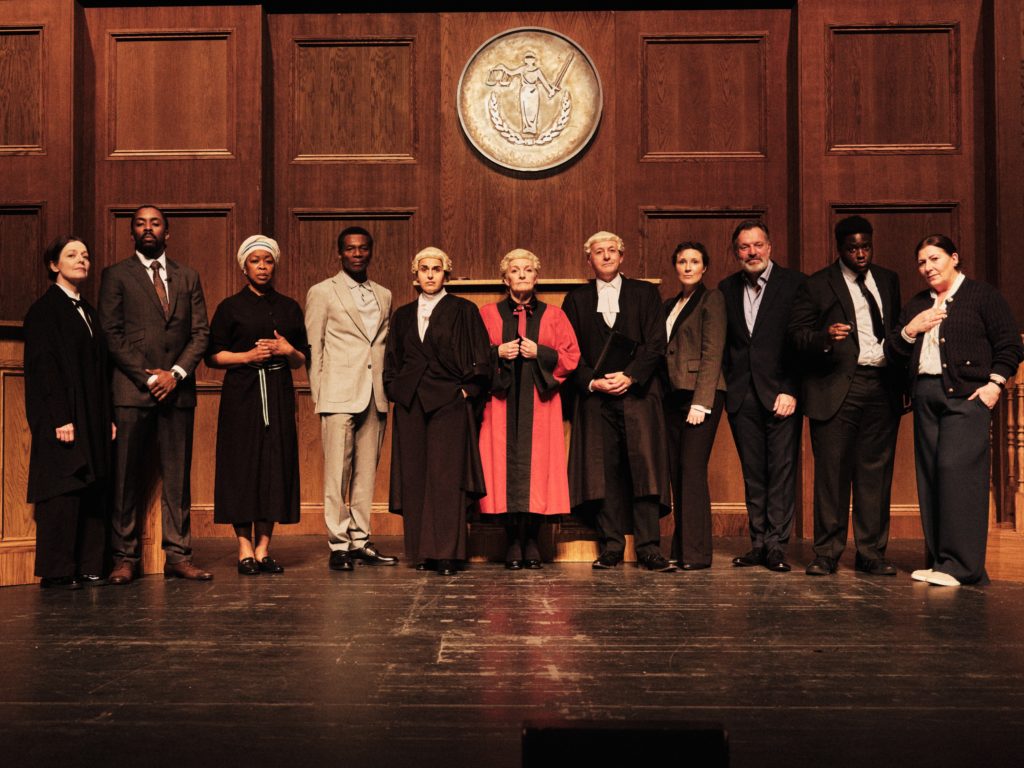
Tigerslane Studios’ cast for Murder Trial Tonight IV, Death Of A Landlord
I WAS really looking forward to this show—perhaps more accurately, this re-trial of a real-life court case—and it didn’t disappoint.
From the moment we entered, Sunday afternoon’s sold-out audience was cast as the jury in the trial of reclusive tenant Tre Bennet, accused of the brutal stabbing of his landlord, Victor Sloane. The only eyewitness: Sloane’s young daughter.
Presented under the direction of Gareth Watts, the stage was starkly arranged as a courtroom, complete with witness box, dock and judge’s bench, while the prosecution and defence occupied opposite sides as a cast of 11 played out Steve Cummings’ script.
When we were asked to stand for the judge’s entrance (Karren Winchester’s Her Honour Judge Amanda Livingstone KC ), the theatrical illusion snapped seamlessly into something far more immersive: participation.
The prosecution’s opening statement (by Alex Kapila’s Ms Victoria Pelham KC) was commanding, laying out what initially seemed like a compelling case. Witness statements, months of unpaid rent, and a description of a Black man in a yellow jacket—identified by the child—combined with blood found on the defendant’s door, all pointed toward Tre (Alpha Kamara).
We were also told that he suffered from schizophrenia, a detail framed to suggest a potential for violent outbursts. Add to this a recent confrontation between Tre and the landlord involving his mother, and the prosecution’s narrative appeared convincing. At this stage, the outlook for Tre Bennet felt bleak.
However, the defence lawyer (Ian Houghton’s Mr Miles Cavendish KC) methodically dismantled this certainty. The yellow jacket, central to the eyewitness account, was shown to be outdated—photographic evidence taken years earlier, with the garment long since discarded. The blood on the door was given a far more mundane explanation: an accidental injury sustained by the landlord while carrying out repairs. Gradually, the cracks in the prosecution’s case began to widen.
The emotional core of the piece came through the testimony of Tre’s mother (Karlina Grace-Paseda’s Dolores Bennet). Her account—detailing her escape from Sierra Leone to build a life in England with her young son—was deeply affecting.
Through her words, and those of Tre’s music teacher (Jason Deer’s Jason Scott), we were introduced to a very different portrait: a gentle, gifted young man shaped by hardship and subjected to racist abuse, yet defined by kindness and creativity. Importantly, the defence also challenged assumptions around mental illness, reminding us that the proportion of people with schizophrenia who commit violent crimes is extremely small.
What makes Death Of A Landlord so powerful is its insistence on confronting bias – both within the justice system and within ourselves. The production subtly raises the issue of racial profiling, prompting us to question whether the investigation may have been too quick to focus on a suspect who “fits the bill,” rather than exploring alternative possibilities.
The balance of the case is its greatest strength. Just when you feel certain, a new detail unsettles your confidence. The writing is sharp and meticulously structured, and the performances are so naturalistic that the boundary between theatre and reality all but disappears. As jurors, the weight of responsibility becomes palpable; the fear of reaching the wrong verdict lingers throughout.
Adapted from a true story, Tigerslane Studios’ production culminates in a modern twist: the audience delivers its verdict – guilty or not guilty – via smartphone using a QR code. Only then is the real-life outcome revealed on a large screen.
It’s a striking and sobering conclusion, leaving you not only reflecting on the case, but on your own judgement – and on this occasion, 84 per cent of York’s jury turned out to be wrong in their verdict.
This is immersive theatre at its most thought-provoking: gripping, unsettling, and impossible to forget.
Celestine Dubruel, theatrical judge and jury member
You’ve been duped. The whole thing is a fiction and its just an excuse for sloppy, racist nonsense. There was no real case, no real jury, and you’ve learned nothing other than the views of the scriptwriter.
I can see no correlation between this and any actual murder. Was it actual a true life case?
Just because the audience voted against the actual jury (if one existed) it doesn’t mean they got it wrong. They just voted the other way, based on the evidence presented.
As it said at the start of the film, 1 in 8 (real) juries are wrong. Who knows if the real jury was one of the 7 correct ones?