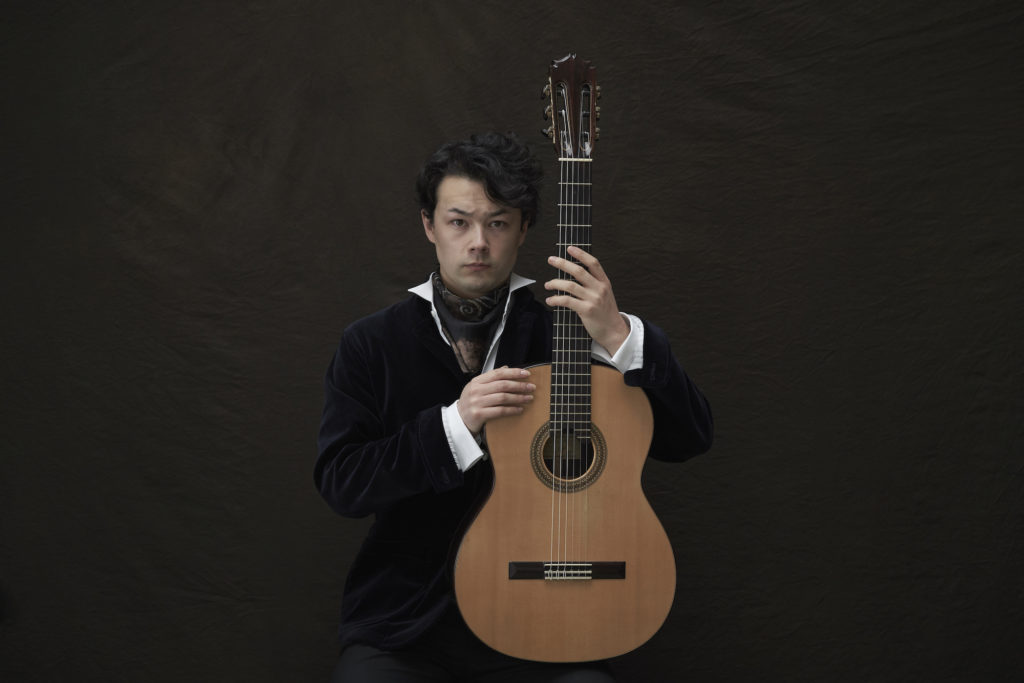
Scottish lutenist and guitar player Sean Shibe. Picture: Iga Gozdowska
THIS concert for the British Music Society of York opened with a request: none of the usual “Please switch off your mobile phones, emergency exits this way” stuff, but a call-out for a USB connector.
This set a tone of the unexpected, of unpredictability, and the concert was all the more refreshing for it.
Sean Shibe opened with a selection of lute pieces from the Rowallan and Straloch Manuscripts. The playing not only showcased his technical brilliance – each note plucked with surgical precision – but also the exquisite, expressive depth. I was drawn into a world which embraced a hypnotic, timeless quality.
I have never heard any of the music by Pierre Attaingnant, but it seemed to me that Sean Shibe approached the early 16th century-transcribed set of dances for solo lute, not as museum pieces but as vibrant living music. His tone was intimate and lucid, the ornamentation discreet yet expressive.
That said, I much preferred the following three unannounced Renaissance lute pieces by John Dowland: Prelude, Queen Elizabeth’s Galliard and Frog Galliard. They formed a delightfully compelling triptych, displaying the full expressive range of Dowland’s lute writing.
I loved the poise and courtly brilliance of Shibe’s Queen Elizabeth’s Galliard and the buoyant rhythm and sharply etched phrasing of its companion, Frog Galliard.
Having been forewarned that the first half was going to be short and the second half a ‘leg-crosser’ – my companion’s observation, not mine – we dutifully headed off to the proverbial refreshment rooms.
Not surprisingly, we were somewhat surprised to see the performer immediately returning with his guitar. Leaving our dignity at the auditorium exit, we quickly resumed our seats as if nothing had happened. And I’m pleased we did, as we were treated to a sublime performance of Bach’s Suite No. 1 in G major for cello, arranged, presumably by Sean Shibe, for solo guitar.
Shibe’s crystal-clear articulation of the weaving contrapuntal lines was not only technically remarkable but went way beyond virtuosity into a world of rediscovery, of genuine musical insight.
The second half should have opened with Sofia Gubaidulina’s short, three-minute solo guitar piece, Serenade (1960), only it didn’t. Instead, it was one of Harrison Birtwistle’s short guitar miniatures called Sleep Song.
Rather than the usual full-force, raw Birtwistle, the piece – as the title suggests – was quiet, introspective, and gently evocative.
The Gubaidulina was interesting in that it was quite traditional, even tonal. I also thought I detected a Spanish influence. Like the Birtwistle, it explored subtle timbres and mood. The performances were beautifully nuanced.
I was as delighted as I was surprised to see Frank Martin’s admirable Quatre pieces brèves for solo guitar – written for the great Spanish guitarist, Andrés Segovia, but premiered by (the even greater) Julian Bream – replaced by James Dillon’s Twelve Caprices for solo guitar.
Not surprisingly, these were characterised by extreme virtuosity: rapid changes from bass and treble (Caprice I); fast passagework (Caprice II); dynamic voice differences (III); crazy-fast stopped notes and harmonics (IV); left-hand extremes (VI); violent attacks (VII), through to a kind of recapitulation in the closing Caprice XII.
The musical as well as the technical demands on the performer are beyond anything I have heard for a solo guitarist, and the performance by Sean Shibe was unbelievably impressive.
For what it’s worth, it reminded me of a highly distilled version of the composer’s utterly magnificent Book of Elements – for solo piano. The problem for me was, unlike the Book of Elements, I really didn’t enjoy the ride; I just hung on for dear life: utterly exhilarating.
Sean Shibe closed the recital with Thomas Adès’ Forgotten Dances. Like the Dillon, the demands on the performer are considerable. Take the opening movement, Overture – Queen of Spiders, for example.
The fast alternation between the bright, metallic, glassy passages played very close to the bridge and the darker, chocolatey passages played very close to the fingerboard; the fast harp-like delicacy in the upper register and the jaw-dropping left-hand agility were delivered with a focus on musicality rather than display.
Was there any tone painting here? Not sure, but there was a brittle, skittering quality and a delightful winding-down of activity signalling closure rather than cadence. By contrast, in the sustained, quiet sonorities of Berceuse – Paradise of Thebes, Shibe conjured a timeless, haunting quality.
His playing in Here Was A Swift was brimming with a volatile, darting vitality. Were there echoes of Satie in Barcarolle – The Maiden Voyage? Absence of goal-orientated repetition, maybe? But the rocking motion suggests unease rather than Satie’s ironic calling card. Not sure.
Carillon de Ville came across as the most grounded, with Shibe marking a ritualistic 4/4 (to my ears) march, but one with nowhere to go. The suite closed with a homage to Purcell, Vesper – a movement signalling restraint, a quiet closing of the cycle rather than resolution. It was beautifully played.
I thought the performance of Forgotten Dances was inspired, and I left the recital believing that Forgotten Dances was the real deal: a masterpiece.
And there we have it: a one-off, truly remarkable programme and performance – a worthy tribute to Andrew Carter, president of BMS York, who died earlier this month.
Review by Steve Crowther