
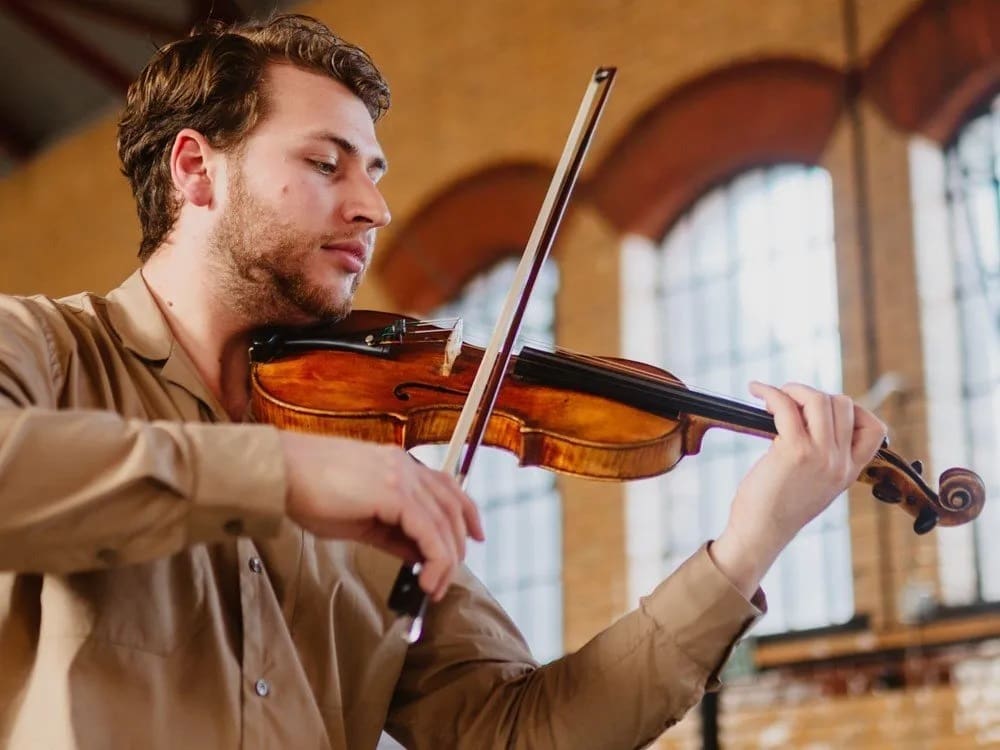
Violinist Jacob George
SATURDAY’S programme opened with Beethoven’s early Octet in Eb, Op. 103 scored for pairs of oboes, clarinets, horns and bassoons.
This proved to be an inspired choice as the players – with no place to hide – delivered an utterly assured performance of a showcase Beethoven work.
The first movement was notable for the excellent solo playing of the principal oboist, Alexandra Nightingale. Importantly, this being very much genuine chamber music, the interest derives from integration with the rest of the ensemble.
This resulted in delightful exchanges between the bassoon, clarinet and oboe. Even the horns had the chance to join the fun towards the end of the movement.
The following Andante came across as a touching duet between the oboe and bassoon (Isabel Dowell). Their intimate exchanges were beautifully delivered, and the rest of the ensemble had the good grace not to intrude. The balance and phrasing were spot on.
The Menuetto e Trio was full of energy and wit – the contrasting Trio delivering the change of mood and colour with the clarinet more prominent. In the Finale: Presto Beethoven gives everybody the chance to show off, and they did.
Here the clarinet takes the leading role from the earlier oboe – Lesley Schatzberger being on fine form and so too the horns. The writing here is particularly demanding and the horn players – Mark Sykes and Tim Pocock – were very good indeed.
What struck me when listening to the work was how democratic Beethoven’s writing was. The hierarchy of the ensemble constantly changed: from principal oboe to oboe and bassoon duet, then ensemble equality to clarinet and horn prominence in the finale.
The second half was given over to Haydn’s radical Symphony No.104 in D major, London. This really is a remarkable work, and I thoroughly enjoyed the Academy’s confident performance. The fortissimo opening – bare fifths (D and A) – delivered that monumental quality, reminiscent of Beethoven’s Ninth.
The atmosphere generated was tonally unsettling; there is a strings-plus-first-bassoon response before the Adagio settles in D minor. The quiet Allegro saw the strings in confident mood, providing a strong performance platform for the woodwind to join in. Indeed, the recapitulation was sung by the flute and oboe. Fascinating listening.
There was much to admire in the following Andante – the simplicity of the opening G major theme; Becky Jobling’s solo flute with delicate woodwind support; the shocking fortissimo orchestral cut-through with syncopated rhythms and agitated strings; the short flute cadenza and the gentle horn fanfare near the end of the movement.
But what really drew me in was the infectious playing which, at times, was so, so seductive. Those gorgeous lilting cadence passages were delightful.
Similarly, it was the joyous sound of the rustic third-movement Menuetto which drew you in. There were fine oboe and bassoon contributions in the contrasting, gentler, chamber-like Trio.
With its drone bass and rustic, folk-like violin theme, the finale once again seems to anticipate Beethoven and here the pastoral language of his Symphony No. 6. Again, the playing was so instinctively infectious that I saw many audience heads nodding to the beat of the music.
The success of the performance not only depended on the quality of the playing, which was pretty impressive throughout, but also on the pacing, the integration of the orchestral grandeur and chamber-music intimacy. For this, Director Alan George deserves much credit.
This leads me nicely into the central work in the programme, Mozart’s Sinfonia Concertante in Eb, K. 364, where he swapped his baton for the viola to duel with Jacob George on violin.
As if to contradict this, the two players emerged out of a substantial opening orchestral introduction as partners, complementing each other rather than competing. Indeed, the subsequent exchanges follow a pattern of call and response, of imitation; they even finish each other’s sentences and act as one with passages in octaves and thirds.
They are genuine equals with distinct voices – the violin’s bright sound contrasting with the darker timbre of the viola. The extended duet cadenza was superbly judged.
I really enjoyed the fast, buoyant exchanges in the Presto conclusion. The back-and-forth exchanges between the two soloists were a bit like musical tennis. What worked here was the spontaneity of engagement.
But it was the second movement Andante, the emotional core of the work, which impacted most. Here we had – sorry to say it, gents – a love duet between the two. Exchanging long, considered phrases, so beautifully embellished. Their closing duet cadenza was one of intimacy rather than one of theatre.
Academy of St Olave’s, 19/9/2026: Alan George, director; Claire Jowett, leader; Jacob George, violin; Alan George, viola.
Review by Steve Crowther