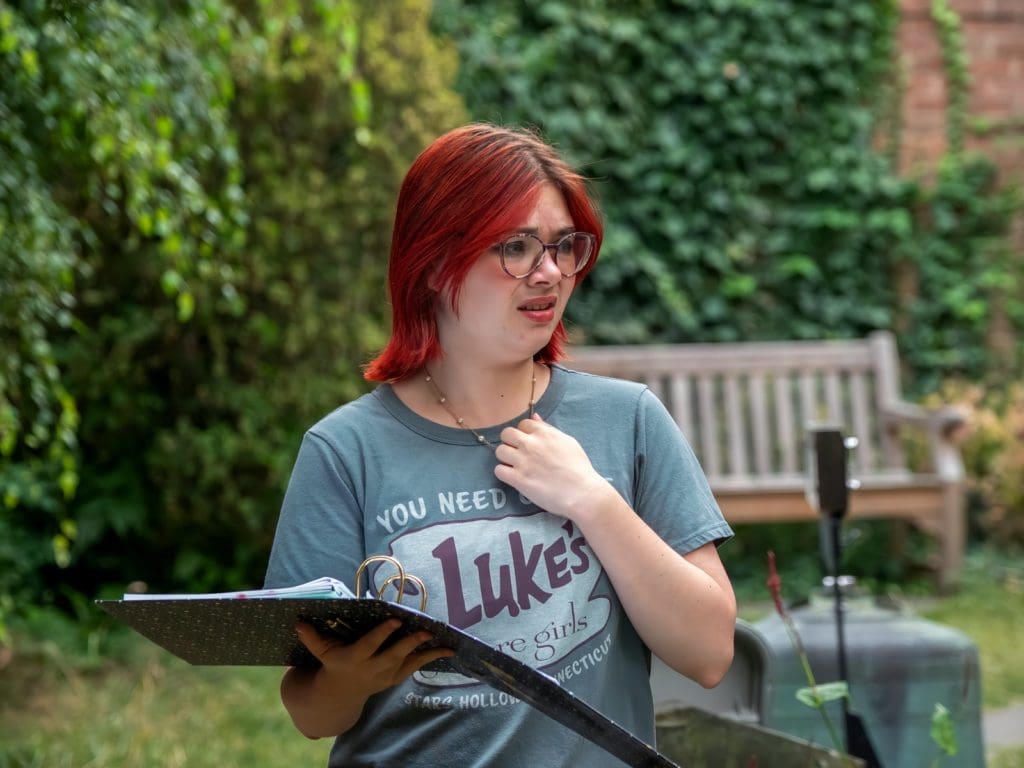
On the stretch: Jamie McKeller’s Lionel and Stuart Lindsay’s Charles limbering up for a doubles match in Summer Sonnets’ What The Deuce? at Holy Trinity Churchyard. Picture: John Saunders
ROSY Rowley and Stuart Green, partners off court, are the new doubles partnership for York Shakespeare Project’s tennis-themed 2026 Summer Sonnets.
Familiar figures on the York stage, they have switched to directing and writing YSP’s regular summer enterprise, wherein ten of the Bard’s sonnets are performed within a framework that changes each year.
Courtly love takes on a new meaning in Summer Sonnets: What The Deuce?, set in the summertime, when the weather is fine at the Goodramgate Lawn Tennis Club as four doubles teams compete for the chance to play in a Wimbledon amateur tournament.
Ace partnership: What The Deuce? director Rosy Rowley and script writer Stuart Greenputting top spin on York Shakespeare Project’sSummer Sonnets with novel tennis theme
Sporting endeavour clashes with unsporting behaviour when partnerships and rivalries on court undermine partnerships off court, taking rivalries to break point in a surfeit of subterfuge and sabotage. “Who has the advantage? Who is at fault? Will the score be love?” ask Green and Rowley, who duly reach for a volley of tennis puns, put away with the flourish of a Federer.
Free drink in hand – alas not Robinsons Lemon Barley Water, but then again Robinsons’ partnership with Wimbledon ended after 86 years in 2022 – the audience settled into seating repositioned by 90 degrees in the Holy Trinity Churchyard.
The cast now performs with the sound of the Chinese restaurant kitchen fans on Goodramgate now behind or to the side of them: an excellent decision that ensures vocal clarity. In addition, Rowley has her actors delivering from closer to the audience, again ensuring no line is lost.
Alan Sharp’s groundsman (in a change of rock band T-shirt from the one referenced in this review) receiving the first of multiple instructions from the tennis club chair, Christine Bramwell’s Elizabeth, in Summer Sonnets: What The Deuce? Picture: John Saunders
York tour guide Alan Sharp is no stranger to speaking on the move, above street noise, and here he does so as the phlegmatic, weather-beaten, worldly-wise groundsman Graham, whose every line is either delivered in iambic pentameter in Stuart Green’s script or is one of the Bard’s smattering of tennis references (or real tennis as it would have been at that time), from Henry V to Hamlet.
In his System Of A Down Mine Is Bigger Than Yours T-shirt and shorts, Sharp’s Graham will open and close the show and make regular interjections to carry out handyman tasks, reappearing with a plunger, rubber gloves, replacement barley water bottle and finally an old-school groundsman’s line marker (with the obligatory squeak). It is a standard-fit line marker, by the way, rather than bigger than yours.
The churchyard grass is not converted into a tennis court (games are conducted as ‘noises off’), but serves as the club grounds where all the shenanigans take place.
Drinks break: Oscar Langford’s Harry, left, and James Robert Ball’s Tony sip the barley water in a joke that will run and run in Summer Sonnets: What The Deuce? as Stuart Lindsay’s Charles looks on. Picture: John Saunders
Each time the drama heightens, invariably in a heated discussion, rather than bursting into song in opera or musical theatre, a protagonist moves seamlessly into sonnet mode, and come the 50-minute mark, all ten will have unburdened themselves in Shakespeare’s silver tongue.
We meet Christine Bramwell’s ever-enthusiastic club chair Elizabeth; her doubles partner, Helen Clarke’s Margo, wife to Jamie McKeller’s ageing club champ, whose doubles partner, Stuart Lindsay’s Charles, is wont to hiding behind trees, desperate to win Margo rather more than his matches.
Of the young things, Oscar Langford’s Harry is a loyal partner to James Robert Ball’s Tony, in more ways than tennis as it becomes increasingly apparent, but Lionel and Margo’s spoilt-brat, posh and pushy daughter Chessie (Effie Warboys, whose birthday falls tomorrow) wants Harry to hurry up in his affections for her. “I’m practically club royalty,” she scoffs, making a racket at every toss and turn.
Squash on the tennis court: Effie Warboys’ insufferably spoilt Chessie, front left, pushing around her doubles partner, Alexa Williams’s Belle. In the background are Oscar Langford’s Harry, left, and James Robert Ball’s Tony. Effie will be celebrating her birthday tomorrow. Picture: John Saunders
Her long-suffering best friend Belle (Alexa Williams) has the hots for Harry too. Meanwhile, club newcomer Vic (Sarah McKeagney), in jeans and Gorillaz T-shirt, is on the lookout for a partner, as we watch everything play out game, set and match, fair game, re-set and mis-match, with delightful mischief in Green’s plot and Rowley’s direction alike.
“Only in tennis does ‘love’ mean you are losing,” laments Lindsay’s Charles in Green’s best line, although Charles’s “I had Brazilian last night,” prompting a misunderstanding Lionel to enquire “Chafing?” is a peach too. Easy mis-steak to make!
All the familiar Shakespeare comedy tropes are present and freshly spun from mistaken identity to a potion in the barley water, cross-dressing to mistaken identity; revenge to lust and unrequited love. You will be rushing home to check whether Mexican Donkey Laxative actually exists.
Sarah McKeagney: One of eight York Shakespeare Project debutants in Summer Sonnets: What The Deuce?, playing tennis club newcomer Vic at Holy Trinity Churchyard. Picture: John Saunders
What The Deuce is YSP’s ninth season of summertime sonnets and third at Holy Trinity, where Rowley and Green have certainly supplied new balls, please, with their rallying call enticing eight of the cast to make both their Sonnets and YSP debut.
Whether Sonnet Walks or Sit-Down Sonnets, Sonnets at the Bar [Convent], Sonnets in Bloom in 2025 or tennis fun and games in 2026, this event remains one of the joys of the York outdoor theatre year for performers, audience and venues alike. You cannot be serious? Very much so.
York Shakespeare Project presents 2026 Summer Sonnets: What The Deuce?, Holy Trinity Churchyard, Goodramgate, York, play resumes tomorrow until Saturday, 6pm and 7.30pm plus 4.30pm Saturday show. Box office: tickets.41monkgate.co.uk.
Doubles troubles ahead: Helen Clarke’s Margo and her husband, Jamie McKeller’s Lionel, the ageing club champ in Summer Sonnets: What the Deuce? Picture: John Saunders
Director Rosy Rowley and writer Stuart Green, on the bench at Holy Trinity Church, Goodramgate, rehearsing with Summer Sonnets cast members and producer Maurice Crichton (arms folded, at the back). Picture: John Saunders
DIRECTOR Rosy Rowley and writer Stuart Green are the new doubles partnership for York Shakespeare Project’s tennis-themed 2026 Summer Sonnets: What The Deuce?
New balls, please, will be served on the grass of Holy Trinity Churchyard, in Goodramgate, York, from Friday to August 15, with a rest day on August 11.
Should you be wondering “Why tennis?”, the game features in no fewer than seven Shakespeare plays: Hamlet, Act II, Scene 1; Henry IV, Part 2, Act II, Scene 2; Henry VIII, Act I, Scene 3; Much Ado About Nothing, Act III, Scene 2; Pericles, Act II, Scene 1; The Two Noble Kinsmen, Act V, Scene 2, and most notoriously in Henry V, Act I, Scene 2.
In that scene, the French Dauphin mocks King Henry by sending him a gift of tennis balls to besmirch his youthful reputation as a frivolous playboy. Henry responds by threatening to turn the balls into cannonballs to play a set as explosive as McEnroe against the French crown.
Ready to serve: Tennis fan William Shakespeare in York Shakespeare Project’s poster for Summers Sonnets: What The Deuce?
Now comes What The Deuce?, where summertime at the Goodramgate Lawn Tennis Club finds four doubles teams competing for the chance to play in a Wimbledon amateur tournament, whereupon partnerships and rivalries lead to sabotage and break point. Who has the advantage? Who is at fault? Will the score be love?
Cue further tennis puns aplenty as Rowley directs Green’s script that asks a new collection of ten characters to play out this new sporting and unsporting situation, where each finds a way to share a Shakespeare sonnet.
Pulling on the traditional and not-so-traditional Wimbeldon tennis whites for York Shakespeare Project (YSP) will be Alan Sharp’s Graham; Christine Bramwell’s Elizabeth; Helen Clarke’s Margo; Jamie McKeller’s Lionel; Stuart Lindsay’s Charles; Oscar Langford’s Harry; James Robert Ball’s Tony; Alexa Williams’s Belle; Sarah McKeagney’s Vic and Effie Warboys’ Chessie.
“Stuart has been wanting to write and I’ve been wanting to direct,” says Rosy. “I’d directed a Direct Approach play for Settlement Players – Night Secrets – so I just wanted to get back into it, and I suppose YSP have taken a bit of a punt on us.”
James Robert Ball, left, and Oscar Langford in rehearsal for Summer Sonnets: What The Deuce? Picture: John Saunders
It should be pointed out that Rosy and Stuart tread the boards regularly in York, first meeting when performing in the York Theatre Royal community play Sovereign in 2023. “We’ve done a few plays together, such as A Kingdom Jack’d in April, and theatre is the thing that brought together as a couple,” says Rosy.
“We’ve now got one of those bricks on the wall at Theatre@41, Monkgate, where we both volunteer, that says ‘Theatre together’.”
Stuart and Rosy settled on 80 per cent of the sonnets before Stuart set to work on the script that weaves ten sonnets into the tennis plotline. “We’ve had great fun putting the story together with classic Shakespeare tropes and then putting them in a tennis setting,” says Rosy.
“We’ve crammed a lot into our 50-minute play,” says Stuart. “We have cross-dressing; mistaken identity; poisoning, revenge; lust; unrequited love…
Director Rosy Rowley and writer Stuart Green in the Holy Trinity Churchyard, the setting for courtly love with a difference in their tennis-themed Summer Sonnets. Picture: Maurice Crichton
… “and of course lots of tennis,” says Rosy. “What’s been really important to us is not making the sonnet just something they recite but part of a conversation, which is the case in all but two of them that will be done as monologues.”
Stuart adds: “We wanted to incorporate the sonnets into conversations in the play, thinking how could a sonnet fit with a particular character? The aim is that the audience doesn’t notice they’ve gone into a sonnet because it makes the sonnets really accessible by putting them in a narrative, where suddenly they make more sense.”
Not all of Shakespeare’s 154 sonnets focus on romantic love. Death, political vexation, artistic rivalries, human flaws and the passage of time are significant themes too, alongside desire and love.
“We thought how could we interpret sonnets in ways that fit with our play, and the beautiful thing is that there are so many ways to interpret them, not just romantic love,” says. “For example, Christine Bramwell’s sonnet reflects her love for the tennis club and the game.
Belle of the ball:Alexa Williams playing the role of Belle in York Shakespeare Project’s tennis-punned Summer Sonnets: What’s The Deuce. Picture: John Saunders
“Right at the start of rehearsals, I had one-to-one table sessions with each actor to see how we could make their sonnet work with the character.”
Stuart adds: “I think it helps that both Rosy and I are actors because we know what each actor can bring to the part.”
Stuart and Rosy have been delighted by the response to this summer’s sonnet project. “We had 30 people applying to take part, which was a record number,” says Stuart. “Then 24-25 auditioned, and we cast ten, where only two of them – Stuart Lindsay and Effie Warboys – had done Summer Sonnets before.
“A lot of them are new to YSP. It wasn’t a conscious decision; it was just that they were the best to put themselves forward.”
Helen Clarke, left, Oscar Langford, Stuart Lindsay and Sarah McKeagney rehearsing with Summer Sonnets: What The Deuce? script writer Stuart Green. Picture: John Saunders
One other new element will be the positioning of the actors in the Holy Trinity churchyard. “We’ve shifted it 90 degrees so that the Chinese restaurant, on Goodramgate, with its fan noise and smells, will now be behind the actors, rather than the audience,” says Rosy. Good decision.
Green by name, green keeper by profession, Stuart first wrote screenplays in his teens and 20s. “I wanted to get into films, but the chances were non-existent, so I became a green keeper, initially at Bushey Hall Golf Club in Watford, then went to college and ended up at Gleneagles for four years,” he says.
“Now I teach green-keeping: I’m a grass nerd! I used to be based at Askham Bryan, where I taught apprentices at the agricultural college. Now I work for Train Together, teaching green keepers and cricket, football and rugby groundsmen.
“There’ll be a groundman as one of the characters in our Summer Sonnets, Alan Sharp’s Graham. I couldn’t resist it! I’ve called on one of my old York Cricket Club contacts to lend us an old line marker – and one of my stipulations was that it had to be squeaky as they generally are!”
Helen Clarke, left, Oscar Langford and Sarah McKeagney rehearsing a scene from Summer Sonnets: What The Deuce? Picture: John Saunders
Tennis gear will carry significance in Rosy and Stuart’s production. “What they’re wearing denotes their status at the club, whether it’s all white or not,” says Rosy. “There has to be a bit of a social statement in that.”
No tennis pun has been resisted. “We realised we didn’t have enough tennis innuendo at first, so I’ve had fun writing some absolute ‘tennis filth’,” says Rosy. “Now it’s unashamedly Carry On Tennis,” says Stuart.
“And of course we had to crow-bar ‘You cannot be serious’ in there too,” says Rosy.
Lara Stafford in her Premium Eclipse Viewer glasses in readiness for August 12’s solar eclipse during the 6pm performance of Summer Sonnets: What The Deuce? Pairs are available for free for Sonnets audience members
Not to be eclipsed…
ON Wednesday, August 12, the UK will experience its deepest solar eclipse since 1999, with up to 96 per cent of the Sun covered by the Moon.
Across North Yorkshire, the partial eclipse will begin at 6.12pm, peak at 7.08pm and finish at 8.02pm. That day’s 6pm and 7.30pm performances of Summer Sonnets: What The Deuce? will go ahead as planned, but do come prepared for the eclipse experience.
Quick question: Do sunglasses protect eyes in a solar eclipse? NO!The official advice is: Never look directly at the Sun.
Why? The Sun can burn the retinas in the eyes, leading to permanent damage or even blindness. This can occur even if your eyes are exposed to direct sunlight for only a few seconds.
Proper eye protection is the only safe option, not sunglasses. The only way to view the Sun safely – eclipsed or not – is to either project or filter the Sun’s rays.
Suggestion: Make your own box projector or acquire safe solar eclipse glasses. NASA also recommends welder’s glasses rated 14 or higher, to be found at welding supply stores.
Lara Stafford demonstrating the benefit of wearing Premium Eclipse Viewer glasses for August 12’s partial eclipse of the Sun
YORK actress, Physics teacher and Theatre of Science communicator Lara Stafford is teaming up with York Shakespeare Project for a special offer for Summer Sonnet audience members. “August 12’s 6pm show coincides with the solar eclipse: the best one to happen to the UK until 2090, with over 90 per cent of the Sun covered by the Moon,” she says.
“It’ll begin just after 6pm and peak an hour later, just after the performance. A £10 Summer Sonnets ticket has always come with a free drink, but to celebrate this cosmic coming together, we’re going to give out a free pair of eclipse glasses with every ticket sold for performances up to the 6pm show on August 12.”
Lara continues: “I buy them in for work anyway, so I’m just ordering a few more! It’s quite difficult to get eclipse glasses cheaply and guarantee they’re not fakes, and you can ‘only’ watch the eclipse with your eyes if you’re wearing eclipse glasses. So it’s an easy way for us to spread the eclipse excitement around York and spread awareness of the sonnets.”
Should you be wondering, a reference to an eclipse can be found in Sonnet No. 35, one that does not feature in Rosy and Stuart Green’s choices for Summer Sonnets: What The Deuce? So here is the quote:
“No more be grieved at that which thou hast done. Roses have thorns, and silver fountains mud; Clouds and eclipses stain both moon and sun, And loathsome canker lives in sweetest bud.”
UPDATE: 11/08/2026
THOSE four lines from Sonnet No. 35 WILL now feature in Wednesday’s 6pm and 7.30pm performances of Summer Sonnets, adding to Alan Sharp’s Shakespeare quotes in his guise as groundman Graham. Every line uttered by the phlegmatic Graham in Stuart Green’s script is either in the rhythm of iambic pentameter or one of the Bard’s references to tennis.
Still shielding their eyes! The Brontë Sisters in York Settlement Community Players’ poster for Underdog: The Other Brontë at Theatre@41, Monkgate
ECLIPSE glasses removed, Lara Stafford will be shining next on the York stage as Charlotte Brontë in Claire Morley’s production of Sarah Gordon’s 2024 play Underdog: The Other Brontë for York Settlement Community Players at Theatre@41, Monkgate, York, from October 13 to 17.
The plot? Charlotte Brontë has a confession about how one sister became an idol and the other became known as the third sister. You know the one. No, not that one. The other, other one…Anne.
Underdog presents an “irreverent retelling of the life and legend of the Brontë sisters like you’ve never seen them before”. This is not a story of well-behaved women but of the power of words, sisters and sisterhood, love and jealousy, support and competition. Tickets for the 7.30pm evening performances and 2.30pm Saturday matinee are on sale at https://tickets.41monkgate.co.uk/.
Alan Sharp’s Warwick, James Tyler’s Lancaster, James Lee’s Gaveston, Emma Scott’s Young Mortimer and Cassi Roberts’s Kent at work on York Shakespeare Project’s Edward II. Picture: John Saunders
AT the heart of phase two of York Shakespeare Project over the next 25 years is the mission to stage not only all of Shakespeare’s plays, but also the finest works of his contemporaries.
The Bard’s first rival in focus will be playwright, poet and translator Christopher “Kit” Marlowe, writer of The Tragicall History of Dr Faustus; Tamburlaine The Great; Dido, Queen Of Carthage; Edward II; The Massacre At Paris and The Jew Of Malta.
York Shakespeare Project (YSP) will stage his intimate historical tragedy Edward II (a.k.a. The Troublesome Reign and Lamentable Death of Edward the Second, King of England) under the direction of Tom “Strasz” Straszewski at Theatre@41, Monkgate, York, from October 17 to 21 at 7.30pm plus a 2.30pm Saturday matinee.
Edward II is king at last. Determined to shower his loved ones with gifts, he summons his exiled lover, Piers Gaveston, 1st Earl of Cornwall. In the face of a king, court and country intoxicated by their passions, the Queen takes her own lover, whereupon the nation is torn apart in a merciless divorce. Their child watches from the shadows, desperate to mend this broken family and nation or bring them to heel.
“Like Marlowe himself, we wanted to focus less on historical accuracy or psychological realism, and instead as a fantasia of power and love. This is a fearful England,” says the director.
Tom Straszewski: director of York Shakespeare Project’s Edward II
Here Tom Straszewski discusses kings and queens, sexuality and social mobility, drag and cancel culture with CharlesHutchPress
What attracted you to directing Marlowe’s Edward II, Strasz?
“I’d just come off the back of directing Lincoln and York’s Mystery Plays and was looking for the next challenge. Edward II came at the perfect moment – something more intimate, but still engaging with a community cast and their own ideas for the play.
“YSP were good enough to trust me with their first non-Shakespeare play. I knew I wanted to treat it as a queer play, not just in terms of the love between Edward and Gaveston, but as something that challenges what it means to be powerful.”
How will you bring contemporary resonance to this age-old story of the struggle for love and power?
“The historical Edward II has tended to be portrayed as a weak king. He lost to the Scots, he wasn’t interested in taking over more land in France, there was a Europe-wide famine…but it’s been horribly tied to debate over his sexuality.
Cassi Roberts, back left, as Kent, Emma Scott as Young Mortimer, James Lee as Gaveston, Thomas Jennings as Lightborn, Stuart Lindsay as the Bishop, Emily Hansen as Pembroke and Alan Sharp as Warwickin rehearsal for York Shakespeare Project’s Edward II. Picture: John Saunders
“The cast were generally wary of judging Edward by medieval standards. Did we really want to judge him for failing to conquer other countries? What we found was a king whose downfall isn’t in rejecting his love for Gaveston or failing to make war, but failure to keep his community safe.
“What’s resonated with many of us is the dramatic increase in transphobia over the last few years. Because of that, we’ve framed power and love as two ways of finding safety. For the nobles, having power lets them keep their loved ones safe. Edward protects Gaveston because he loves him, because it’s the right thing to do – whatever the cost.”
How did you bring drag into your considerations on how to present Edward II?
“It draws on the glamour of royalty. Drag queens, drag kings, it’s about finding something powerful in how you present yourself to the world. So we call our production a fantasia. A work of the imagination, of imagery and visions, rather than pure plot.
“Originally it meant ‘to shine’, and that’s something we’ve engrained in the play: a world of shining gold and dripping pearls, and the seductive shimmer of power and passion. Underneath all that are ordinary people, striving for something glorious.”
Cassi Roberts as Kent, left, and Emma Scott as Young Mortimer. Picture: John Saunders
What drew you to casting YSP Jack Downey, James Lee and Danae Arteaga Hernandez in the principal roles of Edward II, Gaveston and Queen Isabel? “When we first auditioned, we were looking for an ensemble who could all work together. We didn’t know who might be in each part, as long as they brought curiosity and bravery. As we got into the guts of the play, it became clear that James and Jack played off each other.
“There’s something of the current monarch in Jack’s portrayal – torn between his real love on one side, and the rejected wife on the other. James’s Gaveston allows Edward to be gentle, to shrug – for a moment – the weight of kingship off his shoulders.
“Danae has been a real revelation as Queen Isabel, particularly paired with Emma Scott’s Young Mortimer. She’s constantly described as weeping or mourning, but Danae’s found the power behind that.
“I’m also delighted that familiar faces have returned, often bringing something surprising, something I hadn’t seen them do before. Emily Hansen’s found a steely core in Pembroke’s moderation. Harry Summers’ Elder Mortimer gives a wonderfully tender paean to love between men, behind his desire to bash some heads in.”
James Lee’s Gaveston, left, and Jack Downey’s Edward II
How does Jack Downey interpret Edward II? “Jack’s Edward uses weakness as a weapon. He threatens to give his crown away, knowing nobody wants the responsibility. He’ll lie down in the middle of the stage and see if people will really dare to brutalise him. And they back down! He wins!
“Then he starts playing the game on the other’s terms: starts wars, executes his prisoners, abandons his friends for his own safety. That’s when it falls apart. “And what Emma Scott has brought to Young Mortimer is a noble who recognises this, responds to it – she doesn’t rant and bully people, but tries to lead them along with a smile (and the threat of her knife behind it).”
How are today’s issues of cancel culture, celebrity and social mobility woven into your Edward II?
“If our play is a fantasia, we looked at other forms of power and display than the monarchy – and celebrity is chief among them. How we present ourselves and who lies behind it are often different. For Gaveston, he’s met the right people, helped out his friends, risen above his poor background.
Stuart Lindsay as the Bishop, left, Charlie Barrs as Maltravers and Thomas Jennings as Lightborn. Picture: John Saunders
“Gaveston’s enemies don’t see it that way. His crime is not loving the king, but getting rich off it, and they don’t see what he’s done to deserve it. They’ve suffered to keep their people safe. He hasn’t.
“Gaveston and Edward fail to control the narrative, and so they lose their supporters, their fans I guess! The play constantly references the medieval wheel of fortune: if you rise, you must fall. And we can see how quickly someone can rise and fall today.”
What will the set and costume design be?
“All the actors have brought their own designs to the mix, based on their understanding of the characters. Expect to see a little Hollywood glamour, mirrored vanities, gold and pearls. Makeup as a source of power. Underneath it, the decay of the fall.”
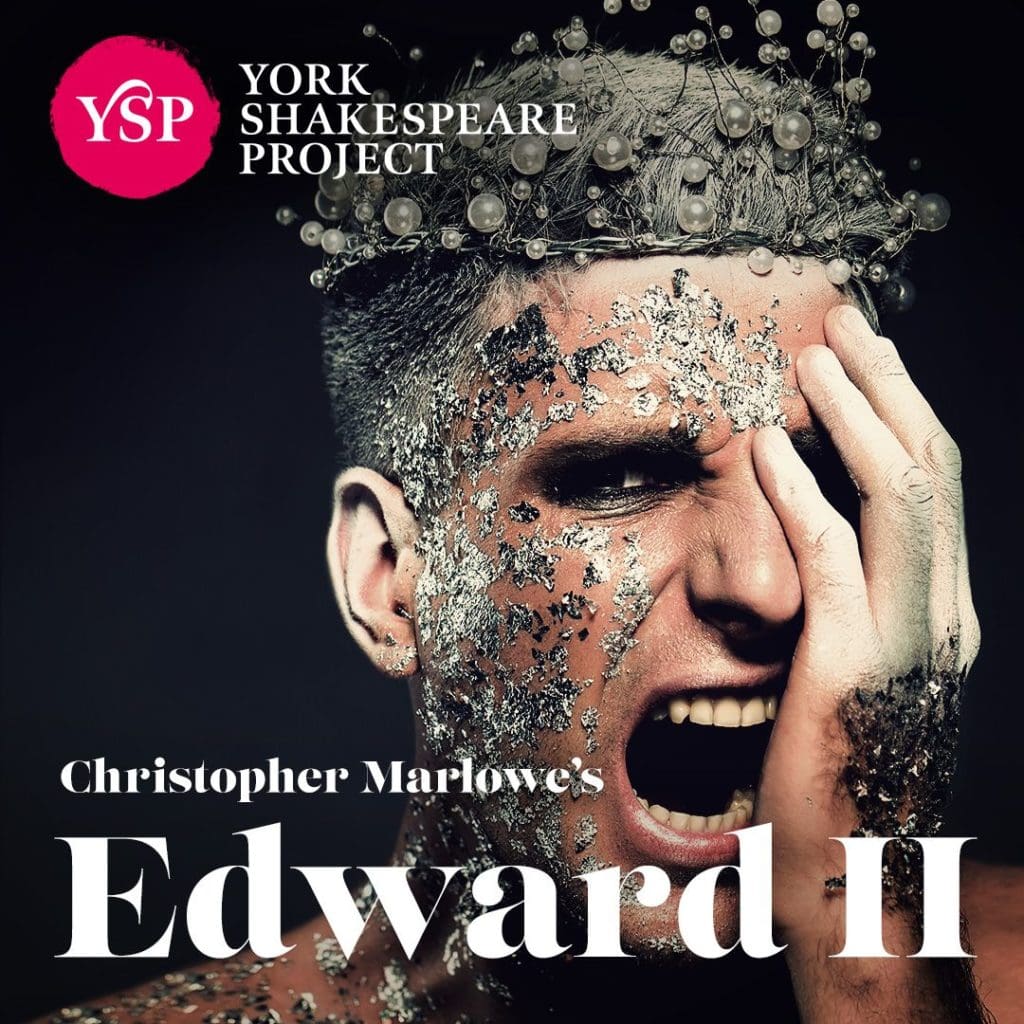
York Shakespeare Project’s poster for Edward II
Where will music fit into your production? “Music comes out in moments of power and desire. Serenades to the king, a power number gearing up for war, a bit of techno. We’ve drawn on what suits the moment. Each of Edward’s lovers sing to him. For example, The Ink Spots’ I Don’t Want to Set The World On Fire: its refrain of ‘Believe me’ is key to it all.”
And finally, Strasz, how do you “rate” his rival Marlowe by comparison with Shakespeare?
“You don’t! You shouldn’t! They were collaborators; they almost certainly worked on Henry VI together; there are phrases and situations that they share. Maybe Shakespeare’s later works have a certain tenderness that Marlowe’s early plays lack, but then Shakespeare had decades of experience beyond Marlowe’s death.
“Marlowe’s not interested in broad comedy, although his insults are witty. But I think he’s willing to let his lead characters let loose at the world. Shakespeare’s characters enjoy the rise to power. Marlowe’s better at the fall.”
Tickets are available at tickets.41monkgate.co.uk or by emailing the box office at [email protected].
Tony Froud: Chair of York Shakespeare Project
Only One Question for: York Shakespeare Project chair Tony Froud
Why will York Shakespeare Project feature works by Shakespeare’s contemporaries in its second cycle of productions?
“AS we embarked on phase two, we wanted to stretch ourselves afresh, in a way matching the great ambition of the original project’s aim (to do all the plays in 20 years). Producing all of Shakespeare’s plays again is a mighty task in itself and will offer new challenges in presenting the texts in new ways for different times.
“But we were mindful that Shakespeare did not exist in a vacuum. Many of his contemporaries were great playwrights in their own right, and there are so many exciting Elizabethan and Jacobean plays that we want to share over the next 25 years.”