REVIEW: Handbagged, Stephen Joseph Theatre, Scarborough, until August 29 *****

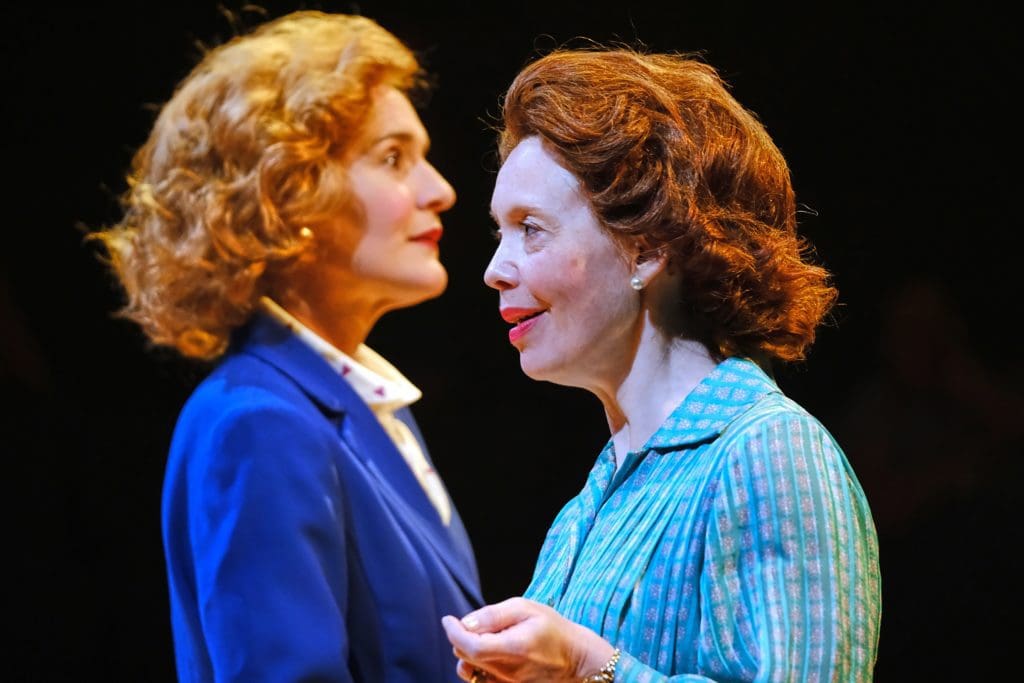
No common ground: Pandora Clifford’s Mags and Liz Garland’s Liz in Handbagged at the SJT. Picture: Tony Bartholomew

THIRTY six years since her resignation and 13 since she died at the Ritz Hotel, Margaret Thatcher still drew boos and derision from the SJT audience – in a town that only turned red from decades of Tory MPs in 2024.

There was a smattering of cheers too, drawing more boos from the derisive naysayers for a Westminster titan that remains as divisive as ever in an age of increasingly short-lived minnows in Downing Street.

Moira Buffini’s 2013 play – so full of wit, brio and intelligence – is neither biased nor one-sided in its depiction of Mrs T, instead letting her speak, vehemently, vigorously, and even vituperatively, for herself over her 11 years as the UK’s first female  Prime Minister. She stands and – seemingly in many eyes and ears on press night – falls by her words.

Words that were fired off in the direction of the other dominant female presence of the British 20th century, Queen Elizabeth II, in their weekly meetings at Buckingham Palace and beyond.

Director Hannah Tyrrell-Pinder in the rehearsal room with Handbagged cast member Simon Darwen. Picture: Tony Bartholomew

Revived by the Stephen Joseph Theatre under the directorship of Hannah Tyrrell-Pinder (whose father, Andrew Pinder, received a CBE for his services to Tony Blair’s Labour government), Handbagged is built on the classic political structure of conflict where people talk but don’t engage in conversation.

Born within six months of each other but poles and circumstances apart, albeit that both had to face a patriarchal world, the PM and HM The Queen serve as a double act, or, to be precise, a double double act, on account of Buffini doubling the combat between  a younger Mags (Pandora Clifford) and Liz (Liz Garland), from the weekly audiences, and an older T (Alexandra Mathie, wig too dark) and Q (Meriel Scholfield).

Observing their younger selves, they each say equally quizzically, “I never said that”, as if they have become unreliable witnesses to their earlier sentiments and assertions.

That said, everything Buffini writes of their awkward conflabs behind closed doors can only be conjecture to complement words from public utterances and Mrs Thatcher’s Downing Street Years memoirs.

Alexandra Mathie’s T: Doubling down on her political philosophies in old age in Handbagged. Picture: Tony Bartholomew

Grim reading: Pandora Clifford’s Mags flicking through the Sunday paper headlines in Handbagged. Picture: Tony Bartholomew

Yet she writes with such cultural savvy, comedic conviction, assiduous detail, such a grasp of her satirical subject, that she brings to mind the mischief-making of  political heavyweights The Thick Of It , House Of Cards or Yes, Prime Minister. It feels all the more truthful for the assured voice of Buffini.

A third double act is at play: our convivial hosts Actor One (Deven Modha) and Actor 2 (Simon Darwen), who spar over who should play Labour Leader Neil “Kinnockio” Kinnock, while allocating themselves such support acts as Denis Thatcher, Prince Philip (only one irascible line), Gerry Adams, Geoffrey Howe, Ronald Reagan, Rupert Murdoch and Michael Heseltine (all Darwen), and Kenneth Kaunda, Nancy Reagan, Michael Shea, Kenneth Clarke, a Palace footman and protestor (all Modha, while refusing to play Enoch Powell).

Serving as Greek chorus too, both challenge Mrs Thatcher’s tendency to skip over her most controversial policies, only to be forced to confront them anew. Throughout their mimicry of accent and mannerism is spot on.
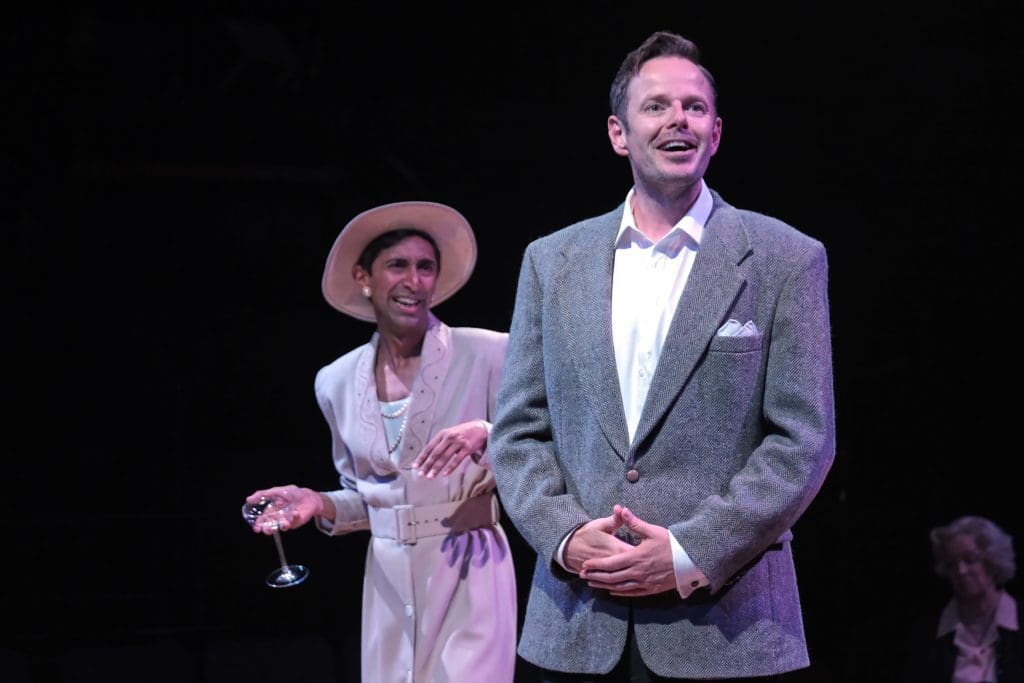
Multi-rolling Actor I (Deven Modha), left, and Actor 2 (Simon Darwen) playing First Lady Nancy Reagan and President Ronald Reagan in Handbagged. Picture: Tony Bartholomew

Deven Modha’s No Poll Tax protestor in Handbagged. Picture: Tony Bartholomew

On the surface, you could be inclined to decide that everyone loves the Queen (especially in Garland and Scholfield’s superb caricatures), whereas Maggie, whether younger or older, remains the humourless villainess of the piece in Clifford and Mathie’s characterisation.  Buffini’s writing is far too bright for that, however, all while making Mrs T funny on occasion through jokes at her expense when breaking through that humour dead zone.

Buffin seeks the humanity in both women. Margaret Thatcher is given every chance to state,  re-state and  double down on political philosophies, and we see her change, as her voice does, ironically adopting “we” when she becomes more “I” and isolated as she loses her allies. Always and forever, her favourite word is No. No. No, until no more.

The Queen’s Christmas Day addresses are the cornerstone of her portrayal: one of compassion, a call for kindness, and in essence Socialist principles from the richest woman in the land. Through the years, PM and HM talk but never bond, for all that time and tea consumption together, never finding common ground.

Out of step? Liz Garland’s Liz dancing with Simon Darwen’s Denis Thatcher and Pandora Clifford’s Mags doing likewise with Deven Modha’s Kenneth Kaunda in Handbagged. Picture: Tony Bartholomew

All six performances are top notch, matched by Pinder’s astute direction, using the Round as a battlefield, where she keeps moving the combatants to emphasise the shifting tectonic plates of the relationship.

Katie Scott’s design is circular too, giving the sense of a merry-go-round thanks in part to Aiden Crawford’s movement direction. A museum shelf of named props and costumes on the stage rim works wonderfully well too for speed of character changes before your very eyes.

As the years tick by since the passing of both protagonists, Handbagged becomes an ever better play, one where Buffini’s skill in weaving her own mischievous political commentary into her modern-day comedy of manners is delivered with witheringly witty  aplomb. Bag a ticket pronto.

Handbagged, Stephen Joseph Theatre, Scarborough, until August 29. Box office: 01723 370541 or sjt.uk.com.

Pandora Clifford’s Mags, Liz Garland’s Liz, Meriel Scholfield’s Q and Alexandra Mathie’s T expressing differing opinions in Handbagged. Picture: Tony Bartholomew

Everything stops for tea: Meriel Scholfied’s Q raises a cup and humorous quips aplenty in Handbagged. Picture: Tony Bartholomew

Ayckbourn’s The Girl Next Door to move back in for four days at SJT in September

Wartime reunion: Naomi Petersen as Lily and Linford Johnson as Alf in Alan Ayckbourn’s The GIrl Next Door. All pictures: Tony Bartholomew

ALAN Ayckbourn’s premiere of his 85th play, The Girl Next Door, will return to Scarborough’s Stephen Joseph Theatre in September for a limited run of only six performances.

The SJT resumption from September 1 to 4 will be followed by a touring run at the New Vic Theatre, the SJT’s fellow theatre in the round in Newcastle-under-Lyme, from September 7 to 18.

Directed by Ayckbourn, The Girl Next Door received its world premiere in Scarborough from June 4 to July 3, performed by two alternate casts to protect against Covid-19.

Lolling around in lockdown: Bill Champion as jaded and jaundiced actor Rob in The Girl Next Door

September’s returning cast will be Bill Champion, Linford Johnson, Alexandra Mathie and Naomi Petersen, who performed the bulk of the shows in the original summer run.

Written by Ayckbourn in lockdown, The Girl Next Door finds veteran actor Rob Hathaway stuck at home during the summer of 2020, with only his sensible, Government mandarin older sister for company.

Rob has little to do but relive his glory days when, as the star of the nation’s favourite television period drama National Fire Service, he ruled the roost as George ‘Tiger’ Jennings: wartime hero and living legend among firefighters.

Alan Ayckbourn in his garden in Scarborough in May 2020 during the first lockdown

One day, Rob spots a stranger hanging out the washing in the adjoining garden. Strange, he thinks, because the neighbours have not been around for months. Just who is the mysterious girl next door, and why is she wearing 1940s’ clothing?

“I was born in 1939, so my earliest memories are of a sort of lockdown: of crowding into Anderson shelters or subway stations; of sleeping in deckchairs or on my mother’s lap. Things have come full circle for me,” says Ayckbourn, 82.

“The Girl Next Door is an affirmation of love across the generations – I hope it’s positive and hopeful for those today crawling out of their metaphorical Anderson shelters blinking into the light.”

Dressed for a Zoom meeting: Alexandra Mathie as Alex in The Girl Next Door at the SJT

For a time-hopping story divided by 78 years but only a hedge, Ayckbourn is joined in the production team by the SJT’s departing associate director, Chelsey Gillard, designer Kevin Jenkins and lighting designer Jason Taylor.

The Girl Next Door can be seen in the Round at the SJT on Wednesday, September 1 at 7.30pm; September 2, 1.30pm and 7.30pm; September 3, 7.30pm, and September 4, 2.30pm and 7.30pm.

Tickets are on sale at £10 upwards on 01723 370541 and at sjt.uk.com. Prompt booking is advised.

The girl next door in The Girl Next Door: Naomi Petersen as Lily

Ayckbourn’s play of the summer The Girl Next Door is now the SJT’s film of the week

Naomi Petersen and Bill Champion in The Girl Next Door at the Stephen Joseph Theatre. Picture: Tony Bartholomew

THE Stephen Joseph Theatre film of Alan Ayckbourn’s latest stage premiere, The Girl Next Door, is available on the Scarborough theatre’s website from 6pm this evening.

Directed by Ayckbourn, his 85th play can be seen in The Round until Saturday and now via sjt.uk.com, in a filmed recording in front of a live audience, until midnight on Sunday (4/7/2021).

In The Girl Next Door, veteran actor Rob Hathaway is stuck at home during the summer of 2020 with only his sensible older sister for company. Rob has little to do but relive his glory days when, as the star of the nation’s favourite TV period drama, National Fire Service, he ruled the roost as George ‘Tiger’ Jennings: wartime hero and living legend among firefighters.

One day, Rob spots a stranger hanging out the washing in the adjoining garden, but his neighbours have not been around for months. Who is the mysterious girl next door? And why is she wearing 1940s’ clothing?

Ayckbourn says: “I was born in 1939, so my earliest memories are of a sort of lockdown: of crowding into Anderson shelters or subway stations; of sleeping in deckchairs or on my mother’s lap. Things have come full circle for me.

“The Girl Next Door is an affirmation of love across the generations – I hope it’s positive and hopeful for those today crawling out of their metaphorical Anderson shelters blinking into the light.”

Writer-director Alan Ayckbourn in his Scarborough garden. Picture: Tony Bartholomew

The filmed production features a cast of Bill Champion, Linford Johnson, Alexandra Mathie and Naomi Petersen.

The SJT’s artistic director, Paul Robinson, says: “We were delighted that part of the funding we received from the government’s Culture Recovery Fund last year was to go towards filming our productions.

“It means that audiences who can’t get to the theatre to see the show, for whatever reason, still have chance to see a high-quality version in the comfort of their own home, and Alan couldn’t have got us off to a better start than with this hit play.”

Written and directed by Ayckbourn, assisted by the SJT’s associate director Chelsey Gillard, The Girl Next Door is designed by Kevin Jenkins with lighting design by Jason Taylor.

Tickets for the film cost £12 each, with a group ticket available at £15 and a version with bonus features, including interviews with Ayckbourn and Jenkins, priced at £20, on 01723 370541 or at sjt.uk.com. To check ticket availability for the last week of the stage production, visit the website.

REVIEW: Ayckbourn’s The Girl Next Door, Stephen Joseph Theatre, Scarborough ****

“Spatial continuum anomaly”: Naomi Petersen’s wartime Lily and Bill Champion’s pandemic-times Rob bridge the age gap in Alan Ayckbourn’s The Girl Next Door. Picture: Tony Bartholomew

Alan Ayckbourn’s The Girl Next Door, Stephen Joseph Theatre, Scarborough, until July 3. Box office: 01723 370541 and at sjt.uk.com

WHO else but director emeritus and Scarborough knighted playwright Alan Ayckbourn could be at the helm of the Stephen Joseph Theatre’s first in-house production of 2021.

He has been chomping at the bit, as the racehorse saying goes, writing even more prolifically and recording and sound-editing two audio plays, Anno Domino and the reawakened ghost story Haunting Julia, as lockdown followed lockdown.

He has missed the interaction with actors and audience alike, as last summer’s premiere of Truth Will Out never did reveal its topical virus truths in The Round.

How joyful to see Sir Alan, 82 and stick in hand, taking his familiar back-row seat for the Tuesday’s press night performance. It was another sign of live theatre’s resurrection, even with the continuing need for face masks, social distancing and a reduced capacity.

The Girl Next Door is premiere number 85, and glory be, it is inventive, witty, poignant, moving and surprising in the best Ayckbourn tradition, with plenty of mischievous humour too, whether digging into politics, Zoom, love, war, English characteristics, our past and present, what has changed, what hasn’t.

All this is wrapped in a tale suffused with magic realism (or not, you decide!) and Ayckbourn’s familiar relish for playing with time. In this case, he applies the term “spatial continuum anomaly” for surely the first time, along with references to Doctor Who and Star Wars.

Standard attire for a Zoom meeting: Alexandra Mathie’s Westminster civil servant Alex at home in The Girl Next Door. Picture: Tony Bartholomew

Ayckbourn’s frustration at his absence from the rehearsal room and stage since 2019 finds a messenger on stage in the form of actor Rob Hathaway (Ayckbourn stalwart Bill Champion), head in his hands, stuck at home in August 2020, sixty, sagging and sad.

He laments the hiatus from all that he loves about theatre, above all the connection, and no, Shakespeare sonnets being performed by glove puppets online is no substitute.

Bored with the prospect of watching yet another box set or daytime TV after losing his role, for disciplinary reasons, as the star of the nation’s favourite TV period drama, National Fire Service, he keeps re-living his past as George ‘Tiger’ Jennings, wartime hero and living firefighter legend, rather than living for the day or even having his morning Cornflakes.

Lockdown has been shared with his big sister, very sensible civil servant Alex (Ayckbourn regular Alexandra Mathie), who has just finished a Zoom meeting with the Chancellor (female, as it happens). We know the ever-sharp Ayckbourn is on the ball because she is wearing pyjamas beneath a jacket, as so many have!

Champion’s enervated Rob is suddenly perked up by the sight of a stranger, a young woman hanging out the washing in the next-door garden. Who is she, he wonders, as the owners, the Jessops, have chosen to isolate at their second home in the Dorset country.

She, we shall learn, is Lily (Naomi Petersen), and on her side of the hedge, it is August 1942, wartime London is under bombardment; the garden has been given over to growing vegetables, with an Anderson shelter beyond. Husband Alf (Linford Johnson) is away doing his bit for Blighty in a tank regiment in Africa; their two children, six and seven, are away too, out of contact, evacuated to somewhere in the country.

What’s it all about, Alfie? Linford Johnson’s 1942 soldier-on-leave Alf sips on a 21st century bottled beer in The Girl Next Door. Picture: Tony Bartholomew

We note the differences, beautifully drawn out by designer Kevin Jenkins: a hosepipe, security lights and characterless all mod cons in the Hathaway kitchen; a watering can, no outdoor lighting and a stove and hand-operated washing equipment for Lily. As ever in an Ayckbourn production, the doors are cut off at halfway but are used almost as regularly as in a farce.

For all the presence of Alex, Rob is adrift; Lily is alone, and through Ayckbourn’s aforementioned “spatial continuum anomaly”, their worlds meet, with all the bewildering confusions and misunderstandings that go with that division of 78 years yet only a hedge.

Born in 1939, and so a wartime London child, Ayckbourn recalls a “sort of lockdown”  of that time, crowding into Anderson shelters and subway stations, and so he draws parallels with the pandemic lockdowns of 2020-2021. Rob keeps mentioning social distancing; Lily mistakes the security lighting for searchlights; Mathie’s Alex mentions she has a wife; Lily is unnerved by the machine-dominated kitchen. Ayckbourn revels in both the similarities and contrasts with the past.

He even plays with knowing about the past, and what  burden that may place on Rob if he were to try to change the course of history. Rather than Back To The Future fun and games, however, Ayckbourn keeps this thread – in the story of Alf – on a more serious trajectory, one of intrigue and mystery in the more melancholic yet still hopeful second half.

On top of it all, in his own words, The Girl Next Door is “an affirmation of love across the generations”, a love that stops feckless, twice divorced Rob in his tracks.

There is a second love story too here: Ayckbourn’s abiding love of theatre, its magic, mystery, wonder, profundity and possibilities, brought to life by a wonderful cast, with a typically brilliant Ayckbourn drinking scene to boot. How blessed we are to be sharing his vision, his playfulness, his wisdom, anew.

Review copyright of The Press, York