
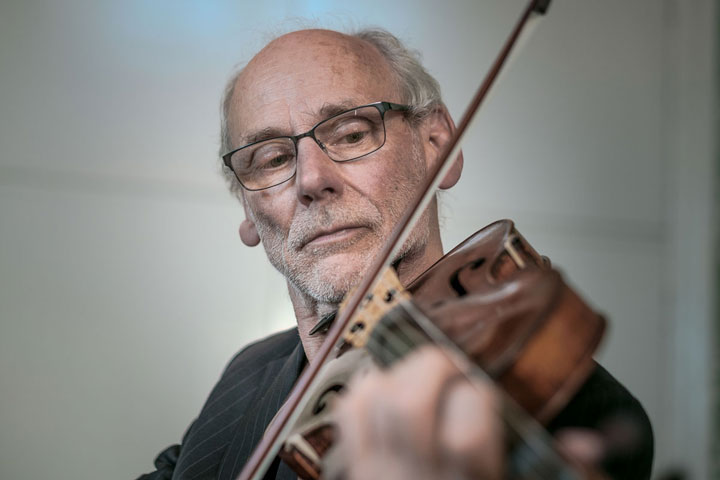
Academy of St Olave’s conductor Alan George
SATURDAY’S concert opened with a focused, effervescent performance of Emil von Reznicek’s Overture: Donna Diana.
The first violins set the tone for the work, delivering a bubbly opening theme followed by a graceful lyrical secondary melody with the woodwinds – clarinet and oboe – and brass adding colour and dialogue to this musical party piece.
Not for the first time, this performance suggested echoes of English rustic, pastoral music: the country dance-like articulation, folk-like decorations of the woodwind and the slightly old-fashioned, genial humour – Eric Coates?
Maybe it’s just a senior thing. Nevertheless, the performance danced with joy as the couple in front of me could testify, bouncing away throughout.
This was followed by Delius’s rarely heard tone poem, A Song Before Sunrise. The playing was finely shaded in atmosphere, a real evocative sense of dawn. The woodwinds – oboe, flute and clarinet – deftly produced the characteristic ‘birdsong’ figures, which evoked the musical dawn chorus. Does the clarinet welcome the sunrise with a musical rooster call? Anyhow, the strings provided a lush background – warm violin and viola colours.
I love Delius, and I loved the way the piece had this searching quality that doesn’t actually seem to arrive at a particular destination, it just meanders beautifully. Again, the performance was very assured, convincing in fact.
I thought the performance of Carl Maria von Weber’s Symphony No. 2 in C major was utterly engaging. Although the opening Allegro is the most symphonically ambitious movement, it did feel like a kind of mini wind concerto.
The oboe tended to shape the lyrical themes with the bassoon active as a melodic partner. The fanfare- like horn calls were delivered neatly, but these seemed to add colour rather than any hint of heroics. The strings, carrying their fair share of the musical discourse, would retreat to allow the winds to shine.
The intimate lyricism of the Adagio came across as more chamber music in tone, rather than the customary symphonic rhetoric. Again, the oboe tended to stand out, Alexandra Nightingale playing the main cantabile melody beautifully.
There were delicate counter-melodies on bassoon – Isabel Dowell – and firm cello and flute contributions, while the strings provided a warm cushion of support.
The Menuetto was an all-round dryly comic experience, especially in its brevity. Here the rustic horns were rhythmically assertive, underpinning the dance character.
The issue for my ears was that the closing Finale, while engaging and driving, was simply too short to properly rebalance the symphony – the opening Allegro is about as long as the other movements in total. Indeed, you could feel the audience reaction ‘is that it’?
There is no doubt that where Haydn, Mozart, and earlyBeethoven aim for architectural balance, Weber pours nearly all the symphonic ‘argument’ into the first movement, leaving the rest as lighter dramatic appendices.
But an interval rethink suggested the work would make more sense when heard as early Romantic theatre dressed in symphonic clothing. Anyhow, the absence of the clarinet was also very noticeable, particularly as we associate the clarinet with Weber. But around the 1800s the core symphonic wind choir was two oboes, two bassoons and two horns. So there you go.
The second half belonged to Schubert’s Tragic Symphony No. 4 in C minor. And the performance was quite remarkable. I can’t really say I get the full majesty of tragedy when I hear this superb symphony, despite the forebodings suggested in the opening Adagio.
The orchestra’s dark, weighty C minor chords were followed by an almost funereal, inward-looking bassoon solo – well played by Isabel Dowell. But, after an assured tempo gear change into the Allegro, the movement does not embrace Beethoven’s sense of a heroic struggle.
What clearly came across in performance was a movement fuelled by restless energy rather than heroics: driven rather than confrontational, with quick tonal shifts providing moment. These were very well performed under the direction of conductor Alan George, as was the programme as a whole.
Further, Schubert transforms the woodwind-string relationship from conversation to commentary. The strings typically propelled the movement with flowing figures and rhythmic energy while the clarinets, Lesley Schatzberger and Andrea Hayden, and oboes, Ms Nightingale and Christina Young, echoed and subtly re-coloured the material. This is radically different from Beethoven.
Strong oboe and clarinet were also prominent in the Andante, a movement shiningwith lyrical grace. When the flute – an impressive Becky Jobling – takes over the line, often echoing the clarinet, the melody rises into a higher register and subtly changes character: what was warm and intimate on the clarinet becomes lighter and more distanced, with a hint of detachment replacing the clarinet’s warmth. Very rewarding.
The Menuetto bristled with energy, quirky off-kilter rhythms, pointed folk-like dialogue, orchestral shifts, and a convincing relaxation of tempo for the central section. Incisive woodwind writing: oboes and bassoons frequently stepped out of the texture with dry, slightly nasal interjections that sharpened the rhythmic outline, while the horns added a rustic edge in the Trio, reinforcing its dance-like, almost outdoor quality.
The pacing of the closing Allegro was pretty much on the money, with chamber-like sections dovetailed seamlessly; indeed, this sense of careful knitting together made the symphonic argument work coherently.
Brief woodwind and horn contributions –dry-edged bassoon figures, oboe-shaped phrase endings, and subdued horn colour – seemed to complement the familiar string–clarinet exchanges, acting more as timbral changes than as overt solos, while maintaining the movement’s momentum.
For a Winter Concert, it left me unexpectedly warm inside.
Review by Steve Crowther