Andy Studdart as Willy Loman and Linda Tester as The Woman, Willy’s mistress, in 1812 Theatre Company’s Death Of A Salesman. Picture: Joe Coughlan
ARTHUR Miller’s Death Of A Salesman will be staged by 1812 Theatre Company at Helmsley Arts Centre from tomorrow to Saturday with a late change of cast.
“Rehearsals have not been without event,” says director Julie Lomas. “Unfortunately our leading lady, Sam Hughes, was involved in a horse-riding accident on October 5, requiring hospitalisation, and is unable to perform this week.
“However, we have a first-rate replacement in Kate Cawte, who will be very skilfully taking the role of Willie Loman’s long-suffering, devoted wife Linda, book in hand.”
Written in 1948, when Miller finished the first act in a single spring day in Roxbury, Connecticut, and premiered on Broadway in 1949, Death Of A Salesman is performed only rarely by amateurs. “It’s been complex and hard work, but rewarding, with both new and regular performers for the company starring in this clever and layered masterpiece,” says Julie.
“We have a very strong leading cast, some of whom have not acted with the company before, plus the return to the stage of drama teacher Jonathan Lewis as Biff Loman.”
Miller’s play focuses on the last 24 hours in the life of Willy Loman, the struggling salesman of the title, who , who cannot understand how he failed to win success and happiness. Through a series of tragic, soul-searching revelations of the life he has lived with his wife, sons and business associates, Miller reveals how his quest for the “American Dream” kept him blind to the people who truly loved him. The plot is set mainly in the 1940s, complemented by Loman’s idealised memories of happier times in the 1930s.
Andy Studdart is making his first appearance with 1812 Theatre Company as Willy Loman. “The title role is a tour de force and it will be a remarkable debut by Andy,” says Julie. “He is not the only newcomer in the cast: Dylan Canton, is playing Happy, one of Willy’s sons, while the other son, Biff, is played by Jonathan Lewis, who is making a welcome return to Helmsley after a prolonged break raising his young family.
“I feel incredibly lucky to have such talented and committed actors on the stage at the same time and working with them has been a joy.”
Regular 1812 players will be in the cast too: Oliver Clive plays the sons’ nerdy friend, Bernard; Beaj Johnson is Charley, said by Willy to be “the only friend I have got”; Richard Noakes is Uncle Ben, Willy’s recently deceased elder brother; Robert Perry is Stanley, the obliging waiter, and Mike Martin plays heartless boss Howard Wagner.
The role of Willy’s seductive mistress goes to Linda Tester and Vicki Mason plays both Charley’s secretary and the very glamorous Miss Forsythe.
“Far from being a miserable play, as the title may suggest, this powerful, fast-moving play is peppered with humour and surprises,” says Julie. “It is energetic and passionate throughout, culminating in emotional scenes, the likes of which are rarely seen on stage. There is some beautiful music and performances are worthy of the highest praise.”
In his introduction to the play, Miller described the setting as being “wholly or – in some places – partially transparent”. This has provided inspiration for 1812’s set, with Julie being guided by Sue Elm in its design and its construction, carried out by a five-strong set-building team led by Michael Goslin and Peter Ives.
Music is integral to Julie’s production too, in particular the melodies, played on a flute to represent Willy’s state of mind. The many sound cues and lighting effects will be operated by Helmsley Arts Centre technical manager James Bentley.
The evocative costumes and properties are supervised by Julie Wilson and Pauline Noakes respectively and the actors have been guided throughout the rehearsals by production assistant Jean Sheridan. The experienced David Tester is the stage manager, assisted by the ever-positive Billie Billington.
Julie has wanted to put on this play for “at least as many years as it took Arthur Miller to write it – ten”. “Miller carefully thought through the impact his inventive, theatrical elements would present on stage, for example, the co-existence of past and present, and the visualisation of Willy’s hallucinations,” she says.
“This challenge appealed to me, together with the sharp detailing of the characters’ emotional states and the relevance the play’s themes still have today.”
1812 Theatre Company presents Death Of A Salesman, Helmsley Arts Centre, October 15 to 17, 7.30pm plus 2.30pm Saturday matinee. Box office: 01439 771700 or helmsleyarts.co.uk.
The poster image for York Theatre Royal’s co-production of Death Of A Salesman with Glasgow Citizens Theatre.Picture: FEAST
YORK Theatre Royal will present a major new revival of Arthur Miller’s Death Of A Salesman as the centrepiece of the new season.
In a first for the St Leonard’s Place theatre, the production will be co-produced with Glasgow’s Citizens Theatre.
Directed by Citizens Theatre artistic director Dominic Hill, Death Of A Salesman will open at York Theatre Royal on March 2 2027, preceded by previews from February 24, and will run until March 27 before transferring to Glasgow from April 7 to May 1 2027.
Richard Grassie’s image for Emma Rice Company’s revival of Tristant & Yseult
Miller’s heartbreaking story of the pursuit of wealth and popularity remains devastatingly relevant today. After 34 years on the road, Willy Loman returns home exhausted, having sacrificed everything in pursuit of success and recognition. Yet the American Dream seems always just out of reach.
When his career falters and the debts mount, Willy is lost in memories of the past as his family tries desperately to reconcile the man they love with the tragic consequences of his delusions.
In another co-production, York Theatre Royal will continue its creative collaboration with the Emma Rice Company and Nottingham Playhouse in a revival of Kneehigh and Emma Rice’s Tristan & Yseult. Last seen on stage in 2017,the production will be staged at York Theatre Royal from April 6 to 17 as part of a nationwide UK tour.
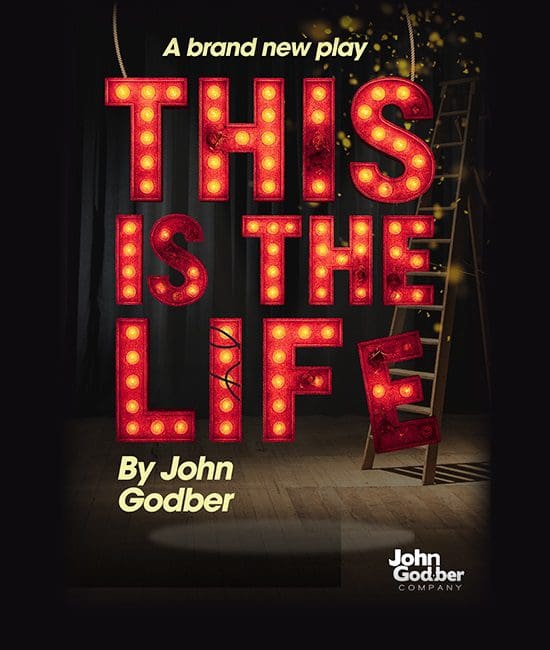
The artwork for John Godber’s new play This Is The Life, touring York Theatre Royal next January
Paul Crewes, York Theatre Royal’s chief executive officer, says: “We’re very excited about this upcoming season. Most notably, in a first for us, we will be working with our friends at Citizens Theatre in Glasgow on Arthur Miller’s modern classic Death Of A Salesman, directed by the fabulous Dominic Hill. This is a wonderful collaboration with a great theatre.
“Spring 2027 will also see us co-producing again with the Emma Rice Company and Nottingham Playhouse on a revival of Tristan & Yseult. I have such fond memories of originally producing this show with Emma when we were both at Kneehigh alongside Mike Shepherd. I can’t wait for York audiences to have the chance to finally see this production that successfully toured the world for many years.”
Paul continues: “These productions join the line-up of our other produced work already on sale, including our revival of Margaret Atwood’s The Penelopiad later this year with Amelia Bullmore as Penelope, our Youth Theatre production of Wendy And Peter Pan and the highlight of the festive season, our panto Snow White And The Seven Dwarfs.
The Penelopiad: Directed by York Theatre Royal creative director Juliet Forster this autumn
“Our dance programme also continues to be one of the most exciting in the north of England, with the return of London City Ballet, the world premiere of the latest show from Carlos Acosta and the Acosta Danza Company and Ben Duke’s Lost Dog coming to York for the first time. I hope we have given audiences plenty to look forward to with a range of classics, new work and family favourites on our stage.”
Dominic Hill, artistic director of Citizens Theatre, says: “I am delighted to be directing a new production of this brilliant Arthur Miller play that is one of the most influential works of the 20th century.
Lost Dog’s Juliet & Romeo, playing York Theatre Royal on November 20 and 21. Picture: Paul Blakemore
“It could not be more timely in the age of Donald Trump’s politics of greed and toxic masculinity. But Death Of A Salesman is also an ordinary working man’s story, as a family tries to wrestle with living up to expectation and forging their own path. I can’t wait to see the reaction from audiences in York and Glasgow to this new production.”
Other highlights include the UK premiere of Acosta Danza’s Cuban Baroque, in collaboration with York Theatre Royal, running from October 1 to 3. The visiting programme also includes the UK premiere of London City Ballet: Firebird – A Mixed Bill ( co-produced by York Theatre Royal, London City Ballet and Opera De Vichy) on September 18 and 19.
In a new touring production starring Jane Asher and Samantha Womack from November 10 to 14, Daisy Goodwin’s By Royal Appointment tells the story of Queen Elizabeth II’s life behind-the-scenes. Lost Dog’s dance-theatre duet Juliet And Romeo flips the story of Romeo And Juliet on its head, blending dance, comedy and theatre on November 20 and 21.
The poster artwork for By Royal Appointment, booked into York Theatre Royal for November 10 to 14
York Theatre Royal will welcome back a variety of York and Yorkshire companies in the upcoming season in the Studio, including York Actors Collective in The Strongbox (October 28 to 31) and Story Craft Theatre’s festive production of The Enormous Christmas Pudding (December 16 to 24).
Wakefield’s John Godber Company will return with John Godber’s new play, This Is The Life, from January 27 to 30 in the Main House, where York Light Opera Company will perform the Dolly Parton musical, 9 To 5 – The Musical, from February 4 to 13.
The poster artwork for David Suchet’s Poirot And More: doing the regional rounds of “non-elitist theatres”
WHERE will David Suchet be spending Wednesday afternoon and evening?
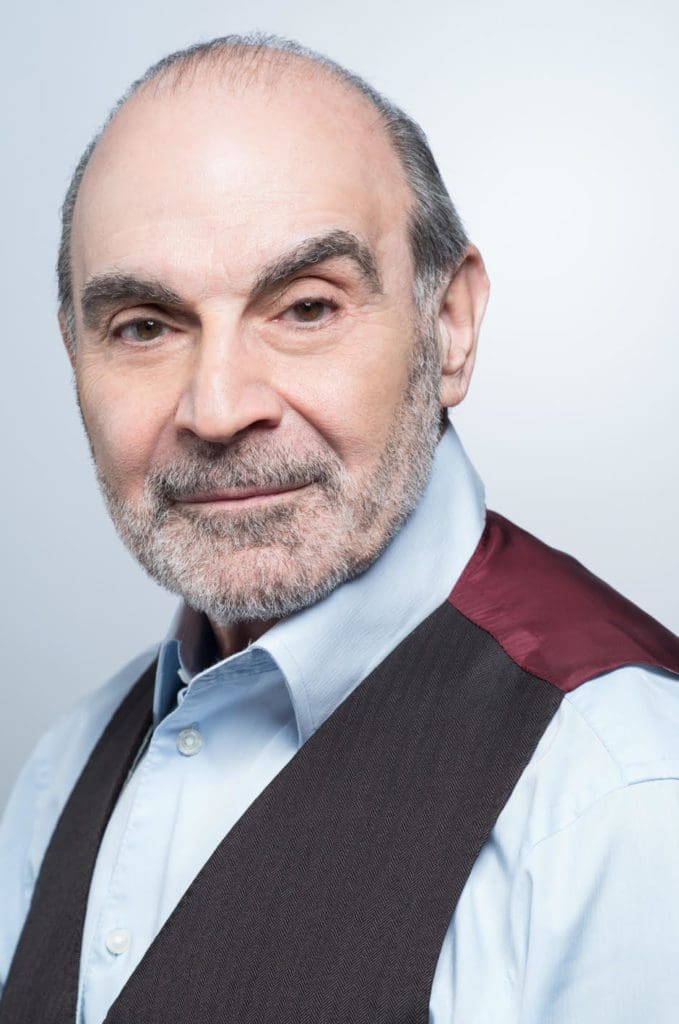
To save you the detective work, the answer is that the beknighted British character actor, now 75, will be on stage at York Theatre Royal, discussing his 50-year career in Poirot and More, A Retrospective.
At 3pm and 8pm, he will be in conversation with Geoffrey Wansell, co-author of his book Poirot And Me, as they look back over his life and work on stage, television, film and radio.
He promises an acting masterclass too, performing extracts and revealing techniques behind his craft and characters.
To go with his dapper, discerning, dainty-stepping Belgian detective Poirot, the “and more” in Suchet’s career has taken in Shakespearean kings, Mozart’s nemesis, Salieri, neurologist Sigmund Freud and media tycoon, MP, suspected spy and fraudster Robert Maxwell.
Would many septuagenarians willingly contemplate the rigours of travelling to 24 destinations on one tour? Suchet was only too happy to do so, especially now that we are emerging from pandemic lockdown and theatres are seeking to build towards recovery.
“I wanted to bring my show to audiences around the country who haven’t had the chance to enjoy theatre for so long,” he explains. “I’ve always believed in the importance of non-elitist theatre. I don’t believe that London is the centre of the universe, as far as anything is concerned – especially the arts.
“And we actors are rogues and vagabonds. Historically we’ve always toured, going right back to the Elizabethans and before. It should be in our DNA; I think actors should put their money where their mouth is and go out and tour.”
Suchet is conscious that Covid’s shadow may lead to continuing reservations over venturing out to a live event, but he hopes his show will be a good way to ease audience anxieties. “We’re visiting a lot of theatres and regions that have meant something to me, in my career. Everything will be safe, there’s only me on the stage, with one of my very best friends,” he says.
“And I’m going to be talking about my early life; how I grew up in London; my school; my very first roles, right the way through to becoming a professional actor, then joining the Royal Shakespeare Company, getting into television and slowly moving into film.”
Among the characters he will inhabit will be Shakespeare’s Oberon, Caliban, Macbeth and Shylock, as well as the inevitable Hercule Poirot. “I’ll talk about how I developed the role of Poirot – not only textually, from the script, but how I prepared for the role, the movement, the walk I developed, and how I found his voice – which is nothing like mine!”
The global adoration of Suchet’s Poirot still staggers him. “It’s extraordinary. It’s now eight years since I stopped filming, and during Covid, my mail bag has doubled,” he says. “Because people have been locked inside, and have been downloading and buying the box sets, and watching all 73 episodes, and they write to me saying it’s got them through the pandemic.
“I had no idea, in 1987 when I started filming, that this series would have the international impact that it has. I’m genuinely humbled by the fact that people still find it so rewarding, and I’m eternally grateful, I really mean it. I never, ever anticipated it.”
On the contrary: when Suchet was first approached about the role, he had the gravest doubts about accepting, even confessing to them in an interview before the series first aired. “I said, ‘I’m frightened it may be boring’,” he admits. “I got into terrible trouble with ITV for saying that.”
Poirot had been portrayed by Peter Ustinov and Albert Finney already, and Suchet had even played Inspector Japp to Ustinov’s Hercule in Thirteen At Dinner, a 1986 TV film. Returning to Agatha Christie’s books, however, he set his little grey cells to work creating a version all his own, now regarded as definitive.
“I never set out to be better than anyone else, or even different – it just happened,” he says. “I reread the stories and engaged with a little man that I hadn’t seen before, and it was that little man that I decided to become.”
Developing the character was a complex, meticulous business. “I’ve always believed an actor’s job is one of creative servitude,” says Suchet. “In other words, I’m allowed my own voice as a creative artist, but never beyond what I believe the writer intended or hoped for his or her creation.”
For Poirot, this meant Suchet applying scrupulous attention to detail. Between takes, he refused to sit for fear of creasing his immaculate suit, choosing instead to rest by using a “leaning board” – an upright contraption pioneered in early Hollywood for actresses in tight, ornate gowns.
Then there was the distinctive facial hair. Poirot’s whiskers were never Suchet’s own; such a moustache would have made him too conspicuous in public. “I would never have been able to maintain it. Over a 13 or 14-hour shooting day, it had to be repeatedly taken off and redressed, so it had to be false.
“It did vary a little bit – I think Christie herself had about eight versions of the moustache in her books – but as near as dammit, we tried to match the one that she describes in Murder On The Orient Express.
“I had to have my dresser and my make-up artist with me constantly, and my dresser would stop a take halfway through – we all gave him permission because I was so particular – and if, say, the bow tie moved, he would come in and straighten it, and we’d have to start the scene again.”
This was not always easy for Suchet’s colleagues. “It would drive the film crew and directors crazy,” he says.
“You may do things that people won’t like, but you never fail. You never fail. So always dare,” advises David Suchet after more than 50 years on stage and screen
He has firm views on the performer-director relationship: “If a director tells me how to act, then we don’t get on,” says Suchet. “A director should point you in the right direction, not tell you how to drive the car.”
He has never been shy about insisting on the integrity of his characterisation. “There were more than one or two occasions when I had to dig my heels in, and there were many contretemps,” he admits.
“Christie never changed Hercule Poirot throughout over 70 stories. He was given small differences: he tried a wristwatch at one point, and he tried changing the width of the stripe of his trousers. But as a person, he never changed.
“You’d be amazed over the years how many directors came in and said, ‘I want to do something completely different with Poirot’. And I had to say, ‘look, I’m terribly sorry, but you can’t’. He’s got to stay the same, because of my ethos of serving my writer.
“So I became his defender in a way. I have a lot of sympathy for all the directors that worked with me, I do! But it’s not me being difficult as an actor. It’s just me protecting the character.”
Suchet’s contract for Poirot was renewed on an annual basis. Each year, he found himself once again unemployed, but those stressful periods turned out to have a glittering silver lining. “It was difficult at the time. I’m a typical Taurean, I like things in their place. Like Poirot, I like order and method, and I’m not very good at uncertainty. I had to put faith in choice and the future, already in a very insecure profession.
“But actually, what a gift! I could fill that time with my theatre work, and other film work in America, and do tours, because I wasn’t contracted. So, my theatre career grew, and thanks to Poirot I was ‘bums on seats’. People wanted to see me.”
This enabled Suchet to tackle meaty drama by Arthur Miller, Eugene O’Neill and Terence Rattigan: “not popular commercial stuff, but big, heavy character roles – major leads in the British theatre, at the same time as doing this mega TV series. Wasn’t I lucky? It couldn’t have worked out better,” he says.
Suchet is an actor with a very strong visual sense. Indeed, he is an accomplished amateur photographer, having learnt the craft from his grandfather, renowned Fleet Street snapper James Jarché.
He brings that artistic flair to vividly describing his richly varied life and career – with all its intricacy, good fortune and rewarding choices – as “a spider’s web”. “I am a spider, we all are,” he says. “We spin our life, and we can’t see what we’re spinning. We don’t know what’s going to happen to us tomorrow.
“Every spider spins a different web. It’s a miracle of nature. The spider spins from behind, and it’s only at the end of each thread that he can turn around and see how his web is forming. That’s how I’ve lived my life. I have no idea what’s happening to me, and then when I look back at my web, I can see all the different patterns. And my goodness, how magnificent my web – my life – has been.”
Among the many highlights, he has played Iago to Ben Kingsley’s Othello at the RSC; Miller’s Joe Keller in All My Sons, where Zoe Wanamaker portrayed Joe’s wife, and George in Edward Albee’s Who’s Afraid Of Virginia Woolf?, when he starred alongside Diana Rigg.
By contrast, he also cherishes Mole, in Toad Of Toad Hall, and his 2015 take on Oscar Wilde’s theatrical gorgon, Lady Bracknell, in The Importance of Being Earnest. “It was huge fun, and a huge challenge to create a real person, and not to turn her into just a pantomime dame,” Suchet recalls.
“I had to be very brave. It was demanding, every night, especially when I started getting big laughs, not to be tempted to over-elaborate, but to be disciplined and truthful.”
In 1993, he seized the opportunity to work with Harold Pinter, “one of our greatest men of the theatre, of all time”, he says. Pinter directed Suchet and Lia Williams in the Royal Court’s British premiere of Oleanna, David Mamet’s controversial play about campus gender politics.
“Working with Harold, I discovered a complete and utter soul mate,” he says. “It felt as if he knew me – the person I was, the way I worked. We became very close.”
Suchet also appeared in Pinter at the Pinter, the Jamie Lloyd Company’s 2018 retrospective season at the West End theatre now named after the playwright. “It was an enormous privilege. I dedicated my performance to Harold,” he says.
Looking back at all the characters he has embodied, he still thinks about many of them, and even misses them – Poirot above all, with the recollection of Curtain, the final, deathbed episode in 2013, still a wrench.
“It was as if I had to kill my best friend,” he says. “He wasn’t just a character to me. He gave me my career. He changed my life.”
Given the benefit of hindsight, would he have done anything differently? “I wouldn’t change a single day. My only note to myself as a young actor would be – never be scared. Don’t try to get it right all the time. Have the courage to be wrong. You may do things that people won’t like, but you never fail. You never fail. So always dare.”
David Suchet: Poirot And More, A Retrospective, at York Theatre Royal, October 13 at 3pm and 8pm. Tickets are still available for both shows on 01904 623568 or at yorktheatreroyal.co.uk.