Why 300 years of Japanese woodblock prints are Making Waves at York Art Gallery

Waves in motion: Making Waves at York Art Gallery. Picture: Lee McLean

MAKING Waves: The Art of Japanese Woodblock Print has taken a year of preparation at York Art Gallery.

On show until August 30, the display of Japanese art and culture brings together more than 100 striking and iconic works from renowned artists such as Katsushika Hokusai, Utagawa Hiroshige and Kitagawa Utamaro, amongst many others, complemented by armoury from the Royal Armoury In Leeds and kimonos from Durham Oriental Museum at Durham University.

To provide an insight into the history and development of Japanese woodblock printing, the exhibition brings together exhibits from York Art Gallery’s extensive collection of Japanese prints, some never exhibited previously, together with prints loaned from Maidstone Museum, Ashmolean Museum and the British Museum and early printed books from the British Library.

Covering more than 300 years of printing history, from the 17th to 21st centuries, Making Waves places particular emphasis on the heyday of Japanese woodblock printing in the 18th and 19th centuries.

At its epicentre is the chance to see Katsushika Hokusai’s The Great Wave off Kanagawa, one of the most recognisable and celebrated artworks in the world. This original print has been lent to York Art Gallery by Maidstone Museum, and like encountering Leonardo da Vinci’s 16th century portrait of the Mona Lisa at the Musée u de Louvre, the work is smaller than you might expect but just as impactful.

Spread across three rooms, Making Waves invites visitors on a journey that begins with a guide to the origins and techniques of early printmaking, before looking at major themes, including the “floating world” of urban entertainments, the beauty of Japanese landscapes, legendary heroes and adventurers from fantastical tales and historical epics, actors and Samurai warriors (representing martial prowess, courage, loyalty and honour). Festivals and seasonal celebrations feature too.

Finally, the exhibition explores how print artists responded to major changes in Japanese society, from Japan’s development into a modern industrial nation in the late 19th century through to the present day.

Utagawa Hiroshige’s Asakusa Rice-fields and Torinomachi Festival, from the series One Hundred Famous Views of Edo, part 4 Winter, 1857, York Art Gallery collection. Picture courtesy of York Museums Trust

Contemporary Japanese woodblock prints feature too in the third room, including several works by Royal Academy of Arts president Rebecca Salter, created in collaboration with Sato Woodblock Workshop, Kyoto, plus Japanese woodblock prints depicting the North York Moors by Scottish artist Laura Boswell, such as Rhubarb Sky.

Look out too for works by London-based artist Nana Shiomi, whose 2001 print, Hokusai’s Wave – Happy Carp is displayed alongside the very woodblocks Shiomi used to produce it, enabling visitors to gain an understanding of the technical process of printing.

Entertainment and festivals, folklore and seasons and travel and adventure all play a major role in these vibrant images, whose dynamic designs remain popular centuries later.

 Making Waves marks the debut of Eleanor Jackson as curator of fine art at York Art Gallery. “I started here in January last year and was given this exhibition to curate straight away. To hit the ground running and to turn it round in a year has been challenging but it’s worked out well,” she says.

“Arranging the loans is by far the most time-consuming part of organising the exhibition, so that was the first task I did, researching potential loans and contacting leading institutions.”

Eleanor continues: “Ever since Japan was opened to Western trade in the 1850s, Japanese art has become increasingly popular in the West and Europe, causing a sensation when first exhibited in Paris, introducing audiences to the woodblock print, and now there are so many fantastic collections in the UK.”

One key curatorial decision was to address the need to add contrast to “the prints being mostly 2D and small”. “It was important to bring in bigger items, such as the armour and kimonos, to provide dramatic sightlines, and to give a fuller flavour of Japanese culture in that period,” says Eleanor. “We also asked our exhibition designers, Journal, from Leeds, to provide a sense of scale.”

The Great Wave off Kanagawa, by Katsushika Hokusai, circa 1829-32. Image courtesy of Maidstone Museum, on loan at York Art Gallery

In addition, the exhibition focus on woodblock print techniques is intended to be of interest to artists, while visitors can “have a go” at woodblock printing”. “It’s important to understand the art of woodblock and the huge amount of work and skill that goes into each one. Even though they are prints, they are unique because they all have imperfections,” says Eleanor.

Summing up the significance of Making Waves, she enthuses: “To bring these works together in this way has been a privilege, and we are so excited to unveil the exhibition.

“The support of national and regional museums, as well as contemporary artists, has been instrumental in allowing us to tell the story of this gorgeous art form. We are grateful to them for lending their precious works to York Art Gallery for this exhibition.”

Making Waves will extend into York Museum Gardens, where a new Japanese- style garden is being installed, ready for the spring and summer months. A Japanese dry garden, or “karesansui”, created in the space behind the gallery, takes inspiration from traditional Japanese gardens with a contemporary interpretation linked to the history of the site.

Often called a “zen”’ garden, the Japanese dry garden is constructed simply using wood, stone and bamboo to create a space for calm contemplation and meditation, inviting people to take time out from their day.

Steve Williams, garden manager at York Museums Trust, says: “Four blossom trees will be a key feature in the garden as we head into spring 2026:  three cherry trees and an apricot tree. Blossom trees hold a cultural significance in Japan, symbolising beauty, impermanence and renewal, which reflect the transient nature of life.

“All the materials included in the Japanese-style garden have been sourced with the intention of longer-term use, and they will be repurposed elsewhere in Museum Gardens following the exhibition.”

Japanese woodblock prints depicting the North York Moors by Scottish-based artist Laura Boswell from Making waves at York Art Gallery. Picture: Lee McLean

Making Waves is accompanied by interactive programme of activities and events, including specialist talks from artists, makers and curators throughout the exhibition run. Interactive guided workshops for over-16s will enable participants to “get to grips” with printing techniques, bookbinding and Ikebana flower arranging throughout the summer months and to create bespoke art to take home.

Siona Mackelworth, head of audience and programme at York Museums Trust, says: “The associated programme and events are designed for all ages to make connections to Japanese art and get involved with the gallery.

“We’re delighted to play host to more internationally important art, building on the success of our Claude Monet and William Morris exhibitions last year, and to share the stories and processes behind Japanese printing by showcasing technically complex and visually impactful artworks.”

Making Waves: The Art of Japanese Woodblock Print, York Arts Gallery, on show until August 30. Entry is included in general admission to York Art Gallery. Tickets: yorkartgallery.co.uk.

Did you know?

THE Japanese art aesthetic of Making Waves extends into York Art Gallery’s two shops, where prints, souvenirs and kimono jackets are on sale. For the creative,  Kintsugi kits and sketchbooks are stocked, as well as themed gifts such as fun socks, chopsticks and lucky welcome soaps.

Many products  display art from the gallery collection or are sourced directly from Japan. In addition, a new print inspired by Japan and York Art Gallery has been created by York artist Lincoln Lightfoot. 

The balcony ceramics shop offers tea bowls and other handcrafted ceramics inspired by Japanese Pottery.  

Did you know too?

PRUSSIAN Blue, the world’s first synthetic pigment, was available widely in Japan from 1830.

Exhibition designers Journal bringing “a sense of scale” to Making Waves at York Art Gallery. Picture: Lee McLean

York Art Gallery revels in young rebels of book world in marvel of a mischievous show

Author, illustrator and 2017-2019 Children’s Laureate Lauren Child at the opening of Marvellous & Mischievous: Literature’s Young Rebels at York Art Gallery. Picture: Anthony Chappel-Ross

PIPPI Longstocking. Jane Eyre. Zog. Matilda. Dennis the Menace. A doodling Latin student. All feature in the British Library’s touring exhibition Marvellous and Mischievous: Literature’s Young Rebels, booked into York Art Gallery until June 4.

Showcasing around 40 books, manuscripts and original artwork, this family-friendly show shines a spotlight on rebels, outsiders and spirited survivors from children’s literature spanning more than 300 years.

Drawn from the British Library’s vast collection, Marvellous and Mischievous celebrates cherished characters who break the rules and defy conventions in an invitation for young and old alike to rediscover their storybook favourites and meet new ones in their homes, schools and on journeys.

Bright idea: A child enjoying the activity room at the Marvellous and Mischievous exhibition. Picture: Anthony Chappel-Ross

Among the exhibition highlights are the first British edition of Lucy Maud Montgomery’s Anne Of Green Gables; the first version of George Cruikshank’s coloured illustrations for Charles Dickens’s Oliver Twist, along with artwork for Jacqueline Wilson’s Tracy Beaker (by Nick Sharratt), Lauren Child’s What Planet Are You From, Clarice Bean?, Julia Donaldson’s Zog (by Alex Scheffler), Judith Kerr’s When Hitler Stole Pink Rabbit and Sarah Garland’s Azzi In Between.

Lucy Evans, the British Library’s lead curator for this exhibition, says: “Marvellous And Mischievous is a fun, interactive exhibition all about exploring what makes a young ‘rebel’ in children’s stories.

“They could be a character that resists authority or breaks away from convention. Children’s literature over the past 300 years has shown that rebels come in all shapes and sizes, including children who may struggle to actually rebel and so their quest is more one of survival; these resilient characters are very much part of our story.”

An activity room with a sensory area and play kitchen complements the exhibition, with opportunities for young visitors to create their own rebel tales by dressing up as the Rebel of The School and reflecting on which cause they might back. In addition, they can enjoy a selection of books in a dedicated reading area.

Charlotte Bronte’s original manuscript for Jane Eyre, on display at York Art Gallery. Picture: Charlotte Graham

Fiona Burton, public engagement manager at York Museums Trust, says: “Marvellous and Mischievous is a fun-filled and interactive exhibition, perfect for the whole family. There’s a variety of books on display, and we hope visitors enjoy and feel inspired by their favourite characters, as well as any new ones that they’ll meet along the way.”

Alongside the exhibition, York Art Gallery is offering events and workshops tailored to all ages. Families can unleash their creativity through workshops and activities run in collaboration with Gemma Curry’s Hoglets Theatre, Curious Arts and Cassie Vallance and Janet Bruce’s Story Craft Theatre, purveyors of Wicked Wednesday interactive story-theatre workshops. Make a note, den building with recyclable materials will take place on Earth Day, April 22.

Adults may take part in events such as illustration masterclasses and storytelling workshops, suitable for those looking to develop new skills.

Reading time: A quiet moment with a book amid Literature’s Young Rebels at York Art Gallery. Picture: Antony Chappel-Ross

“York Art Gallery won the [Kids In Museums] Family Friendly Museum Award in 2016 after reopening [following its £8 million refurbishment], and post-pandemic we’re keen to encourage families back into the gallery,” says senior curator Morgan Feely. “For this exhibition, for example, we’re placing the plinths and the labelling lower, with captions for smaller children too.

“Marvellous and mischievous young rebels really appeal to children, and I can’t think of a better young rebel for our times than climate activist Greta Thunberg.”

The exhibition is divided into three sections, each denoted by a colour, yellow for Home, blue for School and green for Journeys. Home, for example, expresses how rebellion often begins in the home, where children may face the challenge of standing up to nasty grown-ups or the need to try to change their circumstances.

Look out too for cut-outs of tropical trees and flying ducks, seats stuck to the walls and bold wallpaper prints, courtesy of the British Library design team.

Act of rebellion: A chance to dress up in the school changing room as a favourite rebel at York Art Gallery. Picture: Charlotte Graham

Myriad rebels are to be spotted from Peter Pan to Heinrich Hoffmann’s The English Struwwelpeter (Shock-headed Peter), David Walliams’s The Midnight Gang to David Roberts’s Dirty Bertie.

In the School Room can be found a John Aggs illustration for Malorie Blackman’s Noughts & Crosses; an animated Dennis the Menace; Charlotte Bronte’s manuscript for Jane Eyre in the most immaculate handwriting and a page from Roald Dahl’s hand-written first version of Matilda, accompanied by one from the type-written sixth version. 

[We await the red pen version from the “sensitivity readers” at Dahl’s publishers with all their huffin’ and Puffin over removing language deemed to be offensive to 2023 sensitivities!).

Dahl goes from a nascent Matilda’s “very naughty and not at all nice” hatching of a plot to put itching powder in her classmates’ pants to version six’s more recognisable characteristics of facing up to headmistress Miss Trunchbull and playing pranks on her horrible parents as she challenges adults in charge.

“Dare to be a shining light!”: An inspirational illustration for putative young rebels in the Home room at the Marvellous and Mischievous exhibition. Picture: Anthony Chappel-Ross

For the “tiniest” act of rebellion, seek out the 17th century Latin school textbook with a child’s doodle in the margin.

In the Green Room, journeys in books range from Robert Sabuda’s pop-up design for J M Barrie’s Peter Pan to a Japanese version of Alice In Wonderland in fashionable 1920s’ attire; Yu Rong’s illustration for Qin Wenjun’s Mulan to biographies of Eminent Chinse Woman from George III’s collection.

“What is a rebel?” the exhibition asks. “Is it someone who stands up for their beliefs or likes breaking the rules? Someone who is brave, trying to survive a difficult situation, or just enjoying some mischief?”

All of them, rebels with a cause and applause, as witnessed by diversity of stories writ large on York Art Gallery’s walls and floors.

Marvellous And Mischievous: Literature’s Young Rebels, York Art Gallery, Exhibition Square, York, until June 4. Tickets: yorkartgallery.org.uk. Opening hours: Wednesday to Sunday, 10am to 4pm.

The green room at the Marvellous and Mischievous exhibition: Full of stories of journeys, from Peter Pan to refugees. Picture: Anthony Chappel-Ross

Why January 1 is the day to start reading Alex Johnson’s Art Day By Day almanac

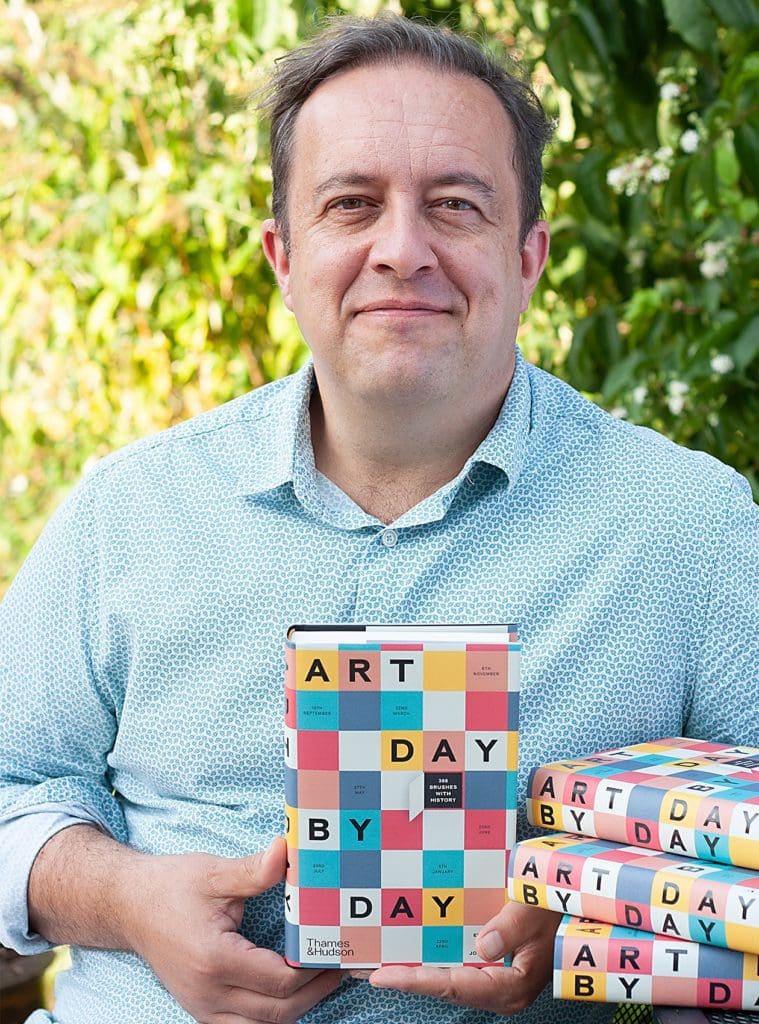
Author and journalist Alex Johnson with his latest book, Art Day By Day. Picture: Vincent Franklin

LOOKING for a cultural book to read one day at a time in 2022? Look no further than Art Day By Day, 366 Brushes With History, edited by Alex Johnson, freelance journalist, writer, design and lifestyle blogger and half-decent snooker player, formerly of this parish.

Published by Thames & Hudson, Alex’s daily almanac presents a selection of historical art events for every day of the year, from the momentous and headline-grabbing to the intimate, amusing, and illuminating; from Donatello to Dennis the Menace, Fabergé to Ferris Bueller’s Day Off, Spain to Senegal.

As Alex puts it, by taking a novel approach to the history of art, Art Day By Day “aims to change the pace at which the story is told”. Hence CharlesHutchPress’s advice to browse it in daily instalments.

Educated in York at Bootham School and trained in print journalism at the Yorkshire Evening Press, as it then was, this polymath of the written form contributes regularly to the Independent, Fine Books magazine and The Idler (on snooker, sheds and microarchitecture) from his St Albans home.

He runs the blogs Bookshelf (on creative bookcase designs) and Shedworking (a term he coined about garden offices) and has now added to that list his sites on tiny houses and “pubworking” (whose day is yet to come, he says). Oh, and he co-created the two The Writers Game games, Classic Authors and Modern Authors, with Laurence King.

Already he has written and edited such books as Bookshelf, Improbable Libraries, A Book Of Book Lists, Book Towns, Shelf Life, The Haynes Shed Manual, Edward Lear And The Pussycat (The Adventures Of Famous Writers And Their Pets), Menus That Made History, How To Give Your Child A Lifelong Love Of Reading and A Soundtrack For  Life (Classical Music To Take You Through The Day) for Scala Radio.

Now he has edited Art Day By Day, “snapshots of the most exciting, unusual and noteworthy art events from around the world and throughout history, told through direct testimonies, eyewitness accounts and contemporary chroniclers”.

“I’ve always been interested in dates and almanacs,” says Alex, who studied Modern History at The Queen’s College, Oxford. “I’d done a couple of books with Thames & Hudson before, so they were perfect for this one.

“The truth is, with nearly all my book covers, I have no input. The publishers send me the cover, saying ‘everyone really likes it’, and I can’t really say ‘No’!” says Alex Johnson. “I think this one works really well”

“Lockdown was a good time to be able to sit down and research it, and like my other books, it’s a book about something I’d like to read about.

“I did lots of arts modules at university as part of my history studies, from Anglo-Saxon art to Renaissance art. Most Oxford History degrees weren’t very flexible but by chance they had several good art modules.”

How did Alex select the subject matter for each day? “There were some things I knew I wanted to write about and some things that jumped out as I looked through the dates; or going through letters and thinking, ‘I want to do something on that’,” he says.

“I wanted it to be as broad as possible, taking in film, comic strips, photography, architecture, even album covers, as well as those things you might expect, like Michelangelo’s Sistine Chapel ceiling and Edvard Munch’s The Scream being stolen, because I didn’t want it to be too highbrow.

“At first it was a case of narrowing it down for each day, then getting down to the last few dates and thinking, ‘nothing happened on that day’, but I was determined to try to avoid too much ‘this or that artist was born or died on this day’, which I thought I could just put at the bottom.”

Comedian Tony Hancock is among the eye-catching entries, for the London premiere of his first leading film role in The Rebel on March 2 1961. “I’ve always been a big Hancock fan, and that was one of the ones I wanted to shoe in, where he played an appalling, childish, inept artist in Paris,” says Alex.

He likes the thought that going down “interesting rabbit holes” could lead readers to other places. “I really hope that they will have the same feeling as I did when they read about the first Fabergé egg and then want to read something far more interesting than those 400 words that will lead them somewhere else,” he says.  “Likewise, by reading condensed versions of some of Van Gogh’s letters, I hope they will seek out more of his letters.”

Artwork – save for the cover design – does not feature in the book. “It’s a shame, but it would have made the book even bigger than its 464 pages, but it’s not like the art is hidden away. If I can find it, then other people can!” urges Alex.

The cover for Alex Johnson’s next book, Rooms Of Their Own

Summing up his philosophy behind Art Dy By Day, he says: “Art is all around us, whether a Woodstock festival poster, a Superman comic or Dennis the Menace’s 1951 debut in The Beano, so that’s why it’s art in the broadest sense, and in many ways, the book is not about art but creative production.

“It would be easy just do something that just features the Great Masters, but there’s no point in doing that, just repeating what we already know, with nothing new added, but this book pinpoints moments of inspiration, when something happened, rather than highlighting great trends.

“It’s about the human side of it all, as things happen to people doing their job, rather than just sitting and pondering!”

Alex has two more books in the pipeline. First up is Rooms Of Their Own: Where Great Writers Write, whether beds, sheds, cafés bathrooms, basements or libraries, published by Frances Lincoln (Quarto) in April with illustrations by James Oses.

The second will be one of Alex’s list books, this one for the British Library, The Book Of Book Jokes, coming out in June. “The trouble with a joke is that you look at it and think, ‘is that still funny?’!” he says. “Some of them are appallingly corny, some are highfalutin. Some are in French or German.”

In the meantime, this is the day when you should buy Alex Johnson’s Art Day By Day. After all, it was included in the arts section of Guardian Bookshop Christmas gift guide.

What features on the Leap Year day of February 29 in Art Day By Day? Sculptor Augusta Savage is born, 1892.

Alex Johnson’s Twitter profile at @shedworking: Writer. Books (art, sheds, food, music, bookish subjects). Columns (@finebooks + @idler). All sorts (@Independent since 2007). Coined term ‘shedworking’.

Where does Alex write and edit? “I used to work from a shed but now removed temporarily to the cellar.”