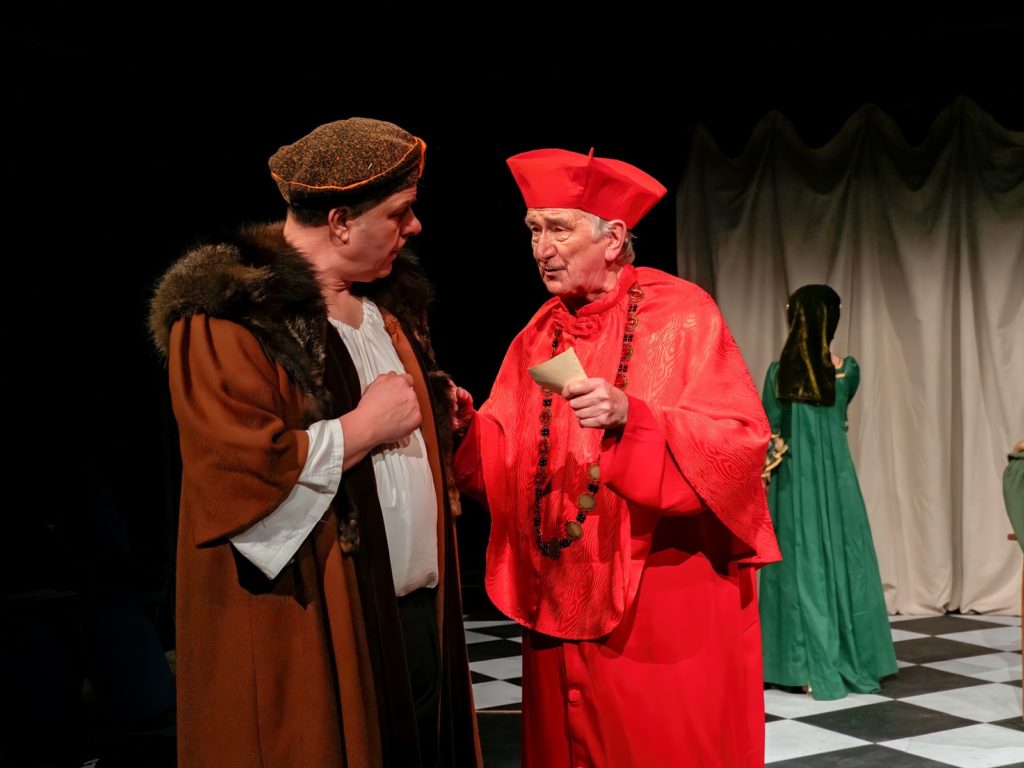
The plot thickens: Paul Osborne’s Thomas Cromwell, left, and Ian Giles’s Cardinal Wolsey in Black Treacle Theatre’s Anne Boleyn
ANNE Boleyn (c.1501-1536) had an extra finger and one head too few after her execution by a French swordsman in the Tower of London.
One of these statements is fiction, the other is fact, but both persist down the years as how we know Anne best, such is the way myth and history overlap.
The sixth finger story was a 16th century fabrication spun by Roman Catholic polemicist Nicholas Sander in 1585 to suggest Anne was a witch in a smear campaign against her daughter, Queen Elizabeth I.
Yet acts of besmirching her as a whore were rife in Anne’s lifetime too, led by those at the very top, leading to her beheading, as Howard Brenton explores in his witty political drama.
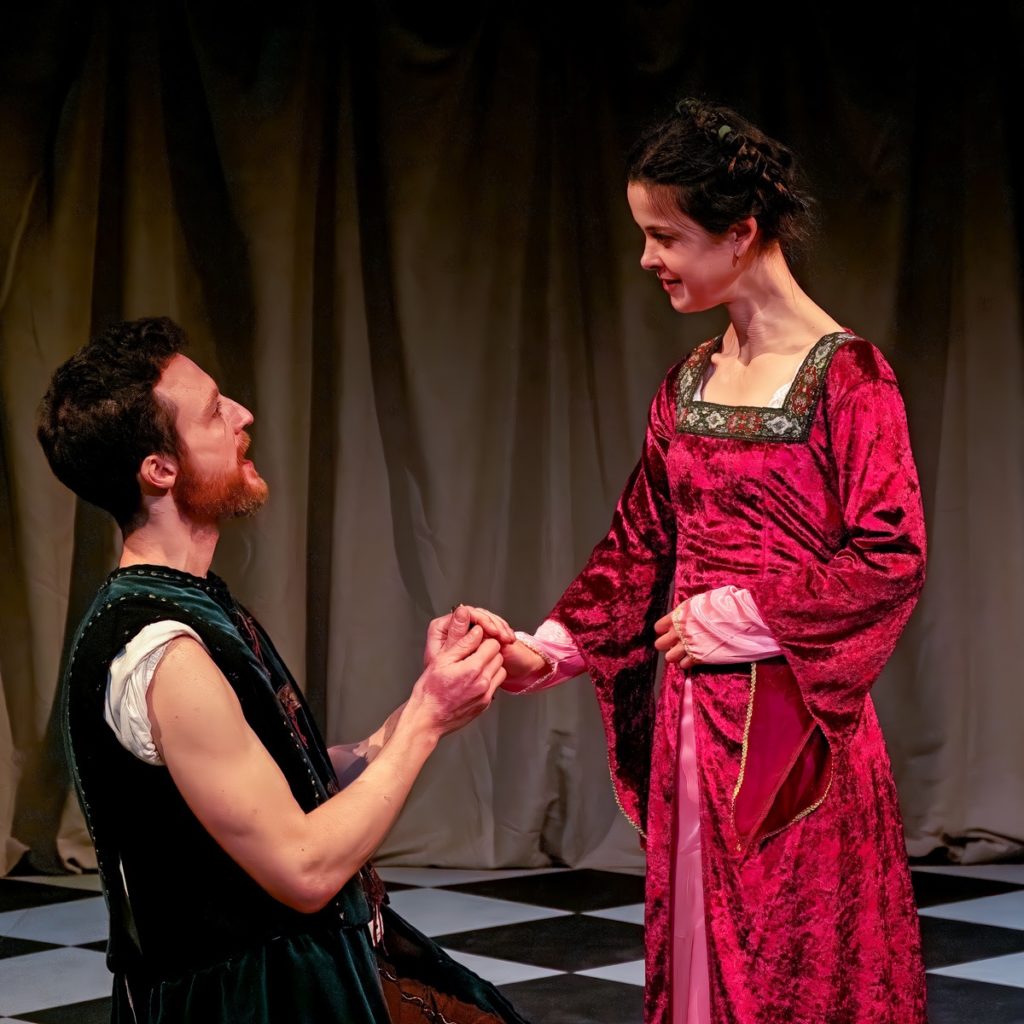
Nick Patrick Jones’s Henry VIII in a tender moment with Lara Stafford’s Anne Boleyn. Picture: John Saunders
Premiered at Shakespeare’s Globe in 2010, Anne Boleyn now breaks its York duck under the direction of Black Treacle Theatre founder Jim Paterson, whose experience of watching a friend in the Globe cast had left an indelible impression.
“This year marks 500 years since Henry’s courtship of Anne began in earnest – in 1526. So it felt like serendipity to stage this play, which makes us reconsider who Anne was, and what an important figure she is in our history,” says Paterson, explaining the timing of his production.
Here’s the history bit: Anne Boleyn was the second wife of King Henry VIII, whose desire to marry her forced the break from the Roman Catholic Church and the dawn of the English Reformation. She was well read, intelligent, queen for only 1,000 days – and by common agreement, the best of the six, so sassy and saucy, in the ultra-competitive Six The Musical.
Brenton puts her front and centre of his historical yet modern epic, both as a ghost in the court of James I and in charting her courtship with Henry VIII, presenting a more rounded and nuanced portrait of Anne as lover, heretic, revolutionary, queen, at once brilliant and bright but reckless too, hot-headed and then not-headed. Was she prey or predator? You decide, maybe for the first time
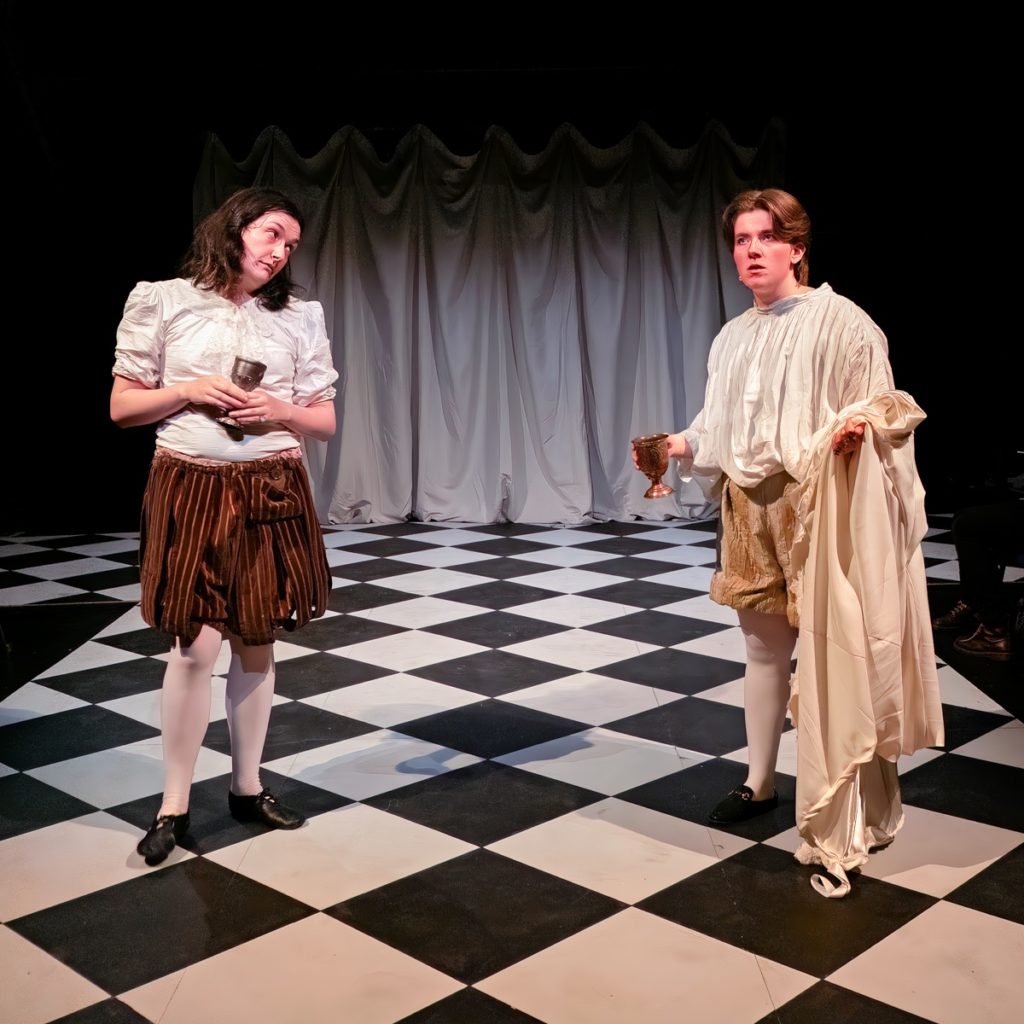
In need of a stiff drink: Cameron O’Byrne’s George Villiers and Katie Leckey’s James I. Picture: John Saunders
The play opens with Lara Stafford’s Anne Boleyn in monologue mode, as she enters the checkboard stage in her bloodstained execution dress, carrying a large embroidered bag. Brenton’s opening stage instruction reads “Aside. Working the audience”, immediately establishing that this play will be on her own terms, like a comedian’s opening gambit or a Fool’s mission statement in Shakespeare, as she teases the audience over the bag’s potential content.
“And why should I want you to love me?” she asks us. “Did anyone around me ever love me, but for the King?” And there’s the rub. Who was on her side? Brenton, as it turns out, Jesus, as she declares, and a curious James I (Katie Leckey), keen to use her information to aid his unconventional attempts to bring warring religious factions together decades later.
Anne pulls out the Bible, or more precisely William Tyndale’s banned version that would sew the seeds of her execution, with a flourish worthy of Tommy Cooper, but with a heavy heart, before making light of her execution when finally producing the severed head. “Funny, a head’s smaller than you think. Heavy little cabbage, that’s all.”
This sets Brenton’s tone, one where his comic irreverence rubs up against reverence, or more precisely the mirage of reverence in a world where Henry’s England waives the rules, where the intrigue and political machinations of Henry’s court undermine and belie the intersection of crown and church.

Anne Boleyn director Jim Paterson
Somehow, Stafford’s Anne must show her mettle to find her way through that ever-tightening thicket, and likewise Leckey’s James I, the Scottish king (here with a fellow Celtic/Northern Irish accent), must negate all the vipers’ poison when assuming the English throne.
In an outstanding return to a lead role, Stafford’s risk-taking Anne exudes intelligence, pluck, conviction, sometimes with humour, like when she mocks Ian Giles’s West Country Cardinal Wolsey for being woolly; sometimes with grave sadness, in the abject despair at failed pregnancies; or at the close, with sincerity, as she champions the power of love (uncannily just as Hercule Poirot does in the finale to Death On The Nile, on tour at the Grand Opera House this week).
Leckey, one of the volcanic forces of the 2020s’ York theatre scene with her Griffonage Theatre exploits, is tremendous here too. Surely James I should not be so much fun, but he is, whether flaunting his relationship with Cameron O’Byrne’s George Villiers, reaching for a glass, mocking the martinet dourness of Paul Stonehouse’s Robert Cecil or being as capricious as President Trump in making decisions.
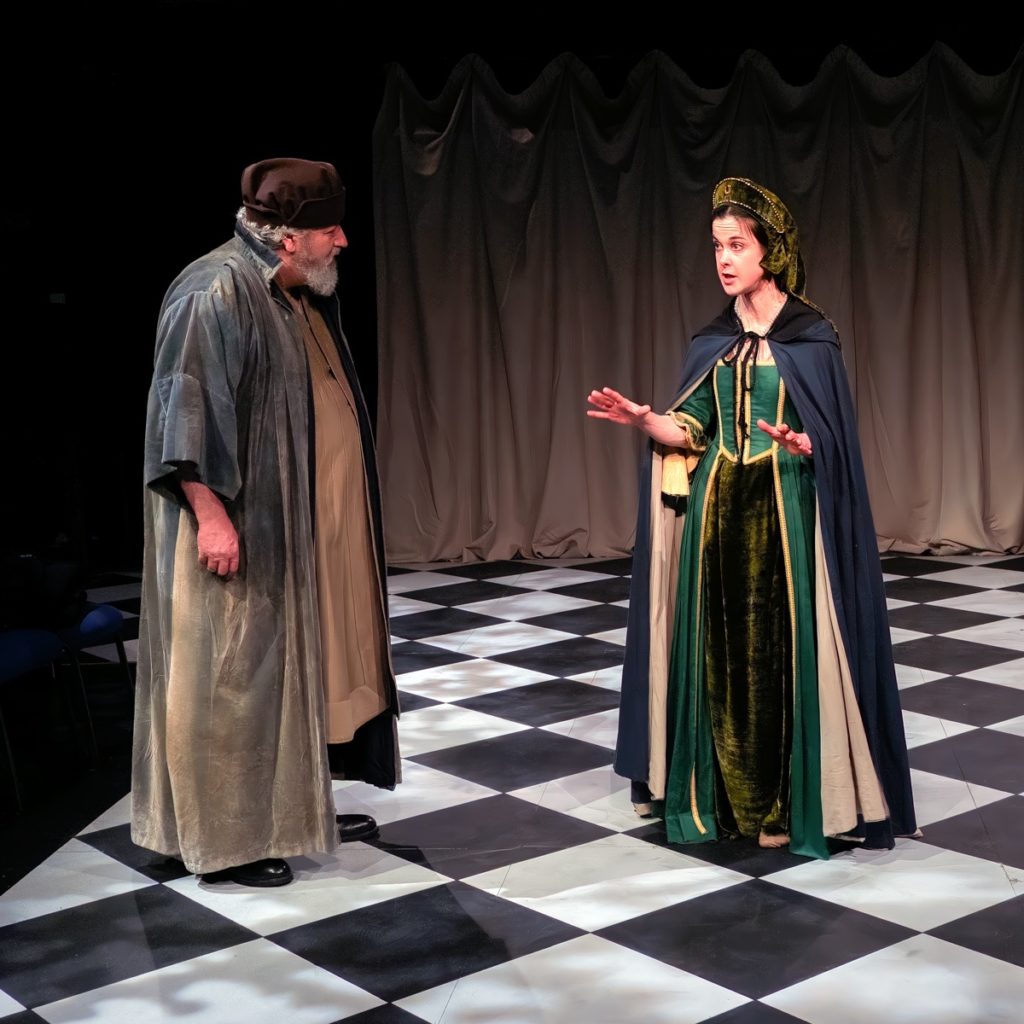
Bible matters: Maurice Crichton’s William Tyndale in discussion with Lara Stafford’s Ann Boleyn. Picture: John Saunders
Stafford’s Anne aside, the women have to play second fiddle, treading on glass to survive in the court, whether Lady Rochford (Abi Baxter), Lady Celia (Isabel Azar) or next-in-Henry’s- roving- eye-line Lady Jane (Rebecca Jackson).
Heavyweights of the York stage assemble for the juiciest male roles. Nick Patrick Jones brings Shakespearean heft (rather than physical bulk) to Henry, already entitled and erratic, demanding and wilful, boastful of his writing powers, but still allowed shards of humour by Brenton (albeit at Henry’s expense) in this clash of the legal and the regal.
Paul Osborne’s Thomas Cromwell, statesman, lawyer and Henry’s chief minister, emerges as the villain of the piece, misogynistic, devious, manipulative, his language industrial, his actions self-serving behind the veneer of duty, with “something of the night about him”. Osborne makes for a complex character rather the two-dimensional baddie of pantomime.
Giles’s Catholic cardinal Thomas Wolsey is the stuffed shirt of Brenton’s piece, righteous, exasperated, as forlorn as Canute when standing against the winds of change.
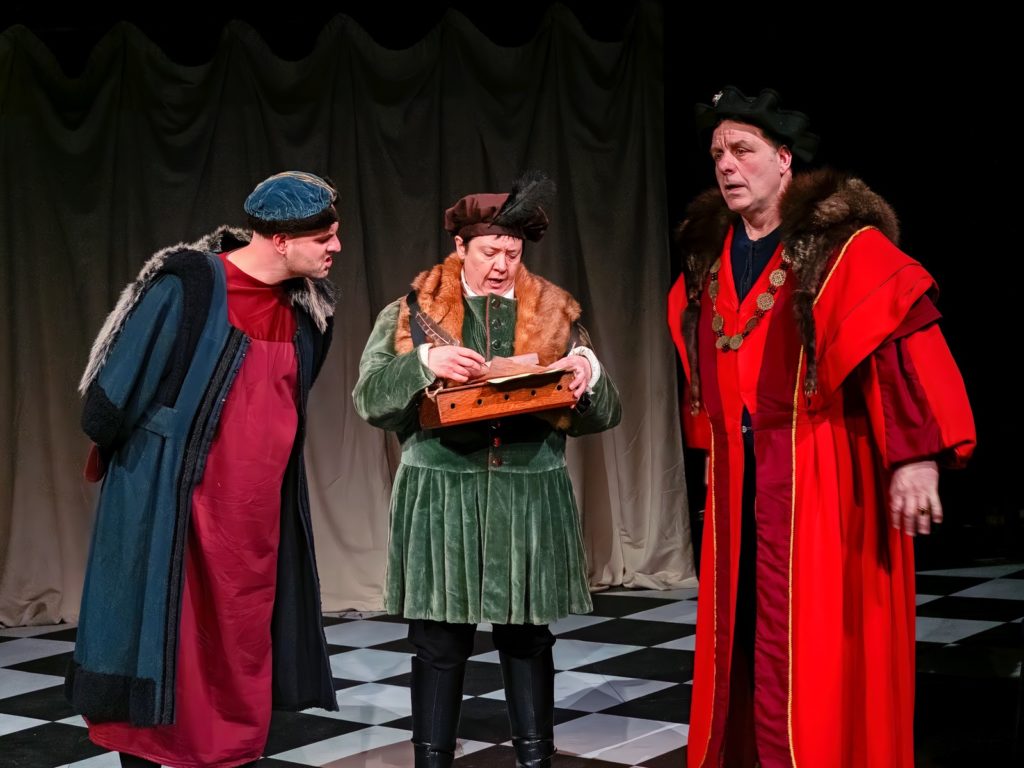
Drafting the Reformation Act: Paul Miles’s Sloop, left, Harry Summers’ Simpkin and Paul Osborne’s Thomas Cromwell. Picture: John Saunders
Never averse to scene-stealing impact, Maurice Crichton brings a twinkle and bravado to William Tyndale, writer of the outlawed Bible that would later form the basis of the King James version. His scenes with Stafford’s Anne are an especial joy.
Harry Summers’ Simpkin/Parrot, Paul Miles’s Sloop, Sally Mitcham’s Dean Lancelot Andrewes and Martina Meyer’s John Reynolds further stir the murky waters, while Richard Hampton’s open-plan set and Julie Fisher and Costume Crew’s costumes evoke the Tudor and Stuart periods.
All in all, Howard Brenton’s Anne Boleyn is far funnier than living in those turbulent times must have been.
Anne Boleyn, Black Treacle Theatre, Theatre@41, Monkgate, York, tonight, 7.30pm; tomorrow, 2.30pm and 7.30pm. Box office: https://tickets.41monkgate.co.uk.