REVIEW: Next Door But One in My Mad Mum, York Explore Library & Archives, May 13 and 14 and schools tour ****

Sophie Maybury’s Harper and Sean Cameron’s Andy dancing in condiment costumes in My Mad Mum. Pictures: James Drury

CONSIDER this statistic: 3.7 million under-18s in the United Kingdom have a parent who struggles with a mental illness. That’s one in three children in every UK classroom.

For too many of them, it feels like a secret they have to carry alone, hence their plight is invisible: hidden in plain sight, leaving them to deal with unique challenges at school and at home.

Our Time Charity, the only British charity dedicated to improving the outcomes for children growing up in these circumstances, has teamed up with York community arts collective Next Door But One for a second time, following up 2025’s How To Be A Kid with a schools tour of Ant Stones’ two-hander My Mad Mum, topped off by two public 5.30pm performances at York Explore.

Sophie Maybury’s new teacher, Miss Knowles, and Sean Cameron’s “scary” head of behaviour, Mr Fletcher, in My Mad Mum

The school shows, which began last week for 3,000 York and North Yorkshire secondary pupils, are ccompanied by discussions on the subject of mental health, identity and being a young carer for a parent.

Next Door But One specialises in raising awareness of often unspoken topics, a brief encapsulated in My Mad Mum, Stones’s deeply affecting story of GCSE pupil Andy (Sean Cameron) and Harper (fellow Leeds Conservatoire graduate Sophie Maybury), the new girl at school.

Billed as a “fast-paced, fun and fearless collision of real friendships, messy families and surviving the stuff no-one warns you about as a teenager”, this hour-long drama serves up their conversations with direct-address frankness, yet both pupils are cramped by a carapace of self-protection.

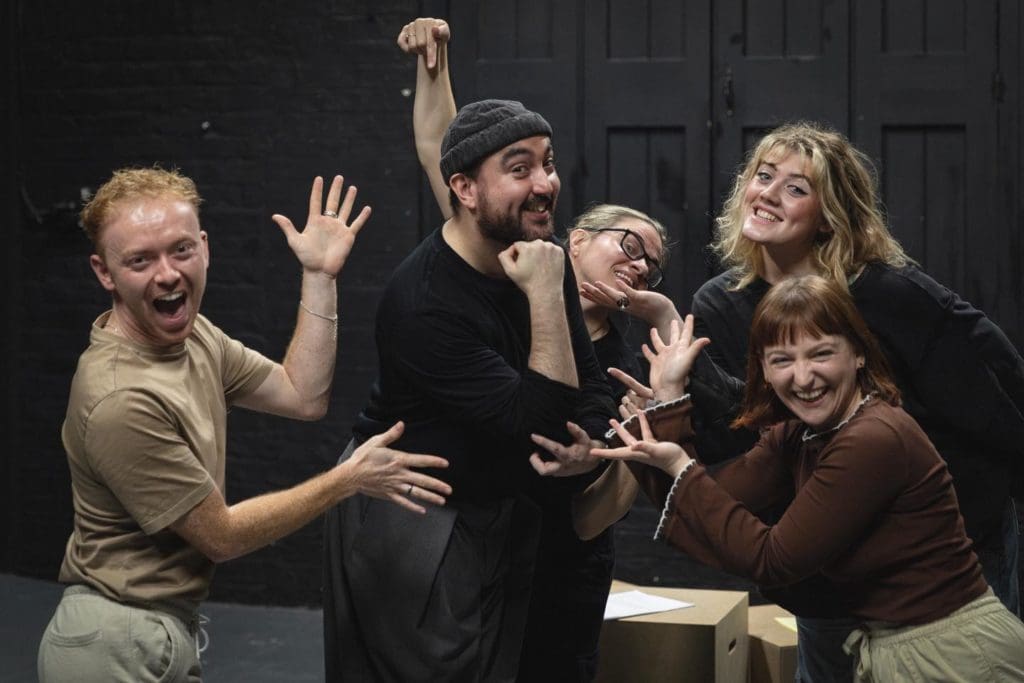
My Mad Mum director Kate Veysey, left, in the rehearsal room with assistant director dramaturg Matthew Harper-Hardcastle and company manager Jane Williamson

Andy is already the subject of “looks, whispers, rumours” of his “mad mum”, whose “health improvements never last”. He shares everything with new soul mate Harper but is unable to tell his teacher, Miss Knowles (Maybury’s colourfully attired second character), of the real reason why he has been late to school three times this week.

Recently qualified, enthusiastic, but with much to learn, her inexperience leads her to respond by rote, sentencing him to detention, rather than investigating further, and it must be hoped that one of the consequences of this play’s exposure of children suffering in silence is a greater understanding, a willingness to dig deeper, to look beneath the surface.

Harper, by contrast, does not reveal her own situation to school poetry champion Andy, instead attributing her father’s need to move to being in the military. She wants to be there to support Andy, rather than burden him with the truth of her “mad dad”, whose doctors are “always holding something back”. 

Sophie Maybury’s Harper and Sean Cameron’s Andy in a playful moment in My Mad Mum

When the revelation comes, it is a shattering moment, portrayed with intense emotional impact by Cameron’s initially wounded Andy and Maybury’s caring Harper.

They share a love of dance moves, one expressed throughout in Bailey Dowler’s carefree movement direction, culminating in the joyful finale of their heightened bond, Andy in a Tomato Ketchup costume, Harper in Yellow Mustard, each topped off by a cone (as if for squeezing).

For all the seriousness of the play’s topic, Stones and director Kate Veysey bring out the humour too, whether in those condiment costumes; a “Mustard/must admit” pun; Harper still writing with a fountain pen or Cameron’s portrayal of the frankly scary head of behaviour, Mr Fletcher.

Catherine Chapman’s fold-out set design turns into a house door for Seam Cameron’s Andy to express frustration with Sophie Maybury’s Harper

Catherine Chapman’s set design is minimalist but all the more effective for that economy: two chairs, one yellow, the other grey, matching the contrasting colours of a fold-up framework that can turn into a bus stop, a slide, a school room, a doorway or a house front.

Stones, Veysey and Cameron and Maybury, in their NDB1 debuts, combine with similarly striking effect in an eye-opening, heartfelt, deeply caring piece of theatre in the cause of social change.

Next Door But One presents My Mad Mum at York Explore, May 13 and 14, 5.30pm, and on schools’ tour.

REVIEW: Next Door But One in When Robins Appear, Explore York library tour until December 21 ****

Emily Chattle’s Lowen, left, Ceridwen Smith’s Robin and Annie Rae Donaghy’s Ellis in Next Door But One’s When Robins Appear. All pictures: James Drury

ACCORDING to British folklore, “robins appear when loved ones are near”.

The beloved Redbreast is omnipresent on Christmas cards, not least  on York printmaker Gerard Hobson’s exclusive illustration for Yorkshire Wildlife Trust’s 2025 charity card.

Mother Hutch had a corner devoted to each Yuletide’s new arrivals, and since her passing in September 2025, your reviewer has worn her favourite Robin badge on his lapel.

That lapel has a new addition, thanks to York community arts collective Next Door But One, whose cast of Ceridwen Smith, Emily Chattle and Annie Rae Donaghy hand out When Robins Appear badges at the conclusion to NDB1’s inaugural Christmas show (after 12 years of wholly inclusive, wholly accessible theatre-making for children and young people in and around the city).

Emily Chattle’s Lowen, left, and Annie Rae Donaghy’s Ellis experiencing “a different kind of Christmas” in Next Door But One’s When Robins Appear

Writer-director Matt Harper Hardcastle has penned “a different kind of Christmas show for those who have a different kind of Christmas”, in part inspired by the loss of his mother to cancer.

Enter the Robin, the harbinger of British winter birds, the messenger from the spirit world whose presence is deemed to be a comforting sign of a late loved one being close at hand.   

Here, the Robin takes the form of Ceridwen Smith in magnificent gold and red, topped off with feathery plumage and tailed with natty red and pink pumps. On occasion, her hand transforms into a bird-sized Robin, again bedecked in festive livery of gold and red.

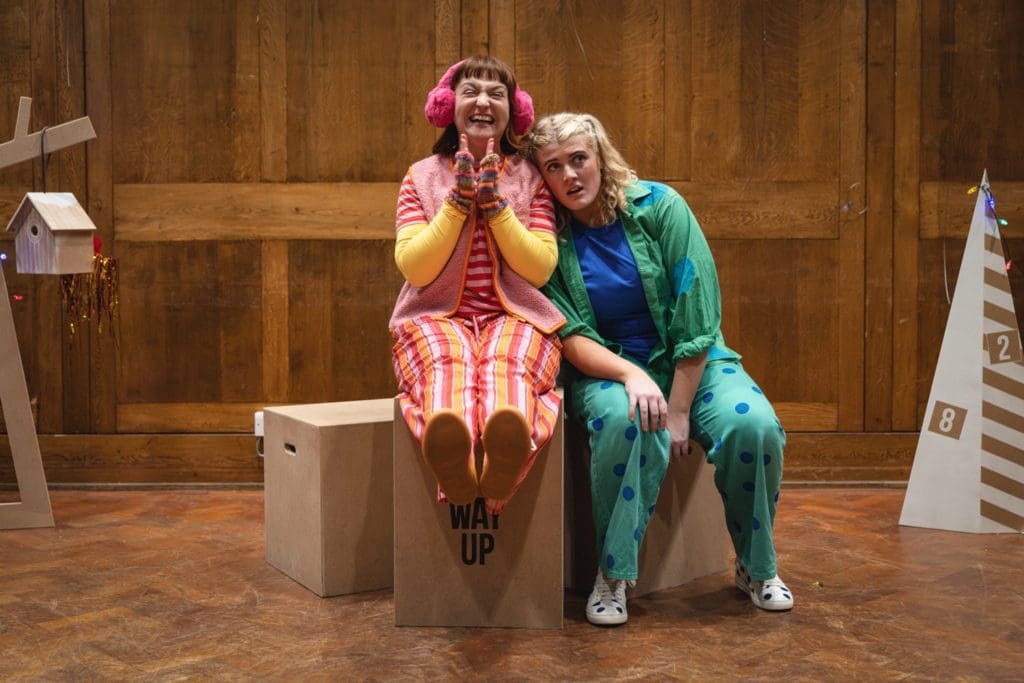
On entering York Explore’s wood-panelled Marriott Room, eyes are drawn to Emily Chattle’s Lowen and Annie Rae Donaghy’s Ellis, each looking glum, avoiding eye contact, tucked away but still in plain sight behind wooden triangular shapes with numbers that evoke both Advent Calendars and decorations in Catherine Chapman’s child’s play of a set design.

Movement director Bailey Dowler, left, writer-director Matt Harper-Hardcastle, Ceridwen Smith, Annie Rae Donaghy and Emily Chattle in rehearsal for When Robins Appear

Lowen, 12, misses her late Gran, known to her as Granbow, on account of wearing clothing as colourful as a rainbow: a habit Lowen  seems to be mirroring in her get-up of pink, red, grey, amber and yellow stripes.   

Ellis, also 12, is looking after her ill mum, both uncertain of her future. She feels as blue as her clothing, a mood not enhanced by moving into a new home and being unable to find her phone charger.

Both she and Lowen are surrounded by boxes: in Lowen’s case, the boxes for packing away Granbow’s belongings with her Dad (played by Smith, denoted by a hat, either worn or held in her hand when this admirable multi-tasker is playing Ellis’s Mum with the simple symbol of a pair of glasses).

Facing a first Christmas without her cherished, shining grandma, Lowen needs to find one elusive box, in particular, the one with her Dad’s fairy lights that Granbow (Smith in role number four) used to transform the cupboard under the stairs where he would retire in shy childhood days.

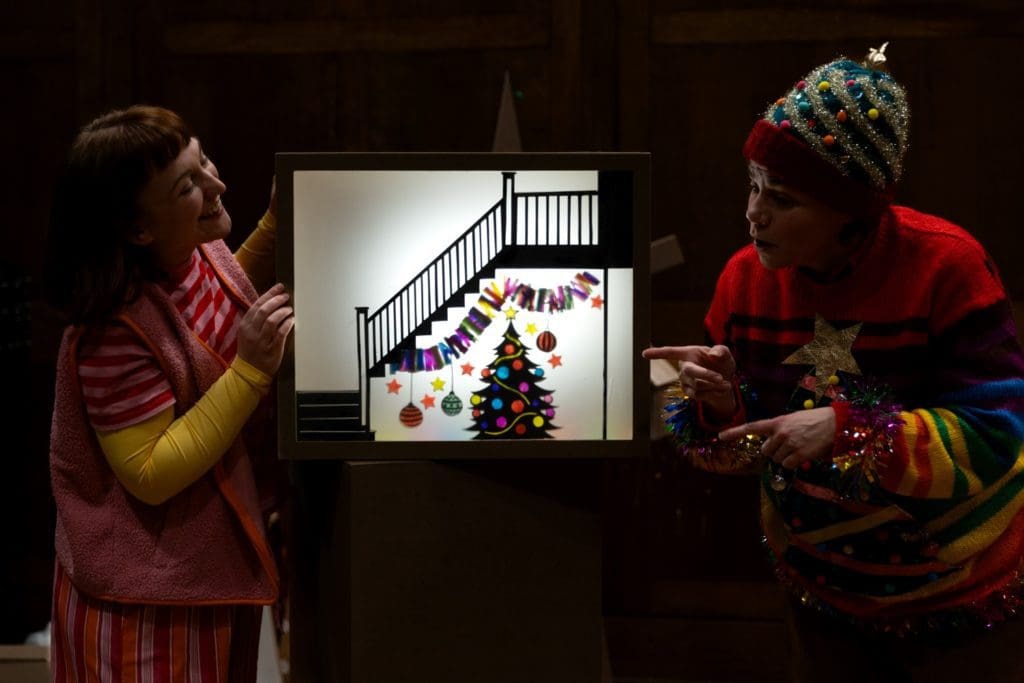
Emily Chattle’s Lowen with Ceridwen Smith’s Granbow in the shadow-play light box scene in When Robins Appear

At the start, Chattle’s Lowen and Donaghy’s Ellis do not know each other, but each is facing the challenge of a “different kind of Christmas”, of dealing with grief or illness, of coming to terms with changing circumstances or a change of address, above all of feeling overwhelmed.

Who should bring them together but Smith’s chatterbox Robin, chirping away ten to the dozen. What then ensues is an invitation from Robin to, first, Lowen, then Ellis, to recall a past Christmas that made them happy and then to invoke the spirit of that story into Christmas this year.

Those fairy lights and Ellis’s Mac’n’Cheese Christmas Day lunch feature in stories told with delightful  interplay, typically imaginative direction by Harper-Hardcastle and highly engaging characterisation by Chattle, already such a whizz at children’s entertainment, and Donaghy, back home for Christmas in York after graduating with first class honours in contemporary theatre at East 15 Acting School and taking her first steps in London’s theatre jungle.

Joshua Goodman’s enchanting songs and Bailey Dowler’s less-is-more movement direction complement Harper-Hardcastle’s beautifully judged direction as the chameleon Smith and the Chattle & Donaghy double act – where they bring out the inner child in us all – hold the attention of children aged seven to 11 and their adults alike.

Emily Chattle’s Lowen, left, Ceridwen Smith’s Robin and Annie Rae Donaghy’s Ellis on Catherine Chapman’s child’s play of a set design

As ever with Next Door But One, whose research took in working with York Young Carers, this is a caring, considerate show, with British Sign Language to boot, that says so much in under an hour for those whose story is not the stuff of glitzy, wham-bam pantomimes.

What’s more, you will not see a better use of boxes this festive season, gradually transforming into a Christmas tree before your eyes, while an earlier shadow-play light box scene is wondrous.

NDB1 are taking When Robins Appear on the road for eight primary school performances as well as public shows in Explore York libraries that all sold out before the tour opened. The £3.50 ticket price makes When Robins Appear the best-value festive family show in York this Christmas.

It would be no surprise to see this magical Robin bobbing around again next winter.

Next Door But One in When Robins Appear at York Explore, at Clifton Explore, December 18, 5.30pm; York Explore, December 20 and 21, 11am and 2pm. All sold out. Box office for returns only: nextdoorbutone.co.uk.

On the Way Up as Emily Chattle’s Lowen and Annie Rae Donaghy’s Ellis find festive cheer in a different kind of Christmas

REVIEW: Tutti Frutti’s The Princess And The Pea as Theatre Royal Studio reopens

Hannah Victoria’s Princess and the pea in Tutti Frutti’s The Princess And The Pea

The Princess And The Pea, Tutti Frutti, York Theatre Royal Studio, 6pm this evening, then on tour. Box office: 01904 623568 or at yorktheatreroyal.co.uk.

SINCE Covid’s cloak turned theatres dark, York Theatre Royal’s dormant Studio could have been added to York playwright Mike Kenny’s Museum of Forgotten Things.

Thankfully, after being used for storage and rehearsals, the Studio has been re-awakened for performances anew, albeit with a capacity reduced from 100 to 71. Out goes seating to the sides; in comes a head-on stage configuration.

A masked-up CharlesHutchPress took up a front-row seat at a morning performance full of excited Badger Hill Primary School children. How lovely to be part of such an occasion full of happy, enchanted faces.

This show is a revival of Leeds children’s theatre company Tutti Frutti’s colour-suffused, playful staging of Mike Kenny’s updated adaptation of Hans Christian Andersen’s story, set in a place where what you see is not what it seems: the aforementioned Museum of Forgotten Things.

Sophia Hatfield in The Princess And The Pea at York Theatre Royal Studio

 In his trademark way of bringing fresh perspectives to familiar stories, he refracts Andersen’s tale of The Princess And The Pea through the status of princesses today, against a backdrop that has moved on again even from the 2014 premiere, in our world of celebrity royals, social-media influencers, selfies and preening Love Island and Kardashian saturation coverage.

“Princesses seem to be back with us as a cultural phenomenon,” Kenny writes in his programme note. “The assumption is generally that a ‘real’ princess is very sensitive and high maintenance. If you read Andersen’s original, you can’t quite tell if he’s supporting or actually taking the mickey out of this attitude”.

Kenny creates a framework where three narrator-curators at the museum, a mother, son and their trainee, delve into the mystery of how a little green pea ended up there in a magical hour of storytelling, songs and silliness.

Bossy-boots Mother (Sophia Hatfield) becomes Queen; layabout Son (Mckenzie Alexander) transforms into the Prince and eager Trainee (Hannah Victoria) will emerge as the Princess of the title.

The “other” princesses in The Princess And The Pea, as sent up by Hannah Victoria, Sophia Hatfield and Mckenzie Alexander

All three raid the museum drawers to play “every type of princess you could imagine” in a send-up of 21st century reality TV types (and maybe even York hen parties) as the spoilt, work-shy, silver-spoon-in-his-mouth Prince is instructed by the Queen to conduct his search for the “real Princess” he should marry.

Kenny’s play follows the Prince’s passage from birth, his privileged, demand-everything, spend-spend-spend progress to this point being denoted by numbered props, whether in a suitcase lining, on an umbrella or inside a hat that also turns into a cake-mixing bowl.

Devotees of Peter Greenaway’s cult 1988 film Drowning By Numbers will recall a similar numerical conceit reaping dividends.

Anyway, back to the storyline. Kenny notes how Andersen reveals nothing about the Princess, beyond her taking the “pea test” to prove she is a real princess, and he duly gives her a story about “what it means to be ‘real’”, rather than a Disney-glossy  princess.

On song: a musical number for Sophia Hatfield, Hannah Victoria and Mckenzie Alexander

Rather than pretty dresses, tantrums and tiaras, Victoria’s Princess has worked in a kitchen, is blown in by the winds and is left standing in the rain until the wastrel Prince – with all staff laid off – has to answer the door himself.

Kenny, very much the people’s playwright, revels in keeping it real, not royal, with delightful mischief in his storytelling as he mirrors Andersen and the Shrek films in his irreverence towards royalty.

He has fun at the expense of Alexander’s callow Prince for being devoid of social graces and practical know-how, but tellingly he rewards him for toughening up when needs must, and likewise he sends up the Queen’s blinkered, old-school ways and haughty airs for being out of date.

Further pleasures come from Kenny raiding the cupboard of familiar fairytale characters and now forgotten things, from Goldilocks’s porridge spoon to Cinderella’s glittering glass slippers.    

Playwright Mike Kenny: “Revels in keeping it real, not royal”

Harris’s cast of actor-musicians thrives on Kenny’s fast-moving sense of fun and games, constant scene and character changes and cheeky humour, allied to his storytelling prowess.

Alexander, a natural for the silly-billy daft lad in pantomime, instantly bonds with the audience with his wide-eyed playing and he loves the chance to be a princess too; Victoria makes for a grounded, streetwise Princess and Hatfield is both fun yet more serious as the older hand in the company.

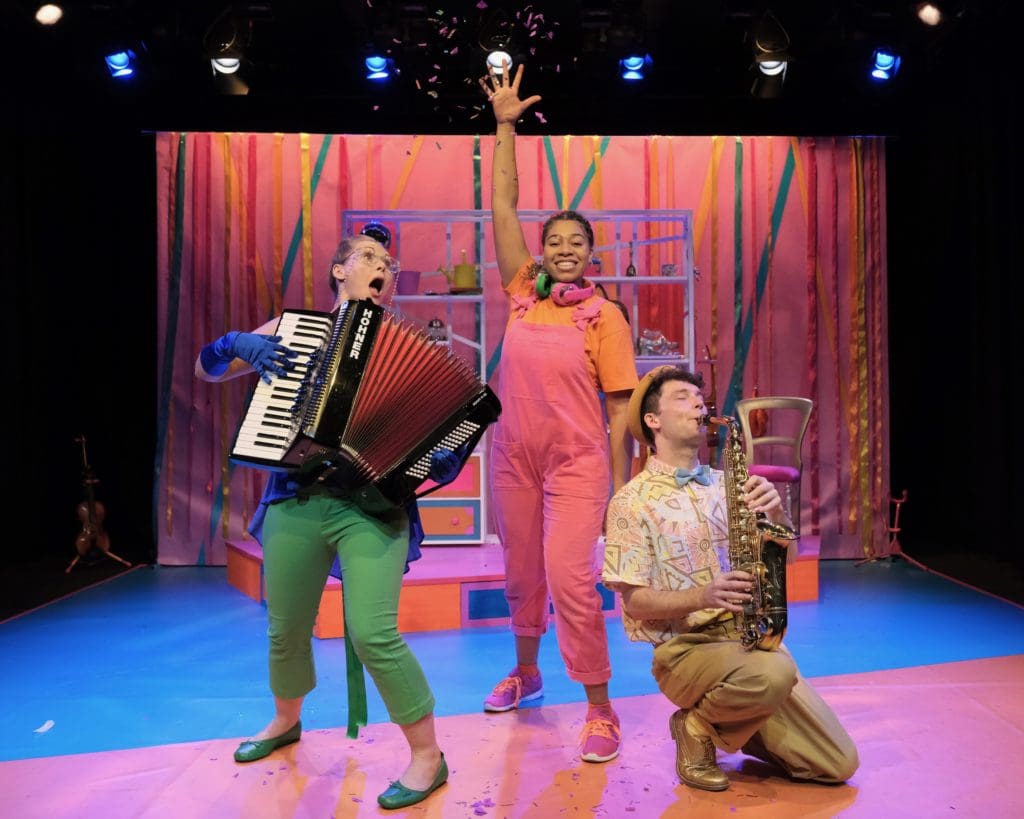
They team up joyfully for Christella Litras’s compositions too, singing characterfully as well as contributing violin, accordion, saxophone and more to complement Litras’s keyboards.  

So much to enjoy here, topped off by Catherine Chapman’s designs, where the stage colours of blue and green, pink and orange, yellow and gold are matched by the actors’ attire. Look out for such clever details as cupboard drawers turning into suitcases – as well as the numbers popping up on myriad objects.

At the finale, the curators change the museum name from Forgotten to Remembered Things. Your reviewer loved this show in 2014; happy to report, it is now even better than first remembered.