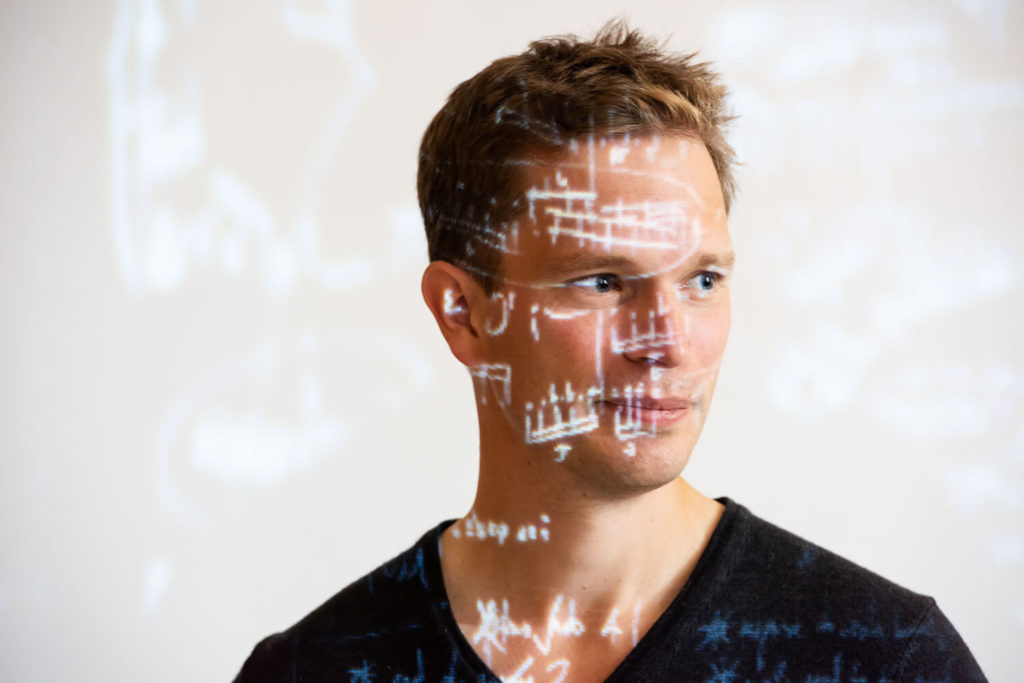
OCTANDRE is a piano quintet, with a double bass replacing the second violin. Think, in other words, of the instrumentation in Schubert’s ‘Trout’ quintet – which ended the programme here.
Before it, we heard works by Nicola LeFanu, her late husband David Lumsdaine and Christian Mason, who happens to be a co-artistic director of Octandre.
But before a note had been played, we were treated to an excerpt from Lumsdaine’s Soundscape 4: Butcher Birds Of Spirey Creek, a dawn chorus recorded in the Warrumbungles, a mountain range in his native New South Wales. Without risking a description, we can say that this remarkable bird has tonal instincts.
Next up was Mason’s Shadowy Fish (2020), which he subtitles ‘Hommage à Schubert’, although its title originates in a Pablo Neruda poem. In three sections, with the outer two labelled “mysterious” amongst other epithets, it is clearly a very personal reaction to the poetry of Schubert’s setting (actually by Christian Schubart), but without obvious relevance to the composer himself.
A viola interlude interrupts the angular motifs that jostle for attention at the start, and there is a viola solo near the close, which may mean that the instrument represents the trout. The plaintive slitherings in the middle – “slow, with a heavy heart” – against sforzando chords in the piano, might have been the fisherman’s moment of truth and the spaced high chords at the close offered the possibility of lament. But one struggled to detect much in the way of water, a mystery indeed.
Much more decisive because more vivid was LeFanu’s briefer Night Song With Frogs, originally a cimbalom solo, dating from 2004. With the strings now accompanied by harpsichord, the original score formed the basis of an improvisation, accompanied by an edited Lumsdaine tape of frogs on the Darling River.
Paradoxically, this sounded quite structured, with the strings flitting like insects around the frogs: motifs like little jigs, sometimes pizzicato, sometimes rapidly bowed, intrigued the ear and came close to blending with the tape, even elaborating upon it.
Lumsdaine’s solo cello piece Blue Upon Blue (1991) continued the theme of dawn and dark, since its title comes from a Buddhist poem about distant hills under evening clouds. The work is almost a duet: against an unpretentious though lyrical melody there is accompaniment of pizzicato and glissandos.
These come into the foreground along with rapid tremolos as the melody fades. It made a tricky combination, but was deftly handled by Corentin Chassard.
It cannot have been easy for the players, switching from the contemporary to the classical in Schubert’s ‘Trout’ quintet. Perhaps for that reason, this was not a particularly Viennese account, but also partly because the pianist, Joseph Houston, dominated most of the textures, more or less rigidly adhering to his own view of the score. There was little sense that he was responding to his colleagues.
Most of the melodic lines in the piano, although competently drawn, were a touch more forceful than would have been ideal for balance.
That said, there were compensating joys. After an edgy scherzo, the trio, taken at a more leisurely pace, was pleasingly smooth. The ‘trout’ theme itself was played without vibrato, a cute move, and the variations upon it strongly varied. Overall, the work would have benefited from a more relaxed approach that reflected Schubert’s own light-heartedness.
Christian Mason: Composer and University of York alumnus at the heart of the first York New Music Weekend
THE inaugural York New Music Weekend will be launched on Friday at the University of York.
Running for three days but staying online for longer, this new annual festival celebrates contemporary music in York.
Under the theme of Time-Space-Sound-Light, the weekend centres on the work of Christian Mason, an award-winning composer and alumnus of the University of York’s department of music.
The online event includes premieres of new pieces and music by the composers who have influenced him, performed by members of The Octandre Ensemble, The Assembled, pianist Rolf Hind and The Chimera Ensemble.
Interviews and recordings contribute to a rounded profile of this leading British young composers.
In Friday’s opening 1pm concert, recorded at the Sir Jack Lyons Concert Hall, The Chimera Ensemble, Britain’s largest student-run contemporary music ensemble, present new works by student composers Emily Linane (Flute Miniature), Lucy Havelock (that silk, unrestricted), Joe Bates (Cataracts), Fred Viner (Bells Wrung) and Becky Davidson-Lund (Shade And Light).
Anna Meredith: Composer studied at the University of York. Picture: Owen Richards
After Axeman by University of York alumna and BBC 6 Music favourite Anne Meredith, the concert concludes with a piece as reflective as its title, Pauline Oliveros’s Mirrorrorrim.
Based on the theme of expressing the visual, the Chimera programme weaves its way from mirrors to luminosity and the nature of bells, exploring colour and texture while featuring an unconventional use of fabric, amplification and distortion.
At 7pm on Friday, Rolf Hind’s online piano concert, Nature, Lockdown And Dreams Of Travel, includes Hind’s Bhutani and Hind et al’s Lockdown Sequence (pieces written for Hind in lockdown from a call on Facebook), Matthew King’s When Birds Do Sing, Christian Mason’s Three Waves From Afar, Elaine Michener’s Tree Scream and Messiaen’s Le Loriot from Catalogue d’Oiseaux.
Online on Saturday at 7pm, pianist Hind and Mason (rin bells, harmonica, electronics) join fellow members of The Octandre Ensemble, Audrey Milhères (piccolo, flute) and Corentin Chassard (cello, scordatura cello) to perform Mason’s Just As The Sun Is Always.
In Sunday’s 1pm online concert, pianist Kate Ledger and The Assembled present the world premiere of Androgynette, a multimedia work by Ledger, James Redelinghuys and artist Angie Guyton. Watch Three Refractions Of A Body Etude on Ledger’s YouTube channel for a flavour of what to expect.
At the festival’s second concert by The Chimera Ensemble, the university’s new music ensemble, on Sunday at 7pm, the focus turns to new works by composers, largely from Yorkshire and the North East, alongside student works.
Rolf Hind, Christian Mason and Kate Ledger: Prominent roles in the inaugural York New Music Weekend
Again recorded at the Lyons, the programme comprises: Ed Cooper’s …incantations fixate…; Linda Catlin-Smith’s Knotted Silk; Nicholas Peters, Placebo; Michele Abondano, The Shimmer Beneath: A Scattering Attempt; James McLeish, Crimson; Rossa Juritz, the sound of wooden dusk; Rebecca Peake, Purple Smoke, and Yue Ming’s The Eternal Circle, plus reprises of Anna Meredith’s Axeman and Pauline Oliveros’s Mirrorrorrim.
This programme considers time, colour, texture and fabric, typified by Catlin-Smith’s irregularly spaced Knotted Silk and Peters’ rhythmically forceful Placebo as The Chimera Ensemble inhabit an exhilarating array of sound worlds.
Among other events this weekend is an interactive video collaboration of dance, music and cinematography between the Scottish Ensemble, Scottish Dance Theatre and composer Martin Suckling, entitledthese bones, this flesh, this skin.
This Watch Anytime feature is a digital work for solo violin and solo dancer by composer Martin Suckling, choreographer Joan Clevillé and cinematographer Genevieve Reeves. Through a bespoke online platform, audience members are invited to combine different audio and visual layers to decide how they want to experience the work in multiple iterations.
Born out of this unique period in our lives, the piece “explores how heightened attention can reveal different experiences of time in our bodies and the environment around us”. This layering of simplicity and complexity also manifests in the way the viewer/listener is asked to make decisions.
In a nutshell, “with every new iteration, we discover new perspectives, new nuances waiting for us in the spaces in between music, cinematography and dance, between the traces of our own memories and the aliveness of our attention.”
Composer Martin Suckling: Interactive video collaboration with the Scottish Ensemble and Scottish Dance Theatre, combining dance, music and cinematography
Another Watch Anytime feature, Distanced Modularity, is presented by Jethro Bagust, Lynette Quek and Ben Eyes, who contend that “the pandemic has been a disaster of unimaginable proportions. Making art and music during such a time, while others are suffering and enduring great hardship, seems futile.
“However, music and art are a great comfort to many, perhaps not more so than the musicians themselves and the social interaction that plays an indelible role in music.”
Using the Ninjam server set-up at York to synchronise two geographically distant modular synth set-ups; Bagust and Eyes explore how streams of found audio, real-time modular synthesis, stochastic compositional processes and video (courtesy of Lynette Quek) can be merged online to create a real-time audio-visual miasma. The piece was recorded live in one take after several distanced rehearsals.
Jethro says: “The instrument I play is populated with numerous chance elements that are linked to musical parameters. These elements of uncertainty blur the distinction between the roles of performer, composer, and audience because we are all hearing the music for the first time.
“Improvising with indeterminate instruments such as this, that defer the note by note production to algorithms, might be akin to steering an animal that you can point in a particular direction but not precisely know their behaviour.
“There is a tension between the human and the machine; the player must listen and react, responding to the system at an indirect meta-level.
A still from Jethro Bagust, Ben Eyes and Lynette Quek’s Distanced Modularity
The pre-recorded audio sources are from John Cage and Morton Feldman, In Conversation, Radio Happening I of V, recorded at WBAI, New York City, 1966-1967.
“Ben’s own set-up is based around a custom Max/Msp patch, linked to a modular synth, that allows real-time interaction with musical sequences and rhythms. Influenced by dub and techno, sound sources in the system are filtered, delayed and reverberated live in the mix to create musical form and progression,” says Jethro.
The festival’s five concerts, all recorded live, will be complemented by a round-table discussion on Sunday at 2pm when the speakers will be British composers and musicologists Martin Suckling, Minyung Im, Carmen Troncoso Caceres, Richard Kearns and Catherine Laws, in response to the pandemic-enforced closure of venues generating an explosion of online music-making.
Join the creative teams behind the festival’s Watch Anytime features, these bones, this flesh, this skin, Ceci n’est pas un piano and Between Air, Clay And Woods Of Certain Flutes, as they discuss ways to approach online performance beyond the “filmed concert” paradigm.
“Explore their online features and bring your questions to this interactive session,” comes the invitation to an event hosted on Zoom. Ticketholders will be emailed the Zoom link the day before the event.
All events are free but booking is required at yorkconcerts.ticketsolve.com/shows. Ticketholders can watch all the performances on demand until Sunday, July 11 at 23.59pm.