REVIEW: Martin Dreyer’s verdict on Opera North, Eugene Onegin, Leeds Grand Theatre, until October 29 and on tour until November 21

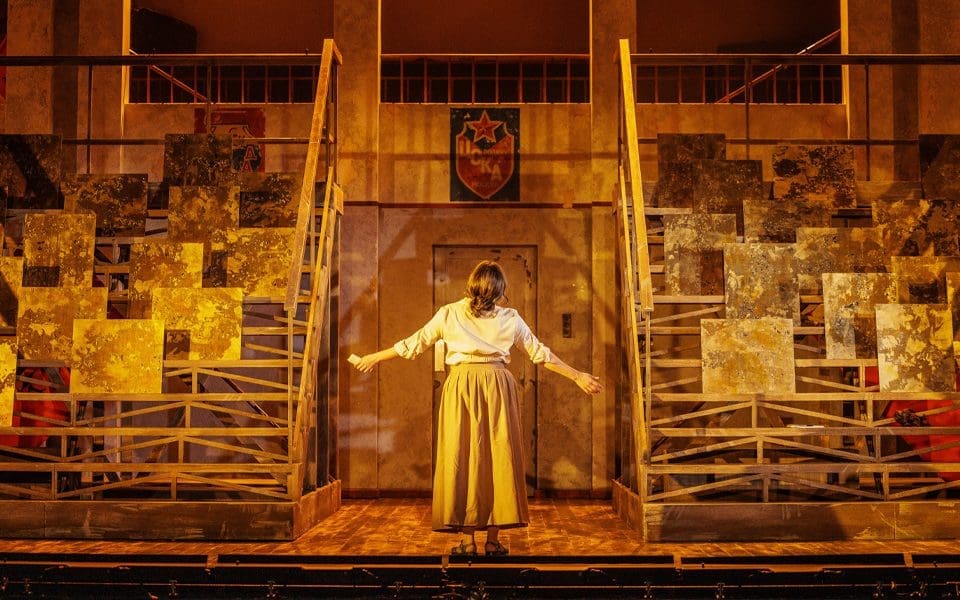
Verity Wingate as Tatyana in Opera North’s Eugene Onedin. Picture: James Glossop

IMAGINE, if you will, a black-tie party, with long dresses and lots of fizz, taking place in the cramped space between two sets of bleachers in a gymnasium, where the paint is peeling off all the doors.

Then again, the same setting has earlier accommodated a young girl writing a letter to her putative lover, scribbling with a ball-point pen in a ring-bound notebook, from which she tears off a page to send.

These scenes may not sound like the stuff of opera, but they are taken directly from Opera North’s new Eugene Onegin, a co-production with Irish National Opera and with Opera Queensland, whose artistic director Patrick Nolan leads this production. They are respectively the ball in Act 3, Scene 1 and Tatyana’s Letter Scene, Act 1, Scene 2.

Tchaikovsky’s setting of Shilovsky’s libretto, in turn derived from Pushkin’s verse novel, inhabits both a country estate and St Petersburg in the 1820s. The current production is set in the 1980s, before and after the time of Gorbachev’s perestroika. In the spirit of glasnost – greater openness – we must seek an explanation.

John Brancy’s Eugene Onegin and Joshua Bloom’s Prince Gremin in Opera North’s Eugene Onedin. Picture: James Glossop

The creatives involved, primarily Nolan, along with set designer Leslie Travers and costume designer Elizabeth Gadsby, begin their production in a small rural community in 1980, as it prepares its contribution to that summer’s Olympics in Moscow, in a gymnasium festooned with portraits of Lenin. It closes in 1991 as the new Russian Federation supplants the collapsed Soviet Union.

While admitting that the correlation between this period and the 1820s is not exact, the group expresses a “desire to bring a contemporary energy to the piece.” It is not immediately apparent that Tchaikovsky’s original lacked energy. Nor is the raw human emotion of that time any less forceful than it was in the 1980s. Indeed general director Laura Canning highlights Tatyana’s resilience as “straight out of Austen”.

While this drab setting may be visually unappetising, there are some musical compensations. Verity Wingate, one of six principals Opera North debutants, makes a properly vulnerable teenage Tatyana.

Although she started uneasily on this opening night, she suddenly found a higher gear for her Letter Scene, which is very much the touchstone of the role. She also achieves a smooth transformation into society’s upper reaches, so that her ultimate rejection of Onegin carries moral weight.

Jingwen Cai as Olga with members of the Chorus of Opera North as villagers in Eugene Onedin. Picture: James Glossop

He is John Brancy, another debutant, whose haughty demeanour is matched by a clean-cut baritone that speaks of self-assurance linked to insensitivity. His friend and ultimate foe, Lensky, is a less appealing figure in Caspar Singh’s hands. While he paces his pre-duel aria delicately, there is also a disturbing unevenness in his focus, now forward, now back, so that the voice comes and goes.

Jingwen Cai is a sparky Olga, Tatyana’s younger sister, full of mischief. Hannah Mason is charming as their mother, Madame Larina, and Claire Pascoe makes a personality of Filipyevna, both amply justifying their elevation from the chorus. So too does Simon Grange as Zaretsky. Florian Panzieri makes pleasingly light work of Triquet’s aria. Joshua Bloom’s dry bass as Prince Gremin lacks aristocratic authority.

The chorus projects with its customary vigour but looks uncomfortable with some of the 1980s vibe that Maxim Braham’s choreography is presumably intended to convey, not helped by casual dress. Even the orchestra under Garry Walker was less than compact in Act 1, but was in impressive stride thereafter on this occasion, as doubtless it will be throughout the run.

Opera North, Eugene Onegin, Leeds Grand Theatre, until November 29. Box office: operanorth.co.uk. Sung in Russian with English subtitles.

Review by Martin Dreyer, Leeds Grand Theatre, 9/10/2026

John Brancy’s Eugene Onegin, front left, in a punch-up with Caspar Singh’s Lensky as Chorus of Opera North members look on. Picture: James Glossop

REVIEW: Martin Dreyer’s verdict on Opera North’s Alcina, Leeds Grand Theatre

Máire Flavin as Alcina in Opera North’s production of Alcina at Leeds Grand Theatre. Picture: James Glossop

Opera North in Alcina, Leeds Grand Theatre, further performances tonight and Thursday, 7pm, then on tour until March 24. Leeds box office: operanorth.co.uk/whats-on/alcina. Also live-streamed on www.operavision.eu

HANDEL’S operatic audiences must have had stamina. Alcina, his most popular success at the box-office, clocks in at over three and a half hours, when given complete.

Nowadays we seem unable to treat Handel’s operas with the same reverence we extend to the parts of Wagner’s Ring, by giving them in full. Hence in Tim Albery’s new production – Opera North’s first attempt at Alcina – the dance music is omitted and the role of Oberto excised altogether. Both contain some top-class Handel.

Covid constraints are doubtless to blame, although not for the conversion of Melisso from bass to mezzo – henceforward Melissa – on the grounds that this was how she originally appeared in Ariosto’s Orlando Furioso, two removes distant from the anonymous libretto Handel actually preferred.

Other considerations apart, the presence of a bass helps to provide a better balance between upper and lower voices.

There was one other constraint. The general manager was at pains to point out in his introductory note that this was the company’s first sustainable production, en route to full Carbon Neutrality (his capitals) by 2030. This was not so much virtue-signalling as a smokescreen smudging the reality that décor and costumes would be ultra-low budget.

So Alcina’s island was experienced only via a video cooked up by Ian William Galloway. It mainly provided a jungle backdrop to the ten armchairs that were virtually the only props in Hannah Clark’s set, barring a bear rug that Alcina briefly ‘wore’, as if joining the ex-suitors she had turned into animals.

That was virtually the only magic on display. There was no sign of her palace. Clark’s costumes, recycled of course, were more appropriate to a 1950s’ nightclub than a desert island, a deliberate excursion into vintage. All of which suited the budget and was doubtless easy to believe if you had worked through it in rehearsal, less credible for someone encountering Alcina for the first time.

These reservations apart, Albery’s particular achievement is to fill the arias with plenty of action, even bringing on stage characters who are merely in the minds of the singers rather than intended to be present. So, there is never a dull moment.

Máire Flavin’s handling of the title role is a work in progress and promises much. But at the moment she has not quite assumed its full potential. The notes are all there and she looks determined enough, but there is not much emotion behind them and her affair with Ruggiero is short of electricity.

Her Act 2 scena, where she fights conflicting emotions, carries theatrical conviction but not the musical punch to match.

Ruggiero is played by the American countertenor Patrick Terry, making his company debut. His best effort is his departure aria, ‘Verdi prati’, where he relaxes into its cantabile line. Elsewhere, there are too many occasions where he tries to produce more sound than suits his voice and pushes himself out of tune. He is persuasive as Alcina’s puppy-dog, but less so thereafter.

The Norwegian mezzo Mari Askvik, another company debutant, delivers the purest Handelian style as Bradamente, the fiancée of Ruggiero who spends much of the show disguised as her brother. Her height and blonde bob reinforce this impression and her coloratura is splendidly clean.

Fflur Wyn is marvellously fiery as Morgana, Alcina’s sister, and tears into her big aria, ‘Tornami a vagheggiar’, with relish. Her on-off affair with Oronte, sung by tenor Nick Pritchard, is the crowning glory of Act 2, underlining what we have been missing from the other principals. Pritchard matches her fervour to a tee. Claire Pascoe makes the most of the shadowy role of Melissa, another enchantress.

Laurence Cummings is stylish in his conducting of a slightly thinned-down orchestra from the harpsichord, with two theorbos adding extra spice. This is a show that will probably mature as the run progresses, but presently does not compensate for its lack of magic.

Review by Martin Dreyer

Secret Link