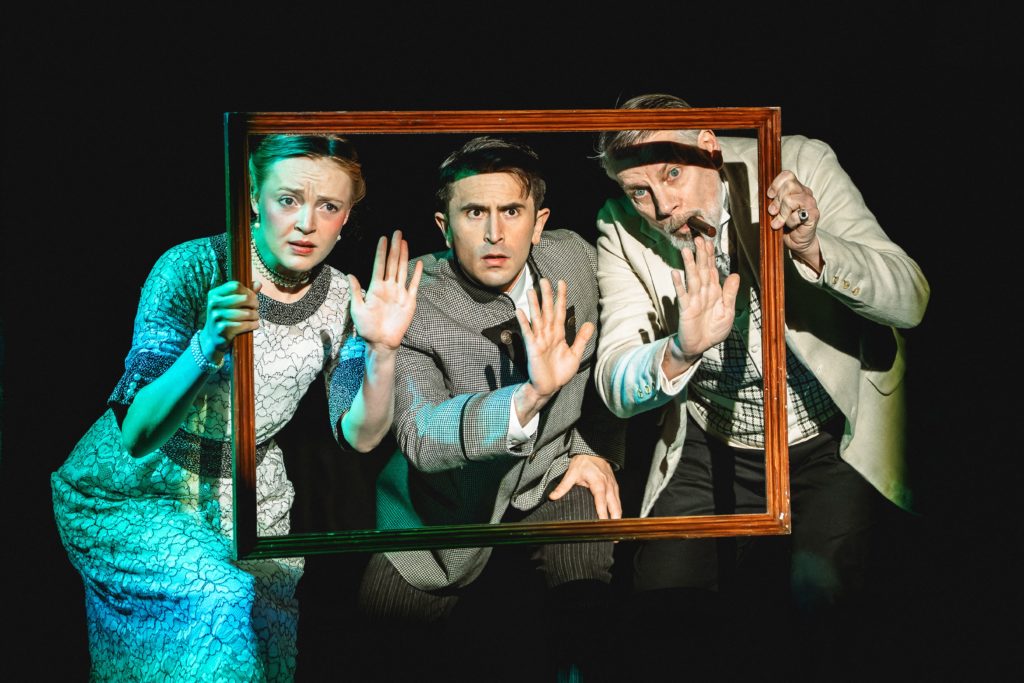
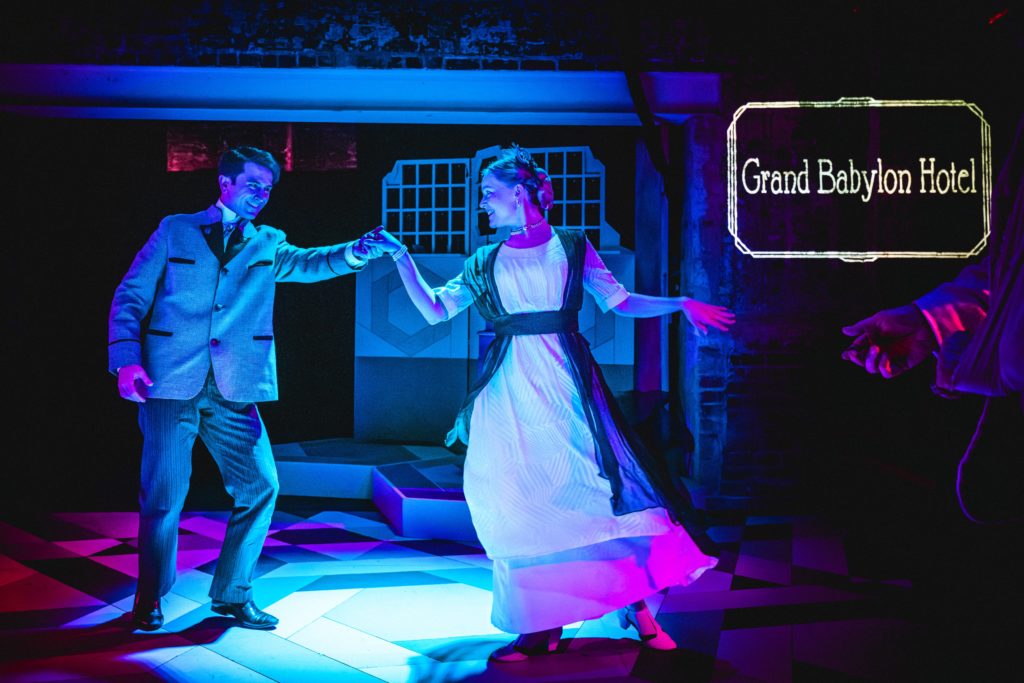
Window of opportunity: Alice Pryor’s Nella Racksole, Thomas Cotran’s Prince Aribert of Posen, centre, and Bill Champion’s Theodore Racksole. Picture: Andrew Billington
CONRAD Nelson. Deborah McAndrew. Bill Champion. All are names familiar to Yorkshire theatre audiences past and present, but what of Arnold Bennett?
He is as much a part of the Potteries as Nelson and McAndrew’s Stoke-on-Trent company Claybody Theatre, but for all his 34 novels, 13 plays, seven volumes of short stories, several self-help books, screenplays and stories for more than 100 newspapers and periodicals, he may be best known for the Omelette Arnold Bennett, the creamy one with gruyere cheese, smoked fish and béchamel sauce, invented in his name by chef Jean Baptiste Virlogeux while he was staying at The Savoy in 1929 to write his 1930 book Imperial Palace.
Bennett loved The Savoy – his second home – and hotel culture at large, a love expressed in his 1902 “rollicking comedy thriller” The Grand Babylon Hotel (based on The Savoy, apparently).
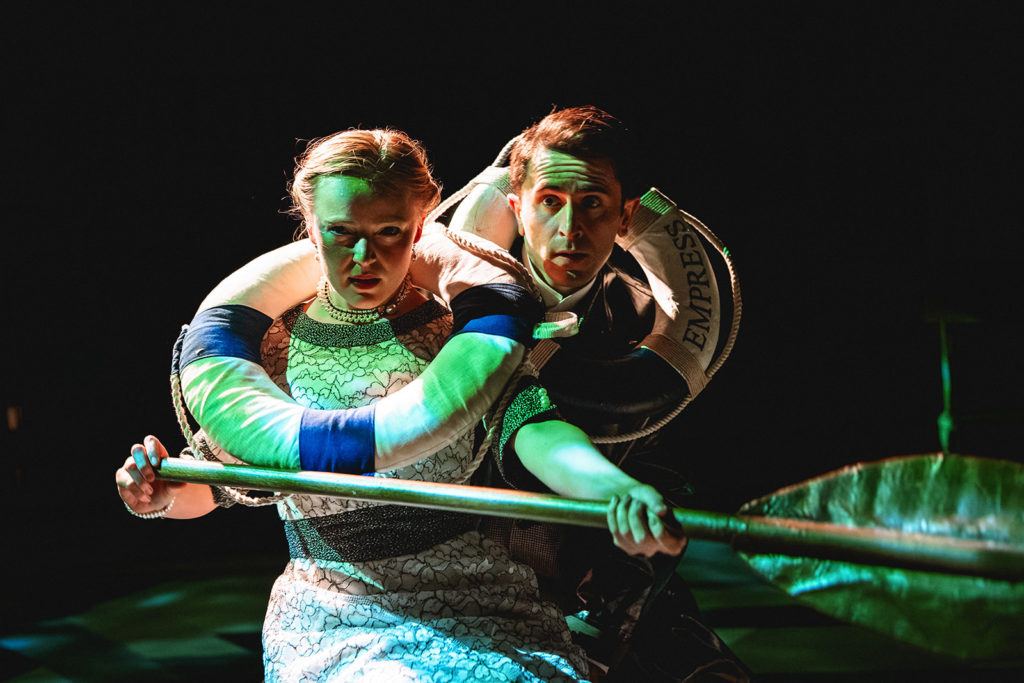
Alice Pryor’s Nella Racksole and Thomas Cotran’s Prince Aribert of Posen take to the water in The Grand Babylon Hotel. Picture: Andrew Billington
Thrice turned into a film, in 1914, 1916 and1920 (in Germany), now it is transformed into a theatrical whirl of a murder mystery drama in the spruce yet madcap style of Patrick Barlow’s reinvention of The 39 Steps, replete with fabulously attired, flamboyant characters, dextrous movement and dance-step interludes, sleight-of-hand role shifts and equally fast costume, accent and location changes on a rising tide of physical comedy and mentally adroit twists and turns.
Co-artistic director Nelson’s touring cast for McAndrew’s wizard, whizzing Jazz Age stage adaptation adds Stephen Joseph Theatre favourite Bill Champion to four players from last autumn’s premiere at the New Vic.
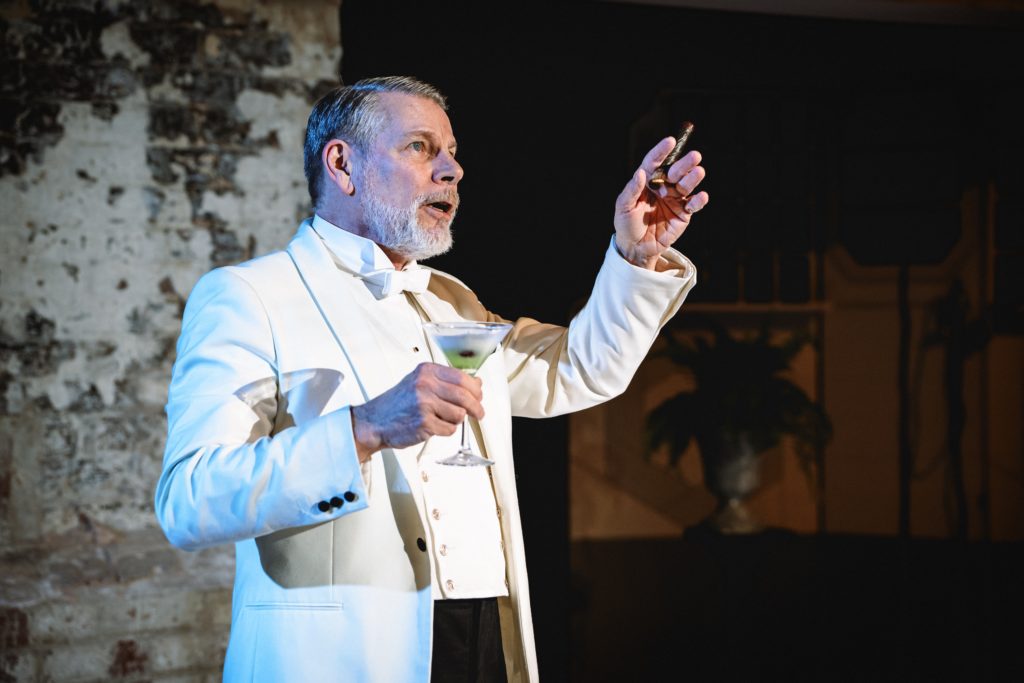
Champion, cigar seemingly forever betwixt his lips, is playing American railroad billionaire Theodore Racksole, whose demanding daughter, Nella (Alice Pryor), wants filleted steak and Bass beer for her birthday treat.
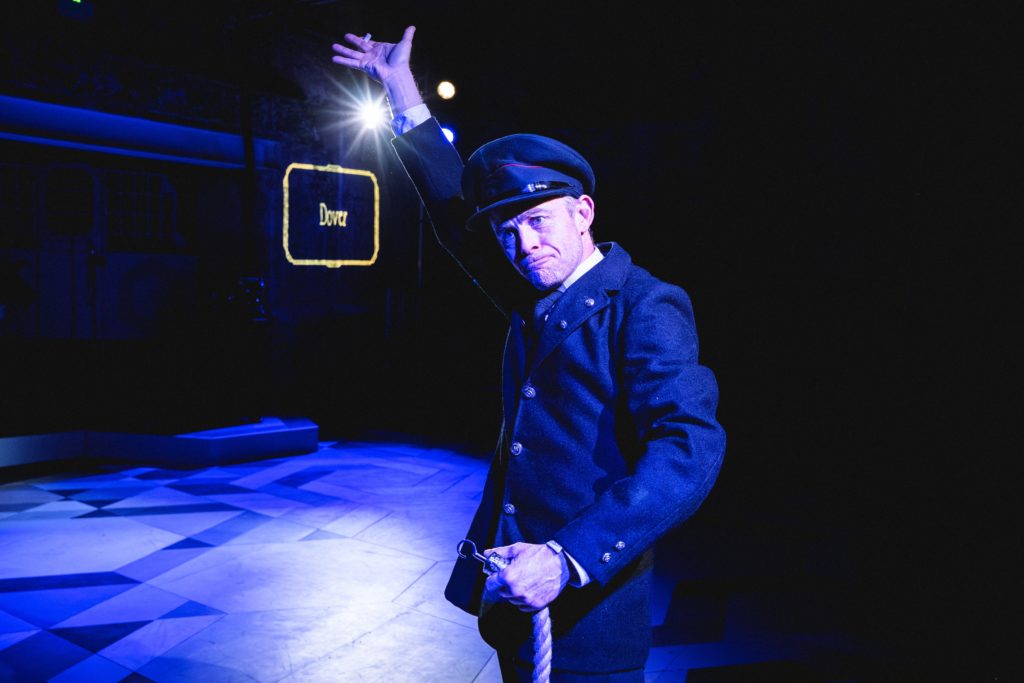
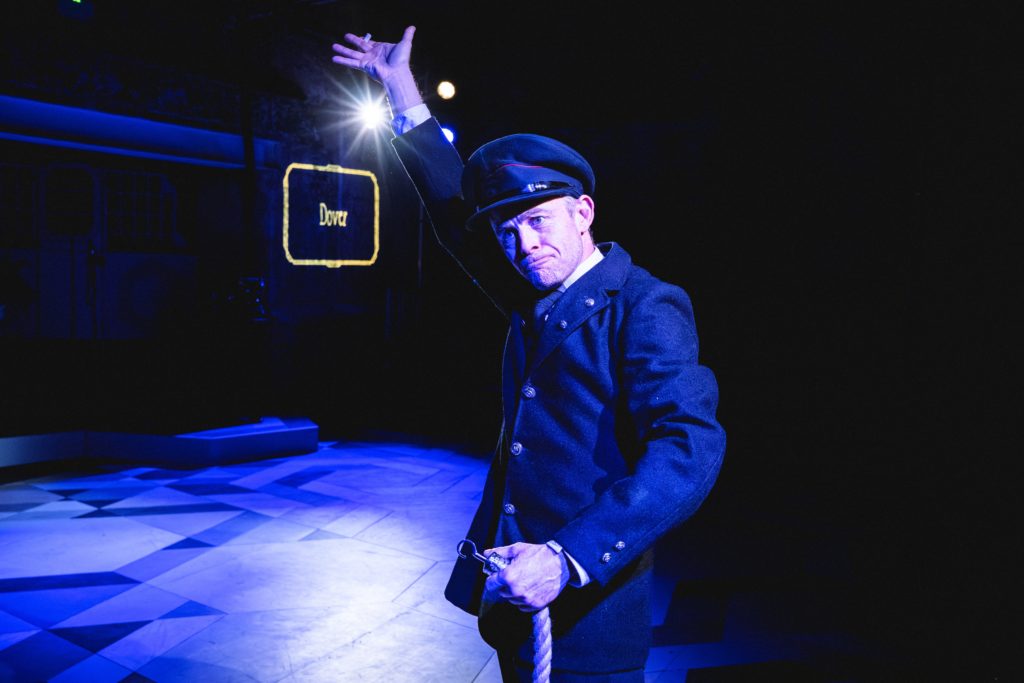
Michael Hugo’s Ticket Collector in The Grand Babylon Hotel. Picture: Andrew Billington
However, as supercilious maitre d’hotel Jules (Michael Hugo) explains, they are not on Italian chef Rocco’s menu at London’s exclusive Grand Babylon Hotel.
Whereupon Theodore buys the chef, the kitchen, the hotel, lock, stock and barrel of unexpected problems. Big mistake? When Reginald Dimmock (Thomas Cotran) keels over, murder is followed by the kidnapping of Nella.
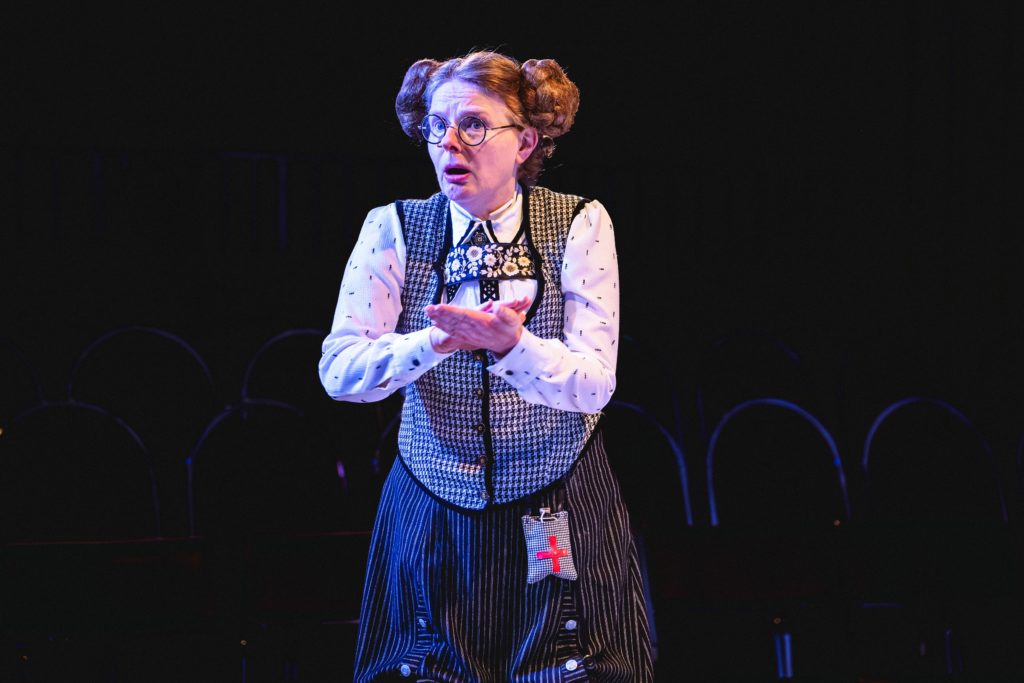
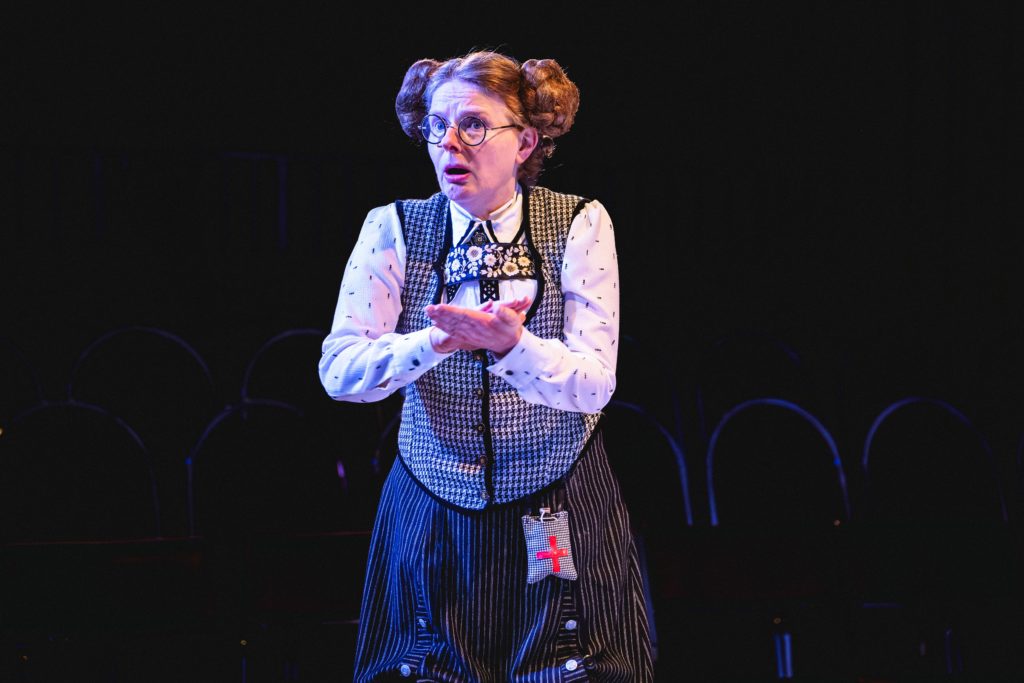
McAndrew stirs myriad characters into the melting pot, even inventing one, German Nanny Heidi (one of four roles for Shelley Atkinson, including fierce hotel worker Miss Spencer, who may really be Baroness Zerlinski).
Shelley Atkinson’s Nanny Heidi in The Grand Babylon Hotel. Picture: Andrew Billington
Thomas Cotran, who you have seen in Mikron Theatre shows, flits between three roles, the unfortunate Dimmock, the heel-clicking German Prince Aribert of Posen and knife-wielding, moustachioed Italian head chef Rocco, having particular fun with the latter.
They are joined in McAndrew’s trio of “clowns” by Michael Hugo, once a fixture in Northern Broadsides productions, and still as elastic and electric in his comic tomfoolery, stealing scene after scene like acts of daylight “rubbery”.
He plays a sextet of roles, each with a different accent, rhythm of speech, manner of movement, whether the alarming Jules, the dastardly Tom Jackson, the Cockney detective Marshall, the Porter or the hypochondriac Prince Eugen of Posen.
Most amusing of all is his growling French ticket collector, fag in mouth, playing tricks on the audience members when asking them to hold a boarding rope. In Tom Jackson mode, aboard a boat, he even asks “beefy John” from the front row to take over the wheel. You won’t see a comic tour de force to rival Hugo on a Yorkshire stage this year, whether leaping into a basket or being thrown around like a rag doll when Prince Eugen is assumed to be dead.
Lis Evans’s costumes are a playful delight, while her open-plan set design can be adapted for differing venues, letting the cast do the heavy lifting in conveying locations, such as when Champion’s Theodore mimes his journey of discovery through the hotel’s unseen interior, banging his head three times on thin air!
Champion and Pryor play it straight while still playing off the crazed comic energy of Atkinson, Cotran and especially Hugo as Nelson’s direction judges the pacing perfectly, each scene surpassing the last.
James Atherton’s compositions, Daniella Beattie’s lighting and floor projections, Damian Coldwell’s sound design and Beverley Norris-Edmunds’ movement direction and choreography all play their part in making The Grand Babylon Hotel so swish and stylish, topped off by Nick Haverson’s physical comedy direction.
Nelson’s cast uses the assets of the SJT’s in-the-round structure to the max, from Champion delivering monologues from the stairways to the three entry points being in constant use. No doubt, the show will adapt to Harrogate Theatre’s classical proscenium arch next month with equal elan.
Wherever you choose to go to see Champion, Atkinson, Cotran, Pryor and Hugo in particular, book now.
Claybody Theatre in The Grand Babylon Hotel, Stephen Joseph Theatre, until Saturday, 7.30pm plus 2.30pm Saturday matinee; Harrogate Theatre, April 1 to 4, 7.30pm and 2pm Saturday matinee. Box office: Scarborough,01723 370541 or sjt.uk.com; Harrogate, 01423 502116 or harrogatetheatre.co.uk.
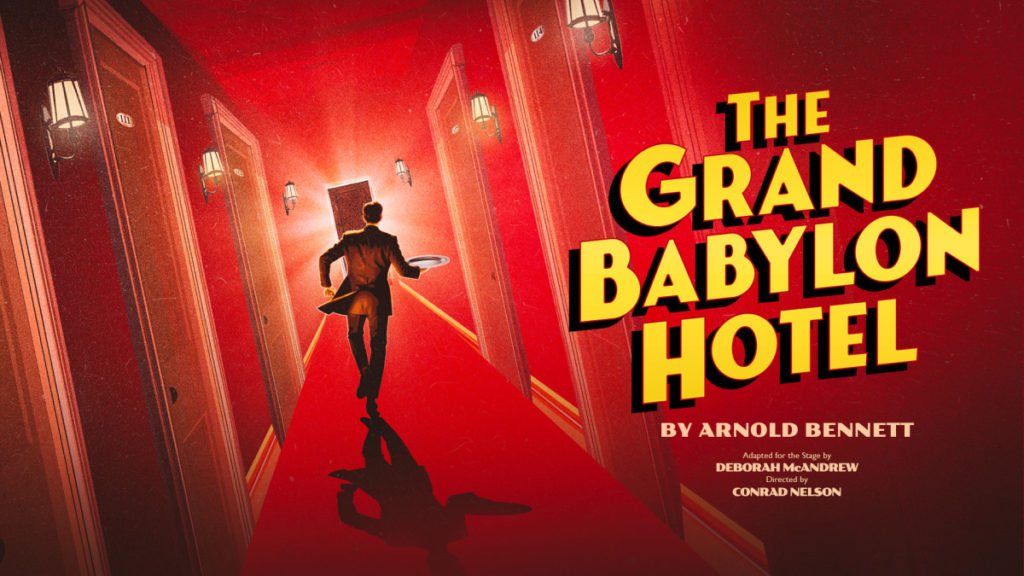
Claybody Theatre’s poster for The Grand Babylon Hotel
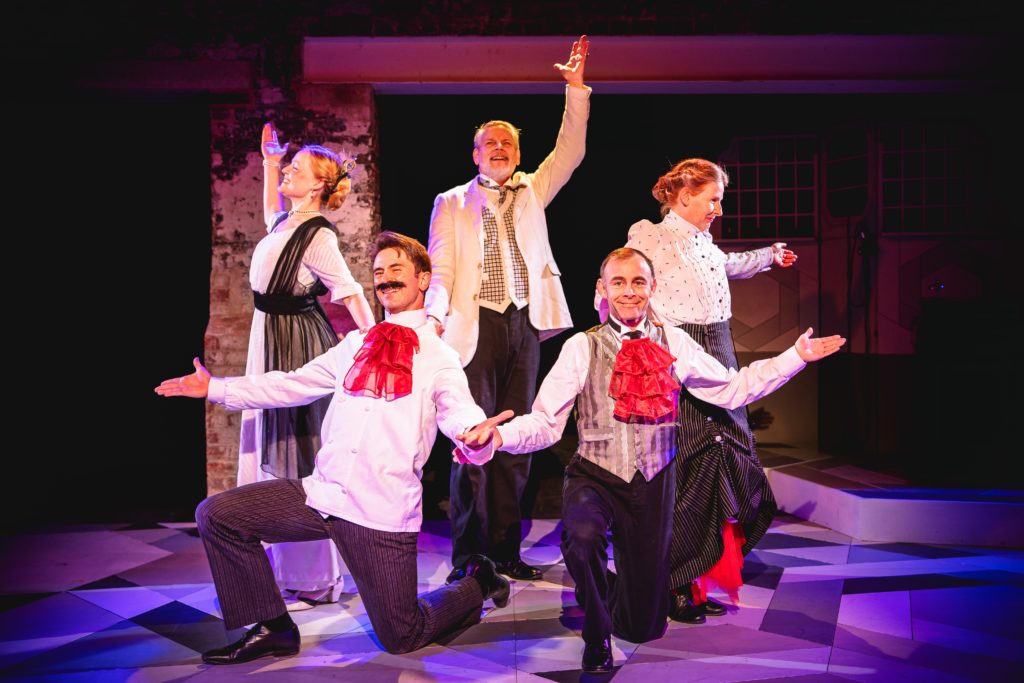
Alice Pryor, back row, left, Bill Champion, Shelley Atkinson, Thomas Cotran, front row, left, and Michael Hugo in Claybody Theatre’s The Grand Babylon Hotel. Picture: Andrew Billington
CLAYBODY Theatre are heading to Scarborough and Harrogate with Deborah McAndrew’s stage adaptation of Arnold Bennett’s 1902 rollicking comedy thriller The Grand Babylon Hotel.
The Stoke-on-Trent company’s co-artistic director Conrad Nelson directs Shelley Atkinson, Thomas Cotran, Michael Hugo, Alice Pryor and Bill Champion in Bennett’s tale of Nella Racksole discovering steak and beer are not on the Grand Babylon Hotel menu for her birthday treat, whereupon her American Railroad millionaire father obligingly buys the chef, the kitchen, the hotel.
However, Theodore Racksole soon finds more on his plate than a juicy steak, with kidnapping and murder for starters. Have Theodore and Nella bitten off more than they can chew?
Conrad left the artistic director’s role at Northern Broadsides in 2018, the same year that Deborah wrote her last play for the Halifax company. The couple headed off to the Potteries, establishing Claybody Theatre and forging links with the New Vic Theatre in Newcastle-under-Lyme, their partners for The Grand Babylon Hotel, whose tour arrives at the Stephen Joseph Theatre, Scarborough, tomorrow. Harrogate Theatre awaits from April 1 to 4.
Here director Conrad and writer Deborah discuss comedy styles, touring, Bennett’s stories and the need for silliness in 2026.
What inspired you to take your work on the road?
Conrad: “It’s a first for Claybody, but not for us as artists. It’s been an ambition for the company for some time, and of course we have a history of touring with previous companies.But also, we were heavily encouraged by fellow artists, artistic directors, theatres and other supporters who will often travel to Stoke-on-Trent to see us.”
Deborah: “When you’re adapting a piece, the material often invites a certain type of treatment. I always knew that this novel would respond best to a small cast, multi-rolling, narrative storytelling, hat swapping, comic playing…in the style of [Patrick Barlow’s] The 39 Steps. Therefore, it’s portable. One of the first things I said was: ‘I think this could tour’.”
Playwright Deborah McAndrew
How did this tour take shape, Deborah?
“We approached the New Vic and said, ‘Do you fancy making this show with us?’ and they said ‘yes’. So we did the show there in the autumn, and we acquired funding from Arts Council England for a short tour, with the plan being to run it at The Dipping House in Stoke and then take it on the road to Hull, Scarborough, Colchester and Harrogate.”
Why tour this 1902 Arnold Bennett story in Deborah’s adaption now?
Conrad: “It’s a great introduction for people who haven’t been to the theatre before or haven’t been for a while; it’s a popular piece of well-crafted, high-quality theatre, which will speak to pretty much anyone, and that’s what theatres are wanting and needing right now to fill their auditorium.”
Deborah: “It’s something that can be absolutely billed as a comedy. People want to be entertained, they want light relief, and it’s the job of those of us who work in the arts to bring relief, distraction and enjoyment. As well as to enlighten, expose and discuss.
“The scales too often weigh heavily on the worthy side of the work, and actually, we must remember the value of the arts in lifting people’s hearts, bringing them together with other human beings to have an experience which makes them more fortified to go out and tackle their lives and the world outside – which at the moment is full of uncertainty, anxiety, violence and concern.
“Going out there with a comedy is right for the times, right for the audience and absolutely right for what we need to do with Claybody right now.”
Stephen Joseph Theatre favourite Bill Champion in the role of Theodore Racksole. Picture: Andrew Billington
To those new to Claybody Theatre’s work, how would you describe the style of this show?
Conrad: “It’s billed as a ‘rollicking comedy thriller’, and we’d invite audiences to come with an open heart, an open mind, and just be ready to be entertained. Within the rollicking comedy, there is real quality; it’s accessible and it’s fun.
“It’s driven by the thing that audiences love most; creativity with actors. We’re making this work with a lot of love, and it’s for the audience, not for ourselves. That’s critical in the way that we make work; how is it going to be received? How is it going to charm, affect, cheer? Without the audience, we are nowhere.”
Deborah: “The characters are warm and likeable, even the dastardly villain is somebody you want to be in the room with. There’s a lovely warmth and charm about these actors that we’re working with as well. They’re people who you want to spend an evening with and have a laugh with.”
Which character did you enjoy writing most and why, Deborah?
“Well, I like funny voices! That’s probably the actor in me. Nanny Heidi is not in the book – I would say, her, because she’s brilliantly performed by Shelley Atkinson, who knows how to do that size of characterisation. And the very ridiculous Frenchman who’s on the boats, which was written by me, and Conrad and Mike Hugo just run with it.”
How would you describe Claybody Theatre’s connection with the audience, Conrad?
“The audience are the whole reason to exist, from the start of the writing into rehearsals, it is a participatory event, and it’s grounded in that. We keep that connection at the forefront of everything we do.
“Deborah had the idea that this show should be an actor–driven piece that would be ideal to tour. All the cast have a fantastic synergy with the audience, establishing that wonderful connection that makes people want to see them again. They are magical performers; it’s not every actor’s gift to be a communicator, but our cast are just really good at delivering the text. It’s a bit of a romp but done with such high quality.”
Thomas Cotran and Alice Pryor in The Grand Babylon Hotel. Picture: Andrew Billington
What draws you to Arnold Bennett’s writing, Deborah, having done Anna Of The Five Towns for the New Vic before the pandemic and The Card in 2022?
“He has brilliant female characters, I really love his women, they feel very real. He writes about characters that I want to spend time with.
“They’re a bit more caricatured in The Grand Babylon Hotel, because it’s a pot-boiler; he wrote it for pure entertainment in serial form. But when you get into his more literary works, like Anna Of The Five Towns, or The Old Wives Tale, you get these complex and interesting characters, particularly female characters.
“His stories respond very well to being transferred to the stage with all these great characters, and when we’re looking for stories to do with Claybody that are related to the Potteries, his work stands out.
“But also when we’ve been asked by our friends at Hull [Truck Theatre], Harrogate and Scarborough, ‘did we have anything we could take there’, it’s expensive to tour, but I thought Bennett’s storytelling would respond to a small cast.”
On tour, how does each theatre space shape the way you tell the story, Conrad?
“Well, the space does really tell the story. You come in, and you play the space that you’ve got. You look at the merits of the space and then play it.
“In the conversion to thrust, in-the-round in Scarborough, and then a traditional proscenium arch space like Harrogate, it doesn’t matter where you see it from, the stage has to feel deep, otherwise you get very flat performances.
Michael Hugo’s Ticket Collector in The Grand Babylon Hotel. Picture: Andrew Billington
“So you respond to the size and intimacy of space, and that’s also to do with the actors’ experience. When the actors come in on the morning, they have to convert their performance extremely quickly. It’s exciting, it gives it a bit of frisson!
“If you come and see it on the first night, you’ll get that lovely energy of actors figuring out what it sounds like. Because you can open your mouth in a different space and it sounds completely different; that’s part of the director’s job to make sure that you’re telling the actor truthfully how it plays.”
Why is it important to create shows that celebrate silliness these days?
Conrad: “I think that’s partly to do with what audiences respond to. You can do a really well crafted, difficult piece of theatre, and then somebody puts on a hat and does a f*rt gag and it gets the biggest response of the evening.
“So we like a bit of bonkers, a bit of eccentricity, you just have to look around on any high street and you will see it in spades. People are anything but dull and characterless. And given the right motivation, we all love a bit of nuts.”
Deborah: “Comedy has always been used as a tool of anarchy. We use comedy to undermine some of the power that people have; it’s being used as a weapon across the world right now, isn’t it? Comedy helps us get through dark times.
“The Grand Babylon Hotel is silly and easy to go with, and hopefully people who might be feeling a bit down, or don’t feel like coming out the theatre, will actually be glad they did. They might get their tank topped up a bit in terms of resilience because I think that’s what comedy can do for us.”
Shelley Atkinson’s Nanny Heidi: the character that Deborah McAndrew most enjoyed writing in her script for The Grand Babylon Hotel. Picture: Andrew Billington
How does the cast share out the parts in The Grand Babylon Hotel, Deborah?
“We have the two American central characters, Theodore and Nella, then three multi-rolling clowns playing everybody else, including the gang of villains. It feels very modern. Bennett was writing at the turn of the [20th] century, so it’s late-Victorian, but feels Edwardian, and we’ve lifted it to ten years later than that.
“Only two characters are American. They’re staying at the Grand Babylon Hotel in London, modelled on The Savoy – Bennett loved that hotel , and of course The Savoy has its famous Arnold Bennett Omelette [created for the novelist in 1929 with its combination of smoked haddock, Gruyère cheese and béchamel sauce].
“The characters are mostly English but there’s also a fake Russian, a Belgian too. I’ve had lots of fun with French, German and Italian characters where I’ve added the actual language, but done in a way that the audience will be able to understand.”
How would you sum up the reaction to the show so far?
Deborah: “What really tells you how they feel is the comments on our Facebook pages, where the response has been chock-full of people saying they’ve been laughing all the way through. Ninety-nine per cent have said they’ve really loved it, and felt they really needed a play like this time when the world is so full of anxieties. This show affirms our humanity, our connectedness, as we laugh together.
“We’re very proud of this show, taking great pleasure in listening to the audience, feeling the warmth in the room.”
Conrad: “That’s the key. As much as attention to detail is important in our work, we are making the show for our audience, not for ourselves. That’s why we still make theatre: that connection between the artist and the audience.”
Claybody Theatre, The Grand Babylon Hotel, Stephen Joseph Theatre, Scarborough, March 18 to 21,7.30pm plus 1.30pm Thursday and 2.30pm Saturday matinees; Harrogate Theatre, April 1 to 4, 7.30pm plus 2pm Saturday matinee. Box office: Scarborough, 01723 370541 or sjt.uk.com; Harrogate, 01423 502116 or harrogatetheatre.co.uk.
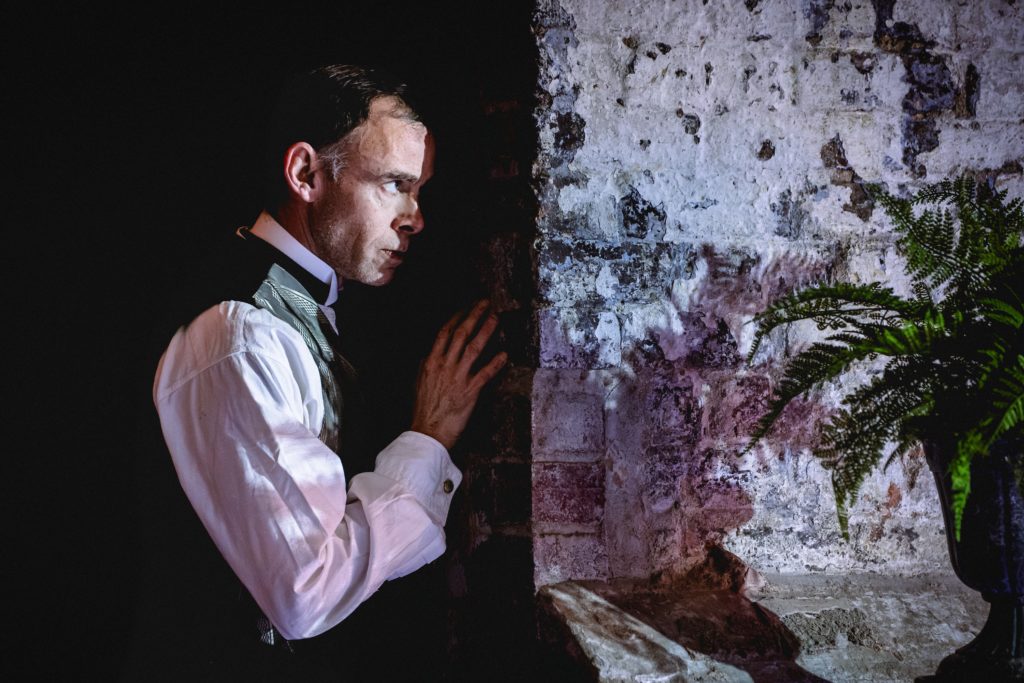
In the shadows: Michael Hugo in The Grand Babylon Hotel. Picture: Andrew Billington