
REVIEW: Margaret Atwood’s The Penelopiad, The Odyssey, Her Story, York Theatre Royal ***1/2

Amelia Bullmore’s Penelope, left, comes face to face with Charlie Russell’s returning Odysseus. Picture: Pamela Raith Photography

THE Penelopiad is the heavyweight centrepiece of York Theatre Royal’s autumn programme, Wednesday’s press night being marked by the presence of Arts Council England luminaries.

Creative director Juliet Forster’s plans to mount Canadian novelist Margaret Atwood’s re-spinning of Homer’s yarn in 2020 were scuppered by Covid’s clenches. Roll on to 2026, when Forster’s all-female production finds its counter-Homer home at last with the self-explanatory full title of The Penelopiad, The Odyssey: Her Story in the city where Actors Of Dionysus and Wright & Grainger’s Greek tragedies have made their mark.

Not only is The Penelopiad “her story” but “their story” too. After The Handmaid’s Tale, Atwood delivers a multitude of Maids here, Penelope’s hand-picked slaves’ daughters: wronged, vengeful and constantly meddling in Penelope’s wishes to re-tell her tale, post-death, in the Underworld.

The glacial Penelope may want to miss out chunks, just like Christopher Nolan’s film made no mention of Odysseus’s philandering ways in his 20-year avoidance of coming home from the Trojan Wars, but the Maids have other ideas, and they will do anything to re-route The Penelopiad’s journey, from child puppetry to a rather short tap dance, girl group singing to acrobatic aerial skills, macho masks to more macho masks.

Pena Iiyambo’s Helen goes full Marilyn Monroe in The Seven Year Itch mode with the masked Maids in Margaret Atwood’s The Penelopiad at York Theatre Royal. Picture:  Pamela Raith Photography

Riot Women actress Amelia Bullmore’s Penelope is still at the core, still an honourable figure of loyalty and  restraint, but the restless riot women of this piece, the Maids, keep breaking her poised rhythm, shattering her sang froid and melancholic air.

Nevertheless, especially in Bullmore’s honeyed tones and elegant white jumpsuit and coat, Penelope’s dry-witted putdowns are the embodiment of Atwood’s own irreverent humour, becoming a particular joy of her ice-queen performance. 

Her spat with Pena Iiyambo’s preening Helen, trollop of Troy, could launch a thousand quips, but one withering epithet suffices, although Iiyambo’s pulchritudinous Helen still has her Marilyn Monroe moment in screen goddess frills in the face of Penelope’s enmity.

Amelia Bullmore’s Penelope, surrounded by her Maids with their macho masks to portray aristo Suitors. Picture: Pamela Raith Photography

Atwood had been haunted by the fate of the Maids, under Odysseus’s orders, prompting the vengeance of The Penelopiad, where the horror counters the jesting humour that mocks Charlie Russell’s Odysseus for having short legs, much as Eric Morecambe would tease Ernie Wise.

Atwood’s Penelope comes across as “methinks she doth protest too much” with her First World problems, complaints of being busy without being so and eating only asphodel flowers in Hades, while using the Maids’ wiles to stave off the unwanted attentions of the Suitors, whereas the Maids are up against it, putting themselves at risk on her behalf.

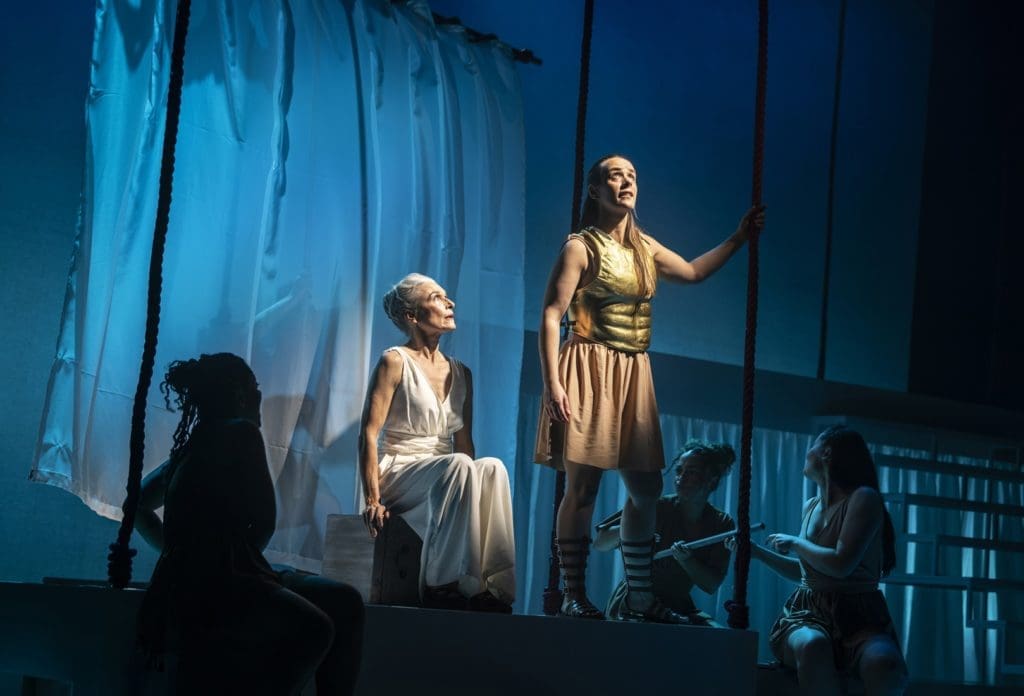
They do, however, find common ground when working together to weave and unpick Penelope’s tapestry to ward off those pesky Suitors. Ropes emerge as the motif that weave their way through Forster’s production and Sara Perks’s design, whether in the tapestry, the aerial circus skills of assorted Maids, pulling Penelope’s bed upwards or downwards, becoming a hissing snake or, spoiler alert, a hangman’s mode of execution.

Amelia Bullmore’s Penelope, right, in discussion on her bed with her Maids. Picture: Pamela Raith Photography

Bullmore’s Penelope has a stillness and depth of character that contrasts with the Catherine Wheel fizz of the octet of multi-rolling Maids, especially when they play the leery, lecherous aristo Suitors, very much 2D stereotypes. Having women taking these roles is a further way of Atwood taking revenge on Homer’s misogyny, all the more forceful for the choreography of Frantic Assembly’s Michelle Edwards.

These graphic caricatures climax in the form of Russell’s Odysseus, mocked by Atwood not only for short legs, but in no longer being a mighty physical specimen, full stop, but a mendacious trickster with dubious moral values.

The Maids (Iiyambo, Russell, Nell Baker, Danielle Bird, Olivia Burton-Laws, Faye Campbell, Kat Johns-Burke and Syakira Moeladi) achieve both individuality and collective vigour the more they come to the fore, while Bird stands out as Eurycleia, the Odysseus loyalist who besmirches the Maids and cuts Penelope out of nursing her son Telemachus.

The Maids displaying rope and aerial skills in The Penelopiad. Picture: Pamela Raith Photography

What are the plus points beyond Bullmore’s elegance with Atwood’s eloquence and the Maids’ zest? Perks’s design, described as chic by Bullmore in her interview, is startling, bright, white, modernist and minimalist, but timeless too, countered by Alexandra Stafford’s palette of colours in her lighting, most notably red to evoke the night of the Trojan Horse.

Edwards’s movement direction maximises the physicality of women playing men; Kate Marlais’s compositions, varying from rousing declamations to quieter underscoring and laments, are at their best when haunting.

The negatives? Whereas the humour in Bullmore’s Penelope is assured, polished and consistent in tone, elsewhere it is more erratic, uneven, sometimes pushing too hard. Given the harrowing denouement to come, it is a difficult balancing act for Forster to achieve, especially when comedy has a tendency to undermine tragedy and outrage, rape and execution. Ultimately, this account of The Penelopiad plays more to the head, the senses of sight and sound, than to the heart.

The Penelopiad, York Theatre Royal, unravelling the strands until October 31. Box office: 01904 623568 or yorktheatreroyal.co.uk.  
Amelia Bullmore’s Penelope and Charlie Russell’s Odysseus in The Penelopiad. Picture: Pamela Raith Photography

Imgine if Charlie Chaplin and Stan Laurel had formed a double act…cue Told By An Idiot letting their imagination run free

Danielle Bird’s Charlie Chaplin, front, being lifted by Jerone Marsh-Reid’s Stan Laurel in a scene from Charlie & Stan with fellow cast members Sara Alexander (Charlie’s Mum and show pianist) and Nick Haverson (Fred Karno and show drummer). Picture: Matt Crockett

CHARLIE Chaplin and Stan Laurel could have been the greatest comedy double act that nearly was, and now they are in Told By An Idiot’s fantasia Charlie & Stan.

On tour from February 7 to March 4 after playing the 47th London International Mime Festival in a run at Wilton’s Music Hall, writer-director Paul Hunter’s silent comedy visits York Theatre Royal from February 14 to 18 in a poignant celebration of two Englishmen who changed the world of comedy

First told by Told By An Idiot in 2019, then revived by producer David Pugh for social-distanced performances and a run outdoors at Cornwall’s Minack Theatre under pandemic restrictions, Hunter’s “trueish” piece of magical storytelling returns in 2023 with its intertwining of real-life events with a fantastical reimagining of Chaplin and Laurel’s two years spent touring together before either became famous.

“The initial starting point was a friend of the company bringing us the idea of telling the story of the then unknown Charlie and Stan setting sail for New York in 1910 as part of Fred Karno’s music hall troupe, sharing a cabin and travelling around North America for 18 months with Stan as Charlie’s understudy,” says Paul, whose revival kickstarts Told By An Idiot’s 30th anniversary year.

“Stan got homesick and came home; Charlie received his invitation to go to Hollywood and within five years became one of the most famous faces in the world.”

 To make Charlie & Stan, Paul created a detailed storyboard structure and then fleshed out the scenarios with the actors, just as with Chaplin would eschew a script in favour of thinking, “the only thing I want to do is make something in a particular place” and then work from there.

Told By An Idiot writer-director Paul Hunter

“I knew I didn’t want to have mime or be experimental or avant-garde, but just tell the story without words but with the help of props and a jazz piano score by Zoe Rahman [played live by Sara Alexander] in a very captivating 85 minutes straight through to mirror the length of Chaplin’s films such as The Gold Rush.”

Paul may “play fast and loose with the facts” in his non-verbal, highly physical show but he did investigate into why a partnership failed to materialise. “Chaplin never mentioned Laurel even once in his autobiography, whereas Stan talked about Charlie, about him being our greatest comedian, until his dying day,” he says.

“Maybe this was the greatest double act that never was, but Chaplin was never going to share the spotlight with anyone, after his horrendous childhood. Maybe he was also jealous of Laurel because he was so talented too. Like when Stan had to go out on stage on his own when Karno refused to increase Charlie’s pay – and there was Charlie, sitting watching him from the fourth row!

“Ultimately, Laurel found his soul mate in Oliver Hardy, whereas Chaplin was a complete one-off, not only an extraordinary performer but also there’s an argument to say he was one of the greatest film directors, working in the dark with new skills as filmmaking changed.”

Paul’s show is based on fact, but “we refer to it as a true fantasy, where setting sail for New York leads us into the world of imagination with flash-forwards to Stan bumping into his future comedy partner and Charlie’s Little Tramp character evolving,” he says.

“We made a very conscious decision that all scenes should be completely inventions of our own, rather than taken from any film – and I love how we’ve been able to hoodwink people into thinking they are movie scenes!”

Setting sail for America: Jerone Marsh-Reid’s Stan Laurel, left, and Danielle Bird’s Charlie Chaplin. Picture: Matt Crockett

Chaplin was 21, Laurel a little younger, when they headed to America. “It’s a big thing, particularly for our two performers, that we wanted to cast them close to the ages that Charlie and Stan would have been,” says Paul.

“Danielle Bird (Charlie) and Jerone Marsh-Reid (Stan), who did the last tour too, are both in their early 20s. If cinema is a palace of dreams, then theatre is its own world of make-believe, and that’s reflected in the casting.

“When I was absorbed in the world of Chaplin, I was fascinated by his movement: he could have been a ballet dancer. Nijinsky even asked him where he trained as a dancer, but he didn’t, but Charlie had this feminine grace, which opened it up to a woman playing the role.

“At times the audience just see Chaplin and forget Dani is a woman. Every night Chaplin has to get a woman out of the audience to swim – and I think it would be more difficult if a man were playing him. There would  be more reluctance to go on stage but they trust a woman and that allows us to go further.”

Likewise, when picking Jerone for Stan, Paul says: “He’s mixed race, from Stafford, and again I thought there’s no point finding someone who can do an impression of Stan Laurel, but they had to capture the spirit.

“He’s being played by an actor who never thought he’d even be seen for the chance to play Stan, but that’s the nature of theatre: a world of imagination, rather than filling in the gaps for the audience, which makes the audience feel smarter – and all our work loves to do that!”

Told By An Idiot in Charlie & Stan, York Theatre Royal, February 14 to 18, 7.30pm plus 2pm, Thursday and 2.30pm, Saturday matinees. Box office: 01904 623568 or yorktheatreroyal.co.uk.

Copyright of The Press, York

Creating a world of imgination: Told By An Idiot actors Jerone Marsh-Reid’s Stan Laurel, left, and Danielle Bird’s Charlie Chaplin in Paul Hunter’s “true fantasy” Charlie & Stan. Picture: Matt Crockett
Secret Link