
Julia Bisby’s Doll, left, and Rosy Rowley’s Jack Falstaff rehearsing Scott Bradley’s A Kingdom’s Jack’d. Picture: Scott Bradley
IOWA playwright Scott Bradley is in York for a month, working on the world premiere of “alternative history play” A Kingdom Jack’d with his fellow American, director Tempest Wisdom.
Together they are putting the ‘international’ into the York International Shakespeare Festival while putting the most English of cult figures in the spotlight in York company 1st Zanni Theatre’s production of his uproarious black comedy twist on Henry IV Part 1 at Merchant Adventurers’ Hall on Wednesday (29/4/2026) and Thursday at 7.30pm.
Tradition has it that Queen Elizabeth I was so delighted by the character of Sir John Falstaff in Henry IV, Part 1 and Part 2, she duly commanded Shakespeare to write a play showing the old rogue in love. Cue The Merry Wives Of Windsor.
Now, Bradley boldly, mischievously re-imagines an iconic moment in political and Shakespearean history: what if disgraced knight Jack Falstaff – played by York stage regular Rosy Rowley – somehow found his way on to the throne of England in 1399, instead of serious warrior-king Henry IV?
In a nutshell, here comes Shakespeare turned upside down, where brutal satire meets broad comedy, delivered in tightly wrought verse in an irreverent that play draws on the medieval world of Henry IV, the Elizabethan imagination that reshaped it and our own contemporary political absurdities.
“Stupid, lecherous, selfish but hilarious, Shakespeare’s most (in)famous clown must somehow fund the army, balance the budget and make foreign policy, between naps of course,” says Scott. “His government is drunk, his enemies are plotting, his allies are scheming, and even his girlfriend’s getting in on the action.
“Falstaff is king…but for how long, as chaos ensues with all these different factions clashing and backstabbing left, right and centre?”

A Kingdom Jack’d playwright Scott Bradley: Presenting his alternate history of kings, rebellion and political chaos inside one of York’s most historic buildings
He wrote an initial version in 2016 in response to the impact on the arts and beyond of Donald Trump’s first term as President of the United States, whereupon Tempest’s mother, Robyn Calhoun, first saw a Playwrights Workshop version in 2017, performed by theatre students at the University of Iowa, where Scott was a lecturer.
Now, with Trump exercising power so erratically in his second term, A Kingdom Jack’d emerges in full bloom in York, with a brisk running time of 45 minutes each half. “I initially contacted Scott asking if I could read the play and maybe bring a staged reading to the Shakespeare festival, and he gave me an incredible amount of licence – I could take it as far as I’d like!” recalls Tempest. “I can only hope I’ve deserved the immense amount of trust he’s put in me and the team.”
After studying theatre at the University of Chicago, Tempest pursued a Masters degree in theatre-making at the University of York, making their mark on the York theatre scene as the creator and host of the bi-monthly Bard at the Bar at Micklegate Social and directing York Shakespeare Project in The Two Gentlemen Of Verona in October 2024.
“I’ve worked on many devised shows before – processes where the writing happens in the rehearsal room and the decisions are largely made through group discovery and consensus, but this is my first time having a playwright in the room, making creative decisions in response to my direction and the cast’s choices,” says Tempest.
“I’ll admit, I was intimidated by the prospect, but it’s been really cool, and Scott is too kind of a person and too good of a collaborator to be intimidating. Of course, I’m not the one who has to re-memorise the script changes, so take that with a grain of salt!”

Staggering performance: Rosy Rowley’s bibulous Jack Falstaff – King “Jack” John II – during rehearsals at Southlands Methodist Church. Picture: Scott Bradley
Scott, who studied drama at the University of Hull in 1986, and later drag with Bloo Lips in London, has worked as an actor, director and producer in a career taking in New York, Chicago and Washington DC before returning to Iowa to teach on the Playwrights Workshop course.
“But in 2016, the election went the wrong way, the way we didn’t want, with Trump winning, and that was devastating,” he says. “I knew I wanted to respond to what was happening in the country, particularly being in the middle of Iowa, which is a red-meat, conservative world: the place I ran away from as a kid.
“I wanted to respond to this crazy, populist President, who was using his presidency to make him and his cronies rich, whereas now, in his second term, he’s just authoritarian.”
Scott was studying Shakespeare’s Henriad, his History plays, at the time. “I thought, what makes Falstaff so enjoyable, and made Trump so enjoyable, as buffoonish provocateurs, was that Falstaff was a crook with no real power and Trump was just a reality TV star.
“They are just these ridiculous guys, whose immorality makes them fun, because they have no power, but what happens when you put that funny buffoon, that funny drunk [Falstaff] in charge? He becomes really terrifying. Falstaff is still very funny, but it’s just that now he has the power to have people beheaded.
“It’s that idea of taking this buffoon, this foolish man, and suddenly he’s in charge of governing the country, when before that luckily there were a few that put up guard rails, but now he has none of that and he’s much more dangerous. But Falstaff is redeemable in that he’s a fictional character.”

Rosy Rowley’s Jack Falstaff in the poster for 1st Zanni Theatre’s premiere of A Kingdom Jack’d at York International Shakespeare Festival
The influence of Charles Ludlam and the Ridiculous Theatre Company in New York can be seen in the politics in Scott’s work. “He was a ‘smarty pants’ who mined pop culture and hooked into history and drag,” he says.
Hence, for A Kingdom Jack’d, you can read A Kingdom Trump’d into the play too. “There’s a bit of Trump in my Falstaff but also some of Boris Johnson too because of how he behaved in Covid, when everyone knew he lying but people loved him anyway,” says Rosy, whose birthday coincides with the opening performance.
“I first read the play about 18 months ago – and I never thought I’d be playing Falstaff as I thought I’d be auditioning for [Mistress] Quickly. As a woman of a certain age, it gets much harder to play leading parts, so to get the chance to play this odious man is amazing.
“I’ve played a lot of male roles, but with Falstaff, the danger lies in over-caricaturing him as a ‘bloke’, so I’m trying not to do that. There’s a vulnerability to Falstaff that you don’t see in Trump.”
Julia Bisby, who is travelling from Sheffield to play the smart London harlot Doll Tearsheet, says: “Because it’s a comedy, they’re exaggerated characters and it’s larger than life, with an emphasis on clowning and physicality.

“One of my favourite things about Doll is her abundance of insults,” says A Kingdom Jack’d actress Julia Bisby. Picture: Scott Bradley
“Doll uses her body as her way of making money, but it’s her brain, her mind, that stands out. She’s super-smart. Amid the greed of all these people fighting for the crown, Doll’s not chasing power, but she has the power, wanting to avoid bloodshed for the good of the country. One of my favourite things about her is her abundance of insults.”
Scott says: “One of the things that I was interested in – and I’m still interested in – is that it’s everyday people that can make a difference, can make changes, and that’s why I was interested in Doll being that figure, the one who has a sense of direction, a sense of morality, and wants a world that’s not craven.”
“But so do all the women [in the play],” says Rosy. “They are the ones who want to make changes…”
…”What happens when you’ve killed off all the men?” ponders Scott. “Perhaps we should give women the chance to have their voice – and the female characters get to do that in this play.”

An alarming moment for Rosy Rowley’s Jack and Julia Bisby’s Doll in A Kingdom Jack’d. Picture: Scott Bradley
He was delighted that Tempest wanted to stage the play with a professional cast and crew at the Shakespeare festival after doing an initial reading with Rosy. “I was all in for that,” he says. “What a great way to present this play, in York, in the Merchant Adventurers’ Hall, in English and Welsh voices that I imagine would have been the voices of that time – making sure we are saying the Welsh words right.
“Having first workshopped the play with young American actors, it’s just such a dream to have British actors of the age of the characters – though we have a couple of Americans in the cast too!”
Scott continues: “I was so thrilled when this production was proposed that I really wanted to be here to kick the tyres. I arrived at the very top of April, so I’ve been here for a month, after I’d done a new draft of the play, where I’d cut a lot of air out of it. I’ve been at most of the rehearsals and it’s been invaluable to hear it spoken.
“I was working on the play as a political satire, where Tempest wanted to pick it up and play with it with clowns. Now I’m really excited to see the play on stage and to see some of the other plays at the festival too.”
1st Zanni Theatre in A Kingdom Jack’d, Merchant Adventurers’ Hall, York, York International Shakespeare Festival, April 29 and 30, 7.30pm. Scott Bradley will conduct a post-show Q&A with Tempest Wisdom after each performance. Box office: yorkshakes.co.uk.

Tempest Wisdom
Q&A with A Kingdom Jack’d director and 1st Zanni Theatre founder Tempest Wisdom
What attracted you to directing this new play?
“The challenges and opportunities of this play are twofold: one is a question of comedy, and one is a question of history.
“Henry IV, Part I and Love’s Labour’s Lost are my two favourite Shakespeare plays, largely because they both break the generic mold. ‘Love’s’ is a bubbly comedy that ends with an uncomfortable injection of reality, and Henry IV is characterised by a profound tension between comedy and history, with Prince Hal as the fulcrum balancing the two.
“There’s the world of the court, dominated by King Henry, where the serious Shakespearean history business of state occurs: war, treasury, public relations, diplomacy.
“And then there’s the world of the Boar’s Head Inn, the trashy Eastcheap tavern where Falstaff reigns over the comedy side of things: elaborate wordplay, plays-within-plays, wine and women and song.
“Scott has taken that push-and-pull in the source material and dialled it up to 11. The script is clever, funny, a bit mean, and moves at a breakneck pace through a catalogue of jokes that range from pure blue humour to all-too-real barely-satire.
“So the first challenge, the comedy challenge, has been managing that tightrope walk: the cycle of warming up an audience to laughter, then bringing the humour around to a darker and darker tone until it’s difficult to laugh at…and then pushing it even further into the absurd, so we’re laughing again…and then starting the cycle all over.
“The history challenge: Picking this play apart is kind of like delving into a fossil record! Many of the characters in Henry IV, as in all of Shakespeare’s history plays, were real people, and so the first layer of ‘sediment’ we can draw from is their lived reality: the King Henry, Prince Hal, and Owain and Catrin Glyndŵr lived and breathed and died (and in the case of Harry Hotspur, their heads were occasionally mounted on Micklegate Bar!).
“They were also public figures, of course, and so the second and third layers of the fossil record are the public perception of them: the perceptions of their fellows and subjects – and how we understand them today.
“Then, naturally, there are the fictionalised, narrativised versions of them we get in Shakespeare’s plays and their various stagings and adaptations, which colour our understanding of the historical fact significantly (not as much as the case of Richard III, but that’s another story).
“Finally, there’s the script itself, Scott’s reworking of ALL of those prior layers, which brings a modern political filter and an entirely new context. So for myself and the actors, working through these semantic layers of history, narrative and cultural consciousness and using all that rich data (those beautiful fossils!) to construct something fresh and new and immediate has been so rewarding.”
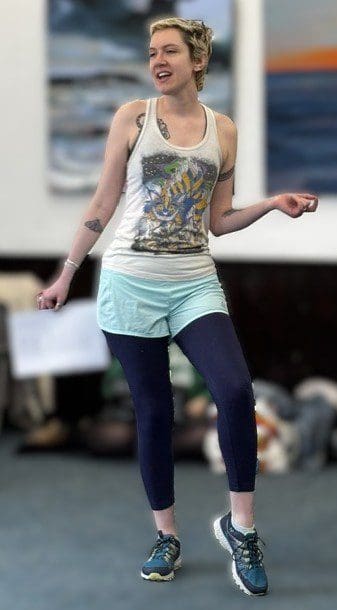
Tempest Wisdom in rehearsal for role as Moth in York Shakespeare Project’s Love’s Labour’s Lost earlier this month
How would you sum up Falstaff in Shakespeare’s plays and how does he contrast with Scott’s Jack Falstaff?
“I have a pet theory that all of Shakespeare’s clowns and fools fit on a spectrum ranging from Genuinely As Stupid As They Seem (Touchstone I don’t believe that man has any idea what’s going on at any point) to Not Even Bothering To Couch Their Opinions In Jokes Anymore (Lear’s Fool).
“Falstaff is unique among his motley peers because he slides up and down that spectrum scene by scene and play by play, even line by line. It puts him in a powerful position, because it makes him unpredictable. You can’t quite tell when he’s playing dumb.
“Scott has made Falstaff not only unpredictable, but dangerous. He now has institutional power on top of his pre-existing social power, and the thrill of watching the effects of that power unfold is hilarious and sickening in equal measure.”
How exciting is it to be premiering an American-written and directed play at York International Shakespeare Festival?
“This show might as well have been written specifically for the York International Shakespeare Festival. The purpose of the festival is to celebrate Shakespeare as ‘the world’s playwright’’, and so our focus is on bringing together culturally specific understandings of and responses to Shakespeare’s work.
“Scott’s play fits that bill to a T, having been born of a particular socio-political anger that I, as an American emigrant, share. (The first draft was written in 2016…a moment of upheaval on the American and global political stage, to put it lightly).
“I hope we’re able to convey some of the rage, despair, absurdity and hope driving this production, as well as getting a few laughs out of people!”
Tempest on founding 1st Zanni Theatre in York:
““It feels like the York theatre scene is having a reckoning. All across the city there are conversations happening: how can we help each other? What do we need to build in order to succeed together? It’s because of that supportiveness that I felt capable of committing to a career as an artist, and I want to build this company based on that same ethos.”

Julia Bisby rehearsing her role as Doll Tearsheet in A Kingdom Jack’d. She first worked with director Tempest Wisdom on Shakespeare Speakeasy play-in-a-day productions of Twelfth Night and Macbeth (re-spun as a comedy) at Theatre@41, Monkgate, York. Picture: Scott Bradley
Who is in the cast for A Kingdom Jack’d?
Rosy Rowley: King “Jack” John II
Julia Bisby: Doll Tearsheet. Performed in Shakespeare’s Speakeasy, York (Twelfth Night, Macbeth)
Oliver James Parkins: Henry “Hal” Bolingbroke. Bristol Old Vic Theatre School graduate
Effie Warboys: Lord Francis/Lady Catrin “Cat” Glendower
Stuart Green: Earl of Worcester/Earl of Northumberland
Jodie Foster: Lady Quickly/Owen Glendower
Liz Bailey: Sir Bardolph/Welsh Guard
Lainey Shaw: Lord Chief Justice/Henry Bolingbroke
Lou Dunn: Ned Poins/John Bolingbroke
Jimmy Johnson: Sir Pistol/Sir Walter Blunt. Performer with Deathly Dark Tours and Wetwang Hauntings
Katie Leckey: Sir Nym/Harry “Hotspur” Percy. Founder of York company Griffonage Theatre
Ro Trimble: Edmund Mortimer/Lady “Kate” Percy

Ro Trimble, Katie Leckey and Stuart Green in A Kingdom Jack’d. Picture: John Saunders
Who is in the production team?
Tempest Wisdom: Director, founder of 1st Zanni Theatre
Scott Bradley: Writer
Pearl Mollison: Stage manager/fight choreographer
Anna Gallon: Producer, from York company Four Wheel Drive Theatre
Grae Heidi-Brookes: Hand-made costume designer
Jai Rowley: Composer, as part of final-year placement at University of Huddersfield
Helena Kerkham: Assistant producer, joining project as part of 1ZT’s on-going work to develop and champion emerging local creative talent
Tia Thompson: Assistant director

Lou Dunn, left, Julia Bisby and Oliver James Parkins in A Kingdom Jack’d. Picture: John Saunders
Scott Bradley: back story
AWARD-WINNING Iowa-born theatre-maker, director, producer and writer, whose credits span New York, Chicago and Washington DC. Works include cult musicals Alien Queen, Carpenters Halloween and We Three Lizas and solo memoir Packing. Holds fellowships and residencies across the United States. A Kingdom Jack’d marks his first full-length UK production.
The impact of Merchant Adventurers’ Hall on A Kingdom Jack’d
MERCHANT Adventurers’ Hall amplifies the play’s resonances. Completed shortly before Henry Bolingbroke’s real-life ascent to the throne, the timber-framed hall is steeped in the same history A Kingdom Jack’d rewires so gleefully. Its vast oak beams, Great Hall proportions and centuries-old mercantile heritage provide a setting where Shakespearean rebellion feels strikingly at home.
The hall offers an inspiring backdrop, its deep historical roots – medieval, Tudor and contemporary – make it an ideal home for A Kingdom Jack’d’s layered world of kings, rebels and political chaos.
Producer Anna Gallon says: “The Hall is a treasure. Bringing new theatre into such a significant space feels like a natural next step in York’s cultural growth. This show plays with three different historical periods at once, and the building meets that challenge beautifully.”