Awake Awake author Fiona Mozley, centre, with Little Apple Bookshop proprietors Tim Curtis and Philippa Morris during her book-selling shift back on familiar book turf
FIONA Mozley returns to her York roots for her first novel in five years, Awake Awake.
Now living in Edinburgh, she headed back to her home city for a promotional day earlier this month, combining face-to-face interviews with a two-hour book-selling shift at Little Apple Bookshop, in High Petergate, where she worked behind the counter from 2016 to 2019.
“It was my favourite ever part-time job, and I’m still friends with Tim Curtis and Philippa Morris, who run it,” says Fiona, settling into a window seat at Waterstones, in Coney Street, where she would give a talk and sign books later that evening.
“Elmet sold 1,000 copies at Little Apple Bookshop alone and it remains their biggest ever-selling selling book.”
After rising to Booker Prize-shortlisted acclaim with that 2017 debut novel, set in Yorkshire, and following it up in 2021 with Hot Stew, set in a Soho brothel, Fiona roots her third novel almost entirely in the York of the 2000s, where her heroine Mary’s father works at York Minster.
“In a five-year period I wrote two and a half novels, and Awake Awake was the one that gained ground,” says Fiona. “Some writers have a ‘difficult second novel’, but mine was already on the way when Elmet came out, though I did ‘um and aarrgh’ because I had a number of ideas and was pursuing them all at once.
“Again, with this new novel, it started as a tandem project, which was that I’d always wanted to write a novel set in the early 2000s, following a bunch of teenagers negotiating those personal and political times.
“I was born in 1988, so in 2002-2003, I was 14-15, when my generation grew up thinking that everything was going to get better; that ‘history’ was over; that conflict had been eradicated; the economy would go from strength to strength and jobs were plentiful. How wrong we were.”
Fiona wanted to examine that moment of optimism and how the world came crashing down as 9/11 and the invasion of Iraq led to a “readjustment of the perception of where we were going”. She would do so through the eyes of teenagers “because they bring an insight and earnestness”, leading to activism and Stop The War marches.
“I decided to set it in a place outside the global capitals, so why not York, which made the perfect setting as I grew up here,” she says. “All my writing is rooted in long history and place – I studied History at King’s College, Cambridge – so the second strand I explored was an examination of the way we think about the past, in particular memories of the Second World War and memories of family histories.
“Awake Awake is very much fiction, but I wanted to think about the story of my grandfather, on my mother’s side, who was born in Leeds and was an officer in the Royal Amy Medical Corps.”
Her grandfather was from the Orthodox Jewish community, but hid it from his wife and his children, prompting Fiona to ponder how and why he did this.
Fiona toyed with the concept of writing in a “counter-fictional” mode – a narrative or thought process that opposes or subverts the established rules, traditions and tropes of a specific story, genre or fictional world. “I was interested in playing with the idea from Quentin Tarantino’s [2009 black comedy] Inglourious Basterds, which I thought went over the top, but I was keen to see how those ideas spoke to each other.”
In 2023, Fiona and her partner spent a month in Cambridge, Massachusetts. “While I was there, I wanted to read some big American novels, so I read some Philip Roth, who I absolutely love and absolutely hate, but he’s never boring,” she says.
“Reading his books gave me permission to go ‘wild’ in my writing, to not shy away from something that might be controversial. I was struck by how he mixed the personal with the political and the international. Reading him, although I’m a hugely different person and writer, it gave me the opportunity to push in that direction.”
Explaining its impact on Awake Awake, Fiona says: “People are often curious about the relationship between real and fictional, and my response is that I find myself unable to write things as I perceive them and write down events as they happen. I would be a terrible lawyer, an unreliable witness, because for me the process of writing is immediately creative and a new world emerges in the telling.
“I looked into this, and a lot of memory is constructed. It’s a creative act, so what I wanted to do was to exaggerate that. Put in the most stark terms, the [central] character is totally overcome by fictional memories – and the book is also about how our identities are totally informed by those memories.”
Awake Awake, by Fiona Mozley, is published in hardback, audio and ebook by John Murray Press.
The cover artwork for Fiona Mozley’s Awake Awake
Five talking points in Awake Awake
The war novel: How can contemporary novelists write about war?
2000s’ nostalgia and optimism: Anti-war movement of early 2000s was the backdrop to Fiona’s teenage years in York. How has that shaped how she and her generation think today?
Memory and mental illness: The novel’s heroine and her brother both suffer from mental ill-health as Fiona traces a “kind of intergenerational trauma”
Second World War: Fiona has Jewish heritage. Her maternal grandfather was from the Orthodox community in Leeds but hid it from his wife and children. How and why did he do so? Fiona brings family history into the novel to speculate on what might have happened to him.
Activism: Backdrop to the 2000s’ sections of the novel is the Stop The War movement and marches.
Author Fiona Mozley. Picture: Aleksandra Maciejewska
Fiona Mozley: back story
FIONA grew up in York, appearing in multiple theatrical productions before studying History at King’s College, Cambridge. Worked behind the counter at Little Apple Bookshop, in High Petergate, York, from 2016 to 2019.
Debut novel Elmet, published in August 2017 by JM Originals, was set in the claustrophobic rural West Riding of Yorkshire, exploring themes of family bonds, revenge, land rights, modern society and the ultimate price of freedom. Shortlisted for the 2017 Booker Prize, it was published in the USA in December 2017 and reissued in a JM Classics edition in 2025.
That year too, Elmet was adapted for the stage by Bradford-raised writer-director Javaad Alipoor for Bradford 2025 UK City of Culture, presented by the Javaad Alipoor Company at Loading Bay, with music by North Eastern folk luminaries The Unthanks & Adrian McNally and movement by Ad Infinitum’s Deb Pugh.
Playing like an ancient tragedy reflected in shards of memory, the world premiere ran from October 22 to November 2 2025 with its story of Cathy and Danny living apart from the world with towering bare-knuckle boxer Daddy, who has built them an idyll amid the trees on a land “made of myths”. However, a great reckoning is coming, led by all-powerful landowner Mr Price, threatening to smash apart everything the trio holds dear.
Second novel Hot Stew, published in 2021, was set in Soho, London, where sex workers Precious and Tabitha fight an eviction order from a real-estate heiress. Third novel Awake Awake was published in June 2026 by John Murray Press.
Fiona has won the Somerset Maugham Award and the Polari Prize and been shortlisted for the Booker Prize, the Ondaatje Prize and The Sunday Times Young Writer of the Year Award. She has been longlisted for the Dylan Thomas Prize and the Women’s Prize too.
She is a Fellow of the Royal Society of Literature.
Becky Unthank, left, Rachel Unthank and Niopha Keegan in harmony at All Saints Church, Pocklington. All pictures: Paul Rhodes
SHOWING no signs of slowing, this tour marks 20 years in showbusiness for the Unthanks. Mercifully, these North Easterners are the perfect antidote to the shallow and throwaway nature of much of what’s spun out for popular entertainment.
All Saints Church in Pocklington is an ideal intimate venue for them. All 200 seats sold out quickly, and the welcome and sound were both warm and inviting.
The Unthanks have been prolific, with a range of releases including lots of diversions to cover the works of others. It made for a really varied evening, with 19 tunes drawn from all corners of their repertoire.
The Unthanks’ musical director, Adrian McNally
The opening salvo of John Dead, On A Monday Morning and What Can A Song Do To You encapsulated this. The last of the three was a cover of Molly Drake’s home recordings (their last recorded diversion). Molly was the mother ofsinger-songwriter Nick Drake and an enormous musical influence on her son who took her inner journeys and piano tunings and made them darker, more abstract and universal.
With all its twists, the set was still steeped in the darkness that we have come to expect from the Unthanks. Their voices conjured a devastating account of The Trimdon Grange Explosion and it was a rare treat to hear Keen And Cry And Weep from the sisters’ musical score to the play Elmet (adapted and directed by Javaad Alipoor from York writer Fiona Mozley’s novel and performed at The Loading Bay, Bradford, as part of Bradford 2025 UK City of Culture).
The Unthanks are one of many, many folk groups, so why are they so beloved? It’s partly their natural North Eastern authenticity (not weakened a jot by adding London Irish Niopha Keegan, who sang and played fiddle).
The Unthanks’ set list for their November 22 concert at All Saints Church, Pocklington
There’s definitely their canny knack of choosing and arranging songs, and their sharp ears for a good story that can last. Most of all, however, it really comes down to the voices and our love of siblings harmony. Becky and Rachel really know how to make the most of what nature has given them.
The goose bump moments also happen when, rarely, all four sing together, bringing in musical director Adrian McNally’s voice at the low end. A grand example was King Of Rome, majestic in its new brass-less arrangement, which brought the second set to life after a less than diverting start.
Twenty years not out, and comparative striplings still, we can hopefully look forward to many more evenings in the Unthanks’ fine company.
The Unthanks performing under the lights at All Saints Church, Pocklington
Storm brewing:York Shakespeare Project cast members in rehearsal for Philip Parr’s production of The Tempest. Picture: John Saunders
YORK Shakespeare Project completes its mission to perform all 37 of Shakespeare’s plays inside 20 years with its first tour, staging The Tempest across North and East Yorkshire from tomorrow (Friday).
Once described by Professor Michael Dobson, Shakespeare Institute director at the University of Birmingham, as “the most ambitious amateur Shakespearean venture in the country”, the project has drawn 350 actors and 300 backstage crew since its debut with Richard III in 2002.
Parrabbola director Philip Parr, founding council member and chair of the European Shakespeare Festivals network and director of York International Shakespeare Festival, has the honour of overseeing YSP reaching its target with a company led by Paul French as Prospero, Effie Warboys as Miranda and Jacob Ward as Ferdinand.
“It’s the final fling, putting pressure on Philip and Paul,” says YSP chair Councillor Janet Looker, former Lord Mayor of York and a stalwart of the project since its inception in 2001.
“Certainly, it comes with issues of responsibility, not just for the production, but for the whole project,” says Philip. “I don’t think you can divorce the play from the event, or the nature of that event, the final production, so there’s a responsibility to those who first thought of doing it 20 years to bring it to a conclusion that feels right.
Lara Stafford’s Gonzala in rehearsal. Remember her Rosalind in As You Like It in the Residence Garden, York Minster, in July 2008 when she was Lara Pattison?
“It’s been impossible not to plan this production without thinking about the context of it being the end of this remarkable mission. We’ve been able to recruit a cast full of people who have performed in different YSP productions across the years, along with some who are performing with YSP for the first time.”
Fiona Mozley, 2017 Man Booker Prize-nominated author of Elmet, Hot Stew and Soho (AdN) had hoped to re-join the YSP ranks for The Tempest but is no longer able to add to her teenage performances in The Taming Of The Shrew and Love’s Labours Lost.
Bringing the stormy play’s island setting and disrupted world to life through communal storytelling in a new interpretation that highlights colonisation, reconciliation and change, The Tempest is an ideal grand finale, argues Philip.
“Shakespeare’s last play deals with many themes that are relevant both to this moment for YSP, but also ones that our society continues to grapple with today: disconnection, corruption, reconciliation and the difficulty of generational change,” he says.
“I’m excited about the way we’re approaching telling this story, using the performing collective to create the island and the ‘magic’ that permeates it, and using the musical skills of many of the performers to ensure the ‘isle is full of noises’.
““Creating a sense of place in the audience’s mind is even more important in this play, because so much of it is storytelling, narration. There’s very little theatre in terms of dramatic events. People just talk a lot and you have to frame that up.”
Effie Warboys’ Miranda makes her point to Paul French’s Prospero in rehearsals for The Tempest. Picture: John Saunders
The YSP committee had taken the decision to undertake a tour as the finale long before Philip was involved. “Originally, we’d always intended to do the last week at York Theatre Royal but the finances got too complex, so it was suggested, ‘well, let’s do something completely different’: a tour. Being at the Theatre Royal on the last night will be the icing on the cake,” says Janet.
“Doing this tour is an example of how YSP has never sat still but has always looked at new ways of doing things, taking on new challenges dynamically.”
Philip adds: “It has a sense of reward for the project to finish at York Theatre Royal and to end with these eight performances, seven on the road, at six venues, concluding back in York. That’s more performances than many productions get; a two-week run with a big cast to present it.
“It’s a big commitment to make and it’s a tour that comes with different demands: some venues have stage exits, some don’t; some have lighting, some don’t, so we’ll be taking a small lighting rig to illuminate the stage.
“I haven’t been to all the venues. I’ve been to some, had video tours of some, but that’s not unusual for a tour. We’ve created a set that’s not difficult to grapple with too, fitting easily into each venue.”
York Shakespeare Project’s banner image for The Tempest
The cast will feature no fewer than 17 Ariel spirits, “The Ariel Collective” as they will be known. “You want to do a celebratory production, so I had a rule that said, ‘if you have been in a YSP production, you have the right to be Ariel’, and it’s been nice that so many people have come out of the woods!” says Philip.
Twenty years of YSP leads to this finale, a play that reflects on ageing, politics and leadership, acquiring knowledge, and the power of magic to transform. “The more experiences you bring into it, the more you see in the conversations about human nature and the chance the play gives to all the characters to go back to where they were but with new knowledge, just as we’d like to be able to go back 20 years but with the knowledge acquired in those years.
“The Tempest might have been Shakespeare wishing that too, and now it’s a treat to find that across all the characters. Because Shakespeare has learnt it all, he can do it all in this play at a time when everyone believed in magic.
“Part of what I was looking at was, if you don’t believe in magic, who is Ariel? By having so many Ariels, Ariel can be in anything that is there. They can make things happen, but in a natural way.”
Janet adds: “Having so many Ariels means they can project from all around the stage because is Ariel is never in only one place.”
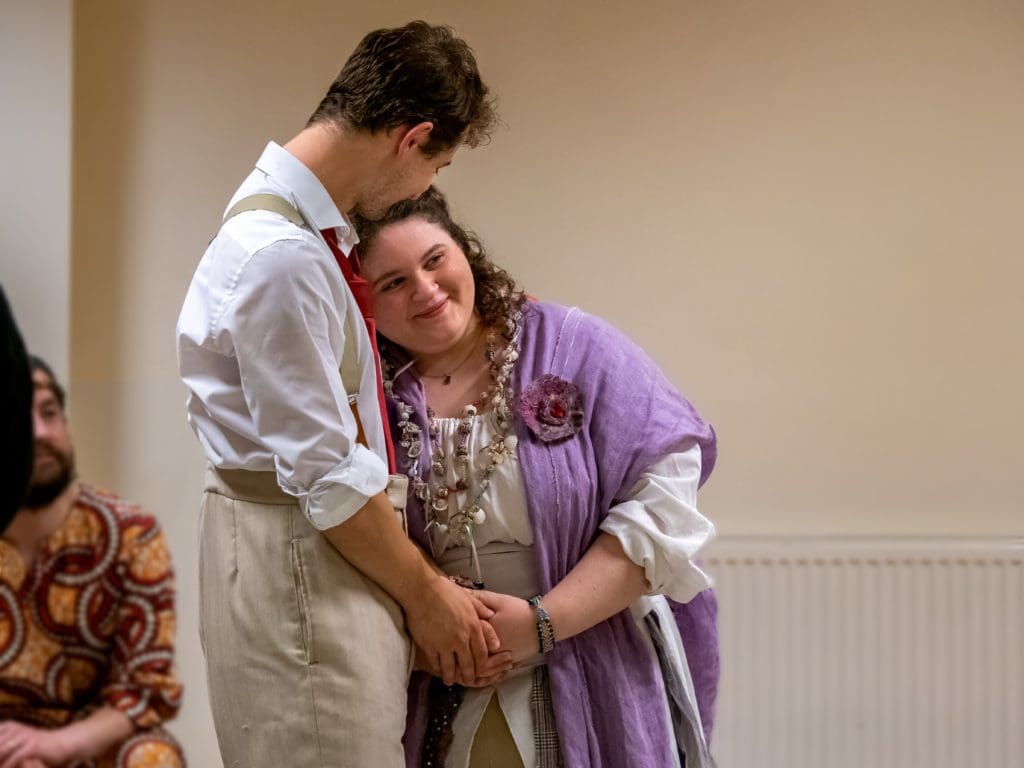
Jacob Ward’s Ferdinand and Effie Warboys’ Miranda in a scene from York Shakespeare Project’s The Tempest. Dress rehearsal picture: John Saunders
Philip rejoins: “With so many voices, you have a spectrum from high soprano to low bass, and how Ariel speaks depends on Prospero’s tone. Then, if they want to tell him off, a lower voice will be used. Prospero has to learn that ruling is about husbanding your resources.”
Philip could not have been more thorough in his preparations for staging The Tempest. “I’ve seen 15 productions this year,” he says. “Three in Poland at the last Shakespeare festival there, which was all about The Tempest. Two in Rumania, one in Italy. A couple here, and more! I had to stop in the end, but every one of them has been an influence.
“You take ideas from past productions, then come up with a thousand ideas and throw 999 of them away.”
Janet says: “The actors then have to take it over and you can’t stop them at that point.” Philip agrees: “That ownership is important because you have to make a choice and then everyone needs to go with that decision. At each performance, that decision is inspired by all sorts of things: the audience, the space, the mood of the night, the actors.”
Twenty years, 37 plays in 35 productions, the mission is complete. Appropriately, the last word goes to Janet, the chair: “It’s difficult to believe that it’s been 20 years since our very first production. We thought we were being rather ambitious when we started – would we really be able to keep this going for 20 years? And we weren’t always sure we’d get there, especially with the events of the past two years.
The Ariel Collective confronting Stuart Lindsay’s Sebastian in the dress rehearsal at Thorganby Village Hall. Picture: John Saunders
“But the commitment of the many supporters who have participated in our productions over the years has seen us reach this last play. We always knew we wanted to finish with something special, and this tour and a finale at York Theatre Royal will be an exciting and unique experience for all the actors and crew, and will give us a chance to share not just the story of The Tempest, but the community ethos of York Shakespeare Project, with a much wider audience. It is a very fitting way to mark the end of this journey.”
The celebratory party the next day (October 2) will be well deserved.
York Shakespeare Project presents The Tempest on tour at Thorganby Village Hall tomorrow (23/9/2022), 7.30pm; Strensall and Towthorpe Village Hall, Saturday, 2.30, 7.30pm; Helmsley Arts Centre, September 27, 7.30pm; Selby Town Hall, September 28, 7.30pm; The Junction, Goole, September 29; Acomb Parish Church Hall, September 30, 7.30pm and York Theatre Royal, October 1, 7.30pm. Box office: yorkshakespeareproject.org and venue box offices; York, 01904 623568 or yorktheatreroyal.co.uk.
York Shakespeare Project’s plot summary for The Tempest:
PROSPERO uses magic to conjure a storm and torment the survivors of a shipwreck, including the King of Naples and Prospero’s treacherous sister, Antonia. The embittered Caliban plots to rid himself of Prospero but is thwarted by the spirit Ariel.
The King’s young son Ferdinand, thought to be dead, falls in love with Prospero’s daughter Miranda. Their celebrations are cut short when Prospero confronts his sister and reveals his identity as the usurped Duke of Milan.
The cast comprises:
David Denbigh; Sonia Di Lorenzo; Jodie Fletcher; Nell Frampton; Paul French; Tony Froud; Emily Hansen; David Harrison; Bronte Hobson; Judith Ireland; Andrew Isherwood; Tom Jennings; Nick Jones; Stuart Lindsay; Michael Maybridge; Sally Maybridge; Sally Mitcham; Andrea Mitchell; Tim Olive-Besley; Megan Ollerhead; Tracy Rea; Eleanor Royse; Emma Scott; Julie Speedie; Lara Stafford; Harry Summers, Effie Warboys and Jacob Ward.
Production team:
Director, Philip Parr; assistant director, Terry Ram; stage managers, Janice Newton and David Harrison; musical director, Nick Jones.
History in the making as York Shakespeare Project completes mission to perform all 37 plays with plans to start all over again!
How it all began: John White’s production of Richard III at Joseph Rowntree Theatre, York, in 2002. Picture: Jeremy Muldowney
YORK Shakespeare Project’s tour of The Tempest will complete “the most ambitious amateur Shakespearean venture in the country”.
Such is the judgement of Professor Michael Dobson, Shakespeare Institute director at the University of Birmingham, describing the mission to perform all 37 of Shakespeare’s plays inside 20 years.
York Shakespeare Project (YSP) was formed in 2002 by a group of actors seeking to replace the challenge and excitement of taking part in the York Minster Millennium Mystery Plays in 2000.
Alan Lyons, an early chair of the project, described its origins in the programme for YSP’s first play, Richard III, staged at the Joseph Rowntree Theatre from October 30 to November 2 2002. “There I was, sitting with Frank Brogan as he dreamt up the idea of the York Shakespeare Project. ‘It won’t work,’ I said. An hour later I changed my mind.
“Maybe I was captivated by the idea. Maybe it was Frank’s persuasive tongue. I am still not sure why. This show [Richard III] is the result of hard work and effort put in by a great number of people since Frank had his original idea.”
After a few years away, Frank Brogan is once more a member of the YSP committee that oversees the project. “In the early days, it was said that the actor who would play Miranda in our concluding production of The Tempest had yet to be born”, Frank recalls.
It almost worked out that way. University student Effie Warboys was not even three months old at the time of Richard III’s opening night in 2002. Now she has been cast by director Philip Parr as Miranda in a tour that adds up to eight performances, seven on the road, at six venues, climaxing at York Theatre Royal on October 1.
Janet Looker, YSP chair and former Lord Mayor of York, has seen every YSP play. “There have been so many memorable productions”, she says. “For 20 years, York Shakespeare Project has frequently surprised and delighted me with the wide variety of performances put on under its banner.
York Shakespeare Project’s 2019 production of Cymbeline. Picture: John Saunders
“So many highlights! A memorable Romeo And Juliet, set in the Fifties’ street gang culture with an amazing female Mercutio [Cecily Boys]: a bravura performance!
“As You Like It in the shade of York Minster, an outdoor production that used the trees and landscaping of the Minster garden to brilliant effect in creating the Forest of Arden – and a Rosalind [Lara Pattison] and Orlando [Toby Gordon] who were probably genuinely as young as the original concept.
“A funny, but moving outdoor production of Much Ado about Nothing, set in the immediate post-war era of the 1940s with Land Girls and ARP wardens and brilliantly evocative use of contemporary music.”
More highlights, Janet? “Hamlet in an old church with ghost and eavesdroppers appearing from behind gloomy pillars, and the background of a dim church around us.
“Henry VI – in two parts – in York’s Guildhall, a building older than the play, but less than a mile from the very gate where the Duke of York’s head was placed: “that York may overlook the stones of York”.
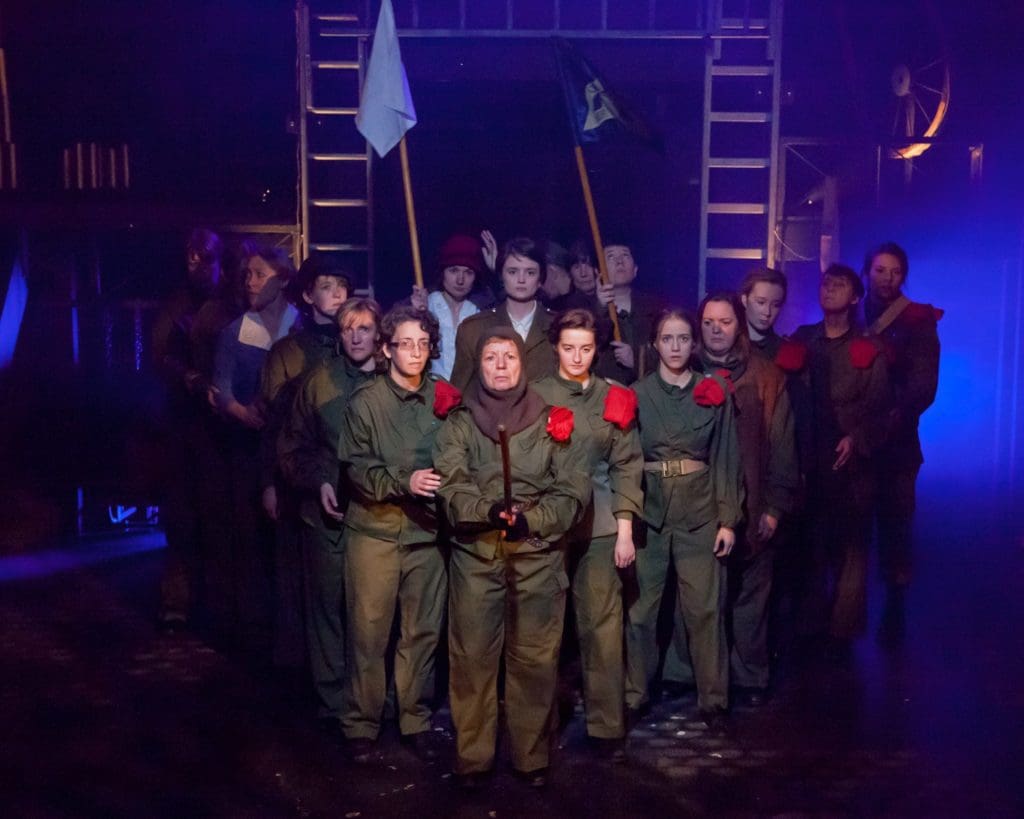
“A stunning all-women cast for Henry V, which was set during the First World War and movingly married the France through which Henry marched, with the trenches in Flanders Field. As an added bonus, one night it was acted on St Crispin’s Day, giving an added shiver to the famous speech.
“Henry VIII, set in King’s Manor, the house where Henry himself stayed when he visited the city, again adding an extra frisson.
“So many memories, and I look forward to adding The Tempest, our last production, to that list. Thank you a hundred times to YSP for giving one Shakespeare fan so much pleasure over the project.”
Toby Gordon: Progressed from York Shakespeare Project minor roles to playing the Devil in the 2016 York Mystery Plays at York Minster. Picture: T Figgins
Since 2002, more than 350 performers have taken part in the plays, aided by 300 backstage crew. Some have appeared only once, but one, retired lecturer Nick Jones, has made as many as 12 appearances. “The project was always a crazy but wonderful idea,” he says. “When I returned to York in 2010, it was already 15 plays in, so of course I couldn’t resist getting involved.
“It was never obvious that we would survive but here we are, approaching our last play, in which I’ve got a small part and am arranging the music. It’s been a unique experience.”
In the desire to avoid a clique, no company of regulars was ever established. Every play has started with genuinely open auditions, with each of the 24 directors being granted total discretion over casting.
YSP has been the stepping stone for many a York actor to move onto greater things. Toby Gordon progressed from minor parts in the 2007 production of Henry VI and a volatile Hotspur in the 2010 Henry IV to star as the Devil in the 2016 York Mystery Plays at York Minster.
He will be playing Joey in the final London run of The Guild of Misrule’s immersive staging of The Great Gatsby, produced by Immersive Everywhere at Gatsby’s Mansion within Immersive/LDN, in Mayfair, until January 7 2023.
Charlotte Wood, who played Cordelia in King Lear in 2016, will take the title role in Cinderella, this winter’s pantomime at the Lighthouse Theatre in Poole.
After appearing for YSP in Maggie Smales’s Henry V in 2015 and Madeleine O’Reilly’s Coriolanus in 2018, Claire Morley is completing her hattrick of all-female Shakespeare productions inChris Connaughton’s three-hander version of Macbeth for Northumberland Theatre Company, whose tour visits Pocklington Arts Centre on September 29.
Mediaevalist and 2017 Man Booker Prize-nominated authorFiona Mozley cites her appearances in YSP productions not only as an essential formative influence on her writing but as fun: “Aged 15, I was cast as Biondello in YSP’s second production, The Taming Of The Shrew. I had a great time and have fond memories of the rehearsals and performances,” says the writer of Elmet, Hot Stew and Soho (AdN) .
Claire Morley, centre, as Henry V in Maggie Smales’s all-female Henry V. Picture: Michael Oakes
“Early exposure to the arts is gold. We all know that the books we read as teenagers stay with us for life, and this is doubly true of acting in plays. I can vividly remember whole passages of the text and regularly think about the complex ideas Shakespeare was teasing out. I learnt a huge amount from my participation in YSP, not only The Taming Of The Shrew but also Love’s Labours Lost, and carry it with me in my own writing.”
Fiona had hoped to re-join the YSP ranks as part of the Collective Ariel (18 actors in total), returning to the boards alongside her father Harold Mozley, who has been an active member of YSP for the past 20 years, but now neither Fiona, nor Harold, is able to do so.
Janet Looker looks back with pride and forward with optimism. “I’ll be passing on the baton to a new chair and a revitalised committee, which will take the project forward. Plans are in place. It’s not in our nature to sit on our laurels.
“The project will continue and intends to perform all of Shakespeare’s plays all over again, this time alongside the best of his contemporaries, and maybe some of the modern takes on the plays too. That might take a little longer. Maybe a 25- year project this time.
“This is the end of York Shakespeare Project One, completed with the odd slippage, given the impact of Covid, but there’s a very strong desire to take the project onwards with YSP Two. We have a very committed committee wanting to take on the next step.
“Some of us will bow out, but YSP Two will find its feet; the challenge is to keep driving it forward. We’ve never had a consistent committee, we’ve always had different people coming on board, but there’s always been a core vision. I look forward to supporting YSP, and particularly the younger faces very keen to give it new momentum.”
York Shakespeare Company’s productions
Richard III, Joseph Rowntree Theatre, York, October 30 to November 2 2002. Director: John White
The Taming Of The Shrew, Pocklington Arts Centre, June 13 and 14; Joseph Rowntree Theatre, York, June 17 to 21 2003. Director: Paul Toy
The Comedy Of Errors, Friargate Theatre, York, December 3 to 6 2003. Director: Chris Rawson
Titus Andronicus, Joseph Rowntree Theatre, York, April 21 to 24 2004. Director: Paul Toy
Peter Watts’s Hamlet in John Topping’s 2013 production. Picture: John Saunders
Love’s Labours Lost, Friargate Theatre, York, December 1 to 11 2004. Director: Chris Rawson
Romeo And Juliet, Rowntree Park, York, July 13 to 24 2005. Director: Sarah Punshon
Two Gentlemen Of Verona, Friargate Theatre, York, November 29 to December 3 2005. Director: Ali Borthwick
A Midsummer Night’s Dream, Rowntree Park, York, July 19 to 30 2006. Director: Mark France
King John, Friargate Theatre, December 5 to 9 2006. Director: Jeremy Muldowney
Henry VI, Parts 1, 2 & 3, produced in two parts, York Guildhall, July 12 to 22 2007. Director: Mark France
As You Like It, Residence Garden, York Minster, July 16 to 27 2008. Director: Roger Calvert
The Merchant Of Venice, Studio Theatre, 41 Monkgate, York, November 12 to 22 2008. Director: Cecily Boys
Julius Caesar, Studio Theatre, 41 Monkgate, York, June 10 to 20 2009. Director: Mark Smith
Richard II, Studio Theatre, 41 Monkgate, York, November 17 to 21 2009. Director: Hugh Allinson
Henry IV, Parts 1 and 2, Church of St Martin-cum-Gregory, Micklegate, York, July 29 to August 15 2010. Director: Tom Cooper
Much Ado About Nothing, Rowntree Park, York, June 29 to July 9 2011; The Dell, Stratford-upon-Avon, July 16 2011. Director: Paul Taylor-Mills
Troilus And Cressida, Upstage Centre Youth Theatre, 41 Monkgate, York, November 15 to 19 2011. Director: Paul Toy
The Merry Wives Of Windsor, Rowntree Park, York, June 25 to June 27, May 30 to Diamond Jubilee Tuesday, June 5 2012. Three performances rained off. The Dell, Stratford-upon-Avon, June 10 2012. Director: Tom Straszewski
Paul French’s Lear and Charlotte Wood’s Cordelia in Ben Prusiner’s King Lear in 2016. Picture John Saunders
Othello, York Theatre Royal Studio, October 23 to 27 2012. Director: Mark France
Hamlet, St Martin-cum-Gregory Church, Micklegate, York, July 18 to August 3 2013; The Dell, Stratford-upon-Avon, August 11 2013. Director: John Topping
Measure For Measure, Friargate Theatre, York, December 5 to 8 2013. Director: Matt Simpson
Twelfth Night, York Theatre Royal Studio, April 3 to 12 2014; The Dell, Stratford-upon-Avon, June 7 2014. Director: Mark Smith
All’s Well That Ends Well, Friargate Theatre, York, November 27 to 30 2014. Director: Maurice Crichton
Timon Of Athens, De Grey Rooms Ballroom, York, May 14 to 17 2015. Director: Ruby Clarke
Henry V, Upstage Centre Youth Theatre, 41 Monkgate, York, October 21 to 31 2015. Director Maggie Smales
Pericles, Prince Of Tyre, Upstage Centre Youth Theatre, 41 Monkgate, York, April 19 to 23 2016. Director: Sophie Paterson
King Lear, Upstage Centre Youth Theatre, 41 Monkgate, York, November 30 to December 10 2016. Director: Ben Prusiner
Henry VIII, King’s Manor, Exhibition Square, York, March 30 to April 1 2017. Director: Ben Prusiner
The Winter’s Tale, John Cooper Studio@41 Monkgate, York, October 24 to 28 2017. Director: Natalie Quatermass
The Two Noble Kinsmen, by John Fletcher and William Shakespeare, De Grey Rooms Ballroom, York, May 2 to 5 2018. Director: Tom Straszewski
Coriolanus, Friargate Theatre, York, November 28 to December 1 2018. Director: Madeleine O’Reilly
Cymbeline, Merchant Taylors’ Hall, Aldwark, York, March 1 to 3 2019. Director: Ben Prusiner
Antony & Cleopatra, John Cooper Studio, 41 Monkgate, York, October 28 to November 2 2019. Director: Leo Doulton
Macbeth, Theatre@41, Monkgate, York, October 26 to 30 2021. Director: Leo Doulton
The Tempest, on tour, September 23 to October 1 2022. Director: Philip Parr
Did you know?
YORK Shakespeare Project’s tour of The Tempest is being accompanied by a retrospective exhibition in celebration of 20 years of YSP productions, running in the York Theatre Royal foyer until October 1. Admission is free.