Dominic Goodwin recalls variety’s golden days in solo comedy show Twice Nightly on tour in Helmsley, Richmond and York

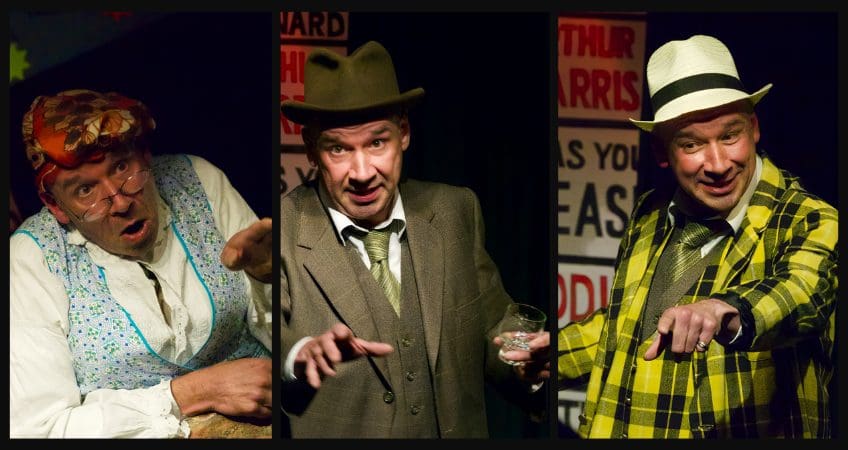
Dominic Goodwin in a triptych of variety guises in Twice Nightly

DOMINIC Goodwin, one-time manager of Helmsley Arts Centre, pantomime dame and actor, returns to his old stamping ground with his first one-man comedy show in a celebration of the glory days of variety on Friday and Saturday.

Written and performed by Goodwin and directed by York director and actor Thomas Frere, Twice Nightly follows the story of struggling comedian Freddie Francis in 1956 as the final curtain hovers over variety.

Many acts of the time are highlighted, including Norman “Over The Garden Wall” Evans (said to be an influence on Les Dawson), Stockton comic Jimmy James, wartime star Robb Wilton and the iconic Max Miller.

“It’s been an honour to perform these stars’ material, and even more so to have the backing of the families,” says Dominic, who will be on tour until July 25, including further North Yorkshire performances at the Georgian Theatre Royal, Richmond, on July 10 and 11 and Friargate Theatre, York, on July 17 and 18.

Dominic Goodwin at his most colourful in Twice Nightly

Here Dominic discusses Twice Nightly, variety’s golden age and going solo with CharlesHutchPress.


Introduce the show, Dominic…

“Freddie Francis has been a second spot comic for 30 years, touring the country on every variety bill going. We find him in 1956 recalling his life spent touring the halls; the ups, the downs, the riotous, the fantastic and the downright silly!

“He recalls his days entertaining the troops during the Second World War, playing at the infamous Glasgow Empire, and we discover what really happened when a speciality act lost her snake on stage!!

“Ultimately Twice Nightly is a fading memory of the variety stage. The death of something that has been part of everyone’s life for decades is now on the decline. Where will Freddie go when he finishes this tour? Who will he go back to, and ultimately who really cares?”

What are your own memories of the golden era of variety? Did you see any of the icons on stage?
“Oh how I wish I had! I’ve only ever seen them in YouTube clips. The sheer diversity of the acts on offer was extraordinary. From singers to comics, contortionists to animal acts like Rumba the man-eating lion! And even a guy who would walk on stage with a live bull!”

Who are your variety heroes?
“It would have to be Jimmy James – he of the “box routine” fame – and Norman Evans. Norman was the forerunner of Les Dawson and Roy Barraclough with their Ada & Cissie act. Norman did his ‘over the garden wall’ sketches with his character of Fanny Fairbottom. Very funny sketches and at the time there was nothing like it.

“I suppose the ultimate variety star would be Max Miller. He had the longest stage life and was top of the bill for longer.”

What has been the gestation of Twice Nightly from idea to stage?
“I originally wrote it in 2015 and performed in Scotland with a cast of eight, when [Easingwold actor, songwriter and magician] Phil Grainger was in it, but the intention was always to do it as a one-man play.”
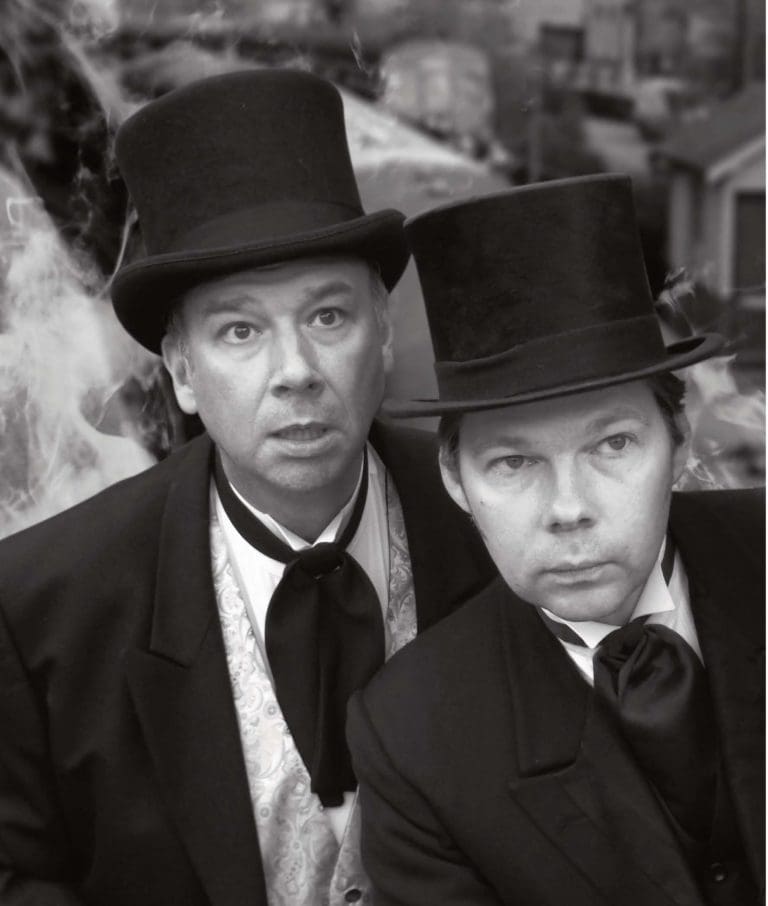
Dominic Goodwin’s Dr Watson, left, and Julian Finnegan’s Sherlock Holmes in Kirkbymoorside company Pyramus and Thisbe Productions’ 2021 revival of Stuart Fortey’s two-hander Holmes And Watson: The Farewell Tour

What was the attraction of performing a solo show when we have often seen you in double acts previously?
“My friends at The Swallow [Scotland’s smallest theatre at Ravenstone, Whithorn, Dumfries and Galloway], have asked about a return of Twice Nightly for a few years and after the success of Switcheroo last year I decided the time was right, while I was still young enough to tackle a one-man play!”

Why is the show called Twice Nightly?
“In the heyday days of variety, the shows would be performed twice nightly, at 6pm and 8pm, so the title kind of fits!”

Which variety acts feature in Twice Nightly?

“The show includes routines from amongst others, Max Miller, Rob Wilton, Jimmy James and Norman Evans, and renditions of many of the popular songs of the time, such as The Man Who Broke The Bank At Monte Carlo, Happy Days Are Here Again and Goodnight Sweetheart.”

What form has the “backing of the [variety act] families” taken for Twice Nightly?
“That has been amazing! Firstly, the Max Miller Appreciation Society has been very helpful. They’ve given me permission to use his gags, and on the matinee of the week I’m doing in Brighton they have booked the theatre out for a social event! So they’ll all sit and watch the show and then we’ll have a little do.

“Jimmy James’s granddaughter has given me permission to do the box routine, and she is actually coming to the show on Thursday (25/6/2026) at Grantham! I had quite an online trawl to find her.

“The Norman Evans routine was written by Ronnie Taylor, who died in the 1970s, and all his scripts and ephemera went to the V&A, but his two daughters have also given me permission to perform a Fanny Fairbottom sketch!”

Dominic Goodwin in the role of Norman Evans’s variety character Fanny Fairbottom

Why did the good old days of variety die out? 

“Things changed, The Beatles, Cliff Richard etc. People wanted something different. When Johnnie Ray came to the UK in 1956, that was the beginning of the end. Then of course the introduction of television, people could see their favourite acts while sitting in their living rooms.”

Have you worked with director Thomas Frere previously and why did you pick him to direct Twice Nightly?
“Thom is a dear good friend and a top-notch director. We’ve worked together a few times now, although always as co-actors, from panto in 2009 to Switcheroo in 2025. This is the first time he’s sat in the director’s seat and I wouldn’t hesitate to hook him again.

“He knows instinctively what will work and what won’t. His understanding of the relationship between actor and audience is top-notch.

“We’ve together worked to give the show its shape and form. He’s also very well aware of when it’s time to stop for the day in the rehearsal room. Doing a one-man show is pretty knackering and generally he wouldn’t let me go on after 4pm.”

What are your happiest memories of your time as manager of Helmsley Arts Centre?
“Running the youth theatre for so many years and watching youngsters really get to grips with texts; meeting some top-class names, like Jonathan Miller, Nicholas Parsons and Robert Powell, and working alongside people who had a real love of the arts centre and its aims.”

Finally, Dominic, why should we see Twice Nightly?
“Come along for a laugh. It doesn’t matter how young or old you are, you’ll go away having had a high old time. If you want to laugh, go! It’s not a show to be viewed as a piece of history; it’s full of fun, with an added dollop of pathos thrown in for good measure.”

Pyramus and Thisbe Productions presents Dominic Goodwin in Twice Nightly, Helmsley Arts Centre, June 26 & 27, 7.30pm; Georgian Theatre Royal, Richmond, July 10 & 11, 7.30pm; Friargate Theatre, York, July 17 & 18, 7.30pm.

Box office: Helmsley, 01439 771700 or helmsleyarts.co.uk; Richmond, 01748 825252 or georgiantheatreroyal.co.uk; York, 01904 655317 or ridinglights.org/friargatetheatre.

Dominic Goodwin making his point in Twice Nightly

REVIEW: Clap Trap Theatre in Switcheroo, York Theatre Royal Studio, tonight and tomorrow, comedy ***, straight ****

Dominic Goodwin’s Pat, left, and Thomas Frere’s Alex in Clap Trap Theatre’s Switcheroo, played comically

SWITCHEROO writer Tom Needham is a BAFTA-nominated North Yorkshire playwright and scriptwriter who lives on a very small farm with, at the last count, three cats, three dogs, six ducks, seven chickens, five pigs, two horses, two turkeys, two llamas and one conure parrot by the name of Pearl.

He has an impressive writing stock too with 100-plus theatre and TV credits: 65 episodes of The Bill over 25 years; episodes of Casualty, EastEnders,  Wycliffe, Dangerfield, Dalziel & Pascoe, Silent Witness and more, plus his own series, Cold Blood and children’s show Retrace.

Needham is in his 13th year of writing for Ryedale company Clap Trap Theatre, Switcheroo being the latest addition to the ghost story The Room Upstairs, The Wrecker, The Rape Queen, Impact and Blindfold.

Rehearsed in Needham and company co-founder Cal Stockbridge’s converted barn near Pickering, shared with a small colony of bats, Switcheroo is heading out on a month-long tour, opening at York Theatre Royal Studio this week and running until June 24.

Directed by Riding Lights Theatre Company artistic director Paul Birch, opening night timer in hand, Switcheroo is spun on a simple premise: “It’s not what you say, it’s the way that you say it”. 

Three squabbling siblings, stuck in the mud of midlife, are confronted by a bombshell revelation in their mother’s will when charged with the task of scattering her ashes.

In keeping with the two faces of theatre, the play is first played out as a rollicking comedy, nudging into farce. Post-interval, the same play, the same dialogue, is replayed seriously seriously by the same actors, but now playing different roles, having done their own switcheroo.

And the way they say it most definitely changes, to the point where you wonder how it could ever have been a comedy in the first place, such is the impact in particular of Dominic Goodwin’s embittered, drunk, wounded Alex, the one who had looked after their mother in her last days.

Cal Stockbridge’s Pat in Switcheroo, played seriously straight

It would be wrong to divulge the plot, but let’s just say it forces Alex, Sam and Pat to confront their past, their relationships, their parental bonds, what is true, what is false, as family secrets bubble to the surface.

Thomas Frere transfers from wild-haired, wild-eyed, heavy-drinking Alex, shirt buttoned erratically, to the uptight, neat, trim, testy Sam, trying to hold things in check. Cal Stockbridge transforms from guarded, glacial Sam to exasperated Pat.

Goodwin, always a larger-than-life presence on stage, all the more so here, changes from the spoilt child of the family to the emotionally bruised Alex, albeit that both his characterisations are marked by self-pity.

Just wondered: could the production do its own switcheroo, where one performance is comedy first, then straight drama post-interval, and the next night would be played vice versa?

Needham answers that question in his programme note: “For a long time, I thought the straight version should go first and then be hammed up in the second, but it just didn’t work that way round.

“The straight version has to be performed second because we learn so much more from it – it contains the pain, the emotion and the truth.”

How right he is, but so too is his observation that Switcheroo is “two completely different plays. And yet, it isn’t.”

Clap Trap Theatre in Switcheroo: A Story Told Twice, York Theatre Royal, tonight, 7.45pm; tomorrow, 2.30pm and 7.45pm, all sold out; Helmsley Arts Centre, May 31, 7.30pm; The Old Dining Room, Thirsk Hall, Thirsk, June 5, doors from 6pm; Georgian Theatre Royal, Richmond, June 6 and 7, 7.30pm; Hutton Rudby Village Hall, June 8, 7.30pm; Askrigg Temperance Village Hall, Leyburn, Wensleydale Community Arts Festival, June 11, 7.30pm; Birdsall House, Birdsall, Malton, June 24 (no details available).

Box office: York, for returns, 01904  623568 or yorktheatreroyal.co.uk; Helmsley, 01439 771700 or helmsleyarts.co.uk; Thirsk, thirskhall.com/events; Richmond, georgiantheatreroyal.savoysystems.co.uk. For Hutton Rudby and Askrigg, go to claptraptheatre.com/2025-tour/. For Birdsall, phone 01944 316000.

How John Godber is making history with his new play The Highwayman, standing and delivering at York Theatre Royal next week

The Highwayman cast of Lancastrian actor-musician Dylan Allcock, left, Yorkshire actress Jo Patmore, Emilio Encinoso-Gil, last seen in the John Godber Company’s Do I Love You?, and Godber Theatre Foundation member Matheea Ellerby. Picture: Ian Hodgson

JOHN Godber has written more than 70 plays, invariably reflecting present-day concerns, woes and joys with humour as dry as a Yorkshire stone wall.

The Highwayman, riding into York Theatre Royal Studio from Thursday to Saturday next week, is different. “It’s the first time I’ve gone back into history,” says writer-director John, now 68, introducing his theatrical adventure where “history has never felt so modern.”

Before any nay’sayer points out he co-wrote Moby Dick with fellow Yorkshire playwright Nick Lane, that one does not count as it was an adaptation of Herman Melville’s 1851 novel.

This one is all John’s own work, albeit with the heavy hand of history leaning on him. “The year is 1769, when Yorkshire’s population had exploded, the races at York were packed, the new theatre in Hull thriving, and the spa towns full,” says John.

“Yorkshire was the place to be; a region drunk on making money, social climbing, gambling and gin, but with wealth in abundance, the temptation was great.”  

Cue The Highwayman, “an exciting and exhilarating romp through history, where history has never felt so modern, theft never more attractive”. “I’m so excited to be bringing The Highwayman to the York Theatre Royal,” says John. “I cannot think of a better city to stage a show about highwaymen, this play coming from the region where Turpin was caught and Nevison made his great leap.”

Why head back into history now, John? “OK, two things. Many things actually. Dick Turpin was arrested in the village I used to live in, North Ferriby, [after shooting his landlord’s cockerel and threatening to kill the landlord, allegedly in the Green Dragon pub in Welton], so there is that story.

“I’d always been sure that Dick Turpin was a good subject for an East Yorkshire tour.  Secondly, John Nevison was most likely to have been the man who rode from York to London on Black Bess, and Nevison was from Pontefract, just down the road from where I was born in Upton, and one of the main storing points for his booty was in Wentbridge, two miles from where I was born. The great leap he made to get away from the rozzers was across an estuary near Pontefract.”

John continues the background story. “That’s only part of the reason. The other was Tate Wilkinson [who managed York Theatre Royal for 36 years in the 18th century] . As an actor, he used to tour the northern circuit of Wakefield, Barnsley, Hull, York, Doncaster and Leeds, like my plays do now, and he opened the Hull Old Theatre in Hull, in Lowgate, too,” he says.

“I met up with Dr David Wilmore, the world expert on Frank Matcham’s theatres, who lives in North Yorkshire,  to talk about the Assizes, how people went to watch the races at York and the hangings too, and in the late 1780s, you’re talking of 100,000 people watching the public hangings.

“This was the levelling up of a different era, so I then started looking at the £22 billion black hole today and thought, ‘if you had no money, what might you be led to do?’, and that’s when all these factors came into my thinking that I’d like to write a play about highwayman, though my character is an invention…”

…“There’s something else you need to know. You know my interest in Brecht and The Threepenny Opera…and The Beggar’s Opera. That was written by John Gay and produced by John Ridge, who had worked with Tate Wilkinson in the early part of his career.”

Put all this together and you have the model for Godber’s highwayman John Swift and his partner Molly May. “She’s referenced in Thin Lizzy’s hit Whiskey In The Jar, which happens to be a song about highwaymen!” says John.

Writer-director John Godber

The Highwayman was sparked by a request from East Riding Theatre in Beverley. “I was approached by ERT to write a play to mark the theatre’s tenth birthday, and I thought, ‘why not do something quite different and relevant to the district?’,” John says.

“We opened at the Georgian Theatre Royal in Richmond [North Yorkshire], where Tate Wilkinson played in the 1790s. That theatre was set up by Samuel Butler, who is buried in St Mary’s churchyard in Beverley.”

History is piling on history in John’s production. “The Woodland Scene, the oldest existing piece of stage scenery in the world, is in the Georgian Theatre’s museum, so I asked if we could replicate it in The Highwayman as we’re setting the play in Georgian times,” says John.

The resulting play has this period setting but with modern dialogue. “The ‘temptation’ in the play’s story leads the highywayman John Swift to come back from fighting the war in France thinking, ‘how am I going to make a living?’, particularly in the rural north,” says John. “So we’re looking at ‘what would you do if you had nothin’ – and with all the wealth around him, there was a lot of thieving to be done.”

What happens in The Highwayman, John? “The narrative starts with the highwayman’s hanging, which is ‘not a great start to a play’ he says, so he takes us back to when he is about to be hanged. Did you know, many of these hangings were unsuccessful and people sometimes survived? Our highwayman survives and because he does so, he changes his outlook to longer rob and work the land instead, and work for Tate Wilkinson too,” he says.

“But things don’t go to plan as his wife, Molly May, likes to spend, so he he goes up the coast on a ship and comes back with lots of goblets but still not enough to satisfy Molly.”

His story arc takes in pirates, the Royal Navy and highwayman John being sentenced to death again, waiting in Newgate Prison to be hanged for a second time. In the meantime, Molly May progresses from a cottage industry, pressing flowers, to inventing scented candles and becoming extremely wealthy from the perfume business at Floris. Whereas he keeps on running out of luck, Molly May takes advantage of opportunistic entrepreneurship.

“It’s been great fun to research the play, finding things I wasn’t aware of, like when you were about to be hanged, you could request a song, though you had to pay for it” says John.

The play may have an historical setting but “it’s a parable for today, close to an allegory. It’s been fascinating to do because it’s very, very different from what I’ve done before, but people come up to me and day, ‘mate, it’s happening now’.”

Reflecting on the early months of the new Labour Government, John says: “I have always voted Labour but I think this might be the last time. I believe we have lost touch with what people who have nothing are feeling. Also, university student fees going up: what’s that going to do?

“I’m not a Trump fan, but what we’re seeing [in America] is a failing of liberal education and a failure to understand what people on the ground are feeling.”

Looking ahead, John’s daughter, Elizabeth, has arranged a John Godber Company tour next year of his hit Northern Soul play Do I Love You?, booked into York Theatre Royal for June 10 to 14 on its 22-week itinerary. For tickets, go to: 01904 623568 or yorktheatreroyal.co.uk.

John Godber Company presents The Highwayman, York Theatre Royal Studio, November 14 to 16, 7.45pm plus 2pm Friday and Saturday matinees, SOLD OUT. Box office for returns only: 01904 623568 or yorktheatreroyal.co.uk.