

Conductor Charlotte Corderoy. Picture: Ryedale Festival
THE oldest professional orchestra in Britain in the world premiere of a flugelhorn concerto, alongside two classical symphonies, together constituted a mouth-watering opportunity. It offered precisely the kind of adventure for which Ryedale Festival has become renowned.
Although still in her 20s, Charlotte Corderoy is a conductor of considerable promise. All sides of her musical personality were on view here. At first, she took a cautious approach to Weber’s Second Symphony, meticulously strong on detail. The tension in her body language, however, did not always reflect the moods she was attempting to capture.
By the second slow movement, she had shaped some fine ensemble in the woodwinds, allowing the solo bassoon to shine. The busy final Scherzo was neatly clipped, with important attention to the composer’s telling rests – and his throwaway ending.
Gabriel Jackson built his new Flugelhorn Concerto, with accompaniment for strings, harp and percussion, around the numerical positions in the alphabet of the letters in ‘Roy Anthony Hargrove’, a trumpeter and flugelhornist in whose memory it was written.
The result, as he freely admits, is a pastoral reminiscence, but his method came across as something of a straitjacket, allowing very little room for any type of virtuoso display from the soloist, Imogen Whitehead.
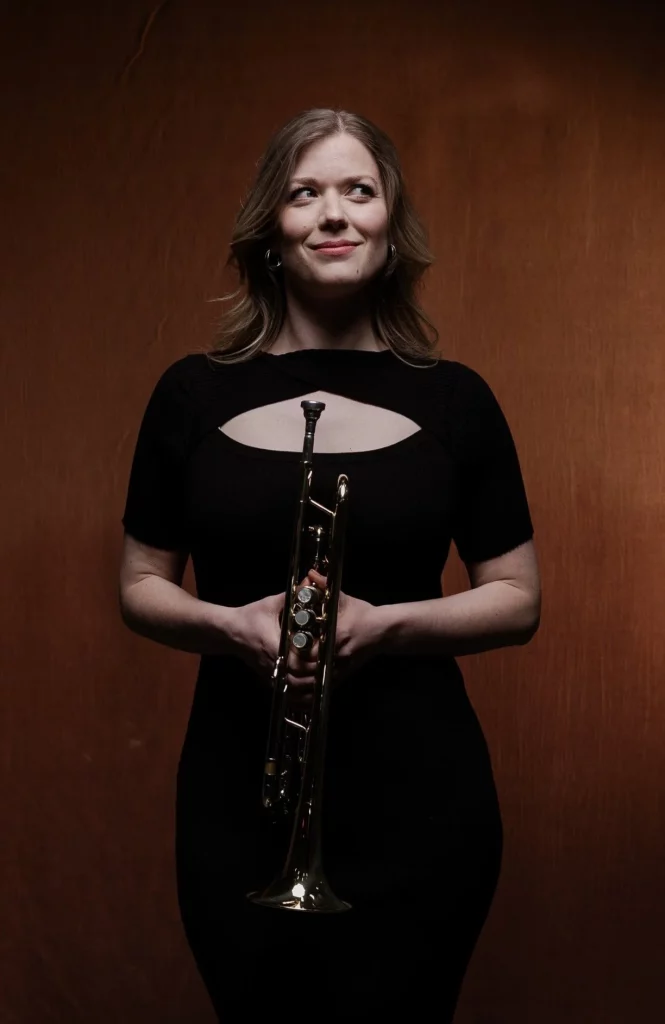
Trumpet and flugelhorn soloist Imogen Whitehead. Picture: Matthew Johnson
It got off to a strong start, with some leaping string figures that recalled Britten, but these were barely recalled later. He soon toned things down by muting his soloist, in company with long, elegiac phrases to which Whitehead brought a lovely legato.
It is true that there were some fanfare-like moments and even string syncopation, but these soon dissipated into a duet between flugelhorn and vibraphone in full warble mode.
Much of what followed was similarly dream-centred, built around a dominant pedal, with only fleeting moments of activity in the strings. There was full-blown trumpeting at the very end. Whitehead had added some tightly decorative little roulades to her otherwise slow lines and was in admirable control throughout, but the piece as a whole never quite caught fire.
In Beethoven’s Fourth Symphony, Corderoy was right in her element and altogether more relaxed. After a suitably weird opening Adagio, the entry into the Allegro was truly exciting, with syncopation taut and accents fierce. Some of the fortes in the slow movement were a touch forceful for the context, but the succeeding Scherzo was light and airy by contrast.
Excitement returned in the finale, where the composer’s ma non troppo was effectively ignored and Corderoy chose a cracking pace. The orchestra stayed right with her and the return of the main theme was absolutely gripping.
Review by Martin Dreyer