
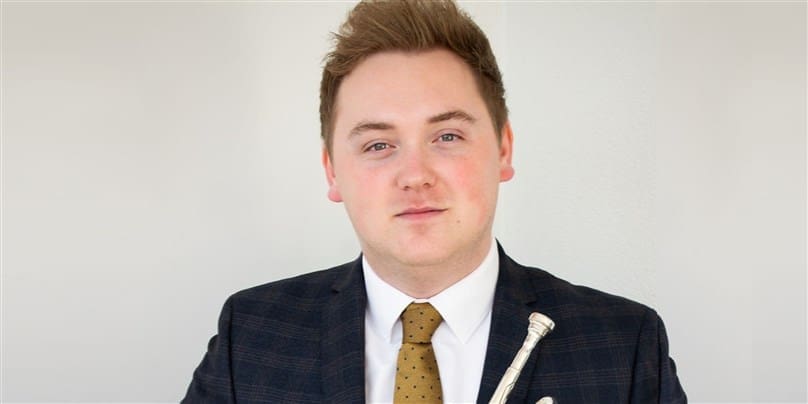
James Fountain: Soloist for Malcolm Arnold’s Trumpet Concerto
SUNDAY afternoon’s concert, the first of York Guildhall Orchestra’s new season, was dedicated to the memory of John Wallace, OBE and trumpeter extraordinaire, who died in January at the age of 76. His widow and daughter were in the audience.
The first half ended with Malcolm Arnold’s Trumpet Concerto, which Wallace had premiered in 1982, played here by James Fountain. The work is extremely compact. The opening fanfares of its Allegro energico lead into some very rapid passages which Fountain delivered with panache, while finding a comfortable legato for the second theme.
In this context, the slow movement took on a powerfully elegiac feel, the muted trumpet eerily supernatural. All that was blown away by the finale, which was exuberant and joyous, truly an evocation of the personality whose memory was being honoured.
The programme had opened with Walton’s Crown Imperial march, a homage to Elgar if ever there were. The orchestra, under its permanent conductor Simon Wright, took a mildly cautious approach, with the contrasting trio theme lacking quite the breadth its sweep implies, but it concluded keenly enough.
Much Spanish music demands a special passion and the second of Falla’s two suites from his ballet The Three-Cornered Hat is no exception. The orchestra took the first dance to find its Iberian feet.
The second dance saw a profound change, perhaps inspired by the cor anglais’s little cadenza. The down-bowed syncopations were fiery and the concluding accelerando superbly taut. Tempo and rhythm in the frenetic finale received exactly the focus they needed, and its ending was properly strident.
The first movement of Walton’s First Symphony, Op 125 in B flat minor, opens and closes with a drum roll, which was a touch self-effacing at first here. Woodwinds predominated where we might have heard more from the strings, but it finished in grand style.
The ‘malicious’ scherzo (presto con malizia) was much edgier, largely due to its fearless syncopations introducing an element of the macabre which Wright seemed to relish.
Simmering anger underpinned the melancholy Andante at first, before it became more tranquil, leaving a need for resolution in the finale. This was primarily exciting for the brilliant focus in its two fugal passages, which emerged with the utmost clarity, spearheaded by the strings. This was YGO at its most determined: the best had been kept to the last.
Review by Martin Dreyer