REVIEW: Black Treacle Theatre in Educating Rita, Theatre@41, Monkgate, York, until Saturday ****

Learning the meaning of “Only connect” in E M Forster’s novel Howards End: Jamie McKeller’s Frank tutoring Florence Poskitt’s Rita in Black Treacle Theatre’s Educating Rita. Picture: John Saunders

BLACK Treacle Theatre founder and director Jim Paterson has brought together two of York’s finest comedy actors for the first time for Willy Russell’s classic two-hander Educating Rita. 

Call it chemistry, call it alchemy, it is inspired casting  as Jamie McKeller and Florence Poskitt unite as whisky-soured university lecturer Frank and working-class Liverpool hairdresser Rita White, who wants to do more than change her name from Susan in signing up for an Open University literature course.

Frank, whose poetic flame has burned out, is only taking on Open University classes as a means to funding his chronic need to drink.  Behind all too many books in his shabby office are hidden bottles, bringing a regular clink to his day as he numbs his senses at his failure to sustain his early promise as a poet.

Keen to learn, keen to change, keen to challenge: Florence Poskitt’s Literature student, Rita White, looking sceptical in Educating Rita. Picture: John Saunders

McKeller’s Frank is one of those drinkers who remains lucid in thought and expression, bleary eyed yet still articulate, waspish, piercingly perceptive, frustrated and frustrating. He talks of tragedy in Shakespeare being different from what we might call “a tragedy” in everyday life, yet Frank’s inability to change his path, his ways, his boozing, while knowing his destination, is closer to the former than the latter.

Poskitt’s Liverpool lip Rita is the one keen to change, to learn, to reach a state of knowledge and understanding, talking ten to the dozen, smoking feverishly, opinionated, frank, humorous.

She wants to lift Frank out of his doldrums too, but he is more concerned about how her initial individuality, her different way of thinking, is changed essay by essay, session by session, to meet the conventional understanding of critical thinking. You sense that this is Russell’s own despair with the education system, its requirements for common grounding, when Literature studies should lead to original thought.

He thinks, he drinks: Jamie McKeller’s Frank in Black Treacle Theatre’s Educating Rita. Picture: John Saunders

In his educating of Rita, Frank makes her more conventional in the world of gown, not town, where her husband Denny objects to her studies, wanting her to focus on starting a family instead.

In turn, Rita learns that no world is perfect, that a quest for knowledge, an insatiable curiosity, may not provide the answers she wants, but she is still better for now having the knowledge to help her move forwards.

There is light, especially in the combustible humour of Frank and Rita’s clashes of cultural thinking in their tutorials, but there is darkness too, whether in Frank’s embittered demeanour and eloquently arrowed self-loathing or the revelation of the troubles of Rita’s flatmate, Trish.

Educating Rita director Jim Paterson

McKeller, whose theatre work has taken in everything from John Godber’s Bouncers to Shakespeare and Rowntree Players pantomime villains and ugly sisters, gives a masterclass in understated performance: every line and movement weighted with significance, never overplayed in Frank’s reliance on drink to medicate his “absolute disaster” of a stagnating life. 

He is superb too at working in tandem with Poskitt’s flighty, effervescent yet increasingly deeper-thinking Rita, a bright spark whose honesty matches the ever-frank Frank as her confidence blossoms in her discovery of art, culture, theatre, herself.  

Yet change is as much of a mental minefield as no change. Frank won’t change, Rita will, but in considering “who they are and who they want to be”, choice may still be influenced by class, by circumstance, by whether you are a man or a woman. 

So much to learn from each other: Jamie McKeller’s tutor Frank and Florence Poskitt’s student Rita in Educating Rita. Picture: John Saunders

Paterson may set Black Treacle’s production in a hybrid of the 1980s and 1990s, but the themes are as resonant as ever, especially at a time when the price of education – the burden of debt it now brings and the difficulty in finding a job afterwards – is challenging our perception of its purpose.

In the educating of Rita, Willy Russell’s universal play is still championing the possibilities and power of knowledge to change, to broaden horizons, to bring greater freedom of choice, against the tide of the frustratingly linear world of academia .

Black Treacle Theatre presents Educating Rita, Theatre@41, Monkgate, York, 7.30pm nightly until Saturday. Box office: https://tickets.41monkgate.co.uk.

Florence and Jamie team up for first time in Black Treacle Theatre’s Educating Rita

Florence Poskitt’s Rita and Jamie McKeller’s Frank in Black Treacle Theatre’s Educating Rita

WILLY Russell’s Educating Rita returns to the York stage in Black Treacle Theatre’s production at Theatre@41, Monkgate, York, from June 9 to 13.

Premiered in 1980 and updated in 2003, the Liverpool playwright’s two-hander tells the story of Rita, a working-class hairdresser hungry for something more, who signs up for an Open University literature course.

There she meets Frank, a disillusioned academic whose passion for teaching has long faded. Their weekly tutorials become a battle of ideas, humour and honesty as Rita’s confidence blossoms and Frank reckons with his own choices and the possibility of a second chance.

“Frank is so wonderfully brilliant and articulate, but also an absolute disaster,” says Jamie McKeller

As Rita discovers the worlds of art, culture and self-expression, she begins to question the life others expect her to live. Change, however, comes with difficult choices, and both teacher and student must reconsider who they are and who they want to be.

Transformed into a film by Lewis Gilbert in 1983, starring Julie Walters, reprising her stage role as Rita opposite Michael Caine, Educating Rita will be performed in York by Florence Poskitt as Rita and Jamie McKeller as Frank.

Director Jim Paterson says: “Even though Educating Rita was written in 1980, it’s not a period piece in the slightest. The play’s themes of the value and purpose of education, how women’s emancipation is still not universal, and how the choices we have depend so much on our class and background, all still have a lot of relevance today and it felt like a good time to revive it.

Jim Paterson: Director of Black Treacle Theatre’s Educating Rita

“Plus it has two brilliantly written characters in Rita and Frank. You worry when staging a well-known play whether you can meet people’s expectations, but I’ve been blown away by how Flo and Jamie have brought a host of different ideas and interpretations to their performances,  which I can’t wait for an audience to see.”

Florence says “Educating Rita is such a brilliant, timeless play, and I cannot thank Jim enough for the opportunity to play Rita. Working alongside Jamie is a joy, and not only are we collaborating well as a team, it feels like were creating something really special.”

Reflecting on playing lecturer Frank, Jamie says: “Frank is genuinely a dream for an actor. He’s so wonderfully brilliant and articulate, but also an absolute disaster. A huge challenge to take on, but to face it with Flo and Jim is nothing but a pleasure. It’s possibly one of the saddest, funniest and most heartfelt scripts I have ever read and I feel very lucky to be a part of this production.”

Up to her eyes in books: Florence Poskitt’s Liverpool hairdresser, Rita, in Black Treacle Theatre’s Educating Rita

Jim had just finished directing Black Treacle in Laura Wade’s The Watsons when Florence pitched the idea of staging Educating Rita. “I didn’t say he had to cast me,” she points out.

Last staged in York in September 2021 in Max Roberts’s touring production starring Jessica Johnson and Stephen Tompkinson at the Theatre Royal, Educating Rita became Jim’s choice for Summer 2026 as soon as he read Russell’s script. “The characters grabbed me; the dialogue crackles – and I said to Flo, ‘OK, what are you doing next June?’.

“Then, when I was speaking to Jamie about something else, I happened to mention Educating Rita, and he said it was a play he’d always been keen to look at. I put Flo and Jamie together and – brilliant! – you could see the chemistry between them straightaway.”

Florence Poskitt and Adam Sowter, her partner in York musical comedy and children’s theatre duo Fladam

To Flo’s surprise, “Somehow we’ve never performed together before, which feels a bit bonkers because we’re so similar in that we both do lots of comedy,” she says.

“It’s been really nice coming together from comedy backgrounds, doing fun stuff, and because we both run our own theatre companies [Flo’s Fladam, with partner Adam Sowter, and Jamie’s Neon Crypt], flying by the seat of our pants, we know about being in the moment and having each other’s back, which is a good feeling in rehearsals.”

Working with Florence for the fourth time and Jamie for the first, Jim notes: “They’re both very empathetic performers and one of the things you notice is how they dive into their roles, where you’ll think about putting yourself in their situation, and in Frank and Rita’s situation, thinking ‘what might come from this?’. From the director’s point of view, it’s fascinating thinking, ‘what will you guys do here.”

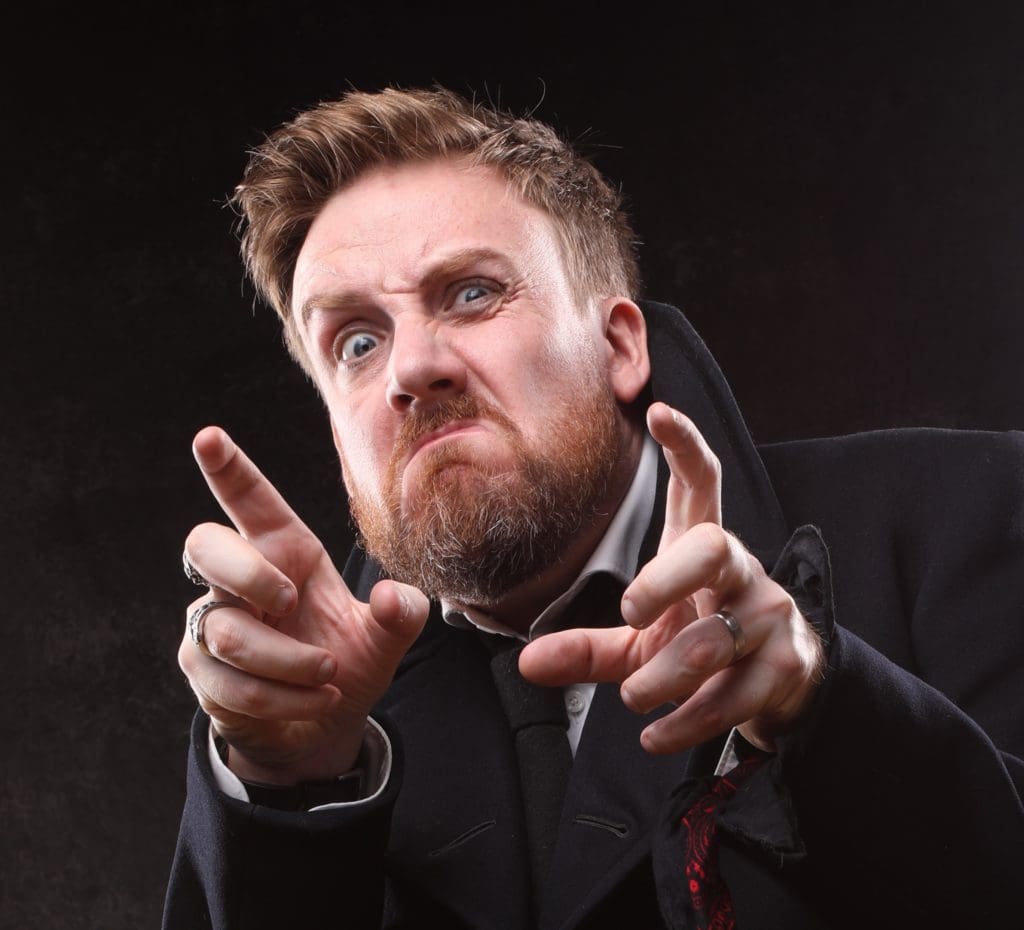
Jamie McKeller in his guise as Dr Dorian Deathly, ghost walk host of Deathly Dark Tours

Florence says: “It’s just so exciting to have the challenge of doing a two-hander, lots of lines to learn, and the Liverpool accent for Rita too, and we’ve loved the experience. One of the things that’s been useful is that Vic [stage technician Victoria Ryan] is from Liverpool; she’s given me some amazing pointers.

“Vic says everything is ‘lazy’ in the Scouse accent, under-pronouncing words and dropping ‘Gs’ from the end of [‘ing’] words and ‘Hs’. I’ve decided to refer to it as ‘theatrical Scouse’  the way I’m speaking it on stage.”

In the educating of Rita in Educating Rita, she changes, but what about the heavy-drinking Frank? “We’ve discussed this a lot,” says Jamie, who will employ a weariness of voice in his performance. “You would hope that Frank has a transformation too, but he doesn’t really change in that there’s only false hope; he talks about tragedy instead.

“Somehow we’ve never performed together before, which feels a bit bonkers because we’re so similar in that we both do lots of comedy,” says Florence Poskitt of appearing on stage with Jamie McKeller for the first time

“In encountering Rita, it doesn’t do anything to redeem or save him. He has a certain lightness in her presence, but then, in her prolonged absence, he is quick to return to the bass line [in his behaviour].”

Jim adds: “Frank’s tragedy is he has the chance to change but he doesn’t like himself enough to make that change permanent.”

Jamie rejoins: “I’m definitely a lighter shade of Frank, but I could see how this situation could happen, but the difference between me and Frank is that I would not allow it to happen to me. Where he is comfortable in these circumstances and is unwilling to make changes, when it comes to ambition, we’re poles apart.”

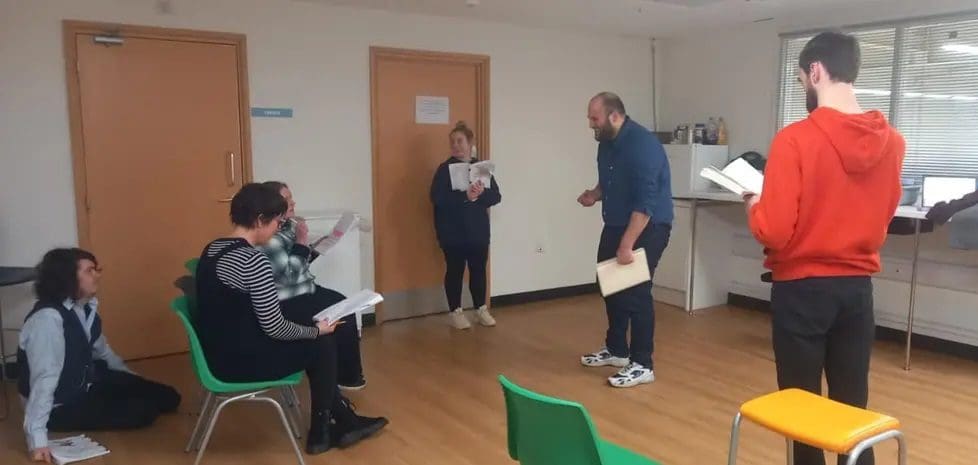
Florence Poskitt in rehearsal for Educating Rita

Jim is giving Educating Rita an unspecified setting that evokes both the 19080s and 1990s. “It can’t be set in 2026, given how things have changed in education,” he says.

“But the only thing that really dates it is Frank’s drunken rant,” suggests Jamie, “To be that dismissive of that behaviour dates it to earlier times.”

Black Treacle Theatre in Educating Rita, Theatre@41, Monkgate, York, June 9 to 13, 7.30pm. Box office: https://tickets.41monkgate.co.uk.

Black Treacle Theatre: back story

FOUNDED by Jim Paterson, York company Black Treacle Theatre has produced Nick Payne’s Constellations (March 2022); Gary Owen’s Iphigenia in Splott (March 2023), Nassim Soleimanpour’s White Rabbit Red Rabbit (November 2023); Dario Fo’s Accidental Death Of An Anarchist (October 2024); Laura Wade’s The Watsons (July 2025, co-production with Joseph Rowntree Theatre), and Howard Brenton’s Anne Boleyn (March 2026).

JIM Paterson is joined in the Educating Rita production team by set and prop designer Richard Hampton, lighting designer Sage Dunn-Krahn and stage technician Victoria Ryan.

Jamie McKeller in rehearsal for Educating Rita

Neon Crypt bring added comic bite to The Hound Of The Baskervilles at Theatre@41

Michael Cornell’s Sir Henry Baskerville, Laura McKeller’s Sherlock Holmes, centre, and Laura Castle’s Dr John Watson in Neon Crypt’s The Hound Of The Baskervilles

YORK Gothic humorists Neon Crypt will serve up The Hound Of The Baskervilles with side-splitting stupidity, hot dog disguises and absolute terror at Theatre@41, Monkgate, York, from May 5 to 9.

Expect a relentlessly silly, very funny and very fast-paced show suitable for all ages, albeit with some mild peril, as Laura McKeller, Laura Castle and Michael Cornell tackle a typically high-brow, 120-minute adaptation by Peepolykus co-founder John Nicholson, in the wake of staging Nicholson and Le Navet Bete’s Dracula: The Bloody Truth last May.

Directed by Jamie McKeller, alias York ghost walk supremo Dr Dorian Deathly of Deathly Dark Tours, Sir Arthur Conan Doyle’s most celebrated Sherlock Holmes story is given a madcap makeover as Holmes and Dr Watson are summoned to investigate the ancient curse of the Hound of the Baskervilles.

To do so, they must unravel the mysterious death of Sir Charles Baskerville, who is found dead on his estate, with a look of terror still etched on his face and the paw prints of a gigantic hound beside his body.

The Hound Of The Baskervilles director Jamie McKeller in Dr Dorian Deathly ghost walk guide mode

“Our memories of The Hound Of The Baskervilles in York go way back to York Theatre Royal doing it with panto villain David Leonard as Holmes [in 2016],” says Jamie. “Within Neon Crypt, there are four of us, and we get together to throw it around the room, saying ‘you read this part’, ‘you read that part’, and it ended up landing the way it has with the two Lauras as Holmes and Watson and Michael playing Sir Henry Baskerville, Sir Charles Baskerville, Dr Mortimer, a cabbie and multiple meat-wielding Yokels.

“We knew one of us would direct the show, and the general feeling was that it would go a certain way, but it didn’t go the way we thought it would! I thought I’d end up as Holmes because he’s so stoic, but then Laura [McKeller] read the part and nailed the arrogance and Basil Rathbone air of ‘Britishness’.

“Laura [Castle] has such an everyman quality to her acting, and she started to read Dr John Watson in an Received Pronunciation English accent, but I said, ‘no, give me Bradford, give me the moors, give me West Yorkshire’, and that’s how she’s now playing him.”

Laura C will focus on Watson and a Yokel, while Laura M will be even busier in her multi-role-playing duties than Cornell. “She’s doing at least ten roles because Holmes is not always present. She’ll be Mr and Mrs Barrymore; the train guard; Cecile Stapleton; Jack Stapleton and Slasher Selden, ‘the Notting Hill murderer’, among others,” says Jamie.

Laura McKeller’s Sherlock Holmes in hot dog disguise in Neon Crypt’s The Hound Of he Baskervilles

“She has to go off, change character and be back on in a heartbeat – and our stage manager, Rebecca Payne, will be multi-rolling too with all the scenes changes, costume changes and props, so she’s as much a character in the show as the other three. Though she doesn’t say anything, she has to do a lot on stage, with the running joke of the cast tipping her every time she comes on but becoming more and more begrudging about doing that.”

Analysing The Hound Of The Baskervilles’ abiding popularity, Jamie says “It’s a good sleuth story where the audience feels ‘Let’s go sleuthing’. If anything, in this version, the story is on the backburner, so there are moments when the sleuthing is going on, where we have to find the chance to hit the brakes to say to the audience, ‘Are you keeping up?’.

“We’re staging it on a thrust set design, so the audience are invited into the action straightaway. Within 30 seconds, the house lights are up and the audience are involved.

“The show is right up our street in terms of silliness, and though we place it in the late-1800s, with Watson in a Victorian two-piece and Holmes in a deer stalker and cape, the cast can break out of the period setting, like the moment when they pull out a mobile phone.”

No smoke without (gun) fire: Laura Castle’s Dr John Watson in Neon Crypt’s The Hound Of The Baskervilles

The two Lauras wore Holmes and Watson’s waxed moustaches in rehearsal for the first time last night (30/4/2026). “But Laura M is no stranger to having moustaches and mono-brows on stage,” says Jamie. “Laura C likes to do her nails with themed symbols on: bats for her Dracula last time; now moustaches on blue nails for Doctor John Watson!”

From Star Wars music in one scene to the bubbling bromance of Holmes and Watson, anything could happen in Neon Crypt’s show. “I think there’s permission that if anyone ‘cracks’ on stage in a preposterous comedy, it’s not the end of the world,” posits Jamie. “It makes it feel more grounded, and you’re at such close quarters with the audience at Theatre@41 that it’s a really transformative venue, where you can have it anyway you want.”

Jamie has plenty on his thespian plate, by the way. “I’ll be playing Frank in Jim Paterson’s production of Educating Rita for Black Treacle Theatre in June, and with the volume of lines in each show, I couldn’t have done both Sherlock and Frank,” he says.

Neon Crypt in The Hound Of The Baskervilles, Theatre@41, Monkgate, York, May 5 to 9, 7.30pm plus 2.30pm Saturday matinee. Box office: tickets.41monkgate.co.uk.

Florence Poskitt: Playing hairdresser and Open University Eng Lit student Rita in Black Treacle Theatre’s June production of Educating Rita

YORK company Black Treacle Theatre will present Educating Rita, Willy Russell’s warm, witty and moving two-hander about the power of education to change lives, at Theatre@41, Monkgate, York, from June 9 to 13.

Company founder and director Jim Paterson will direct Jamie McKeller and Florence Poskitt in Russell’s tale of Rita, a working-class hairdresser hungry for something more, signing up for an Open University literature course.

There she meets Frank, a disillusioned academic whose passion for teaching has long faded. Their weekly tutorials become a battle of ideas, humour and honesty as Rita’s confidence blossoms and heavy-drinking Frank wrestles with his demons and the possibility of a second chance.

As Rita discovers the worlds of art, culture and self-expression, she begins to question the life others expect her to live. Change, however, comes with difficult choices, whereupon both teacher and student must reconsider who they are and who they want to be. Tickets for the 7.30pm performances are on sale at tickets.41monkgate.co.uk.

Coming next from Neon Crypt

NEON Crypt will stage The Battersea Poltergeist and Uncanny podcaster, broadcaster and journalist Danny Robbins’s smart, modern-day London supernatural thriller 2:22 A Ghost Story at Theatre@41, Monkgate, York, in Halloween week.

“Nick Hern Books contacted us to say the rights were becoming available from midday that day and would we be interested?” says Neon Crypt artistic director Jamie McKeller, who will feature in the cast alongside Laura McKeller, Laura Castle and Michael Cornell, directed by Alex King.

More details will follow.

Dr Dorian Deathly: Making the Grand Opera House his latest haunt for ghost stories

Deathly Dark Tours to go behind scenes at Grand Opera House on May 25

DR Dorian Deathly, alias Jamie McKeller, is teaming up with the Grand Opera House, York, for a “unique experience on stage and behind the scenes after dark” as visitors investigate the Cumberland Street theatre’s 120-year history with the York ghost walk host on May 25.

Deathly Dark Tours supremo Dorian will lead ghost-walkers on a backstage tour replete with stories of people connected with the theatre’s past. Tours will start at 6pm, 7pm and 8pm. Box office: atgtickets.com/york.

REVIEW: Black Treacle Theatre in Anne Boleyn, Theatre@41, Monkgate, York, off with her head until Saturday ****

The plot thickens: Paul Osborne’s Thomas Cromwell, left, and Ian Giles’s Cardinal Wolsey in Black Treacle Theatre’s Anne Boleyn

ANNE Boleyn (c.1501-1536) had an extra finger and one head too few after her execution by a French swordsman in the Tower of London.

One of these statements is fiction, the other is fact, but both persist down the years as how we know Anne best, such is the way myth and history overlap.

The sixth finger story was a 16th century fabrication spun by Roman Catholic polemicist Nicholas Sander in 1585 to suggest Anne was a witch in a smear campaign against her daughter, Queen Elizabeth I.

Yet acts of besmirching her as a whore were rife in Anne’s lifetime too, led by those at the very top, leading to her beheading, as Howard Brenton explores in his witty political drama.

Nick Patrick Jones’s Henry VIII in a tender moment with Lara Stafford’s Anne Boleyn. Picture: John Saunders

Premiered at Shakespeare’s Globe in 2010, Anne Boleyn now breaks its York duck under the direction of Black Treacle Theatre founder Jim Paterson, whose experience of watching a friend in the Globe cast had left an indelible impression.

“This year marks 500 years since Henry’s courtship of Anne began in earnest – in 1526. So it felt like serendipity to stage this play, which makes us reconsider who Anne was, and what an important figure she is in our history,” says Paterson, explaining the timing of his production.

Here’s the history bit: Anne Boleyn was the second wife of King Henry VIII, whose desire to marry her forced the break from the Roman Catholic Church and the dawn of the English Reformation. She was well read, intelligent, queen for only 1,000 days – and by common agreement, the best of the six, so sassy and saucy, in the ultra-competitive Six The Musical.

Brenton puts her front and centre of his historical yet modern epic, both as a ghost in the court of James I and in charting her courtship with Henry VIII, presenting a more rounded and nuanced portrait of Anne as lover, heretic, revolutionary, queen, at once brilliant and bright but reckless too, hot-headed and then not-headed. Was she prey or predator? You decide, maybe for the first time

In need of a stiff drink: Cameron O’Byrne’s George Villiers and Katie Leckey’s James I. Picture: John Saunders

The play opens with Lara Stafford’s Anne Boleyn in monologue mode, as she enters the checkboard stage in her bloodstained execution dress, carrying a large embroidered bag. Brenton’s opening stage instruction reads “Aside. Working the audience”, immediately establishing that this play will be on her own terms, like a comedian’s opening gambit or a Fool’s mission statement in Shakespeare, as she teases the audience over the bag’s potential content.

“And why should I want you to love me?” she asks us. “Did anyone around me ever love me, but for the King?” And there’s the rub. Who was on her side? Brenton, as it turns out, Jesus, as she declares, and a curious James I (Katie Leckey), keen to use her information to aid his unconventional attempts to bring warring religious factions together decades later.

Anne pulls out the Bible, or more precisely William Tyndale’s banned version that would sew the seeds of her execution, with a flourish worthy of Tommy Cooper, but with a heavy heart, before making light of her execution when finally producing the severed head. “Funny, a head’s smaller than you think. Heavy little cabbage, that’s all.”

This sets Brenton’s tone, one where his comic irreverence rubs up against reverence, or more precisely the mirage of reverence in a world where Henry’s England waives the rules, where the intrigue and political machinations of Henry’s court undermine and belie the intersection of crown and church.

Anne Boleyn director Jim Paterson

Somehow, Stafford’s Anne must show her mettle to find her way through that ever-tightening thicket, and likewise Leckey’s James I, the Scottish king (here with a fellow Celtic/Northern Irish accent), must negate all the vipers’ poison when assuming the English throne.

In an outstanding return to a lead role, Stafford’s risk-taking Anne exudes intelligence, pluck, conviction, sometimes with humour, like when she mocks Ian Giles’s West Country Cardinal Wolsey for being woolly; sometimes with grave sadness, in the abject despair at failed pregnancies; or at the close, with sincerity, as she champions the power of love (uncannily just as Hercule Poirot does in the finale to Death On The Nile, on tour at the Grand Opera House this week).

Leckey, one of the volcanic forces of the 2020s’ York theatre scene with her Griffonage Theatre exploits, is tremendous here too. Surely James I should not be so much fun, but he is, whether flaunting his relationship with Cameron O’Byrne’s George Villiers, reaching for a glass, mocking the martinet dourness of Paul Stonehouse’s Robert Cecil or being as capricious as President Trump in making decisions.

Bible matters: Maurice Crichton’s William Tyndale in discussion with Lara Stafford’s Ann Boleyn. Picture: John Saunders

Stafford’s Anne aside, the women have to play second fiddle, treading on glass to survive in the court, whether Lady Rochford (Abi Baxter), Lady Celia (Isabel Azar) or next-in-Henry’s- roving- eye-line Lady Jane (Rebecca Jackson).

Heavyweights of the York stage assemble for the juiciest male roles. Nick Patrick Jones brings Shakespearean heft (rather than physical bulk) to Henry, already entitled and erratic, demanding and wilful, boastful of his writing powers, but still allowed shards of humour by Brenton (albeit at Henry’s expense) in this clash of the legal and the regal.

Paul Osborne’s Thomas Cromwell, statesman, lawyer and Henry’s chief minister, emerges as the villain of the piece, misogynistic, devious, manipulative, his language industrial, his actions self-serving behind the veneer of duty, with “something of the night about him”. Osborne makes for a complex character rather the two-dimensional baddie of pantomime.

Giles’s Catholic cardinal Thomas Wolsey is the stuffed shirt of Brenton’s piece, righteous, exasperated, as forlorn as Canute when standing against the winds of change.  

Drafting the Reformation Act: Paul Miles’s Sloop, left, Harry Summers’ Simpkin and Paul Osborne’s Thomas Cromwell. Picture: John Saunders

Never averse to scene-stealing impact, Maurice Crichton brings a twinkle and bravado to William Tyndale, writer of the outlawed Bible that would later form the basis of the King James version. His scenes with Stafford’s Anne are an especial joy.

Harry Summers’ Simpkin/Parrot, Paul Miles’s Sloop, Sally Mitcham’s  Dean Lancelot Andrewes and Martina Meyer’s John Reynolds further stir the murky waters, while Richard Hampton’s open-plan set and Julie Fisher and Costume Crew’s costumes evoke the Tudor and Stuart periods.

All in all, Howard Brenton’s Anne Boleyn is far funnier than living in those turbulent times must have been.

Anne Boleyn, Black Treacle Theatre, Theatre@41, Monkgate, York, tonight, 7.30pm; tomorrow, 2.30pm and 7.30pm. Box office: https://tickets.41monkgate.co.uk.

How Anne Boleyn knocks them for six in Howard Brenton’s Tudor marital clash, staged by Black Treacle at Theatre@41

Lara Stafford’s Anne Boleyn and Nick Patrick Jones’s Henry VIII rehearsing for Black Treacle Theatre’s Anne Boleyn. Picture: Jim Paterson

MOVE over Six The Musical with its six wives of Henry VIII competing in song for the right to be the queen of queens.

The focus falls on only one of his brides, his second pick, Anne Boleyn, in Howard Brenton’s play of that title, to be staged by York company Black Treacle Theatre at Theatre@41, Monkgate, York, from March 3 to 7.

Anne Boleyn, you will recall, was the first beheaded one, exiting stage left on May 19 1536, when charged with adultery and incest, her execution conducted by a skilled French swordsman inside the Tower of London, where she was she was forced to kneel in the French style to be given the chop.

So much for the history. Brenton’s play, premiered at Shakespeare’s Globe Theatre in 2010 to mark the 400th anniversary of the King James Bible, presents the story of “one of England’s most important and intriguing historical figures”.

“Lover, heretic, revolutionary, queen, Anne Boleyn has been a figure of fascination ever since her momentous courtship with Henry VIII that led to the English Reformation and Henry’s break with the Catholic Church,” says Black treacle director Jim Paterson

“Traditionally seen as either the pawn of an ambitious family manoeuvred into the King’s bed, or as a predator manipulating her way to power, Anne – and her ghost – are seen in a very different light in Brenton’s epic play.”

Anne Boleyn director Jim Paterson

Winner of Best New Play at the Whatsonstage.com Awards in 2011, the play has a dual focus, both on Anne’s life from her arrival at court and on James I’s attempts to bring warring religious factions together as the ripples of her marriage and death continue to reverberate through England decades later. 

Whereupon Anne comes alive for him, a brilliant but reckless young woman, whose marriage and death transformed the country forever.

“This is a dynamic, dramatic and often very funny play that helps us look at both Anne Boleyn and the birth of the Church of England in a new way,” says Jim. “The reign of Henry VIII and establishment of the Church of England is one of England’s ‘creation myths’, which shapes how we think about the country and the moments and actions it is built on.

“Brenton’s play asks us to reconsider this outside of the history books, particularly through the clever juxtaposition of the early days of James I’s reign, as he grapples with clashing religious factions, and the intrigue and politics of Henry’s court and Anne’s attempts to forge her own path through it.”

Jim continues: “In fact, this year marks 500 years since Henry’s courtship of Anne began in earnest in 1526. So it felt like serendipity to stage this play, which makes us reconsider who Anne was, and what an important figure she is in our history.”

Taking the role of protagonist Anne Boleyn and antagonist Henry VIII will be Lara Stafford and Nick Patrick Jones. “I’m playing a woman in a lead part in a play and neither of those has happened since The House Of Bernarda Alba in 2009,” says Lara, who worked as an actor, including at York Dungeon and, for a while, in Hindi films in India, before retraining as a physics teacher.

Lara Stafford’s Anne Boleyn, with the masked ladies of the Tudor court behind her, in rehearsal for Black Treacle Theatre’s Anne Boleyn. Picture: Paul Hutson

“It’s fascinating because, how often does a woman, in her early 40s, who can’t belt out a tune, get a chance like this to play a lead role? That chance has come with Black Treacle.”

Anne Boleyn appears as both wife and ghost. “She gives the opening scene from the perspective of having been through it all,” says Lara. “It’s interesting what she looks back on in a light-hearted way here.

“For Anne, the most upsetting part of her life were her pregnancies [she is believed to have fallen pregnant three or four times in her marriage from 1533 to 1536]. It’s a big part of her journey, whereas she’s quite flippant reflecting on getting her chopped off.

“There are moments of almost cheekiness, bawdy humour from James 1, where the play starts off light and playful, but then grows darker and darker, like Anne’s life.”

Nick chips in: “The second half is quite brutal, and Brenton doesn’t shy away from that.” Indeed not, as Nick plays a regal role for the third time. “I was the Earl of Richmond in York Shakespeare Project’s Richard III in 2023, then a folkloric King Henry from the tenth century in a devised piece that Skald Theatre did at Rise@Bluebird Bakery in Acomb last year, and now Henry VIII.

Nick Patrick Jones’s Henry VIII to the fore in a scene with Lara Stafford’s Anne Boleyn in rehearsal for Jim Patterson’s production of Anne Boleyn. Picture: Jim Paterson

“There’s a particularly iconic image of Henry being incredibly large both physically and metaphorically – this larger-than-life character – but you have to create the real person underneath, rather than a caricature. Brenton has done a lot to make that happen by giving the actor a living breathing human being to play, rather than just spouting political statements.”

Lara rejoins: “For almost the first time, he’s written it as Anne’s story, whereas previously it was written by men trying to make their place in history, where she is just ‘wife number two’.”

“She’s the chosen one, or actually she chooses him,” says Nick. “She’s the most significant one in that although four came after her, they were all in her shadow.”

“Exactly, it could only be that she set the tone,” says Lara. “I had no idea until doing this play just how much she drove their relationship.”

Nick concludes: “There’s a strong sense of them as potential equals, but the political structure doesn’t allow them to be equals in court, thus preventing her from fulfilling her potential.”

Black Treacle Theatre presents Anne Boleyn at Theatre@41, Monkgate, York, March 3 to 7, 7.30pm plus 2.30pm Saturday matinee. Box office: https://tickets.41monkgate.co.uk.

Paul Osborne’s Thomas Cromwell, left, and Ian Giles’s Cardinal Wolsey in Black Treacle Theatre’s Anne Boleyn. Picture: Paul Hutson

Who’s in Black Treacle Theatre’s cast for Anne Boleyn?

Anne Boleyn – Lara Stafford

Henry VIII – Nick Patrick Jones

Thomas Cromwell – Paul Osborne

Cardinal Wolsey/Henry Barrow – Ian Giles

Lady Rochford – Abi Baxter

Lady Jane – Rebecca Jackson

Lady Celia – Isabel Azar

Simpkin/Parrot – Harry Summers

Sloop – Paul Miles

William Tyndale – Maurice Crichton

James I – Katie Leckey

Robert Cecil – Paul Stonehouse

George Villiers – Cameron O’Byrne

Dean Lancelot Andrewes – Sally Mitcham

John Reynolds – Martina Meyer

Katie Leckey’s James I, right, rehearsing a scene with Cameron O’Byrne’s George Villiers. Picture: Paul Hutson

Who’s in the production team?

Director – Jim Paterson

Lighting designers – Sage Dunn-Krahn and Kathryn Wright

Lighting technicians – Emma Jones and Dave Robertson

Set and prop designer – Richard Hampton

Costume designer – Julie Fisher and Costume Crew

Black Treacle Theatre: back story

YORK company has produced Constellations (March 2022); Iphigenia In Splott (March 2023); White Rabbit, Red Rabbit (November 2023); Accidental Death Of An Anarchist (October 2024) and The Watsons (July 2025, co-production with Joseph Rowntree Theatre).

REVIEW: Black Treacle Theatre in The Watsons, finishing Austen business at Joseph Rowntree Theatre, York ****

Sisters doing it for themselves? Jennifer Jones’s Elizabeth Watson, left, Livy Potter’s Emma Watson and Florence Poskitt’s Margaret Watson in Black Treacle Theatre’s The Watsons. Picture: Dave Lee

WHEN studying semiotics and semantics in year three of Cardiff University’s English Literature degree more than 40 years ago, one discussion point was ‘Who’s in control of a novel’. The writer?  The characters? Or the reader?

Roll forward to York company Black Treacle Theatre’s York premiere of The Watsons, where writer Laura Wade and indeed the characters ask that same question. The reader is replaced by audience members, whose control here is whether to laugh or not at Wade’s ever more anxious comedy.

The question is heightened by the playwright’s challenge. Wade penned Posh (the Royal Court one about the Oxford University dining club of Cameron and BoJo notoriety) and Home, I’m Darling (the darkly comic one about sex, cake and the quest to be the perfect 1950s’Welwyn Garden City housewife): two social studies of English behaviour. The Watsons is a third such study, but with a difference.

Not a fan: Victoria Delaney’s oft-disapproving Lady Osborne. Picture: Dave Lee

Wade picks up the unfinished business of a Jane Austen novel with all the familiar tropes of young sisters desperately having to seek husbands as the only way to improve their circumstances from a pool of unsuitable cads and awkward aristocrats, but with one sister demanding to do it on her own terms. For Pride And Prejudice’s  Lizzy Bennet, read The Watsons’ Emma Watson (Livy Potter).

Emma is 19, new in town in 19th century English society, but promptly cut off by her rich aunt and consigned back to the family home with her sisters, the more earnest  Elizabeth (Jennifer Jones) and ever excitable Margaret (Florence Poskitt).

Into Austen’s whirl spin the irresistible cad, Nick Patrick Jones’s Tom Musgrave, the tongue-tied toff, Cameron O’Byrne’s Lord Osborne, and his grandstanding mother, Victoria Delaney’s  Lady Osborne, with daughter Miss Osborne (Effie Warboys) in tow. A vicar is on the marital march too, Andrew Roberts’s awfully nice Mr Howard.

Livy Potter’s 19th century Emma Watson looks startled as Sanna Jeppsson’s Laura uses her 21st century phone in The Watsons. Picture: Dave Lee

So far, so Austen, if  Austen mini, and then…enter Laura (Sanna Jeppsson in her stage return after time out for yoga-teaching studies). Laura, wearing period costume when first seeking to fit in, turns out to be Laura Wade, wading in to explain that Austen’s story went no further (beyond notes to her sister containing advice on who Emma should not marry).

What happens when the writer loses the plot? Jeppsson’s Laura takes over, but it is not as straightforward as that. She does not merely grab Austen’s reins and gallop to the finishing line as the affairs of their heart play out. Instead, The Watsons becomes a piece of meta-theatre, exploring the role, the motives and the creative process of a writer, who, spoiler alert, ends up losing the plot herself.

What’s more, Laura will not have it all her own way. Potter’s feisty Emma speculates: what if she decides what she wants to do, rather than going along with Laura’s plotlines. Trouble is brewing, trouble accentuated by Emma’s fellow abandoned Austen characters rebelling too. Time for a breather, plenty to discuss.

Livy Potter’s Emma Watson puts Andrew Roberts’s clergyman, Mr Howard, to use carrying parcels in The Watsons. Picture: Dave Lee

Re-enter Jeppsson’s Laura, mobile phone in pocket and by now wearing jeans. Re-enter Austen’s increasingly errant characters as The Watsons heads ever further off-piste.

Not everything works – after all, this a reactivated novel in progress with room for trial and error – and you will not be surprised when Jeppsson’s Laura has an exhausted, exasperated meltdown, but you will surely love the characters’ philosophical discussions on Thomas Hobbes and Jean-Jacques Rousseau, led by Matt Pattison’s scene-stealing Robert Watson.

What begins as stilted Regency period drama becomes free-form modern theatre of the absurd, mischievous yet smart, like the works of Austentatious, wherein Wade examines the art of storytelling, the right to free will and who has the final say on our finales.

Cry havoc: Effie Warboys’ Miss Osborne, centre, leads the battle charge in Black Treacle Theatre’s The Watsons. Picture: Dave Lee

Under Jim Paterson’s playful yet still sincere direction, The Watsons keeps the surprises coming, the energy dynamic, the intellect busy and the humour unpredictable. All the while, Jeppsson’s vexed Laura is the serious one, coming up with a theory to Potter’s Emma as to why Austen put the pen down on her.

Amid the social commentary, the parallels with today’s values, the ever dafter comedy, this union of writer, character and audience hits its peak.  

Black Treacle Theatre in The Watsons, Joseph Rowntree Theatre, York, tonight, 7.30pm; tomorrow, 2.30pm and 7.30pm. Box office: York, 01904 501935 or josephrowntreetheatre.co.uk.

What’s on? The Watsons at the double, that’s what, in York and Helmsley

A montage of Black Treacle Theatre cast members in Laura Wade’s The Watsons at the Joseph Rowntree Theatre

TWO productions of The Watsons, Laura Wade’s take on unfinished Jane Austen business,  are opening on the same night in York and Helmsley tonight.

Jim Paterson directs Black Treacle Theatre’s production at the Joseph Rowntree Theatre; Pauline Noakes is at the helm for 1812 Theatre Company at Helmsley Arts Centre. 

What happens when the writer loses the plot? Find out as Emma Watson, 19 and new in town in the elegant world of early 19th-century England, is cut off by her rich aunt and dumped back in the family home, from where she must navigate society, marriage prospects and her future.

Emma and her sisters must marry, fast, but there is one hitch (not of the marital kind). Jane Austen did not finish this story. Who will write Emma’s happy ending now? Enter Laura Wade, who takes the incomplete novel to fashion a sparklingly witty play that looks under Austen’s bonnet to ask: what can characters do when their author abandons them?

As a recognisably Austen tale begins to unfold, something unexpected happens. Bridgerton meets Austentatious, Regency flair meets modern twists, and the plot goes ever more off-piste.

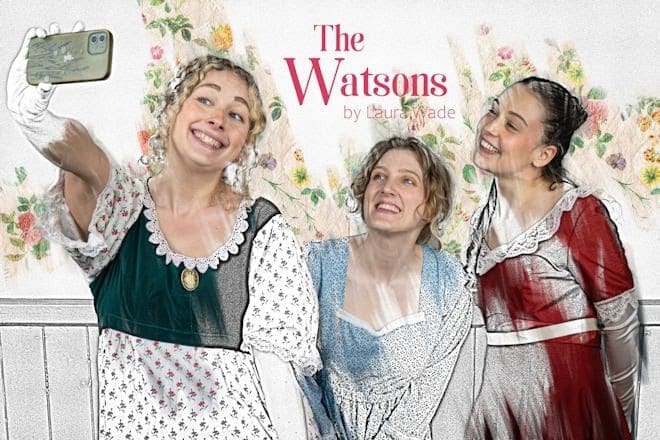
Florence Poskitt’s Margaret Watson, left, Jennifer Jones’s Elizabeth Watson and Livy Potter’s Emma Watson in the poster for York company Black Treacle Theatre’s The Watsons

Playful, clever, and full of surprises, The Watsons starts as a period drama and transforms into a bold reimagining that spins Regency charm into a dazzling modern theatrical experience, exploring storytelling, free will and who gets to write our endings.

Penned by Posh and Home I’m Darling writer Wade, the play was first produced at Chichester Festival Theatre. Now Black Treacle Theatre takes up the challenge, collaborating with the Joseph Rowntree Theatre in a fundraising production for the JoRo.

Director Jim Paterson says: “The Watsons is simply brilliant. My mind was fizzing from the moment I first read this funny, smart and dynamic play that offers us so much scope for creativity in staging it.

“Laura Wade is one of our best playwrights, and her adaptation of Jane Austen’s unfinished novel both fulfils and plays with expectations of what ‘a Jane Austen story’ is, and what she means to us all. With the brilliant cast and creative team bringing this to life, I can’t wait for us to share this with an audience this summer – and celebrate Jane’s 250th birthday.”

Appearing in Paterson’s cast will be: Livy Potter as Emma Watson; Jennifer Jones, Elizabeth Watson; Florence Poskitt, Margaret Watson; Matt Pattison, Robert Watson; Abi Baxter, Mrs Robert; Maggie Smales, Nanny; Victoria Delaney, Lady Osbourne; Cameron O’Byrne, Lord Osbourne; Effie Warboys, Miss Osbourne; Nick Patrick Jones, Tom Musgrave; Andy Roberts, Mr Howard; Sally Mitcham, Mrs Edwards; Paul Miles,  Captain Bertie, and Sanna Jeppsson, Laura.

Jeanette Hambidge’s Nanny, left, Becca Magson’s Emma Watson, Vicki Mason’s Margaret Watson, Linda Tester’s Servant and Oliver Clive’s Lord Osborne in 1812 Theatre Company’s The Watsons

MEANWHILE, how is the 1812 Theatre Company promoting the same play? Here’s how: “The Watsons are coming! Who, you may ask? The Watsons are a family created by Jane Austen in a story she never finished, possibly due to grief over the death of her beloved father.

Whatever the reason, we have been unable to follow their unfolding lives, although several characters and their concerns bear close similarity to popular Austen figures, until now.

“Step forward Laura Wade, a playwright whose works have graced the stages of the National Theatre and the Stephen Joseph Theatre in Scarborough with the West End hit Home I’m Darling.

“Wade has taken the story of The Watsons, their affairs, values and outlooks, and continued their lives in an altogether unexpected and intriguing way. Gradually we come to realise that despite the outward differences of clothes and habits of the early 19th century, their interests are not too dissimilar to our own. Though perhaps ours are becoming stranger!

Vicki Mason’s Margaret Watson, left, and Jeanette Hambidge’s Nanny in 1812 Theatre Company’s The Watsons

“The result is a play inspired by Jane Austen’s work, in this, the 250th anniversary of her birth. Presented by the 1812 Theatre Company at Helmsley Arts Centre, giving Austen fans a chance to relish a new work and others to observe that her people are not just Georgian dresses and uniforms but have personalities, feelings and problems. The play wears its comedy lightly and is a lively piece, authentically using dance music that Jane herself copied out!”

Pauline Noakes’s cast comprises: Becca Magson as Emma Watson; Julia Bullock, Elizabeth Watson; Vicki Mason, Margaret Watson; Richard Noakes, Uncle Robert Watson, ; Julie Wilson, Aunt Robert Watson; Barry Whitaker, Mr Watson; Jeanette Hambidge, Nanny; Beaj Johnson, Tom Musgrave; Oliver Clive, Lord Osborne; Sue Smith, Lady Osborne; Rosie Hayman, Miss Osborne; Mike Martin, Mr Howard; Robert Perry, Charles Howard; Linda Tester, Servant; Heather Linley, Servant, and Graham Smith, Dancing Master.

The Watsons, Black Treacle Theatre, Joseph Rowntree Theatre, York, July 9 to 12, 7.30pm and 2.30pm Saturday matinee; 1812 Theatre Company, Helmsley Arts Centre, July 9 to 12, 7.30pm. Box office: York, 01904 501935 or josephrowntreetheatre.co.uk; Helmsley, 01439 771700 or helmsleyarts.co.uk. 

Pop Yer Clogs Theatre, York’s new repertory theatre company, go Wilde in debut show The Importance Of Being Earnest

Introducing Pop Yer Clogs Theatre company co-founders, lined up for debut production The Importance Of Being Earnest. Poster art by: Ian Cotterill

POP Yer Clogs Theatre, a new repertory company of York professional actors, will stage Oscar Wilde’s The Importance Of Being Earnest from tomorrow to Saturday at Theatre@41, Monkgate, York.

Oscar Wilde’s comedy of mistaken identity, high society and a mislaid handbag forms their inaugural production after forming in March 2023.

“The name  ‘Pop Yer Clogs’ was chosen as we wanted something ‘Yorkshire’ and humorous that hinted at our origins as a company,” says company co-founder Andrea Mitchell. “We all met in an immersive scare attraction [York Dungeon].” 

Staging a faithful adaptation of Wilde’s waspish comedy of manners, Pop Yer Clogs will adorn the production with specially recorded music by Matt Robair and Nick Trott, handmade 1890s’ costumes by cast member Lydia McCudden and lighting and sound by Niamh Cooper and Ethan Canet-Baldwin.

Andrea Mitchell, as Lady Augusta Bracknell, left, Harry Murdoch, as Jack Worthing, and Lydia McCudden, as Gwendolen Fairfax, in rehearsal for The Importance Of Being Earnest

The company was founded last year to bring productions of classic dramas to the York stage for an accessible price of £10 per ticket. First up is The Importance Of Being Earnest, Wilde’s 1895 satire that pokes fun at the absurdity of Victorian upper-class society, armed with an arsenal of his most famous one-liners…and that immortal exclamation, “A handbag?”

Jack Worthing (played by Harry Murdoch) and Algernon Moncrieff (Rob Cotterill) are two friends from very different worlds: country and town. Jack is a carefree young man who invents a fictitious brother named Ernest, adopting this persona to escape his country home and live a double life in London.

Jack falls in love with Algernon’s cousin, Gwendolen Fairfax (Lydia McCudden). When he discovers that Gwendolen could only marry a man named Ernest, Jack plans to kill off his fictional brother and assume the name for himself.

Pop Yer Clogs Theatre’s cast for The Imprtance Of Being Earnest

Meanwhile, Algernon learns of Jack’s excessively pretty niece, Cecily Cardew (Erin Keogh), who has fallen for Jack’s imaginary brother. He hatches a scheme of his own to pretend to be the fictitious Ernest in order to win Cecily’s heart.

As the two men become entangled in each other’s elaborate lies, their deceptions unravel in a whirlwind of rushed proposals, disapproving relatives and mistaken identity, but soon they learn the vital importance of being earnest.

Further roles go to Andrea Mitchell as Lady Augusta Bracknell, Lucy Crawford as Miss Prism, Jack Higgott as the Reverend Canon Chasuble and director Christopher Leslie as the two butlers, Lane and Merriman.

Company co-founder Leslie studied performance practice at Leeds University Centre and has taken part in many productions throughout Yorkshire. Cotterill, Keogh and Mitchell are among those who work in the character acting team at York Dungeon.

Rob Cotterill’s Algernon Moncrieff, left, and Harry Murdoch’s Jack Worthing rehearsing a scene for Pop Yer Clogs Theatre’s The Importance Of Being Earnest

Leslie says: “Earnest is a play everyone has heard of but has not necessarily seen. It is such a delightfully witty and farcical play, and it will be a treat to put it on this week. We have a superb and stellar cast on our hands and everyone has been working extremely hard.”

Harry Murdoch, who plays Jack Worthing, adds: “Not a single rehearsal goes by where we don’t find ourselves in fits of giggles. Every character has their own moment to show off all their absurd eccentricities, and the part of Jack offers so much for me to play with.

“Throughout the play he goes from experiencing the highest intensity and anxiety to moments of the deepest despair and vulnerability. The perfect range of emotions for a comedic lead!”

Theatre@41 trustee Jim Paterson says: “As Wilde himself said, ‘the only way to get rid of a temptation is to yield to it’. We heartily encourage the people of York to take that advice and yield to the temptation to see The Importance Of Being Earnest. We love welcoming new companies to our studio and can’t wait to see Pop Yer Clogs take on this brilliant comedy.”

Pop Yer Clogs Theatre director Christopher Leslie, second from right, working with his cast in rehearsals for The Importance Of Being Earnest

In addition to staging Earnest, Pop Yer Clogs are rehearsing for an abridged performance of Alice In Wonderland at York Theatre Royal Studio on May 16 at 6pm as part of the Theatre Royal’s TakeOver festival, run in tandem with York St John University. The company will return to Theatre@41 with a full-length production of Alice In Wonderland in November.

Pop Yer Clogs Theatre in The Importance Of Being Earnest, Theatre@41, Monkgate, York, May 1 to 4, 7.30pm. Running time: Two hours, including interval. Box office: tickets.41monkgate.co.uk or at https://tinyurl.com/3c4rvbbe. Tickets for Alice In Wonderland: 01904 623568 or yorktheatreroyal.co.uk.

TakeOver festival: the back story

ANNUAL collaboration between York Theatre Royal and York St John University, wherein students control the theatre’s event programme and commission performances from professional companies such as Pop Yer Clogs Theatre. The 2024 festival will run from May 13 to 18.

REVIEW: York Shakespeare Project in The Taming Of The Shrew, Theatre@41, Monkgate, York, ends tomorrow ****

Nick Patrick Jones’s Hortensio, left, Stuart Green’s Grumio, Mark Simmonds’s Vincentio, Sam Jackson’s Lucentio, hidden, Mark Payton’s Gremio, back, Rosy Rowley’s Baptista Minola, front, Kirsty Farrow’s Bianca, Joy Warner’s Merchant/Widow and Flo Poskitt’s Katherine in York Shakespeare Project’s The Taming Of The Shrew. Picture: David Kessel

TWENTY one years have passed since York Shakespeare Project first staged The Taming Of The Shrew as its second ever production.

Staging Shakespeare’s “most controversial” comedy has become even more awkward in that time. The term “Gaslighting” is in common parlance; the #MeToo movement has found its voice; misogyny and sexism are a minefield of social media debate, Andrew Tate et al.

In 2003, Paul Toy, YSP’s director for Shrew, talked of the “welcome gains of feminism leaving it as less of a comedy, more of a problem play”. In 2009, Mooted Theatre’s Mark France saw the 1592 play’s sexual politics as “a gradual meeting of minds” in a war of words between Kate and Petruchio where both subvert the roles that society has determined for them. He coined the term “casual cruelty” to encapsulate the ploys of deception conducted by Tranio, Lucentio and Hortensio.

In 2003, Toy reversed the usual gender casting of the lovers and their servants, with Alice Borthwick, a tall Scot with a pageboy haircut, playing Petruchio in strapping manner opposite John Sharpe’s Katherina with his/her pale commedia dell’arte face and rouge lips. “There is now no pretence that what you see is `real’,” he said. “Hopefully, the play can be seen as less of a treatise and more of a game”.

Now, Maggie Smales, whose all-female version of Henry V in 2015 lingers in the memory, returns to the YSP director’s chair for ‘Shrew’, assisted by Claire Morley [her Henry , from that production].

Smales had played a serving wench in a South Yorkshire For Youth production of ‘Shrew’ in the mid-Sixties in Rotherham and Bianca in 1972 on her Bretton Hall drama course, now recalling them as “exemplifying the hypocrisy of a time that seemed to be offering the opportunity of gender equality without any real shift in attitudes”.

“We thought we were shaping a new world order with altered values,” she laments. “But there’s still quite a lot to be done about gender equality”.

Florence Poskitt’s Katherine in York Shakespeare Project’s The Taming Of The Shrew

No better time to start than now with this bracing production of ‘Shrew’, astutely edited by Smales and Morley. In their hands, ‘Shrew’ remains a combustible, hot and bothered drama that does not shy away from the “inherent misogyny” and gaslighting abuse in Petruchio’s regime of sleep deprivation and starvation rations for Katherine.

Crucially, however, Florence Poskitt’s feminist Katherine has the last say, not so much a shrewish shrew as shrewd in determining her path, rather than “melting” to Petruchio’s taming techniques after their calamitous nuptials.

Smales has set Shakespeare’s battle of the sexes/war of words in 1970, when the sun was setting on the Summer of Love and Germaine Greer published The Female Eunuch, a landmark statement in the feminist movement.

More precisely, Smales’s ‘Shrew’ opens in 1960 with a reimagined induction/prologue (replacing the Christopher Sly one), the cast exchanging presents beside the Christmas tree. The players then find themselves transported into a 1970 world wherein they experience and perform the play.

Judith Ireland’s costumes, from her own collection apparently, evoke that psychedelic age of flares, scarves, long hair, dark glasses and headbands, matched with the hits of Hendrix, The Who and Credence Clearwater Revival.

Ah, the whiff of nostalgia, the look, the sounds, setting up the boisterous fun and games that play out in the hands of Lara Stafford’s Tranio and Sam Jackson’s Lucentio, swapping clothes, genders and roles, and the deluded sparring of Nick Patrick Jones’s Hortensio and Mark Payton’s Gremio (in professional actor turned Shakespeare teacher Payton’s ‘first proper acting experience for almost 20 years’ – and what a joyful return he makes).

Stuart Green’s Grumio, with his guitar and shades, adds to the rock concert vibe, along with Joy Warner in her roadie cameo, while Rosy Rowley and Poskitt both perform a song, Rowley in the rowdy spirit of a Janis Joplin; Poskitt, in white, in a quiet solo spotlight in Fred Neil’s Everybody’s Talkin’.

Jim Paterson’s Petruchio. Picture: David Kessel

Rowley is playing Baptista Minola, traditionally Katherine and Bianca’s father, but here turned into their mother: a significant change that alters the male-dominated dynamic. A decision typical of Smales’s good judgement that always marks out her direction.

The “Taming” remains a battle waged between the needs of individual freedom and the demands of social conformity that decree that Katherine should be wed and that Petruchio seeks to apply in his unconventional way.

Poskitt, who took on her role with only a week to learn her lines and another to join the last week of rehearsals, is known for her wide-eyed comedy chops and singing, but there is much more lurking inside that comes out here (as it did in Agatha Christie’s And Then There Were None). Wild, scolding-tongued, as those around her decry, her subversive Katherine is ultimately more than a match to Petruchio’s prodding. Not so much a woman ‘tamed’ at the end as one establishing her own rights.

Paterson’s Petruchio pulls off the balancing act of being a rock music-loving, preening popinjay but humorous too for all his outrageous behaviour. Rik Mayall, Rupert Everett, that brand of English humour.

Maggie Smales has conquered Shakespeare’s problem play, no problem. This ‘Shrew’ is funny, furious, feminist, with an eye to the future too, as peace, love and equality are secured at last. 

Performances at 7.30pm tonight; 2.30pm and 7.30pm tomorrow, as part of York International Shakespeare Festival. Box office: tickets.41monkgate.co.uk.

Maggie Smales to direct The Taming Of The Shrew for York Shakespeare Project at York International Shakespeare Festival

Maggie Smales: Directing York Shakespeare Project in The Taming Of The Shrew. All pictures: SR Taylor

YORK Shakespeare Project welcomes back Maggie Smales to direct The Taming Of The Shrew, Shakespeare’s controversial battle of the sexes, at Theatre@41, Monkgate, York, from April 23 to 27.

“We are absolutely delighted to have Maggie as our director,” says YSP chair Tony Froud. “We know that she will find an exciting way to let the play speak to us in 2024.”

This is the first time that Maggie has directed for York Shakespeare Project since her all-female version of Henry V, chosen as “York Play of the Year” in the 2015 Hutch Awards.

Chesca Downes: Playing Kate in The Taming Of The Shrew

YSP’s multi-coloured psychedelic poster announces the production’s setting in 1970. The Sixties have shaken off the post-Second World War blues. The baby boomers are growing up, primed and ready to do their own thing. The world is opening up, promising peace, love and equality. Surely, The Times They Are a’Changin’ and the old order is dead? Or is it, asks Smales’s production.

“This will actually be my third encounter with this play,” she says. “I played in it as a youngster in Rotherham in South Yorkshire Theatre for Youth in the 1960s, then as a Bretton Hall drama student in 1970, and it was experiences of those days that gave me the inspiration for my ideas for this production.”

At the centre of the play are Kate and Petruchio, played in Franco Zeffirelli’s 1967 film version by Elizabeth Taylor and Richard Burton. YSP’s Kate is University of York student Chesca Downes, in her first YSP role after playing a number of major roles at the university, such as the duchess in The Duchess Of Malfi.

Jim Paterson: Playing Petruchio for a second time

Opposite her will be Jim Paterson, a face more familiar to YSP audiences, who will recall his lead roles in The Two Noble Kinsmen, Cymbeline and Antony And Cleopatra. He is no stranger to the part of Petruchio, having played him in Cole Porter’s musical Kiss Me Kate in 2019.

Further roles go to Rosy Rowley as Baptista Minola; Kirsty Farrow, Bianca; Mark Payton, Gremio; Nick Patrick Jones, Hortensio; Sam Jackson, Lucentio; Mark Simmonds, Vincentio; Lara Stafford, Tranio; Cari Hughes, Biondello; Stuart Green, Grumio, and Joy Warner, Merchant and Widow.

As YSP’s second cycle of staging all of Shakespeare’s plays over 25 years rolls on, The Taming Of The Shrew will be performed as part of the 2024 York International Shakespeare Festival. Tickets for the 7.30pm evening performances and 2.30pm Saturday matinee are on sale at boxoffice@41monkgate.co.uk.