REVIEW: The Last Picture, York Theatre Royal Studio, until February 14 ****

Robin Simpson’s Sam, the emotional support dog, in Catherine Dyson’s The Last Picture. Picture: S R Taylor Photography

“I CAN’T think of anyone better to play a dog than Robin,” said York Theatre Royal creative director Juliet Forster at Saturday night’s post-show discussion.

She is referring to West Yorkshire actor and storyteller Robin Simpson, best known in York for his six seasons as the Theatre Royal’s pantomime dame – and already confirmed for next winter’s Snow White & The Seven Dwarfs too.

Simpson’s ability to connect with audiences is “extraordinary”, said director and associate artist John R Wilkinson, an ability needed for both his panto role and now York Theatre Royal, English Touring Theatre and An Tobar and Mull Theatre’s world premiere co-production of Catherine Dyson’s one-act solo play.

In a nutshell, what links the two parts is the requirement for “direct address” to the audience. Here Simpson is playing Sam, an emotional support dog on a Year 9 school trip to a museum (unspecified but the Imperial War Museum in all but name).

Robin Simpson: Storytelling prowess in The Last Picture. Picture: S R Taylor Photography

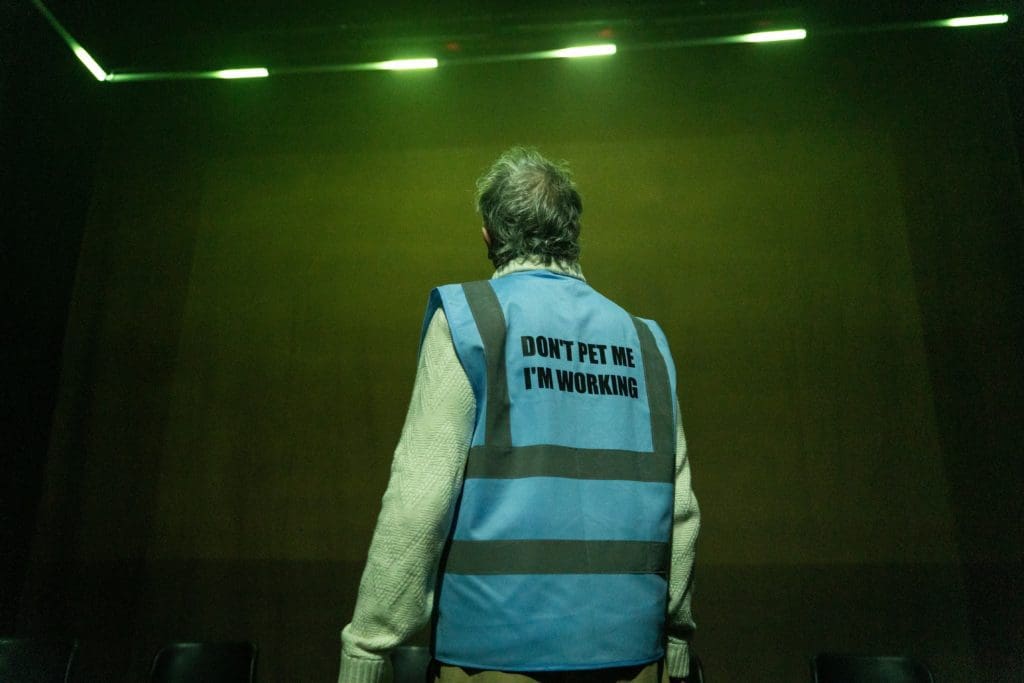
Simpson is not dressed as a canine, nor does he walk on all fours, but his tabard bears the message “Don’t Pet Me I’m Working” and his roll-neck jumper and trousers evoke the colours of a Golden Retriever or Labrador.

This dog talks, taking the narrator’s role, while evoking the school head of history and a particularly sensitive schoolboy, and taking the audience by the hand as he invites us to imagine being in a theatre in 2026,then the group of school children, on the bus trip and in the museum, and most hauntingly, the victims of the Nazi Holocaust  in each Second World War picture.

Writer Dyson decreed only a few stage instructions, the most significant being that the pictures being described by Sam should never be shown. Instead, the images should be formed in our imagination – one of theatre’s most powerful tools – but such is the impact of Kristallnacht  (the Night of Broken Glass), the children’s exodus from Poland, the Jewish ghettos and the concentration camps that, when combined with Dyson’s descriptions and Simpson’s storytelling prowess, we readily draw on imagery from history books, films and documentaries.

Dyson’s structure is methodical, building momentum all the while. A head count is taken as regularly as Simpson’s Sam asks us how we are feeling after each picture. Simpson’s narrator explains how Sam can sense our emotions, our distress, without having the capacity to understand the play’s greater question: Why?

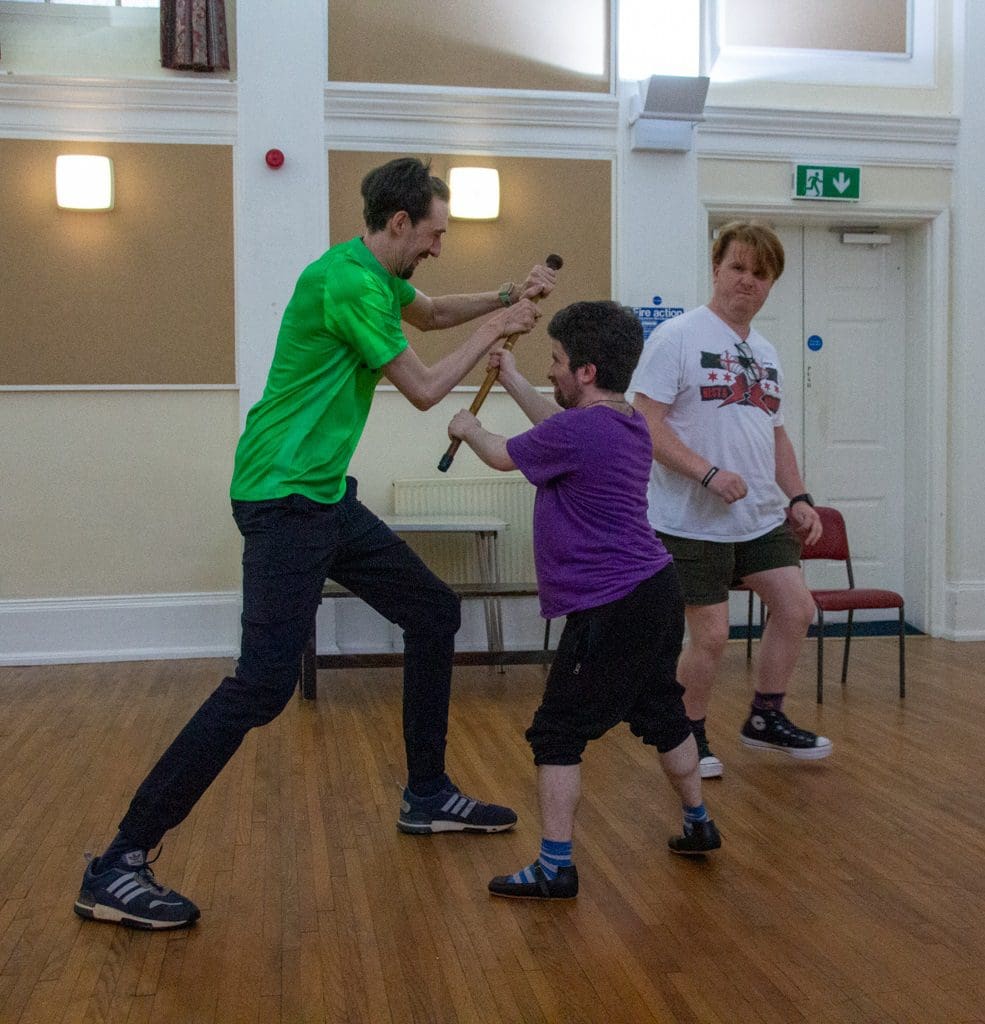
Director John R Wilkinson in rehearsal with actor Robin Simpson for the world premiere of The Last Picture

Gradually, we see teacher, breakaway 13-year-old pupil and dog all break down in reaction to what they are encountering, all  conveyed so expressively by Simpson. 

We learn too of other children’s reactions: wanting to know when lunch will be; wondering why something that happened so long ago in a different country should matter to them as they head from room to room, one marked Escalation, Deportation, Final Solution. They reach for the mobile phones at the earliest opportunity to flick through the latest posts.

Interestingly, contrary to myth, dogs do see in colour, but not in the same way we see colour, and here Wilkinson and set designer Natasha Jenkins complement Dyson’s descriptions of colour used by Sam to sum up the mood of each scene.

The back wall is covered with a plain cloth (an aid for us to build up a picture); the flooring has a metallic black sheen, framed by Isle of Skye lighting designer Benny Goodman’s strip lighting that changes from white to yellow. When the cloth drops suddenly, the stage is bathed in fiery orange.

Natasha Jenkins’s set design for York Theatre Royal’s production of The Last Picture. Picture: S R Taylor Photography

The minimalism stretches to the props: one table to the side, with a water bottle marked Sam (for Simpson’s vocal lubrication) and five lecture hall/school room chairs that Simpson uses in differing ways, most disturbingly to portray dead children when lain on their side.

Every detail has been thought through to the max, honed in four weeks of rehearsals, a research visit to Holocaust Centre North in Huddersfield, and in Wilkinson’s bond with Dyson over the power of abstract, non-literal  theatre and European drama, as well as in Simpson’s remarkably adroit performance.

The Last Picture had begun life as one of 37 new plays picked from 2,000 entries to mark the500th anniversary of Shakespeare’s First Folio in 2023 with a national playwriting initiative, when Wilkinson directed a rehearsed reading at York Theatre Royal and saw its potential for a full-scale production.

Robin Simpson’s Sam in a rueful moment in The Last Picture. Picture: S R Taylor Photography

This is that production, the full picture of The Last Picture, and what a fitting, moving first show for the Theatre Royal to make for the Studio space since the accursed Covid pandemic.

Add Max Pappenheim’s sound design, a devastating use of Mendelssohn’s music – deemed “degenerate” by the Nazis – and movement direction full of circular rhythm by Alexia Kalogiannidis, and Dyson’s play is unique, wholly original, thoroughly theatrical.

The Last Picture is unmissable, unforgettable, urgently needed theatre at its best.

The Last Picture, York Theatre Royal Studio, until February 14, 7.45pm plus 2pm Wednesday and Saturday matinees, then on tour. Box office: 01904 623568 or yorktheatreroyal.co.uk. The tour will visit HOME Manchester, February 18 to 21; Bristol Old Vic, February 24 to 28; Yvonne Arnaud Theatre, Guildford, March 5 to 7;  Mull Theatre, March 11 and 12; Bunessan Village Hall, March 13; Iona Village Hall, March 14.  

How Robin Simpson is switching from pantomime dame to dog for The Last Picture at York Theatre Royal Studio

Director John R Wilkinson and actor Robin Simpson in the rehearsal room for York Theatre Royal’s premiere of Catherine Dyson’s The Last Picture: James Drury

IN the first York Theatre Royal production to be made for the Studio since 2019, associate director John R Wilkinson directs Robin Simpson in The Last Picture from February 5 to 14.

After his sixth season as the Theatre Royal pantomime dame in Sleeping Beauty – and confirmed already for a seventh winter in Snow White And The Seven Dwarfs – Robin will swap the dame’s frocks and puns for the role of a dog in YTR, ETT and An Tobar & Mull Theatre’s world premiere co-production.

Robin will play an emotional support dog in Catherine Dyson’s 75-minute solo play, first performed in a reading at the Theatre Royal as one of 37 winning scripts selected from more than 2,000 entries by the Royal Shakespeare Company for its 37 Plays competition in 2023.

“We were given three of the plays to do in book-in-hand readings,” recalls John. “Juliet [creative director Juliet Forster] did  one about MeToo ; Mingyu [resident artist Mingyu Lin] Lin directed one about immigration and diaspora. Then, by default, I was given this one – and I lucked out because The Last Picture was the best play.

“Part of the deal is that the writer comes up to see the reading. Catherine is an actress from Swansea – one of her main roles was playing the ‘woman in black’ in The Woman In Black, the role that’s never credited in the programme! – and she’s branched out into writing plays.

“She and I really connected over my love of European theatre – bare-bones abstract  work – that leans into a storytelling in collaboration with the audience, where there’s very little in terms of set and design elements and instead the audience is encouraged to conjure the play for themselves.”

Dyson’s monodrama invites you to imagine yourself in a theatre in 2026. Now picture yourself as a Year 9 student on a school trip, and then as a citizen of Europe in 1939 as history takes its darkest turn. While you imagine, emotional support dog Sam will be by your side to look after you and keep everyone safe in a play built around empathy, its power and limits and what it asks of us.  In a nutshell, The Last Picture explores our shared past, our present,  and the choices we face today.

“For context, Catherine has Jewish heritage,” says John. “Her grandfather escaped persecution just before everything happened in Poland, escaping over the Tatra Mountains, so there’s a personal connection with this story.”

In a novel theatrical conceit, “Catherine was interested in telling the story through the eyes of a dog”, says John, in a device where Robin does not come on dressed as a dog but gives voice to what the dog is seeing and experiencing.

Robin says: “Pretty much straightaway it’s made clear that it’s being told by a dog, where we’re asking the audience to go on a journey of the imagination, when the story is told through a series of pictures created in language.”

John rejoins: “There are only one or two, very clear, stage directions by Catherine, but one was that there should be no actual pictures: they should all be created in the audience’s imagination.”

The production will lean into folklore and ritual. “The play is really fascinating in that we’re operating on several different levels. Firstly, I’m telling a story where I’m asking the audience to accept that I’m a dog, who’s part of a group of Year 19 pupils – aged 13, 14 – as their emotional support on a museum visit,” says Robin.

“Then I ask the audience to be the pupils, so they’re very much part of the story, sometimes in the story with me, and at other points we’re asking them to empathise with the people  in the pictures created through language, because it’s a play about empathy and humanity.”

Robin continues: “I think the reason Catherine chose the dog’s point of view is that the dog can say dispassionately what’s going on in the pictures without having that human connection to the story, so the audience can make up their own mind.

“In finding the voice for the dog, it has to be about a balance between telling the story and colouring the story with emotion without performing it.”

John adds: “It’s such a clever form of storytelling that Catherine has leant into. One thing we said is that it’s not an animal study, but the dog gives the storytelling comfort and warmth.”

At the beginning, there is a description of how dogs have the ability to absorb human emotions without understanding them. “The dog picks up on the children’s emotions of being affected by what they’re seeing without the dog understanding why,” says Robin.

“What Catherine has done really cleverly is that there a lot of sticky political situations going on in the world that she doesn’t directly refer to,” says John. “But in terms of what she’s asking the audience to do, she doesn’t give a political viewpoint but she lets you sit and reflect on how it relates to what’s happening now.”

The Last Picture, York Theatre Royal Studio, February  5 to 14, except February 8, 7.45pm plus 2pm, February 7, 11 and 14. Box office: 01904 623568 or yorktheatreroyal.co.uk.

REVIEW: York Theatre Royal in Sovereign, King’s Manor, Exhibition Square, York, until July 30 ****

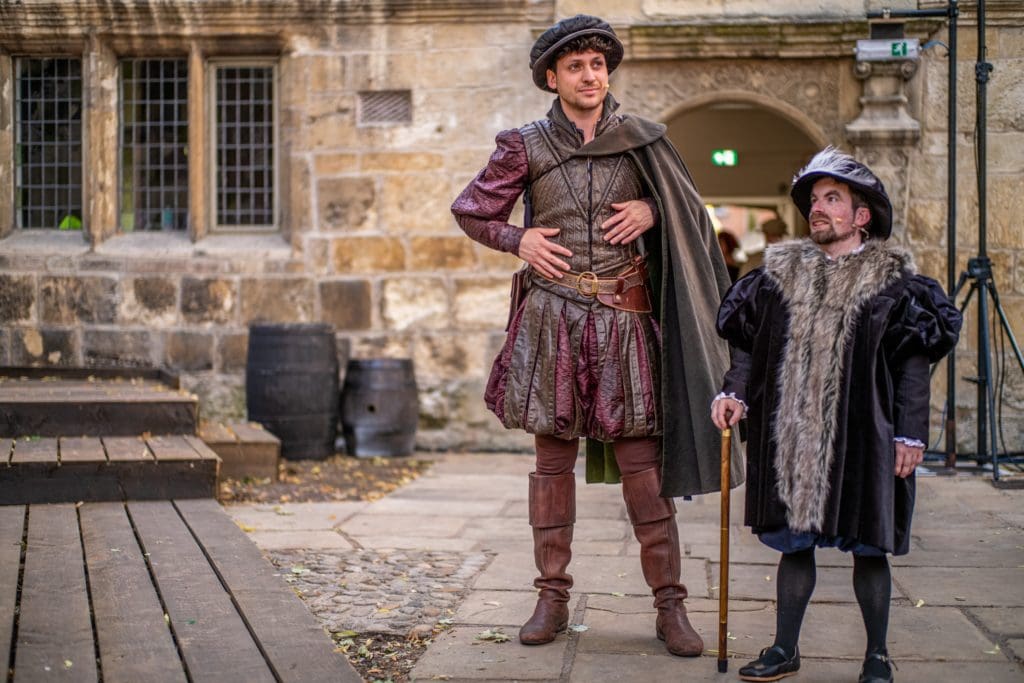
Sleuth and sidekick: Fergus Rattigan’s Matthew Shardlake with Sam Thorpe-Spinks’s Jack Barak in Mike Kenny’s adaptation of C J Sansom’s Sovereign in the King’s Manor courtyard. Picture: Charlotte Graham

FIRST the bad news. Not the July weather forecast, but the Sold Out notices denoting you are too late to book for the rest of the fortnight run of this summer’s York Theatre Royal community play.

Such has been the demand to see Mike Kenny’s adaptation of C J Sansom’s Tudor-set thriller in the very place where the biggest chunk of this best-selling sleuth story is set: King’s Manor, so re-named from the Abbot’s House to mark Henry VIII’s visit to the city with his latest queen du jour, Catherine Howard.

Staged in partnership with the University of York on its city campus, Sovereign plays out in the courtyard, the one with the tree at its epicentre and steps that add both height and dramatic statement to co-directors Juliet Forster, John R Wilkinson and Mingyu Lin’s grand production.

Aside from the front row, each capacity house of 240 is protected by a canopy from the rain, leaving the cast of 100 to battle with the elements, as they did last night and rather more so amid Saturday’s heavy downpours.

Kenny, a veteran of York outdoor productions from 2012’s The York Mysteries in the Museum Gardens and Blood + Chocolate on the city streets, even has Sovereign’s Greek chorus – or Women of York Chorus, to be precise – defy the rain with a knowing Yorkshire shrug. They will comment on a woman’s lot in Henry’s world with feminist ire too, resonating with the #MeToo era.

In our age of “levelling up”, but not levelling truthfully with the people, Kenny makes much of the north-south divide in Sovereign, right from the opening scene where Mark Gowland’s gouty, vainglorious Henry makes claim to godlike status, to the chagrin of Rosy Rowley’s no-nonsense God on a York Mystery Plays wagon on the other side of the stage.

As the play unfolds, towards its close after two hours and 45 minutes, Kenny makes a series of bullet pronouncements on the division between Protestant South and Papist North. Not only did Henry take land from Yorkshire landowners and dissolve the monasteries of God’s Own Country, but he put a stop to the Mysteries, seeing them as Catholic propaganda. History will tell you the wagons rolled on for a while longer, but then fell silent until the 1951 Festival of Britain.

Henry is a hated figure in York in Sansom’s story, as he seeks to impose the Royal Progress of 1541. The “Southerans” are unwelcome, not only “Fat Harry”, but also disabled lawyer Matthew Shardlake (Fergus Rattigan) and his Jack-the-lad Jewish sidekick, Jack Barak (University of York history and politics alumnus Sam Thorpe-Spinks).

Shardlake is mocked as a bottled spider by Henry, a crouchback by others; Joe Hooper’s Fulke Radwinter takes against Barak and Shardlake, taunting Barak about the events of March 16 1190, the Massacre of the Jews at Clifford’s Tower.

At Clifford’s Tower in Sovereign the body of Robert Aske, convicted of high treason by Henry, is still hanging five years after his execution in 1537. Plenty more bodies will pile up by the play’s end, more in the tradition of Jacobean tragedies.

Thorpe-Spinks has called Barak “Dr Watson to Shardlake’s Holmes”, but he rather more reminds you of Dennis Waterman’s Terry McCann in Minder with his feisty willingness to challenge all comers and eye for the ladies. Or one lady in particular, Livy Potter’s resourceful Tamasin Reedbourne, as Potter continues her run of winning performances in recent months.

Rattigan makes for a wily and worldly Shardlake, but lawyers have a bad name in this world – another dig delivered with comic timing in Kenny’s canny script – and so he becomes a more complex character as Sansom’s stinging story progresses. Not a conventional hero, not morally straight-backed, but remorseless as a Poirot. By comparison, Thorpe-Spinks’ lovable Barak is a little under-used, but then he is preoccupied with Potter’s Tamasin.

Shardlake and Barak have been sent north to keep an eye on political prisoner Edward Broderick (Nick Naidu-Bock, haunted and haunting), but the murder of a York glazier finds the plot thickening like a bechamel sauce.

So much is bubbling away in Sansom’s story: Matthew Page’s Giles Wrenne earnestly seeking to challenge Henry’s right to the throne; the Conspiracy at work; Scarlett Rowley’s insouciant Queen Catherine playing away from home with Josh Davies’s former beau Thomas Culpeper (or Culpepper in this version); Maurice Crichton’s curmudgeonly Yorkshireman Maleverer in peak scene-stealing form.

Not only does this community play have a chorus but an even larger York Ensemble for crowd scenes and dance numbers steered by movement director Hayley Del Harrison, and a King’s Ensemble for more north-south shenanigans.

The directing triumvirate achieves a balance between scenes on a physical grand scale and ones of more intimacy of a psychological nature. As for spectacle, look out for dramatic entrances by horses and a bear, courtesy of Animated Objects’ animal heads, and a cock-fighting scene too.

Dawn Allsopp’s set design works in happy union with King’s Manor, Hazel Fall’s costume designs are a Tudor delight and Craig Kilmartin’s lighting design plays to daylight’s progress into night. Out of view, to the side, apart from musical director Madeleine Hudson’s outstretched arms, is the choir, but their contribution is vital, commenting in song on what is ensuing through Dominic Sales’s wonderful compositions.

Yes, Sovereign could be shorter, and in a future staging it probably would be, but Mike Kenny has worked his Midas touch once more. York Theatre Royal is ahead of the game too: a television series of Sansom’s stories is on its way.

York giving Fat Harry the proverbial two fingers will live long in the memory.

Box office for returns only: 01904 623568 or yorktheatreroyal.co.uk.

Once he studied history and politics in York. Now Sam Thorpe-Spinks stars in Henry VIII mystery thriller Sovereign at King’s Manor

Sam Thorpe-Spinks looks forward to performing Sovereign – “a crime drama in situ” – at King’s Manor. Picture: Alex Holland

SAM Thorpe-Spinks first made his mark on the York stage scene in student productions while reading History and Politics at the University of York.

He later trained at Guildhall School of Music and Drama and now returns to the city as one of two professional actors leading a 100-strong community cast and choir in York playwright Mike Kenny’s adaptation of C J Sansom’s Tudor-set thriller, Sovereign.

PlayingJewish sidekick Jack Barak to Irish actor Fergus Rattigan’s disabled lawyer Matthew Shardlake in the York Theatre Royal co-production with the University of York, Sam’s role just happens to combine history and politics, as well as murder and mystery, in a story to be staged outdoors at King’s Manor, one of the key locations in Sansom’s novel, from Saturday (15/7/2023) to July 30.

“That’s why doing this play is interesting, having studied History and Politics at university here from 2011 to 2014. I remember being at Clifford’s Tower one night from three till five in the morning and not realising its historical significance at the time,” he recalls.

“My Jewishness is something I’ve only rediscovered in the past five years. My mother’s side of the family escaped the pogrom in the early 20th century, went to Belfast and set up a synagogue there.

“When I was at drama school, I was aware of antisemitism in the theatre world. Before that, my grandmother, Gillian Freeman, wrote the novel The Leather Boys [1961] and the screenplay [for Sidney J Furie’s 1964 film], writing the book based on her Jewish history.

“I got in touch with my Jewishness culturally, rather than through faith, and last year I set up Emanate with my friend Dan Wolff [his fellow actor-producer] to champion new Jewish writing. Last August, we sold out a two-night run of six short scenes by Jewish writers at the Kiln Theatre (formerly the Tricycle Theatre), and we’ll be going to the Soho Theatre (London) in August for two weeks with three new plays by Alexis Zegerman, Ryan Craig and Amy Rosenthal, exploring birth, marriage and death.

Sam Thorpe-Spinks playing a soldier in Quicksand at York Theatre Royal’s TakeOver festival in his University of York days

”So, my Jewish curiosity has filtered its way into my work. Once I finish Sovereign on the Sunday (30/7/20230), I’ll start rehearsals on the Monday for Alexis’s play, The Arc, the one that looks at marriage.”

Since June 14, his focus has been on rehearsals for Sovereign, linking up with Theatre Royal creative director Juliet Forster and co-directors John R Wilkinson and Mingyu Lin’s community cast, whose rehearsal schedule for this summer’s world premiere had begun in March.

“Jack Barak is the Dr Watson role, the assistant, and there’s been a lot of fun acting alongside Fergus’s detective. Barak is certainly more the lovable rogue character of the detective duo. He’s not a strong man but he’s lot more equipped to sniff out trouble and deal with it – and he has a charming propensity to find women for himself,” says the six-foot tall, blue/green-eyed, black-haired Sam.

“He has a little love interest in the play that leads him into trouble, but the book series concludes with him marrying and having children, so he does learn about love!”

Kenny’s adaptation focuses on Sansom’s story of lawyer Shardlake and Barak being sent from London to York to await the arrival of Henry VIII at King’s Manor, only to be plunged into a mystery that could threaten the future of the crown when a York glazier is murdered.

“It’s such a privilege to be performing at King’s Manor,” says Sam. “Normally you have to use your imagination, but I don’t have to use any for this! York is steeped in Tudor times, and to be appearing in a play performed where the story happened is quite rare.

“The Minster is a constant reminder of the city’s history, so you can never escape the play, and that’s a good thing.”

Lead actors Fergus Rattigan, left, and Sam Thorpe-Spinks at King’s Manor, York, where Mike Kenny’s adaptation of C J Sansom’s best seller will be staged from Saturday. Picture: Alex Holland

As for Henry VIII, already given a hard time in SIX The Musical at the Grand Opera House in late June, “they hate Henry in York, or certainly they do in this play,” says Sam. “He’s a southerner trying to exert his southern ways on the north, and both Shardlake and Barak are from the south too, so they’re treated with suspicion as well.”

Sovereign is Sam’s third play since leaving drama school, in the wake of Emanate and Peter Gill’s Something In The Air (Jermyn Street Theatre, London). “It’s the first one I’ve done on this scale, with so many cast members,” he says.

“The way Mike Kenny has adapted such a vast novel, bringing the characters into a palatable play that you can follow easily, he’s done an amazing job, keeping it really lean to the bone, and it feels like a play that was born to be performed by a community cast.

“You should see it because it’s a rich and colourful portrait of York in the 16th century, with murders, blood, treason and romance, and a cast of 100-plus performing in the actual location where the story took place. A crime drama in situ!”

No need for a sales pitch: Sovereign has sold out already.

York Theatre Royal and University of York present Sovereign outdoors at King’s Manor, Exhibition Square, York, from July 15 to 30. Tickets update: Sold out. Box office, for returns only,  01904 623568 or at yorktheatreroyal.co.uk.

Copyright of The Press, York

Sam Thorpe-Spinks

What’s in a name? Sam Thorpe-Spinks

Sam: Hebrew origin, meaning “told by God” and “God hears”.

Thorpe: Derived from Old Norse or Old English, denoting a hamlet or village. Many place names in England have the suffix “thorp” or “thorpe”. Those of Old Norse origin abound in Yorkshire, Northumberland, County Durham, Yorkshire, Lincolnshire, Cambridgeshire, Norfolk and Suffolk.

Spinks: ‘Spink’ (noun) denotes a finch or the sound of a particular bird cry. ‘Spink’ (verb) denotes a finch calling or chirping or making a characteristic sound.

Fergus Rattigan plays the ‘Tudor Poirot’ in Henry VIII thriller Sovereign at King’s Manor

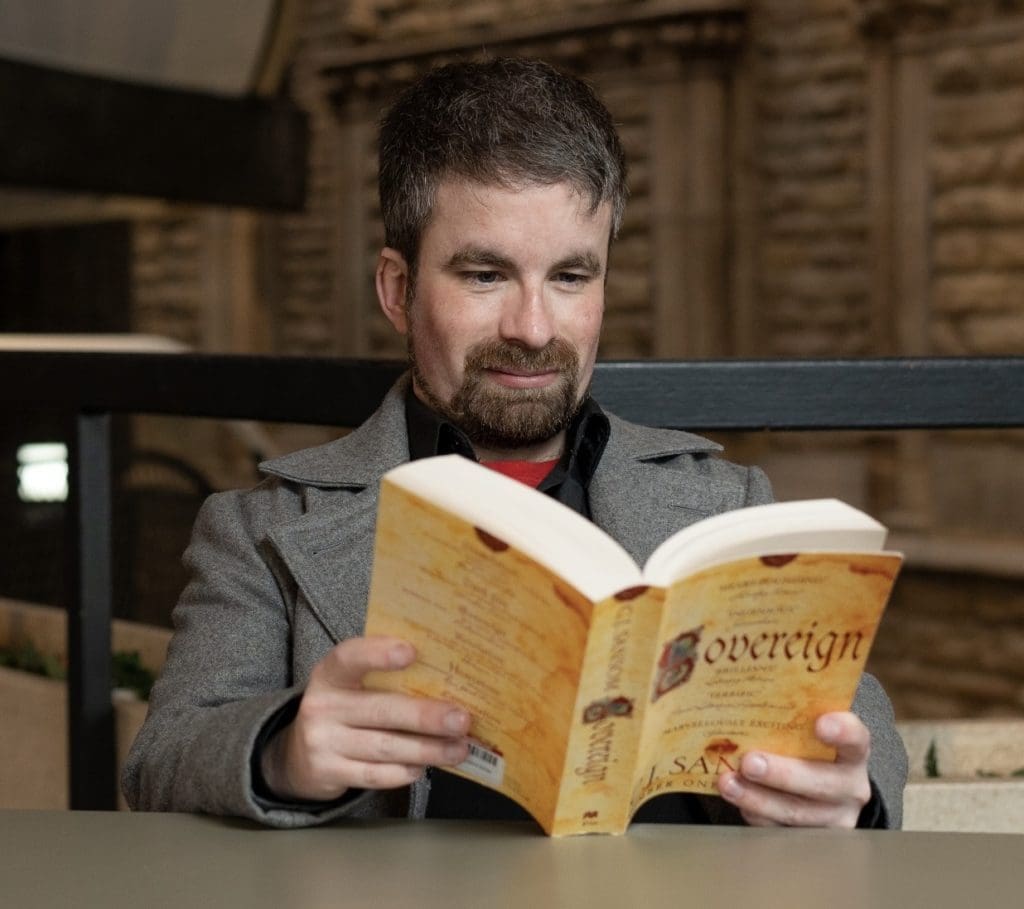
Lead actor Fergus Rattigan with a copy of C J Sansom’s novel Sovereign. Pictures: Simon Boyle

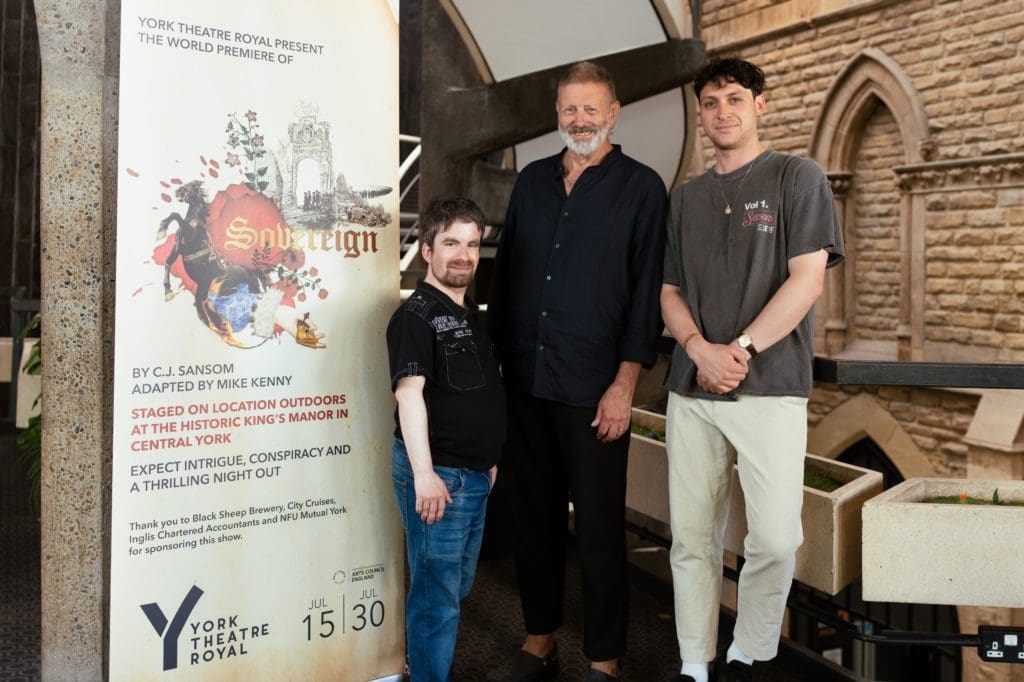
AS the poster pronounces, expect intrigue, conspiracy and a thrilling night out when York Theatre Royal’s 120-strong community cast stages Sovereign on location at King’s Manor, Exhibition Square, York.

Leading the company in this open-air world premiere of York playwright Mike Kenny’s adaptation of C J Sansom’s Tudor-set thriller will be Irish actor and stage combat fighter Fergus Rattigan.

From July 15 to 30, Fergus plays disabled lawyer Matthew Shardlake, working in tandem with assistant Jack Barak (fellow professional Sam Thorpe-Spinks, late of the University of York). This “detective” duo is in York awaiting the arrival of Henry VIII, only to be plunged into a murder mystery that could threaten the future of the crown.

“I’m a Plantagenet/Tudor nut, right through to this period, and I’ve worked at Shakespeare’s Globe on occasion,” says Fergus. “When I came to York in the summer of 2021, when the Covid restrictions were softened and we were allowed to travel, I did a Viking tour, visited the Minster and walked the City Walls, reciting bits of Richard III. My partner is a historian, by the way.”

The role of Shardlake is made for Fergus. “I read the script and thought, ‘well, yes, I know this world, I know these characters, I know what’s happening, and even the way the character is described as a ‘hedgehog’ and ‘brothel spider’: one of those insults that echoes Shakespeare’s hunchbacked Richard III – and I’ve played Richard III on Zoom for the company Shake-Scene Shakespeare.

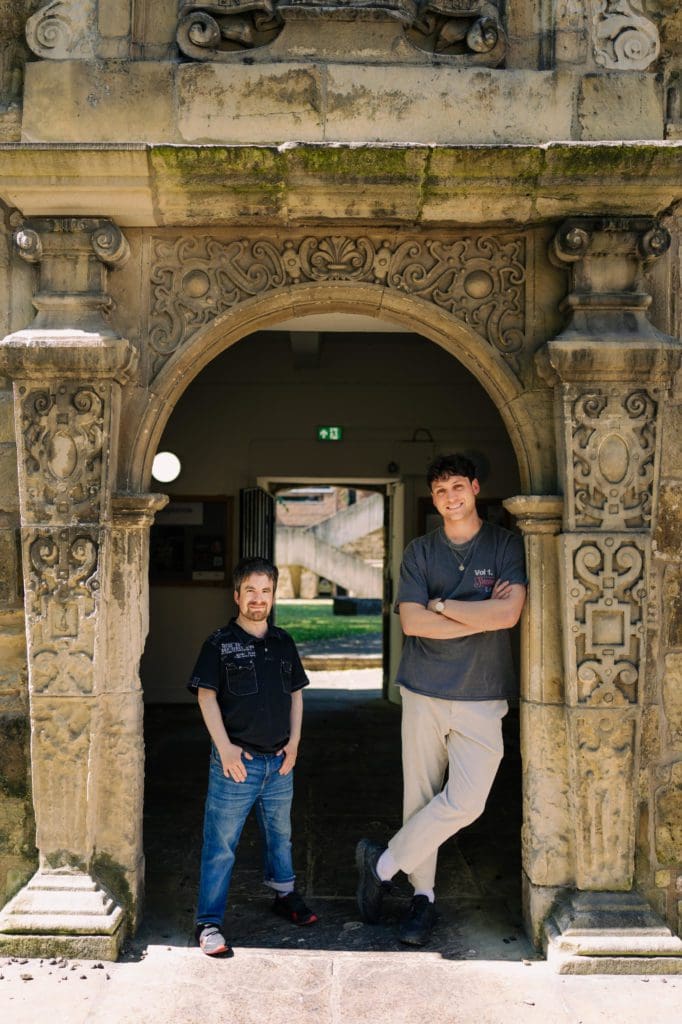
Actors Fergus Rattigan, left, and Sam Thorpe-Spinks with Sovereign adaptor Mike Kenny

“I’ve also directed bits of Richard III for the Dublin Shakespeare Festival in the Tudor crypt at Christ Church Cathedral, when we did scenes all around the city.”

Fergus’s agent informed him of the York Theatre Royal production. “The minute I learned about it, I was, ‘yes, yes, I’m very interested’!” he recalls. “I was auditioned by Juliet Forster and co-director John R Wilkinson on Zoom and then I came for an interview with all three co-directors [Mingyu Lin is the third] to see if I would be comfortable working with a community cast and whether I’d be comfortable with my disability being portrayed on stage.”

The answer was an emphatic “yes”. He cherished both the “juicy role” role and the performing opportunity. “Not only do I love and study the Tudor period but Shardlake has my mindset. He’s a bit of an outsider, which is something I can relate to both as a disabled person in a world not designed for disabled people but as a foreigner from another country. I’m very used to that outsider nature.

“I see myself very much reflected in him. When he’s in front of the King, there’s a moment of embarrassment. I’ve felt that. I’ve been in public where everyone is staring at me for just being myself. As a short man I’ve had people laugh at me for no reason, things like that. Or have judged me when I turned up for a job and I’m half the size they thought I was going to be.

“Shardlake’s situation is surprisingly relatable. He keeps a lot of it to himself, which is quite true to life with a lot of disabilities. The amount people are going through internally is always worse than what’s happening externally.”

Fergus Rattigan, centre, in the rehearsal room for Sovereign

Fergus’s condition is dwarfism, or dwarf syndrome, to quote the medical term. He notes how pantomime productions are increasingly not using dwarf actors, some preferring puppets, for Snow White And The Seven Dwarfs.

“I’ve worked with a group of seven actors for some time in Snow White. We were at the Festival Theatre in Edinburgh last Christmas and I’ll be working with the same company next Christmas. But you see some theatres not doing that now – and it’s not the dwarf actors being asked about it. It’s people being offended on our behalf – and now on the poster it’ll still say ‘The Seven Dwarfs’ but in the script it’ll say ‘The Magnificent Seven’.

“I’d say the term ‘dwarf’ is fine. Everyone knows what you mean. There’s no confusion. There’s nothing derogatory about it. People think they are generic characters but it’s just more clear than it is for other characters that it’s our characteristic.”

Fergus had not read C J Sansom’s novels before Shardlake came his way. “But I don’t know how I hadn’t because I’ve read historical novels and fictional stories of the period, especially by Philippa Gregory, who happens to live in Yorkshire,” he says.

Before auditions began, he read Sansom’s source novel, first quickly, then more thoroughly to add Post-It notes. “You can tell he has researched the period thoroughly, and likewise Mike Kenny’s script refers loyally to the book,” says Fergus.

Fergus Rattigan at King’s Manor, where he will play the disabled lawyer Matthew Shardlake

What stirred his interest in such novels and works of fiction? “It’s a weird thing. I got into Shakespeare very early on, but in Ireland we don’t have the focus on history the way you do over here, particularly not studying the War of the Roses,” says Fergus.

“So, I didn’t know what people were referring to when I came over here. I thought, ‘I must read about it’, and then I started to read historical novels and fictional works .”

Now he is at the centre of one such story, Sovereign. “It’s fiction and conspiracy on top of history, where Shardlake gets to step in as the Poirot of his period. He just tends to be in the right place – or the wrong place! – at the right or wrong time, depending on how you look at this little ‘hedgehog’ man,” says Fergus.

“There’s pressure to get the performance right, but you can also make it your own. You’re not trying to find your unique slant on Hamlet but to find the character, seeing how big or small to make his character, how proud he is as a proper lawyer or ashamed of his disabilities.

“For me, acting is about reacting to those around me and responding to that – and this time it’s a cast of 120.”

York Theatre Royal presents Sovereign outdoors at King’s Manor, York, July 15 to 30. Tickets update: SOLD OUT. Box office for returns only:  01904 623568 or yorktheatreroyal.co.uk

Copyright of The Press, York

York Theatre Royal to stage CJ Sansom’s Tudor thriller Sovereign as community play on grand scale at King’s Manor in July

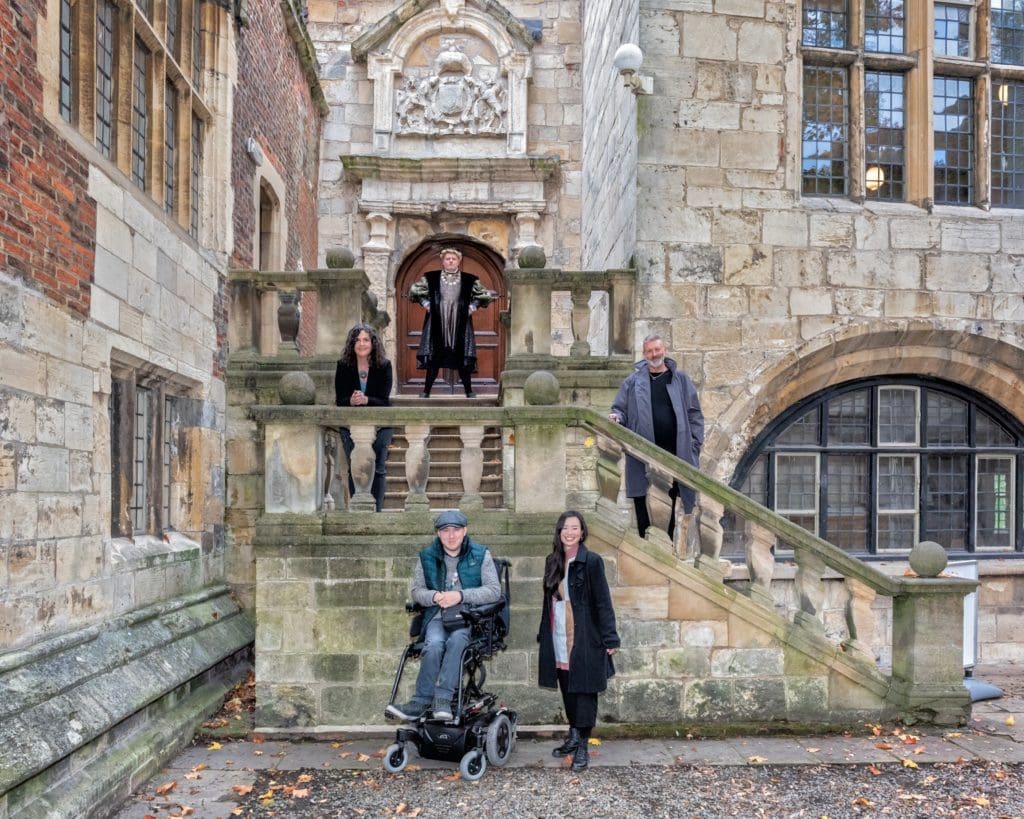
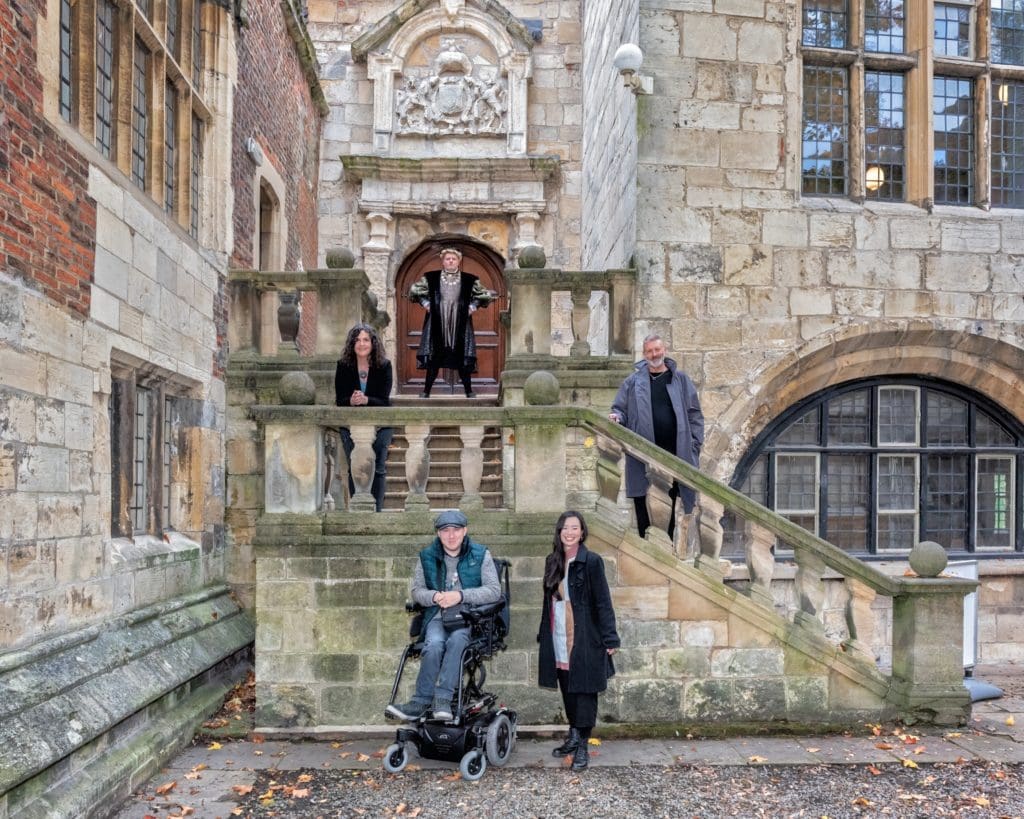
On the king’s manor: The Sovereign figure of Henry VIII (Mark Gowland) stands over York Theatre Royal creative director Juliet Forster, playwright Mike Kenny and, front, Juliet’s co-directors John R Wilkinson and Mingyu Lin at the launch of the Theatre Royal’s community production of Sovereign. Picture: Ant Robling

IN the climax to York Theatre Royal’s Sovereign Season, a community cast will stage a majestic outdoor summer production in the grounds of King’s Manor in Exhibition Square.

Adapted for the stage by prolific York playwright Mike Kenny, the world premiere of CJ Sansom’s York-based Tudor thriller will run from July 15 to 30 under the direction of Juliet Forster, John R Wilkinson and Mingyu Lin.

York Theatre Royal is seeking to assemble a cast of 100 adults and young performers aged nine and over from this month’s auditions for a production “on a grand scale”.

The use of King’s Manor could not be more apt, given Sansom’s setting of the story in Tudor York in 1541, when the Council of the North would meet there.

History records that St Mary’s Abbey, in Museum Gardens immediately behind King’s Manor, was suppressed by Henry VIII in 1539, destroying most of the monastery. King’s Manor – or Abbot’s House as it was known – survived, however, and continued to be the Council of the North’s headquarters.

In anticipation of an “ostentatious” Royal visit by Henry VIII and Queen Catherine Howard in 1541, the city of York repaired and improved the building. The royal party duly occupied the manor house for 12 days, their visit leading to the building becoming known as King’s Manor.

In Sansom’s York of 1541, the play follows lawyer Matthew Shardlake and his assistant Jack Barak who await the arrival of Henry VIII on his northern progress.

Tasked with a secret mission, Shardlake is protecting a dangerous prisoner who is to be returned to London for interrogation. When the murder of a York glazier plunges Shardlake into a deep mystery that threatens the Tudor dynasty itself, he must work against time to avert a terrifying chain of events.

Told through the voices of the people of York, the Theatre Royal production promises to release all the intrigue, conspiracy and thrills of Sansom’s novel. Alongside the community ensemble, two professional actors will star in the production too. Rehearsals begin on April 15, taking in two weekday evenings and Saturday daytimes in the lead-up to the tech weeks from July 3 and 10.

Already the Sovereign Season has taken in the world premiere of David Reed’s Guy Fawkes, with the Royal Shakespeare Company’s political thriller Julius Caesar still to come from June 13 to 17, directed by Atri Banerjee.

“A lot of the plays in the season deal with different forms of leadership and resistance; what’s good leadership; what’s good sovereignty,” says Theatre Royal creative director Juliet Forster.

“The jewel in the crown is CJ Sansom’s historical thriller Sovereign, the third book in the Shardlake trilogy, where Henry VIII came up here to sort out the northern rebels, beat us into line and show his power in his northern progress.”

York playwright Mike Kenny: Adapating CJ Sansom’s Sovereign for the York Theatre Royal community production

Welcoming the chance to adapt Sovereign, Mike Kenny says: “It will push the form of community theatre in all sorts of ways. I got invited to a conference in Montpellier [France] about large-scale community theatre, and though I’d never thought of it as being a very British thing, I was asked to talk about the York experience of staging community plays.

“I was aware, as I was talking through the experience, that every time we’ve done such a play, we were pushing the envelope because, in York, we don’t take the pre-digested version, we take the local story and push it.

“In this instance, I don’t think anyone has done that with a whodunit like this one, where Shardlake, the central character is disabled and gets a lot of stick because of that.”

Mike continues. “The book is set in 1541, well before Shakespeare’s play Richard III was written [1592-93], which reflected attitudes towards disability. It’s an interesting development in community theatre to have a disabled actor in the lead role.”

Co-director John R Wilkinson points out: “Shardlake’s sidekick is Jewish, another prejudice of that time.”

Mike rejoins: “That’s particularly potent in York, where the play is set, more than 300 years after the Massacre at St Clifford’s Tower, where the Jewish pogrom happened in 1190. A couple of the scenes are set there, so it’s pushed the boat again.”

Juliet says: “It’s the first time we’ve done an adaptation as a community play. Normally we take history and creative a fictional history, like we did for Blood + Chocolate, In Fog And Falling Snow, Everything Is Possible: The York Suffragettes and The Coppergate Woman.

“This time, there’s already an historical fictional narrative and we’re then bringing out the really strong York connections.”

Mike notes how: “One of the things that hit me hard was how Henry VIII was directly responsible for the end of the medieval Mystery Plays, which had been a Catholic tradition in York. They came to an end in Henry’s time, finally being stopped 20 years after his visit.”

Just as the revived York Mystery Plays have set the benchmark for community productions in the city, so York Theatre Royal continues to relish picking up the baton and taking that theatrical form in new directions.

York Theatre Royal presents CJ Sansom’s Sovereign at King’s Manor, Exhibition Square, York, from July 15 to 30. Box office: 01904 623568 or yorktheatreroyal.co.uk.

Copyright of The Press, York

Follow in Henry VIII’s footsteps at King’s Manor by taking part in Tudor thriller Sovereign, next summer’s York Theatre Royal outdoor community production

On the king’s manor: The Sovereign figure of Henry VIII (Mark Gowland) stands over York Theatre Royal creative director Juliet Forster, playwright Mike Kenny and, front, Juliet’s co-directors John R Wilkinson and Mingyu Lin at the launch for York Theatre Royal’s 2023 community production. Picture: Anthony Robling

HERE comes the call-out for community cast members to take part in York Theatre Royal’s majestic outdoor summer production, Sovereign, in 2023.

The world premiere of C.J. Sansom’s York-based Tudor thriller, adapted for the stage by York playwright Mike Kenny, will run in the grounds of King’s Manor, Exhibition Square, York, from July 15 to 30 next summer.

Applications are open to be involved in the cast and choir in Juliet Forster, John R Wilkinson and Mingyu Lin’s community theatre production on a grand scale, with York Theatre Royal seeking around 100 adults and young performers aged nine and over.

Set in Tudor York in 1541, the play follows lawyer Matthew Shardlake and his assistant Jack Barak who await the arrival of Henry VIII on his northern progress.

Tasked with a secret mission, Shardlake is protecting a dangerous prisoner who is to be returned to London for interrogation. When the murder of a York glazier plunges Shardlake into a deep mystery that threatens the Tudor dynasty itself, he must work against time to avert a terrifying chain of events.

Told through the voices of the people of York, the Theatre Royal production will release all the intrigue, conspiracy and thrills of Sansom’s novel. Alongside the community ensemble, two professional actors will star in the production too.

Co-director Juliet Forster, the Theatre Royal’s creative director, says: “We’re so excited to stage Mike Kenny’s brilliant adaptation of C.J. Sansom’s Sovereign next summer. To do so against the spectacular backdrop of the grounds of King’s Manor, where Henry VIII actually visited, makes it even more special.

“This is a York story and we’re thrilled to invite the people of York to be a part of this community production and help us to bring it to life on the stage.”

Co-director John R Wilkinson says: “York has a wonderful history of epic, large-scale community productions and we’re thrilled that Sovereign will be the focus for next summer.

“There are lots of opportunities to get involved. We would like to see even more people, who haven’t taken part in a community show before, join us for this special production.”

Fellow co-director Mingyu Lin adds: “This is a fantastic and rewarding opportunity to be involved in such a large-scale community production and we’re really keen to hear from people from all backgrounds and experience levels who are interested in taking part.

York Theatre Royal creative director Juliet Forster: Co-directing Sovereign

“Even if you’ve never acted before but have a passion for the stage, we’d love to hear from you. York has such a wonderful tradition of community theatre and I can’t wait to be a part of it.”

Cast and choir members are invited to express their interest via these links before Monday, December 19 December, ahead of January’s auditions.

Acting – Adults: https://form.jotform.com/222853605081352  

Acting – Young people: https://form.jotform.com/223133353863352

Choir: https://form.jotform.com/223254058788364

In addition, an online and in-person drop-in session for people who identify as d/Deaf and Disabled and are interested in finding out more about participating will be held on Tuesday, December 6 from 2pm to 3pm.

This session will be led by co-director John R Wilkinson and community connector Lydia Crosland in the York Theatre Royal Studio or on Zoom at: https://us06web.zoom.us/j/81599256774 Meeting ID: 815 9925 6774.

Rehearsals will start on April 15 2023, taking in two weekday evenings and Saturday daytimes (times to be confirmed.)

All cast and choir members must be available for all tech rehearsals and the production run. Tech weeks:  Weeks starting July 3 and July 10 2023. Opening night: July 15.

Show schedule: Saturday, July 15, 7pm; Tuesday, July 18, 7pm; Wednesday, July 19, 7pm; Thursday, July 20, 7pm; Friday, July 21, 7pm; Saturday, July 22, 2pm and 7pm; Sunday, July 23, 2pm.

Tuesday, July 25, 7pm; Wednesday, July 26, 7pm; Thursday, July 27, 7pm; Friday, July 28, 7pm; Saturday, July 29, 2pm and 7pm; Sunday, July 30, 2pm.

Opportunities for further volunteers to help out backstage, in areas such as stage management, wardrobe, lighting, props, marketing, photography, fundraising and front-of-house, will be announced in 2023.

Sovereign was the Big City Read in 2009. Find out more about C.J. Sansom’s Shardlake series here. 

Tickets for Sovereign are selling fast already on 01904 623568, in person from the Theatre Royal box office or at yorktheatreroyal.co.uk/show/sovereign/

York playwright Mike Kenny: Adapting C.J. Sansom’s Sovereign for next summer’s York Theatre Royal community play at King’s Manor

REVIEW: The Coppergate Woman, York Theatre Royal, until Sunday ***

Radiant: Kate Hampson’s Coppergate Woman sees the light in The Coppergate Woman. Picture: : Jane Hobson

THIS is the first York Theatre Royal community play in five years and, more significantly, the first since pandemic restrictions were lifted, although the cloud of Covic hangs all too heavy over Maureen Lennon’s storytelling drama.

There is a sense of relief that we can gather again, perform together, build plays from scratch with faces old and new, but The Coppergate Woman is not a drama suffused with joy until its finale’s promise of a post-apocalyptic green new world.

Such a vision is ushered in with composer and musical director Nicolas Lewis’s most upbeat song, hand claps and all, but given all that is going around us, from higher and higher temperatures to higher and higher living costs and fuel prices, it is sung on a wing and a prayer.

The harsh realities of these times have seen cast members pull out through not being able to afford the travel costs or having to commit to working extra shifts to make ends meet, and therefore no longer being available for the heavy rota of rehearsals.

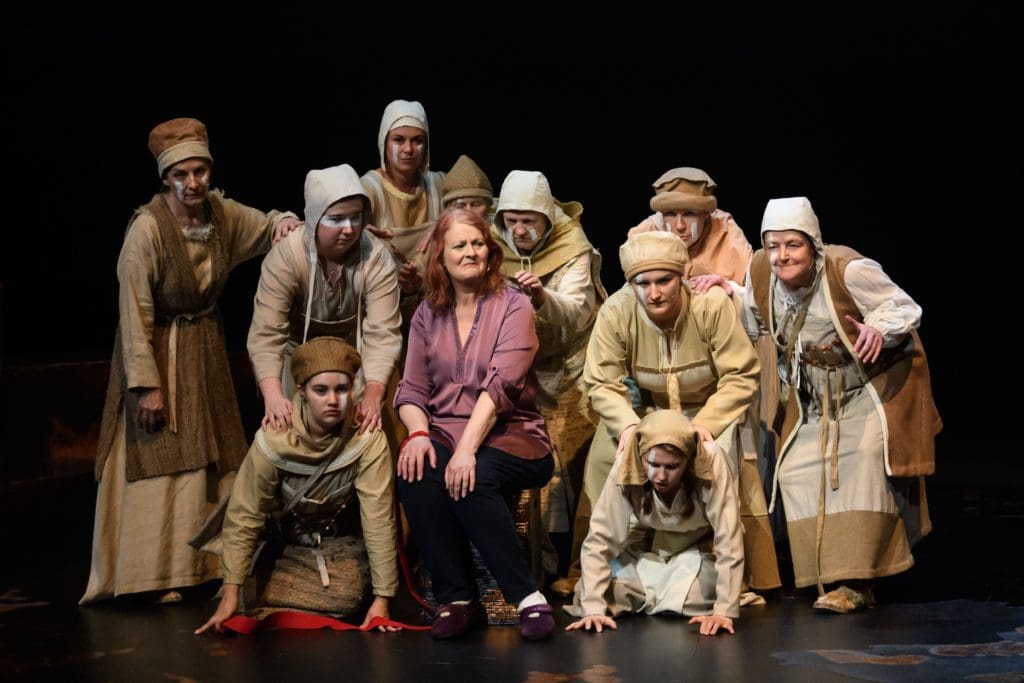
Ancient meets modern in The Coppergate Woman at York Theatre Royal. Picture: Jane Hobson

That said, community spirit bursts out of the 90 performers and plentiful choir members, as they build on the legacy of Blood + Chocolate (on York’s streets in 2013), In Fog And Falling Snow (at the National Railway Museum in 2015) and Everything Is Possible: The York Suffragettes (by the Minster and at the Theatre Royal in 2017 ).

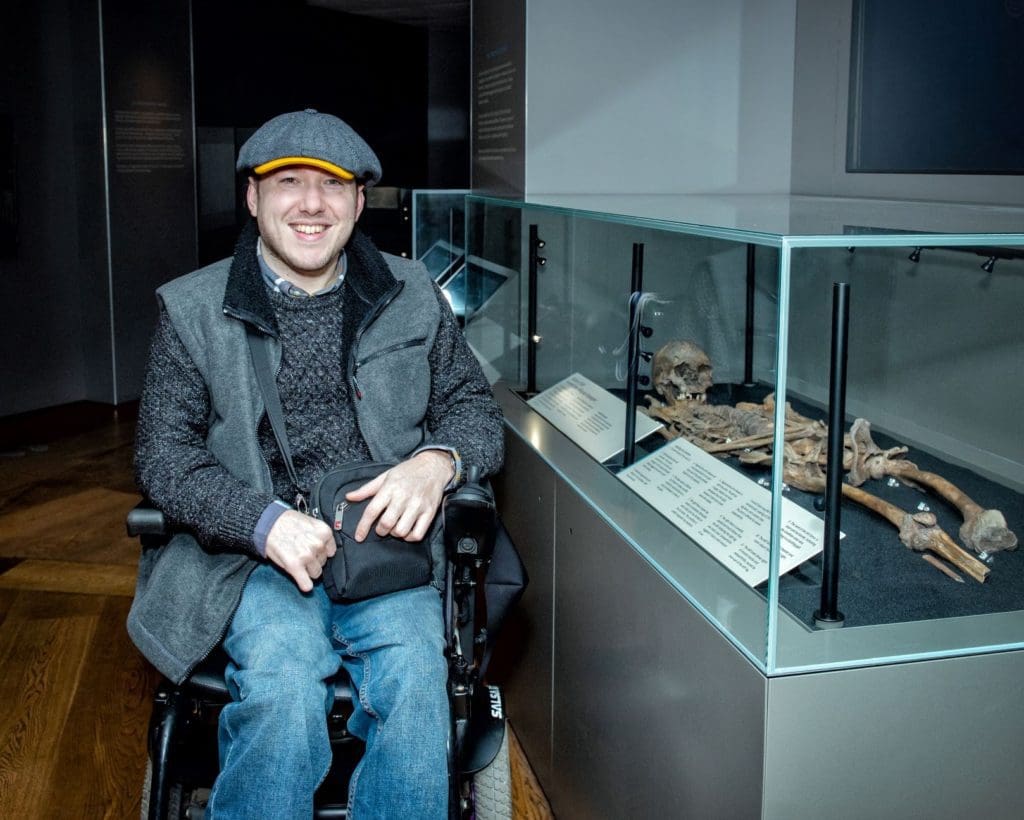
All three were rooted in York history, and so, to an extent, is The Coppergate Woman, albeit she is as much a woman of mystery as Viking history. Her bones were found in a shallow grave in an excavation by the River Foss and she has since lain encased in glass at Jorvik Viking Centre.

Research revealed she had moved to Jorvik (York) from either South-West Norway or northernmost Scotland, was robustly built, had a pronounced limp from a degenerative joint disorder, consumed a heap of herring in her lifetime and died at 46.

Hull playwright Maureen Lennon’s number one haunt as a child was Jorvik, where she was drawn to those bones and to the model of that woman in blue. Now she puts flesh on those bones, and after the choir, ensemble and assorted principals set the play in motion on Sara Perks’s open-plan, uncluttered set with a backdrop of David Callanan’s audio-visual designs, professional actor Kate Hampson’s Coppergate Woman emerges in her glass case in that familiar blue.

Breakout moment: Kate Hampson’s Coppergate Woman emerges in her glass case. Picture: Jane Hobson

She duly smashes the case – as denoted by the sound of breaking glass and accompanying visuals – and sets about smashing the scientific facts as she re-awakes in modern-day York, charged with uncovering the answers as to why we are where we are.

She was 44, she corrects with a smile, probably a weaver, and now certainly a weaver of stories. Now let’s get down to business. She will be the conduit between past and present in Lennon’s world of myth and modern reality, but first she sets the scene, with a humorous observant eye, one that made your reviewer crave for rather more of this then-and-now contrasting York detail.

Coppergate Woman comments with amusement on Jorvik Viking Centre’s infamous stinking smell, but then sniffs 2022 York air for the first time. It smells of metal, she says, chemicals and cleaned surfaces: a triple-whammy discomfiting reminder of pollution, climate change and Covid.

Later, reference is made to King’s Square now being the place of buskers: another wry observation that plays well to the home crowd filling the Theatre Royal auditorium.

Sigyn (Catherine Edge) catches venom to protect her imprisoned husband Loki (Edward Hammond). Picture: Jane Hobson

Past and present constantly interweave in Lennon’s dense construction as she asks: “In an ever-changing world, how do we hang on to who we are when the grounds are shifting beneath our feet? How do we look forward and rebuild, when the End Times feel ever more real?”

Coppergate Woman sheds the rudimentary clothing to be revealed as a Valkyrie, a shepherd of the dead and dying, a servant of Odin, whose duty is to guide lost souls to the halls of Valhalla. Why? Because Ragnarok is coming, “when the gods will perish, fire will triumph, and only then will the world will rise again, made anew”.

In other words, Hell on Earth is nothing new, as Lennon mirrors four stories of ghastly, grim, abominable Norse legend with torrid tales of toiling, struggling people in York today.

As old gods do battle with new, Lennon favours an epic scale for the past, the world of Odin (Paul Mayo Mason), Frigg (Jessica Murray), Baldr (Andy Williams), thunderous Thor (Andrew Isherwood), cunning Loki (Edward Hammond), wife Sigyn (Catherine Edge) and Fenrir, the wolf (portrayed by a swaying sextet of bodies, superbly choreographed by movement director Xolani Crabtree).

York Theatre Royal creative director Juliet Forster, left, and playwright Maureen Lennon with the model of the Coppergate Woman at Jorvik Viking Centre

Modern York’s stories are more in keeping with soap opera or kitchen-sink drama: from Nicola Wild’s Sarah to Val Burgess’s Nana, Joanne Rule’s Fern to community play debutant Darren Barrott, constantly kicking out in frustration.

The voice of the future, the herald of hope, is young Liv (Hannah Simpson on Wednesday, sharing the role with Ilya Cuthell), driven by her predilection for painting in the rain (and if she didn’t start off with watercolours, they would be by the end).

Lennon does not shy away from the blood and guts of Norse legend, for example Loki being bound in chains made from the stretched entrails of his son. Those entrails are red, a virulent colour motif that runs throughout the play, used to powerful effect both by designer Perks and movement director Lewis.

Hampson, in her belated Theatre Royal debut in the city where she has lived for three decades, leads with a performance that glows: she can be gravely serious, frustrated, questing, comforting, resolute, but also delights in shards of humour and a narrator’s permission to step outside the action.

Hammer to the Thor: Andrew Isherwood enjoys delivering another blow in The Coppergate Woman. Picture: Jane Hobson

Isherwood’s Thor, hair extensions et al, has something of the Marvel comic-book about him; Barrott and Hammond stand out too, but this is a team show, from ensemble to choir, musicians to a multitude of costume makers and the hair and make-up crew.

Hazel Jupp’s costume designs are worthy of a carnival, and praise too for Craig Kilmartin’s lighting and Mike Redley’ sound (making light of having so many voices on stage).

Nicolas Lewis’s largely earnest compositions would benefit from more oomph and greater contrast, characteristics essential to community singing that demands rather more fun and coloratura. Too much had to weigh on that last number.

Directors Juliet Forster and John R Wilkinson pull the strings of such a large-scale enterprise with a passion for community theatre writ large, spectacle aplenty and more than a nod to in-vogue gig theatre. The joy here, however, rests more in that return after five years than in a troubling play for the End of Days that feels a bit of a drag when we need an uplift.

The Coppergate Woman, York Theatre Royal, 7.30pm tonight until Saturday; 2.30pm matinees, Saturday and Sunday. Box office: 01904 623568 or at yorktheatreroyal.co.uk

The end: Composer and musical director Nicolas Lewis, centre, leading the finale to The Coppergate Woman. Picture: Jane Hobson

Who was the Coppergate Woman? Kate Hampson prepares to put flesh on Viking bones in Theatre Royal community play

Shrouded in mystery: Shrouded in mystery: Kate Hampson prepares to tell the Coppergate Woman’s story at York Theatre Royal

REHEARSING the lead role in York Theatre Royal’s summer community production can be lonely for Kate Hampson.

“On a morning rehearsal, it’s usually just been me and the directors,” says Kate, the only professional in Juliet Forster and John R Wilkinson’s cast of 90 for Maureen Lennon’s epic storytelling drama The Coppergate Woman.

This is partly because the York actor and yoga enthusiast had to play catch-up. “I’ve stepped into rehearsals when you don’t want to feel like you’re on the back foot, but Juliet and John have done a great job in integrating me after the community cast started a while before me and had already formed various scenes. My task has been to think, ‘how do I enhance those scenes?’.”

Fostering a love of theatre from the age of eight and trained in theatre, film and television at York St John University and clowning at the Utrecht School of Arts, Kate has performed for Northern Broadsides, West Yorkshire Playhouse, Oldham Coliseum and Hull Truck Theatre, playing Mother and Mrs Perks in The Railway Children last winter, but The Coppergate Woman will mark two firsts.

Kate Hampson in rehearsal for The Coppergate Woman

“I’m working with a community cast for the first time,” she says. “There’s a little bit of pressure there; it’s a challenge, and I’d be lying if I didn’t say there was a feeling of it being daunting, but everyone has been really supportive and it’s been exhilarating to work with so many people. I think it’s perfect that a play all about the community has been cast from the community.”

Despite living in York for 27 years, Huddersfield-born Kate has never performed on the Theatre Royal’s main-house stage. “I did some work on a New Playwrights project, doing play readings with Damian [former artistic director Damian Cruden], but that was in the Studio, so Saturday will be my first time,” she says.

She will be keeping it in the family, however, as her husband, fellow professional actor Julian Kay [from the  Kay family of York lawyers] has graced that stage, performing in pantomimes.

Kate took a ten-year break from the stage to focus on bringing up their two children (son Arthur, 14, who has taken his first steps as an actor in Doctor Who and Brassic, and daughter Elsie, 12).

York Theatre Royal creative director Juliet Forster, left, and The Coppergate Woman playright Maureen Lennon with Jorvik Viking Centre’s model of the Coppergate Woman

“I admire actors who do continue to work in theatre when they have a young family, but with both Julian and I doing theatre professionally, it just felt that wasn’t possible,” she says.

“In those ten years off stage, I did some TV and commercials, and if you’re lucky enough the corporate world will sustain you. I love theatre but with young children, they’re the priority.”

The Railway Children at Hull Truck was a joyous return. “It’s lovely to be back in theatre, playing to live audiences, working with people in the business again,” says Kate.

From Saturday, she will be experiencing that excitement again, playing the title role in The Coppergate Woman, Maureen Lennon’s story that puts the flesh on the bones of a woman whose remains were found near the River Foss and are now exhibited under glass at the Jorvik Viking Centre.

“That’s another pressure. To do her justice, this woman who had family, friends, a job, and you want to recognise that sensitively,” says Kate Hampson of playing the Coppergate Woman

“What we know from history is that she was either Norwegian or northern Scottish and you can tell from her teeth that she’d eaten a lot of herring,” says Kate.

“So, you make choices from that. Is she Scandinavian, is she northern? We’re identifying her as Yorkshire; we know she came to York in her teens. It’s curious to think about what her accent would have sounded like, and I guess we can’t really know, so you just have to decide.”

Kate was familiar with the Coppergate Woman from the many visits she undertook to Jorvik with her children. “I felt like we were almost on speaking terms as we went there so frequently. At one point, the children kept wanting to go every weekend!” she recalls.

In Lennon’s play, the Coppergate Woman vacates her Jorvik resting place to venture into “crisis-hit modern-day York”. “Maureen weaves post-Covid stories into the play, when there’s still a hangover from such challenging times,” says Kate. “She also weaves in more Norse myths and legends and stories of everyday York folk today.

“My task has been to think, ‘how do I enhance those scenes?”, says Kate Hampson, after joining rehearsals for The Coppergate Woman with the community cast’s preparations already well under way

“Ultimately, it’s all about storytelling, connecting  and communicating, and how we collaborate with each other. It’s a play about hope and how we need to come together for our future.”

At the core of that play is the Coppergate Woman, as portrayed by Kate. “It’s a privilege to be playing a real person – wondering what she looked like, what she thought and what her origins were. You want to honour her, as you would with any real person you play,” she says.

“That’s another pressure. To do her justice, this woman who had family, friends, a job, and you want to recognise that sensitively – and Maureen has done that in her writing.

“I listened to a podcast about the Coppergate Woman, where they looked at historical artefacts, and then historians created her life from that, but not just one life, but various options. Maureen listed to that podcast too and chose the play’s path from that.”

Kate Hampson looks forward to performing on York Theatre Royal’s main-house stage for the first time

Summing up The Coppergate Woman, Kate says: “For me it’s about Norse legends and myths, and though Norse gods are usually imposing figures, the Coppergate Woman is a real woman who existed, and it’s important to see her as a human that the audience can connect with.

“We know very little about her, but we’re trying to get the essence of her, and that’s why you have to ground her in a real person.”

Championing York Theatre Royal’s passion for staging community theatre productions, Kate concludes: “It’s become a tradition here, and one the management wants to continue as the Theatre Royal were leading lights in establishing such shows. It’s a real testament to the theatre’s commitment that so soon after the Covid lockdowns, they’re mounting a play on such a scale.

“It’s remarkable how so many people want to give so much time to make a drama together, telling stories of York.”

The Coppergate Woman, York Theatre Royal, July 30 to August 7 (no shows on July 31 and August 1). Performances: 7.30pm, July 30, August 2, 3, 4, 5 and 6; 2.30pm, August 6 and 7. Box office: 01904 623568 or yorktheatreroyal.co.uk.

Copyright of The Press, York

JORVIK’S Coppergate Woman to come to life in York Theatre Royal’s community play. Actors and backstage team needed

York Theatre Royal co-directors Juliet Forster, second from right, and John R Wilkinson and playwright Maureen Lennon with JORVIK staff members at the recruitment launch for The Coppergate Woman community play

HAVE you ever wondered who was “The Coppergate Woman”, whose remains are displayed in a glass case in the JORVIK Viking Centre in York after being discovered in a shallow pit by the River Foss.

One of only two full skeletons on show from the archaeological dig, she features in model form in the Coppergate visitor attraction, her identity unknown, but now she is to be “brought back to life in modern-day York” in this summer’s York Theatre Royal community project.

Directed by creative director Juliet Forster and associate artist John R Wilkinson, the storytelling show is being written by Hull playwright Maureen Lennon, fleshing out the very barest of bones for four interlinking stories to be performed by a community ensemble of between 80 and 100 from July 30 to August 6 on the main stage.

This week, working in partnership with JORVIK, the Theatre Royal issued a call-out for people to participate in the production, both backstage and on stage, where the company will be led by a yet-to-be-confirmed professional actor in the title role. 

Performers, musicians and those keen to work in stage management, wardrobe, lighting, props, marketing, fundraising and front-of-house are asked to visit yorktheatreroyal.co.uk for details of how to sign up for roles on and off stage.

Explaining how  she came to write the play, Maureen says: “Juliet approached me to say they were thinking of doing a community show that engaged with York’s Viking history and how stories of our ancestors might bridge the gap between their world and our world. How might they have an impact on how we live now, and what could we learn from each other?”

Playwright Maureen Lennon with JORVIK Viking Centre’s model of The Coppergate Woman

Juliet recalls: “The idea came from thinking about the importance of storytelling in our world and how do we draw people together. The Vikings were storytellers and I started thinking about the Vikings because it’s an area we as a theatre had not explored before and is a very interesting part of our history.

“I’d seen Maureen’s early play Bare Skin On Briny Waters at the 2017 Edinburgh Fringe and invited her company, Bellow Theatre, to bring it to the Theatre Royal Studio in 2018. She felt the right fit for the play we wanted to do this summer, but we’d never met in person until Monday this week!”

Maureen was delighted to receive the Theatre Royal commission. “Growing up in Hull, I used to really love going to JORVIK as a child, when although it was a museum, it felt like going to a theme park,” she says. “I hadn’t been back for years, but then revisited it to research for the play and I got really interested in the Coppergate Woman.”

Being confronted by her skeleton was a real example of two worlds meeting, says Maureen. “That’s the privilege of storytelling: we get to imagine her story, thinking about who she might have been and what she might say of our world.

“She’s in our world now, whether she likes it or not. I wondered if she was lonely. I wondered who she had been and what she would think about me staring at her now. It felt intimate and yet so much about her was unknown. 

York Theatre Royal creative director Juliet Forster with JORVIK’s skeleton of The Coppergate Woman

“I wanted to give her the power to look at us just like I was looking at her in that moment. I wanted her to speak – although obviously in reality I’m glad she didn’t.”

This summer’s play was always envisaged as a project that talked about community, togetherness, and the power of storytelling in our societies, in light of the pandemic, says Maureen.

“That was the jumping-off point for The Coppergate Woman, which weaves myth with contemporary stories. The Vikings had an end-of-the-world story in their mythology, Ragnarok, and in our tale the Coppergate Woman is awakened to try to help four people of York live through their own version of Ragnarok. It’s about hope and heartache and loss – and starting again, together.”

Co-director John R Wilkinson says: “It’s been five years since we last did one of our community plays, but given all that’s gone on in the past couple of years, it’s really necessary and heartening to be able to bring people together again, this time through a storytelling piece.

“I would argue that storytelling has become a slightly underappreciated artform, so it’s interesting to be able to explore it in a community play.”

“Theatre should be about accentuating its strengths: that live interconnection between performers and the audience through direct storytelling,” says The Coppergate Woman co-director John R Wilkinson

Maureen says: “Storytelling has a flexibility to it that’s perfect for this show, because it’s not a show about one person but about the people of York, who take part in the story as a chorus of ‘Norns’, storytellers who operate in a similar way to the Fates in Greek mythology.”

Juliet rejoins: “That makes it distinctly different from any community production we’ve done in the past. We’ve gone back to the bare bones to conjure a world just with words. That act of coming together collectively to tell a story is something we’ve been really lacking.”

John concurs: “There seems to be a trend for trying to compete with streamed shows, but theatre should be about accentuating its strengths: that live interconnection between performers and the audience through direct storytelling.”

The last word goes to Maureen, who says: “The Coppergate Woman is a chance to tell a different story about the Viking community when we tend to associate them with invasion, violence and horns.”

The Vikings built bridges in the city, just as her community play builds bridges between York’s past and present through storytelling.

Tickets for The Coppergate Woman will go on sale next month with more details to follow.

Copyright of The Press, York