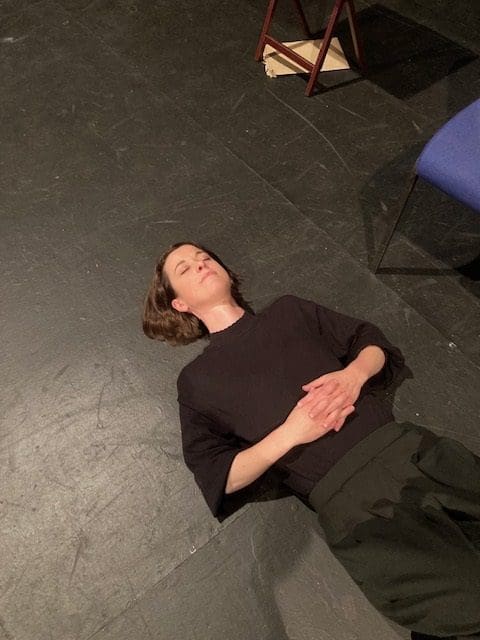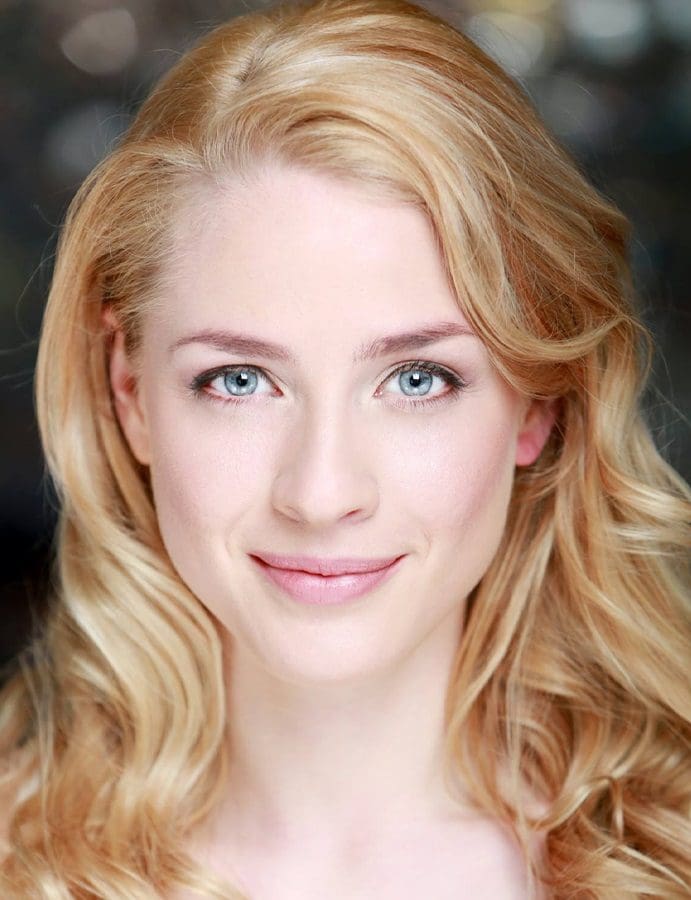
Where love becomes 40-love as Rosy and Stuart serve up Shakespeare sonnets on tennis court at Holy Trinity Church

Director Rosy Rowley and writer Stuart Green, on the bench at Holy Trinity Church, Goodramgate, rehearsing with Summer Sonnets cast members and producer Maurice Crichton (arms folded, at the back). Picture: John Saunders

DIRECTOR Rosy Rowley and writer Stuart Green are the new doubles partnership for York Shakespeare Project’s tennis-themed 2026 Summer Sonnets: What The Deuce?

New balls, please, will be served on the grass of Holy Trinity Churchyard, in Goodramgate, York, from Friday to August 15, with a rest day on August 11.

Should you be wondering “Why tennis?”, the game features in no fewer than seven Shakespeare plays: Hamlet, Act II, Scene 1; Henry IV, Part 2, Act II, Scene 2; Henry VIII, Act I, Scene 3; Much Ado About Nothing, Act III, Scene 2; Pericles, Act II, Scene 1; The Two Noble Kinsmen, Act V, Scene 2, and most notoriously in Henry V, Act I, Scene 2.

In that scene, the French Dauphin mocks King Henry by sending him a gift of tennis balls to besmirch his youthful reputation as a frivolous playboy. Henry responds by threatening to turn the balls into cannonballs to play a set as explosive as McEnroe against the French crown.

Ready to serve: Tennis fan William Shakespeare in York Shakespeare Project’s poster for Summers Sonnets: What The Deuce?

Now  comes What The Deuce?, where summertime at the Goodramgate Lawn Tennis Club finds four doubles teams competing for the chance to play in a Wimbledon amateur tournament, whereupon partnerships and rivalries lead to sabotage and break point. Who has the advantage? Who is at fault? Will the score be love?

Cue further tennis puns aplenty as Rowley directs Green’s script that asks a new collection of ten characters to play out this new sporting and unsporting situation, where each finds a way to share a Shakespeare sonnet.

Pulling on the traditional and not-so-traditional Wimbeldon tennis whites for York Shakespeare Project (YSP) will be Alan Sharp’s Graham; Christine Bramwell’s Elizabeth; Helen Clarke’s Margo; Jamie McKeller’s Lionel; Stuart Lindsay’s Charles; Oscar Langford’s Harry; James Robert Ball’s Tony; Alexa Williams’s Belle; Sarah McKeagney’s Vic and Effie Warboys’ Chessie.

“Stuart has been wanting to write and I’ve been wanting to direct,” says Rosy. “I’d directed a Direct Approach play for Settlement Players – Night Secrets – so I just wanted to get back into it, and I suppose YSP have taken a bit of a punt on us.”

James Robert Ball, left, and Oscar Langford in rehearsal for Summer Sonnets: What The Deuce? Picture: John Saunders

It should be pointed out that Rosy and Stuart tread the boards regularly in York, first meeting when performing in the York Theatre Royal community play Sovereign in 2023. “We’ve done a few plays together, such as A Kingdom Jack’d  in April, and theatre is the thing that brought together as a couple,” says Rosy.

“We’ve now got one of those bricks on the wall at Theatre@41, Monkgate, where we both volunteer, that says ‘Theatre together’.”

Stuart and Rosy settled on 80 per cent of the sonnets before Stuart set to work on the script that weaves ten sonnets into the tennis plotline. “We’ve had great fun putting the story together with classic Shakespeare tropes and then putting them in a tennis setting,” says Rosy.

“We’ve crammed a lot into our 50-minute play,” says Stuart. “We have cross-dressing; mistaken identity; poisoning, revenge; lust; unrequited love…

Director Rosy Rowley and writer Stuart Green in the Holy Trinity Churchyard, the setting for courtly love with a difference in their tennis-themed Summer Sonnets. Picture: Maurice Crichton

… “and of course lots of tennis,” says Rosy. “What’s been really important to us is not making the sonnet just something they recite but part of a conversation, which is the case in all but two of them that will be done as monologues.”

Stuart adds: “We wanted to incorporate the sonnets into conversations in the play, thinking how could a sonnet fit with a particular character? The aim is that the audience doesn’t notice they’ve gone into a sonnet because it makes the sonnets really accessible by putting them in a narrative, where suddenly they make more sense.”

Not all of Shakespeare’s 154 sonnets focus on romantic love. Death, political vexation, artistic rivalries, human flaws and the passage of time are significant themes too, alongside desire and love.

“We thought how could we interpret sonnets in ways that fit with our play, and the beautiful thing is that there are so many ways to interpret them, not just romantic love,” says. “For example, Christine Bramwell’s sonnet reflects her love for the tennis club and the game.
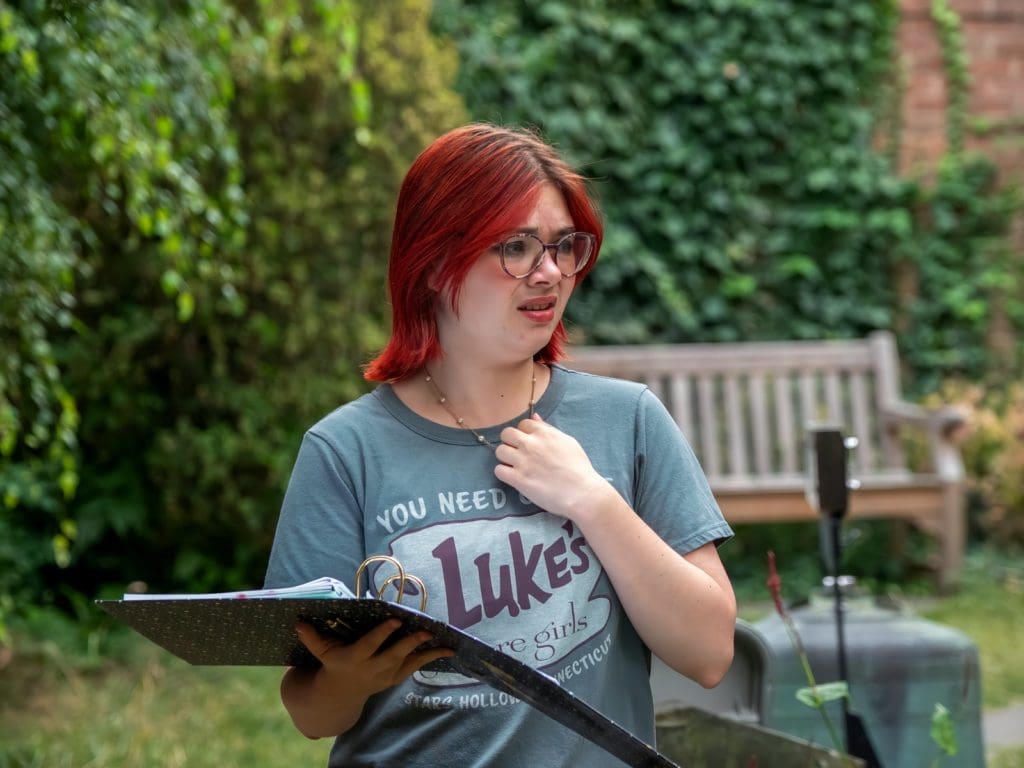
Belle of the ball: Alexa Williams playing the role of Belle in York Shakespeare Project’s tennis-punned Summer Sonnets: What’s The Deuce. Picture: John Saunders

“Right at the start of rehearsals, I had one-to-one table sessions with each actor to see how we could make their sonnet work with the character.”

Stuart adds: “I think it helps that both Rosy and I are actors because we know what each actor can bring to the part.”

Stuart and Rosy have been delighted by the response to this summer’s sonnet project. “We had 30 people applying to take part, which was a record number,” says Stuart. “Then 24-25 auditioned, and we cast ten, where only two of them – Stuart Lindsay and Effie Warboys – had done Summer Sonnets before.

“A lot of them are new to YSP. It wasn’t a conscious decision; it was just that they were the best to put themselves forward.”

Helen Clarke, left, Oscar Langford, Stuart Lindsay and Sarah McKeagney rehearsing with Summer Sonnets: What The Deuce? script writer Stuart Green. Picture: John Saunders

One other new element will be the positioning of the actors in the Holy Trinity churchyard. “We’ve shifted it 90 degrees so that the Chinese restaurant, on Goodramgate, with its fan noise and smells, will now be behind the actors, rather than the audience,” says Rosy. Good decision.

Green by name, green keeper by profession, Stuart first wrote screenplays in his teens and 20s. “I wanted to get into films, but the chances were non-existent, so I became a green keeper, initially at Bushey Hall Golf Club in Watford, then went to college and ended up at Gleneagles for four years,” he says.

“Now I teach green-keeping: I’m a grass nerd! I used to be based at Askham Bryan, where I taught apprentices at the agricultural college. Now I work for Train Together, teaching green keepers and cricket, football and rugby groundsmen.

“There’ll be a groundman as one of the characters in our Summer Sonnets, Alan Sharp’s Graham. I couldn’t resist it! I’ve called on one of my old York Cricket Club contacts to lend us an old line marker – and one of my stipulations was that it had to be squeaky as they generally are!”

Helen Clarke, left, Oscar Langford and Sarah McKeagney rehearsing a scene from Summer Sonnets: What The Deuce? Picture: John Saunders

Tennis gear will carry significance in Rosy and Stuart’s production. “What they’re wearing denotes their status at the club, whether it’s all white or not,” says Rosy. “There has to be a bit of a social statement in that.”

No tennis pun has been resisted. “We realised we didn’t have enough tennis innuendo at first, so I’ve had fun writing some absolute ‘tennis filth’,” says Rosy. “Now it’s unashamedly Carry On Tennis,” says Stuart.

“And of course we had to crow-bar ‘You cannot be serious’ in there too,” says Rosy.

York Shakespeare Project presents 2026 Summer Sonnets: What The Deuce?, Holy Trinity Churchyard, Goodramgate, York, August 7 to 15, except August 11, 6pm and 7.30pm plus 4.30pm Saturday shows. Box office: https://tickets.41monkgate.co.uk/seasons/2e40b388-a069-4f16-bafe-30250ae8c13a

Lara Stafford in her Premium Eclipse Viewer glasses in readiness for August 12’s solar eclipse during the 6pm performance of Summer Sonnets: What The Deuce? Pairs are available for free for Sonnets audience members

Not to be eclipsed…

ON Wednesday, August 12, the UK will experience its deepest solar eclipse since 1999, with up to 96 per cent of the Sun covered by the Moon.

Across North Yorkshire, the partial eclipse will begin at 6.12pm, peak at 7.08pm and finish at 8.02pm. That day’s 6pm and 7.30pm performances of Summer Sonnets: What The Deuce? will go ahead as planned, but do come prepared for the eclipse experience.

Quick question: Do sunglasses protect eyes in a solar eclipse? NO!The official advice is: Never look directly at the Sun.

Why? The Sun can burn the retinas in the eyes, leading to permanent damage or even blindness. This can occur even if your eyes are exposed to direct sunlight for only a few seconds.

Proper eye protection is the only safe option, not sunglasses. The only way to view the Sun safely – eclipsed or not – is to either project or filter the Sun’s rays.

Suggestion: Make your own box projector or acquire safe solar eclipse glasses. NASA also recommends welder’s glasses rated 14 or higher, to be found at welding supply stores.

Lara Stafford demonstrating the benefit of wearing Premium Eclipse Viewer glasses for August 12’s partial eclipse of the Sun

YORK actress, Physics teacher and Theatre of Science communicator Lara Stafford is teaming up with York Shakespeare Project for a special offer for Summer Sonnet audience members. “August 12’s 6pm show coincides with the solar eclipse: the best one to happen to the UK until 2090, with over 90 per cent of the Sun covered by the Moon,” she says.

“It’ll begin just after 6pm and peak an hour later, just after the performance. A £10 Summer Sonnets ticket has always come with a free drink, but to celebrate this cosmic coming together, we’re going to give out a free pair of eclipse glasses with every ticket sold for performances up to the 6pm show on August 12.”

Lara continues: “I buy them in for work anyway, so I’m just ordering a few more! It’s quite difficult to get eclipse glasses cheaply and guarantee they’re not fakes, and you can ‘only’ watch the eclipse with your eyes if you’re wearing eclipse glasses. So it’s an easy way for us to spread the eclipse excitement around York and spread awareness of the sonnets.”

Should you be wondering, a reference to an eclipse can be found in Sonnet No. 35, one that does not feature in Rosy and Stuart Green’s choices for Summer Sonnets: What The Deuce? So here is the quote:

“No more be grieved at that which thou hast done.
Roses have thorns, and silver fountains mud;
Clouds and eclipses stain both moon and sun,
And loathsome canker lives in sweetest bud.”

UPDATE: 11/08/2026

THOSE four lines from Sonnet No. 35 WILL now feature in Wednesday’s 6pm and 7.30pm performances of Summer Sonnets, adding to Alan Sharp’s Shakespeare quotes in his guise as groundman Graham. Every line uttered by the phlegmatic Graham in Stuart Green’s script is either in the rhythm of iambic pentameter or one of the Bard’s references to tennis.

Still shielding their eyes! The Brontë Sisters in York Settlement Community Players’ poster for Underdog: The Other Brontë at Theatre@41, Monkgate

ECLIPSE glasses removed, Lara Stafford will be shining next on the York stage as Charlotte Brontë in Claire Morley’s production of Sarah Gordon’s 2024 play Underdog: The Other Brontë for York Settlement Community Players at Theatre@41, Monkgate, York, from October 13 to 17.

The plot? Charlotte Brontë has a confession about how one sister became an idol and the other became known as the third sister. You know the one. No, not that one. The other, other one…Anne.

Underdog presents an “irreverent retelling of the life and legend of the Brontë sisters like you’ve never seen them before”. This is not a story of well-behaved women but of the power of words, sisters and sisterhood, love and jealousy, support and competition. Tickets for the 7.30pm evening performances and 2.30pm Saturday matinee are on sale at https://tickets.41monkgate.co.uk/.

REVIEW: Black Treacle Theatre in Anne Boleyn, Theatre@41, Monkgate, York, off with her head until Saturday ****

The plot thickens: Paul Osborne’s Thomas Cromwell, left, and Ian Giles’s Cardinal Wolsey in Black Treacle Theatre’s Anne Boleyn

ANNE Boleyn (c.1501-1536) had an extra finger and one head too few after her execution by a French swordsman in the Tower of London.

One of these statements is fiction, the other is fact, but both persist down the years as how we know Anne best, such is the way myth and history overlap.

The sixth finger story was a 16th century fabrication spun by Roman Catholic polemicist Nicholas Sander in 1585 to suggest Anne was a witch in a smear campaign against her daughter, Queen Elizabeth I.

Yet acts of besmirching her as a whore were rife in Anne’s lifetime too, led by those at the very top, leading to her beheading, as Howard Brenton explores in his witty political drama.

Nick Patrick Jones’s Henry VIII in a tender moment with Lara Stafford’s Anne Boleyn. Picture: John Saunders

Premiered at Shakespeare’s Globe in 2010, Anne Boleyn now breaks its York duck under the direction of Black Treacle Theatre founder Jim Paterson, whose experience of watching a friend in the Globe cast had left an indelible impression.

“This year marks 500 years since Henry’s courtship of Anne began in earnest – in 1526. So it felt like serendipity to stage this play, which makes us reconsider who Anne was, and what an important figure she is in our history,” says Paterson, explaining the timing of his production.

Here’s the history bit: Anne Boleyn was the second wife of King Henry VIII, whose desire to marry her forced the break from the Roman Catholic Church and the dawn of the English Reformation. She was well read, intelligent, queen for only 1,000 days – and by common agreement, the best of the six, so sassy and saucy, in the ultra-competitive Six The Musical.

Brenton puts her front and centre of his historical yet modern epic, both as a ghost in the court of James I and in charting her courtship with Henry VIII, presenting a more rounded and nuanced portrait of Anne as lover, heretic, revolutionary, queen, at once brilliant and bright but reckless too, hot-headed and then not-headed. Was she prey or predator? You decide, maybe for the first time

In need of a stiff drink: Cameron O’Byrne’s George Villiers and Katie Leckey’s James I. Picture: John Saunders

The play opens with Lara Stafford’s Anne Boleyn in monologue mode, as she enters the checkboard stage in her bloodstained execution dress, carrying a large embroidered bag. Brenton’s opening stage instruction reads “Aside. Working the audience”, immediately establishing that this play will be on her own terms, like a comedian’s opening gambit or a Fool’s mission statement in Shakespeare, as she teases the audience over the bag’s potential content.

“And why should I want you to love me?” she asks us. “Did anyone around me ever love me, but for the King?” And there’s the rub. Who was on her side? Brenton, as it turns out, Jesus, as she declares, and a curious James I (Katie Leckey), keen to use her information to aid his unconventional attempts to bring warring religious factions together decades later.

Anne pulls out the Bible, or more precisely William Tyndale’s banned version that would sew the seeds of her execution, with a flourish worthy of Tommy Cooper, but with a heavy heart, before making light of her execution when finally producing the severed head. “Funny, a head’s smaller than you think. Heavy little cabbage, that’s all.”

This sets Brenton’s tone, one where his comic irreverence rubs up against reverence, or more precisely the mirage of reverence in a world where Henry’s England waives the rules, where the intrigue and political machinations of Henry’s court undermine and belie the intersection of crown and church.

Anne Boleyn director Jim Paterson

Somehow, Stafford’s Anne must show her mettle to find her way through that ever-tightening thicket, and likewise Leckey’s James I, the Scottish king (here with a fellow Celtic/Northern Irish accent), must negate all the vipers’ poison when assuming the English throne.

In an outstanding return to a lead role, Stafford’s risk-taking Anne exudes intelligence, pluck, conviction, sometimes with humour, like when she mocks Ian Giles’s West Country Cardinal Wolsey for being woolly; sometimes with grave sadness, in the abject despair at failed pregnancies; or at the close, with sincerity, as she champions the power of love (uncannily just as Hercule Poirot does in the finale to Death On The Nile, on tour at the Grand Opera House this week).

Leckey, one of the volcanic forces of the 2020s’ York theatre scene with her Griffonage Theatre exploits, is tremendous here too. Surely James I should not be so much fun, but he is, whether flaunting his relationship with Cameron O’Byrne’s George Villiers, reaching for a glass, mocking the martinet dourness of Paul Stonehouse’s Robert Cecil or being as capricious as President Trump in making decisions.

Bible matters: Maurice Crichton’s William Tyndale in discussion with Lara Stafford’s Ann Boleyn. Picture: John Saunders

Stafford’s Anne aside, the women have to play second fiddle, treading on glass to survive in the court, whether Lady Rochford (Abi Baxter), Lady Celia (Isabel Azar) or next-in-Henry’s- roving- eye-line Lady Jane (Rebecca Jackson).

Heavyweights of the York stage assemble for the juiciest male roles. Nick Patrick Jones brings Shakespearean heft (rather than physical bulk) to Henry, already entitled and erratic, demanding and wilful, boastful of his writing powers, but still allowed shards of humour by Brenton (albeit at Henry’s expense) in this clash of the legal and the regal.

Paul Osborne’s Thomas Cromwell, statesman, lawyer and Henry’s chief minister, emerges as the villain of the piece, misogynistic, devious, manipulative, his language industrial, his actions self-serving behind the veneer of duty, with “something of the night about him”. Osborne makes for a complex character rather the two-dimensional baddie of pantomime.

Giles’s Catholic cardinal Thomas Wolsey is the stuffed shirt of Brenton’s piece, righteous, exasperated, as forlorn as Canute when standing against the winds of change.  

Drafting the Reformation Act: Paul Miles’s Sloop, left, Harry Summers’ Simpkin and Paul Osborne’s Thomas Cromwell. Picture: John Saunders

Never averse to scene-stealing impact, Maurice Crichton brings a twinkle and bravado to William Tyndale, writer of the outlawed Bible that would later form the basis of the King James version. His scenes with Stafford’s Anne are an especial joy.

Harry Summers’ Simpkin/Parrot, Paul Miles’s Sloop, Sally Mitcham’s  Dean Lancelot Andrewes and Martina Meyer’s John Reynolds further stir the murky waters, while Richard Hampton’s open-plan set and Julie Fisher and Costume Crew’s costumes evoke the Tudor and Stuart periods.

All in all, Howard Brenton’s Anne Boleyn is far funnier than living in those turbulent times must have been.

Anne Boleyn, Black Treacle Theatre, Theatre@41, Monkgate, York, tonight, 7.30pm; tomorrow, 2.30pm and 7.30pm. Box office: https://tickets.41monkgate.co.uk.

How Anne Boleyn knocks them for six in Howard Brenton’s Tudor marital clash, staged by Black Treacle at Theatre@41

Lara Stafford’s Anne Boleyn and Nick Patrick Jones’s Henry VIII rehearsing for Black Treacle Theatre’s Anne Boleyn. Picture: Jim Paterson

MOVE over Six The Musical with its six wives of Henry VIII competing in song for the right to be the queen of queens.

The focus falls on only one of his brides, his second pick, Anne Boleyn, in Howard Brenton’s play of that title, to be staged by York company Black Treacle Theatre at Theatre@41, Monkgate, York, from March 3 to 7.

Anne Boleyn, you will recall, was the first beheaded one, exiting stage left on May 19 1536, when charged with adultery and incest, her execution conducted by a skilled French swordsman inside the Tower of London, where she was she was forced to kneel in the French style to be given the chop.

So much for the history. Brenton’s play, premiered at Shakespeare’s Globe Theatre in 2010 to mark the 400th anniversary of the King James Bible, presents the story of “one of England’s most important and intriguing historical figures”.

“Lover, heretic, revolutionary, queen, Anne Boleyn has been a figure of fascination ever since her momentous courtship with Henry VIII that led to the English Reformation and Henry’s break with the Catholic Church,” says Black treacle director Jim Paterson

“Traditionally seen as either the pawn of an ambitious family manoeuvred into the King’s bed, or as a predator manipulating her way to power, Anne – and her ghost – are seen in a very different light in Brenton’s epic play.”

Anne Boleyn director Jim Paterson

Winner of Best New Play at the Whatsonstage.com Awards in 2011, the play has a dual focus, both on Anne’s life from her arrival at court and on James I’s attempts to bring warring religious factions together as the ripples of her marriage and death continue to reverberate through England decades later. 

Whereupon Anne comes alive for him, a brilliant but reckless young woman, whose marriage and death transformed the country forever.

“This is a dynamic, dramatic and often very funny play that helps us look at both Anne Boleyn and the birth of the Church of England in a new way,” says Jim. “The reign of Henry VIII and establishment of the Church of England is one of England’s ‘creation myths’, which shapes how we think about the country and the moments and actions it is built on.

“Brenton’s play asks us to reconsider this outside of the history books, particularly through the clever juxtaposition of the early days of James I’s reign, as he grapples with clashing religious factions, and the intrigue and politics of Henry’s court and Anne’s attempts to forge her own path through it.”

Jim continues: “In fact, this year marks 500 years since Henry’s courtship of Anne began in earnest in 1526. So it felt like serendipity to stage this play, which makes us reconsider who Anne was, and what an important figure she is in our history.”

Taking the role of protagonist Anne Boleyn and antagonist Henry VIII will be Lara Stafford and Nick Patrick Jones. “I’m playing a woman in a lead part in a play and neither of those has happened since The House Of Bernarda Alba in 2009,” says Lara, who worked as an actor, including at York Dungeon and, for a while, in Hindi films in India, before retraining as a physics teacher.

Lara Stafford’s Anne Boleyn, with the masked ladies of the Tudor court behind her, in rehearsal for Black Treacle Theatre’s Anne Boleyn. Picture: Paul Hutson

“It’s fascinating because, how often does a woman, in her early 40s, who can’t belt out a tune, get a chance like this to play a lead role? That chance has come with Black Treacle.”

Anne Boleyn appears as both wife and ghost. “She gives the opening scene from the perspective of having been through it all,” says Lara. “It’s interesting what she looks back on in a light-hearted way here.

“For Anne, the most upsetting part of her life were her pregnancies [she is believed to have fallen pregnant three or four times in her marriage from 1533 to 1536]. It’s a big part of her journey, whereas she’s quite flippant reflecting on getting her chopped off.

“There are moments of almost cheekiness, bawdy humour from James 1, where the play starts off light and playful, but then grows darker and darker, like Anne’s life.”

Nick chips in: “The second half is quite brutal, and Brenton doesn’t shy away from that.” Indeed not, as Nick plays a regal role for the third time. “I was the Earl of Richmond in York Shakespeare Project’s Richard III in 2023, then a folkloric King Henry from the tenth century in a devised piece that Skald Theatre did at Rise@Bluebird Bakery in Acomb last year, and now Henry VIII.

Nick Patrick Jones’s Henry VIII to the fore in a scene with Lara Stafford’s Anne Boleyn in rehearsal for Jim Patterson’s production of Anne Boleyn. Picture: Jim Paterson

“There’s a particularly iconic image of Henry being incredibly large both physically and metaphorically – this larger-than-life character – but you have to create the real person underneath, rather than a caricature. Brenton has done a lot to make that happen by giving the actor a living breathing human being to play, rather than just spouting political statements.”

Lara rejoins: “For almost the first time, he’s written it as Anne’s story, whereas previously it was written by men trying to make their place in history, where she is just ‘wife number two’.”

“She’s the chosen one, or actually she chooses him,” says Nick. “She’s the most significant one in that although four came after her, they were all in her shadow.”

“Exactly, it could only be that she set the tone,” says Lara. “I had no idea until doing this play just how much she drove their relationship.”

Nick concludes: “There’s a strong sense of them as potential equals, but the political structure doesn’t allow them to be equals in court, thus preventing her from fulfilling her potential.”

Black Treacle Theatre presents Anne Boleyn at Theatre@41, Monkgate, York, March 3 to 7, 7.30pm plus 2.30pm Saturday matinee. Box office: https://tickets.41monkgate.co.uk.

Paul Osborne’s Thomas Cromwell, left, and Ian Giles’s Cardinal Wolsey in Black Treacle Theatre’s Anne Boleyn. Picture: Paul Hutson

Who’s in Black Treacle Theatre’s cast for Anne Boleyn?

Anne Boleyn – Lara Stafford

Henry VIII – Nick Patrick Jones

Thomas Cromwell – Paul Osborne

Cardinal Wolsey/Henry Barrow – Ian Giles

Lady Rochford – Abi Baxter

Lady Jane – Rebecca Jackson

Lady Celia – Isabel Azar

Simpkin/Parrot – Harry Summers

Sloop – Paul Miles

William Tyndale – Maurice Crichton

James I – Katie Leckey

Robert Cecil – Paul Stonehouse

George Villiers – Cameron O’Byrne

Dean Lancelot Andrewes – Sally Mitcham

John Reynolds – Martina Meyer

Katie Leckey’s James I, right, rehearsing a scene with Cameron O’Byrne’s George Villiers. Picture: Paul Hutson

Who’s in the production team?

Director – Jim Paterson

Lighting designers – Sage Dunn-Krahn and Kathryn Wright

Lighting technicians – Emma Jones and Dave Robertson

Set and prop designer – Richard Hampton

Costume designer – Julie Fisher and Costume Crew

Black Treacle Theatre: back story

YORK company has produced Constellations (March 2022); Iphigenia In Splott (March 2023); White Rabbit, Red Rabbit (November 2023); Accidental Death Of An Anarchist (October 2024) and The Watsons (July 2025, co-production with Joseph Rowntree Theatre).

Tempest Wisdom turns York Shakespeare Project’s ‘Two Gents’ into Victorian music hall with scene-stealing dog at Theatre@41

Puppeteer Wilf Tomlinson and a bare-footed Lara Stafford (Launce) in rehearsal for York Shakespeare Project’s The Two Gentlemen Of Verona. Picture: Tony Froud

WHAT can a dog puppet do that a human can’t? Find out in York Shakespeare Project’s  The Two Gentlemen Of Verona at Theatre@41, Monkgate, York, from tomorrow to Saturday.

‘Two Gents’ is possibly the first play Shakespeare ever wrote and certainly the only one with a part for a canine.

Settling into a mission to bring all Shakespeare’s plays to York on a second cycle, these facts could have presented YSP with some interesting challenges. Luckily YSP found a director eager to deliver a fascinating take on this 1593 comedy.

Originally from the United States of America, Tempest Wisdom studied theatre at the University of Chicago before pursuing a Masters degree in theatre-making at the University of York.

Already making their mark on the York theatre scene as the creator and host of the bi-monthly Bard at the Bar, a Shakespeare karaoke night at Micklegate Social, now Tempest is bringing their enthusiasm and talent to YSP’s autumn production.

“I’m setting The Two Gentlemen Of Verona in a Victorian music hall,” says Tempest. “A bawdy, raucous place where a host of variety acts will come together to stage the play.”

Theatre@41 will be transformed for the occasion, giving cast members  the exciting challenge of becoming variety performers, each delivering their special act as well as lines from Shakespeare’s play, including Launce with his performing dog, Crab.

Nick Patrick Jones’s Proteus and Mark Payton’s Duke Of Milan in the rehearsal room. Picture: John Saunders

“The play-within-a-play structure combines Shakespeare’s signature wit with the razzle-dazzle and slapstick of an evening of variety,” says YSP chair Tony Froud. “A live pianist will add to the Victorian feel of the evening; Shakespeare’s characters will seamlessly rub shoulders with classic music-hall songs, such as Champagne Charlie and The Lass Of Richmond Hill, as the newly assembled company of knife throwers, strongmen, musicians and comedians pool their skills to bring together this rarely-performed comedy.”

Tempest explains the rationale behind the music-hall setting. “Two Gentlemen is one of Shakespeare’s earliest works, and you can already see the characteristic zaniness of his comedies beginning to take shape: cross-dressing, love songs, ribald humour.

“In my opinion, the best Shakespeare productions use their setting to complement the themes and tone of the text, and I thought a music hall, with its quick pace, slapstick and bawdiness, would be the best way to bring that zaniness to its full potential.”

The Two Gentlemen Of Verona is known by some as the play enjoyed by Dame Judi Dench’s Elizabeth I in the 1998 film Shakespeare In Love. The Queen is particularly taken by the performing dog, Crab, who, in time honoured fashion, outshines the actors.

The appearance of a dog is one of the most famous features of the play. In YSP’s production, Crab will be a puppet, built and brought to life by the capable hands of York theatre-maker and puppeteer Wilf Tomlinson.

“Working with Wilf is a joy,” says YSP cast regular, Lara Stafford, who plays Crab’s owner, Launce. “Crab might not have any lines but he’s got a huge presence; it’s a complete double act, and we’re having a great time in rehearsal. There are a lot of things human actors aren’t allowed to do that dog puppets can get away with. It’s going to be very funny.”

In the spotlight: director Tempest Wisdom

Tempest Wisdom

Where are you from?

“My answer changes depending on how much time you have! My father served in the Marine Corps through the entirety of my childhood, so I had a typical ‘military brat’ upbringing, moving across the world every couple of years.

“To this day, I haven’t lived anywhere longer than four years, and that was an anomaly. That’s all going to change, though: rehearsals for this production began on my third Moving-To-York anniversary, and if I have my way, I’ll be sticking around for several more.”

Where did you study and what part did Shakespeare play in your education?

“I went to school at the University of Chicago, where I had the honour of studying with the Shakespeare scholar David Bevington. He came to every production the Shakespeare troupe on campus ever put on, and would host a wine-and-cheese dramaturgy night at his home for the team.

“One of the highest compliments I have ever received was from him, when I played Antipholus & Antipholus in a vaudeville production of The Comedy of Errors (from which I have stolen shamelessly for Two Gents. If by any chance the director of that show ever reads this article: hello, Jacob, I’m not sorry!)

“Professor Bevington came up to me afterwards and told me it was one of his favourite student productions he’d ever seen. There are many people back in the States that I wish could see this show, and he is foremost among them.

“More recently, I received my Masters in Theatre-Making from the University of York.”

York Shakespeare Project’s poster for The Two Gentlemen Of Verona at Theatre@41, Monkgate, York

What first drew you to performing and now directing Shakespeare? 

“I’ve been performing and studying Shakespeare since I was 11 years old, when I was cast in a bit part in a school production of Romeo & Juliet. I was given the iconic ‘Do you bite your thumb at me, sir?’ line in Act I, Scene I… and I completely flubbed it!

“To me, the fun of directing Shakespeare in particular, and really any exciting script, is in the storytelling. These are densely packed texts on both the macro and micro level, and it’s my job as director to puzzle out how to unpack as much as possible, to use the mechanics of the stage to reveal, highlight, comment or inflect.

“In many ways it’s the same with clowning: the challenge is to tell a story to the audience as clearly as possible. In this case, the text and the clowning have brought out the best in each other. I find that happens very often with Shakespeare: the man knew how to write for clowns!”

What gave you the idea to give Two Gents a Victorian variety act/music hall setting?

“Like I said, I think a strong sense of physical comedy and clown in a performance of Shakespeare really allows the text to sing. In this case, I mean that literally: this performance features a poem from the text set to original music composed by our music director, Stuart Lindsay.

Charlie Spencer’s Thurio, left, and Nick Patrick Jones’s Proteus in the rehearsal room at Theatre@41, Monkgate, York. Picture: John Saunders

“So, clown was my first port of call when thinking about staging Two Gents. In terms of the music hall specifically, this play features such a zany cast of characters, many of whom only show up for a scene or two, and I wanted to highlight each and every one of them as a series of variety acts.

“There are plenty of interesting thematic resonances between this setting and the text, particularly when it comes to the sexual politics of 16th-century courtly romance and the prudishness for which the Victorians are known; the ideas Shakespeare is exploring around the construction of a public persona and the codification of celebrity that occurred in large part as a result of the national popularity of the music hall, and the evolving social codes around how women were allowed to exist in public.

“But to be completely honest with you, the primary thought that went into the choice was ‘how much fun would it be if…?’

“And, not to spoil anything, but the play-within-a-play framework gives us leeway to question and push back against some assumptions that Shakespeare’s text makes.”

How would you describe an evening at Bard at the Bar to the uninitiated?

“I need to start by saying that Bard at the Bar was not my idea. I lived in Seattle before I came here, where Bard in a Bar was my absolute favourite social event. When I left, I missed it so terribly, and I felt so strongly that York would love this sort of thing that I sought the blessing of the creator, Anthea Carns, to bring it with me.

“Bard at the Bar is Shakespeare, ‘karaoke’ style. What that means is I choose a play and pick out a couple key scenes, which are then performed sight-unseen by volunteers on the night.

“Everyone has a script in one hand, a drink in the other, and mischief on the brain. Recently we’ve had a love sonnet performed to a dog, a fight involving a chair being thrown (a stage fight, of course, not a real one), an a cappella rendition of Tom Jones’s It’s Not Unusual, and lots and lots of dirty jokes.

“It takes place on the last Sunday of every other month in The Den at the Micklegate Social, and both lovers of Shakespeare and those completely unfamiliar with his work have told me how much fun it is.

“I unfortunately had to cancel the last one because I caught Covid, but I’m pleased to announce that we are back on for November 24 (7pm), when we’ll be doing ‘The Scottish Play’ [Macbeth]. The best place for updates on that project is @bardatthebar_york on instagram and eventbrite.”

Who’s in the York Shakespeare Project cast for ‘Two Gents’?

Effie Warboys’ Silvia and Pearl Mollison’s Outlaw mid-rehearsal. Picture: John Saunders

Proteus:   Nick Patrick Jones

Valentine: Thomas Jennings

Silvia: Effie Warboys

Julia: Lily Geering

Chairwoman:  Jodie Mulliah

Pianist:  Stuart Lindsay

Panthino:  Charlie Barrs

Speed:  Liz Quinlan

Launce : Lara Stafford

Crab:  Wilf Tomlinson

The Duke of Milan: Mark Payton

Thurio:  Charlie Spencer

Antonio:  Stuart Green

Lucetta: Anna Gallon

Sir Eglamour: Jonathan Cook

The Outlaws:  Pearl Mollison, Kay Maneerot and  Celeste North Finocchi

York Shakespeare Project in The Two Gentlemen Of Verona,  Theatre@41, Monkgate, York, Tuesday (cut-price preview) to Saturday,  7.30pm plus 2.30pm Saturday matinee. Box office: tickets.41monkgate.co.uk. “Book now for the event of the 19th century!” says Tempest.

Mark Payton’s Duke of Milan, left, and Charlie Spencer’s Thurio. Picture: John Saunders

REVIEW: Black Treacle Theatre in York premiere of White Rabbit, Red Rabbit, Theatre@41, Monkgate, York ***

Lara Stafford: Dying a death on stage…or not in White Rabbit, Red Rabbit on Wednesday

NO director. No rehearsal. No advance sight of the script. Only a brief list of instructions sent to the actor in a pdf by the producer 48 hours before the performance. Novel indeed.

“An actor’s nightmare,” suggested Black Treacle Theatre producer Jim Paterson, “but an audience’s dream.”That said, Maurice Crichton, Lara Stafford, Maggie Smales, Alan Park and today’s two performers, Sonia Di Lorenzo (matinee) and Sanna Jeppsson (evening), were intrigued to take on the one-off challenge of a 70-minute script, each for one solo performance, passing on the baton without a word to the next in line.

CharlesHutchPress had been expecting to see Maggie Smales on Thursday, but when he chanced upon Lara Stafford in Micklegate on Wednesday, after his plans to attend the Aesthetica Short Film Festival launch or Teenage Fanclub at Leeds Brudenell Social Club came to nought, the reviewer resolved to review her that night instead.

Both were in the dark about what would unfold. White Rabbit, Red Rabbit was written in 2011 by Iranian playwright Nassim Soleimanpour, when he was forbidden to leave his native Iran, but the play was designed to travel the world in his place; words without end.

Enter Lara, to be handed an envelope by Jim Paterson. Let the journey into the unknown begin, and quickly it emerges that this will not be a solo performance, but an immersive one with plenty of audience involvement.

Both on stage and off, in the case of your reviewer, who ticked the box for having a notebook to hand, at the writer’s request, to take notes…and subsequently send him an email as evidence of the night’s performance.

Without giving too much away, the tone of the piece turns from jocular to darker, bleaker, graver, a gradual switch handled well by Stafford, whose performance elides from playful to no messing about, this is serious.

More experimental performance art than play, White Rabbit, Red Rabbit does not call on Stafford to develop a role, a character, but to be a mistress of ceremonies, a malleable conduit through which the script will pass in a series of tests.

Not only her comic skills come into play, but her prowess at orchestrating an audience, as she would do in her physics teaching career too.

Above all, White Rabbit, Red Rabbit testifies to the power of the unexpected in theatre, when actor and audience are equally surprised and on edge, each reliant on the other for what will happen next.

White Rabbit, Red Rabbit, Theatre@41, Monkgate, today at 2.30pm and 7.30pm. Box office: https://tickets.41monkgate.co.uk. Tickets are £10 full price and any ticket buyers for one performance can see another one for £5 (plus booking fee). Running time is approximately 70 minutes.

No rehearsal, no director, no sight of the script in advance. Six actors, one per show, take on White Rabbit, Red Rabbit in York

Maurice Crichton: In the dark tonight, just as much as the audience for the hush-hush White Rabbit, Red Rabbit

AN actor’s nightmare will be an audience’s dream, promises producer Jim Paterson, when White Rabbit, Red Rabbit makes its York debut from tonight (7/11/2023) to Saturday at Theatre@41, Monkgate.

This groundbreaking play requires the actor to perform the script having never seen it before setting foot on stage.

Originally written in 2011 by Iranian playwright Nassim Soleimanpour, who at the time was forbidden to leave his native Iran, White Rabbit, Red Rabbit is a play designed to travel the world in his place. Whereupon the audience will join each different performer on a journey into the unknown.

Soleimanpour’s 70-minuite play has been performed all over the world by actors such as John Hurt, Whoopi Goldberg, Nathan Lane, Martin Short, Sinead Cusack and Dominic West, all taking to the stage with no prior sighting of the script.

Now White Rabbit, Red Rabbit receives its York premiere at the hands of six actors, each performing the script for one performance only. “They will never have seen the script until I hand them an envelope to open as they enter the stage,” says Jim. “They are told almost nothing in preparation. There is no rehearsal or director.” 

Sanna Jeppsson: Saturday night performance

Given that the play relies on no-one knowing the plot, details cannot be shared in advance, and so audience and actor alike will be in the same position of not knowing what will happen, duly creating an “exciting and truly unpredictable show”.

“One of the best things about going to the theatre is that it’s a live experience where each performance is different and unpredictable,” says Jim. “Times that by 100 and you’ve got this play. Both the actor and the audience don’t know what’s going to happen from moment to moment, which I think will create a really exhilarating atmosphere.

“Each of our six actors is only performing the play once with no preparation – so each performance will be entirely unique for that audience. That’s why we’ve put on a ticket offer, so that you can come back to watch another actor perform it for half-price, and see what will be an entirely different take on the play.”

Jim adds: “A lot of us have had that dream where we’re suddenly in a theatre and are expected to go on stage in a play when we don’t know the lines or what we’re supposed to be doing. So, I’m massively grateful to these performers for agreeing to take the leap and make that scary dream a reality!”

First to step into the unknown tonight will be Maurice Crichton, stalwart of York Settlement Community Players and much else besides on the York theatre scene. “I think it’s going to be about the audience experiencing an actor being surprised by what they’re in, and – to an extent – vicariously experiencing those feelings themselves,” he says. “It excites me to see if I can relax enough to do the play justice!”

Alan Park: Friday man

Fresh from Settlement Players’ Government Inspector, Sonia Di Lorenzo will perform the Saturday matinee. “I’m looking forward to finding out what it’s about,” she says. “It sounds really intriguing from what I know of it – which is just the title! I’m excited to see how it unfolds and what it entails and where it’s all going to lead.”

Sanna Jeppsson will take on the Saturday night challenge. “It’s exciting and scary because I don’t know how I’m going to react in the moment: what my body’s going to feel like, what my pulse is going to be doing, what my breath is going to be doing – I just don’t know! But I’m very interested to find out,” she says.

Presented by York company Black Treacle Theatre, in association with Aurora Nova, White Rabbit, Red Rabbit will be performed by Maurice Crichton tonight; Lara Stafford tomorrow; Maggie Smales, Thursday; Theatgre@41 chair Alan Park, Friday; Sonia Di Lorenzo, Saturday matinee, and Sanna Jeppsson, Saturday night.

White Rabbit, Red Rabbit, Theatre@41, Monkgate, York, November 7 to 11, 7.30pm plus 2.30pm Saturday matinee. Box office: https://tickets.41monkgate.co.uk. Tickets are £10 full price and any ticket buyers for one performance can see another one for £5 (plus booking fee).

Did you know?

BLACK Treacle Theatre produced Nick Payne’s Constellations in March 2022 and Gary Owen’s Iphigenia In Splott in March 2023, both at Theatre@41, Monkgate, York.