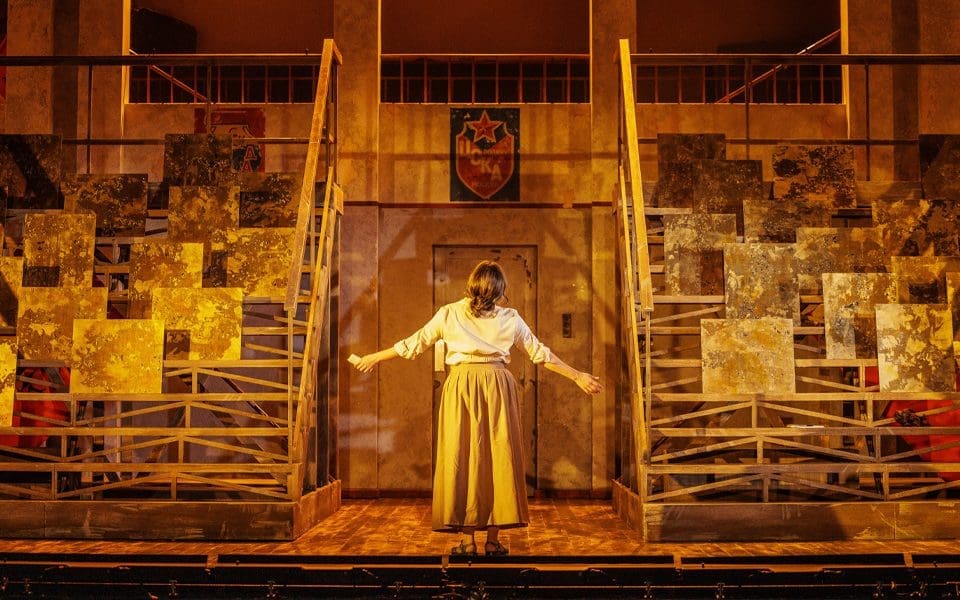
Verity Wingate as Tatyana in Opera North’s Eugene Onedin. Picture: James Glossop
IMAGINE, if you will, a black-tie party, with long dresses and lots of fizz, taking place in the cramped space between two sets of bleachers in a gymnasium, where the paint is peeling off all the doors.
Then again, the same setting has earlier accommodated a young girl writing a letter to her putative lover, scribbling with a ball-point pen in a ring-bound notebook, from which she tears off a page to send.
These scenes may not sound like the stuff of opera, but they are taken directly from Opera North’s new Eugene Onegin, a co-production with Irish National Opera and with Opera Queensland, whose artistic director Patrick Nolan leads this production. They are respectively the ball in Act 3, Scene 1 and Tatyana’s Letter Scene, Act 1, Scene 2.
Tchaikovsky’s setting of Shilovsky’s libretto, in turn derived from Pushkin’s verse novel, inhabits both a country estate and St Petersburg in the 1820s. The current production is set in the 1980s, before and after the time of Gorbachev’s perestroika. In the spirit of glasnost – greater openness – we must seek an explanation.

John Brancy’s Eugene Onegin and Joshua Bloom’s Prince Gremin in Opera North’s Eugene Onedin. Picture: James Glossop
The creatives involved, primarily Nolan, along with set designer Leslie Travers and costume designer Elizabeth Gadsby, begin their production in a small rural community in 1980, as it prepares its contribution to that summer’s Olympics in Moscow, in a gymnasium festooned with portraits of Lenin. It closes in 1991 as the new Russian Federation supplants the collapsed Soviet Union.
While admitting that the correlation between this period and the 1820s is not exact, the group expresses a “desire to bring a contemporary energy to the piece.” It is not immediately apparent that Tchaikovsky’s original lacked energy. Nor is the raw human emotion of that time any less forceful than it was in the 1980s. Indeed general director Laura Canning highlights Tatyana’s resilience as “straight out of Austen”.
While this drab setting may be visually unappetising, there are some musical compensations. Verity Wingate, one of six principals Opera North debutants, makes a properly vulnerable teenage Tatyana.
Although she started uneasily on this opening night, she suddenly found a higher gear for her Letter Scene, which is very much the touchstone of the role. She also achieves a smooth transformation into society’s upper reaches, so that her ultimate rejection of Onegin carries moral weight.

Jingwen Cai as Olga with members of the Chorus of Opera North as villagers in Eugene Onedin. Picture: James Glossop
He is John Brancy, another debutant, whose haughty demeanour is matched by a clean-cut baritone that speaks of self-assurance linked to insensitivity. His friend and ultimate foe, Lensky, is a less appealing figure in Caspar Singh’s hands. While he paces his pre-duel aria delicately, there is also a disturbing unevenness in his focus, now forward, now back, so that the voice comes and goes.
Jingwen Cai is a sparky Olga, Tatyana’s younger sister, full of mischief. Hannah Mason is charming as their mother, Madame Larina, and Claire Pascoe makes a personality of Filipyevna, both amply justifying their elevation from the chorus. So too does Simon Grange as Zaretsky. Florian Panzieri makes pleasingly light work of Triquet’s aria. Joshua Bloom’s dry bass as Prince Gremin lacks aristocratic authority.
The chorus projects with its customary vigour but looks uncomfortable with some of the 1980s vibe that Maxim Braham’s choreography is presumably intended to convey, not helped by casual dress. Even the orchestra under Garry Walker was less than compact in Act 1, but was in impressive stride thereafter on this occasion, as doubtless it will be throughout the run.
Opera North, Eugene Onegin, Leeds Grand Theatre, until November 29. Box office: operanorth.co.uk. Sung in Russian with English subtitles.
Review by Martin Dreyer, Leeds Grand Theatre, 9/10/2026

John Brancy’s Eugene Onegin, front left, in a punch-up with Caspar Singh’s Lensky as Chorus of Opera North members look on. Picture: James Glossop