York abstract artists Liz Foster
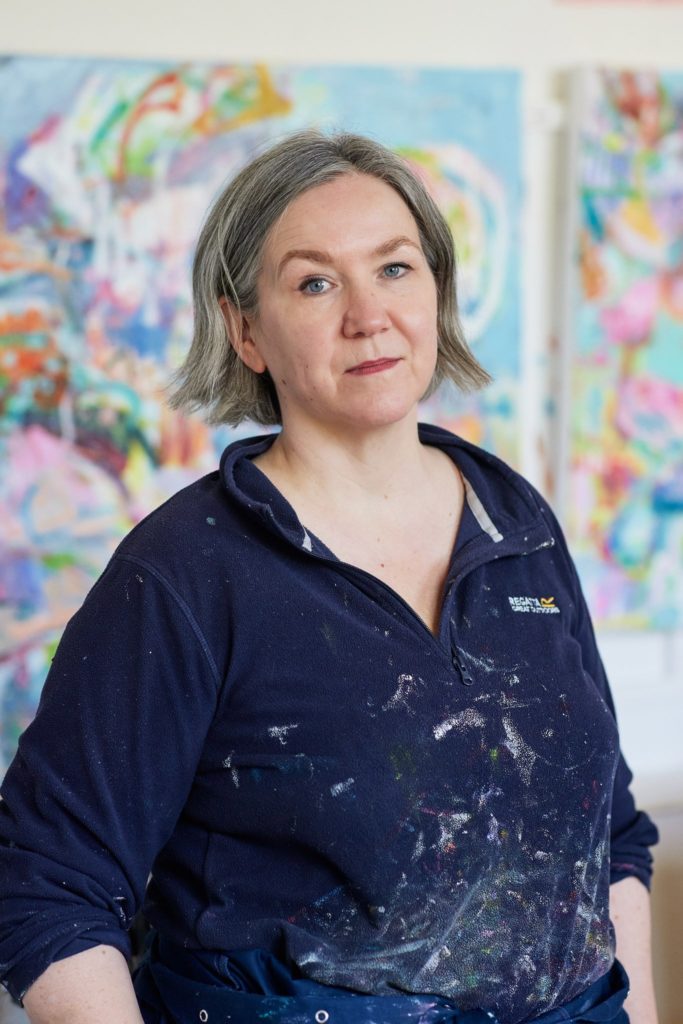
YORK artist, art tutor and mentor Liz Foster launches her Deep Among The Grasses exhibition at Rise@Bluebird Bakery, Acomb, York from 6pm to 9pm on February 12. All are welcome.
On show until April 10, the eight abstract oil paintings continue Liz’s personal exploration into memory, place and landscape in this first showing of her new series.
The exhibition invites viewers into a world of painterly abstraction full of colour and atmosphere in works that consider Liz’s relationship with the landscape of her childhood, drawing on memory and imagination to create expansive and gestural canvases, depicting into rich, expansive imagined spaces.
Her largest piece, Green Air, takes its title directly from a passage in Virginia Woolf’s 1931 novel The Waves. The fictional children play outside, absorbed in the garden, up to their necks in soil, stems and leaves. As if underwater, they imagine sinking through the green air of the leaves, just touching the ground with the tips of their toes.
Like the fictional characters, Liz’s real memories of being immersed in the space, rather than viewing it from a safe distance, are at the core of what she is exploring.
Drawing on her background and experience of growing up in the flat-lands of East Yorkshire, the works speak to broader themes of changes to the environment and childhood freedoms and isolation.
Liz studied at the Glasgow School of Art and has exhibited works spanning oil painting, watercolour, collage and print at the Royal Academy, Royal West of England Academy, London Art Fair and the Mercer Art Gallery in Harrogate.
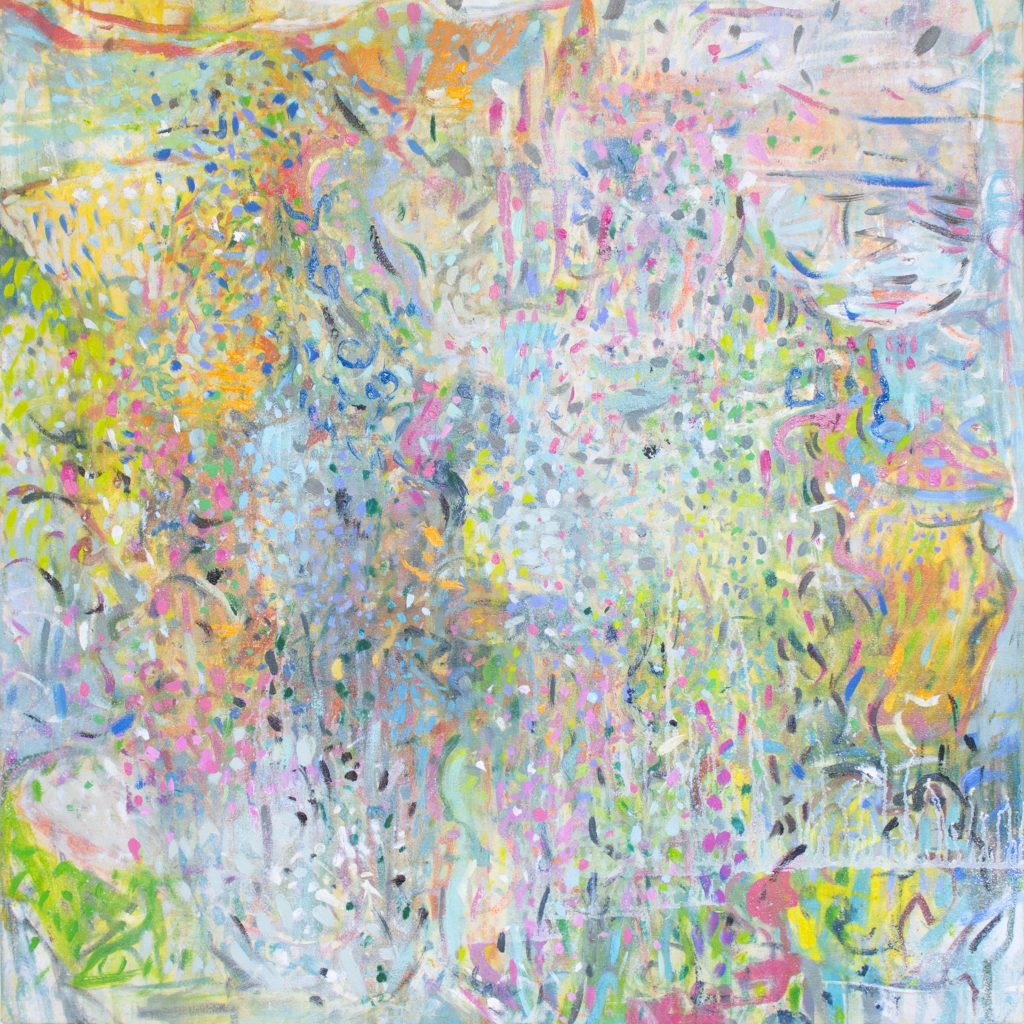
Paper Tree, oil on canvas, 100cms x 100cms, by Liz Foster
Here Liz discusses Deep Among The Grasses with CharlesHutchPress.
How did this exhibition come about? You have exhibited at Bluebird Bakery previously…
“Yes, I had a solo show back in 2023, when I was invited by their curator, artist Jo Walton. I’d worked with Jo a few years earlier, so I already knew her.
“In 2023, she was looking for new artists who made large-scale work that could fill the space. She asked, and I said ‘yes’. A couple of years later, I was delighted that she asked again!
In combining memory and landscape in your work, do you paint landscapes from memory or from existing material?
“My paintings aren’t direct representations of places, so I don’t use reference materials such as photos. Although I don’t work from sketches either, I do draw a lot, especially plants and trees.
“I like to observe and take notes of how things look or are put together – all of this ‘research’ feeds into my work tangentially, so my painting remains loose and intuitive.”
Your work takes in watercolour, collage and print too, so why paint these particular works in oils?
“For works on canvas, I nearly always use oils. The buttery texture of the paint, slow drying time and saturated colour allow me to paint in an expansive, gestural and fluid way.
“I’m a process-led painter, which means that I don’t have a fixed image in mind when I begin. It’s very open ended. I add paint, wipe it off, come back the next day and it’s still malleable. I think of oil as a very generous and patient paint.”
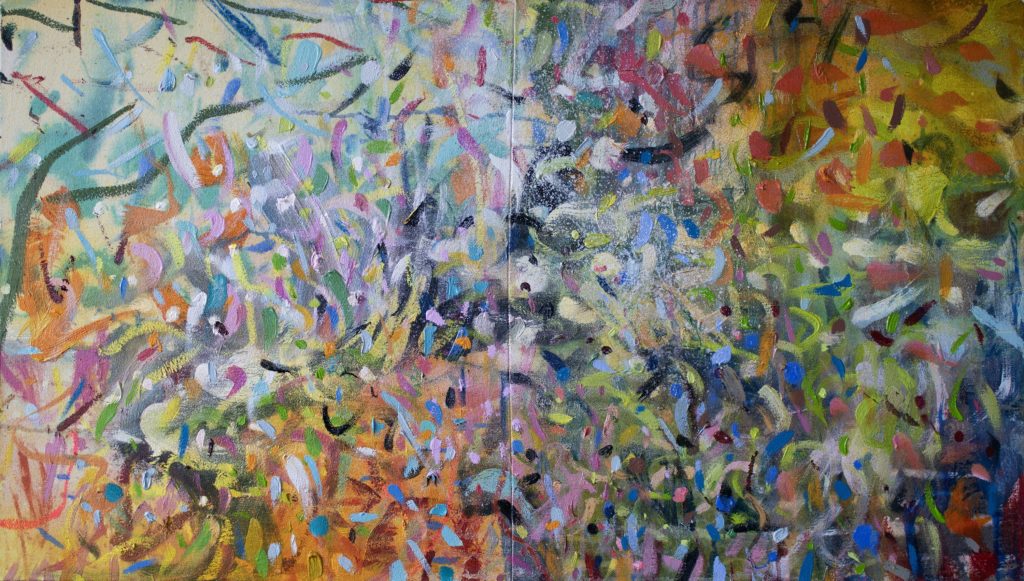
Swoop, oil on canvas, 45cm x 70cm, by Liz Foster
Does a relationship with landscape change from childhood to adulthood?
“Yes, I think so. There is certainly a sense of wonder that we lose as adults. I think also the sense of scale shifts; as children a small garden can feel like a kingdom. We move through it differently, hiding, climbing, digging.
“I remember, as a kid, I used to play in the mud and dig up worms; it was messy and physical. As an adult, I suspect I sit and look more. I love how landscapes are scarred over time with pathways and ancient markings.”
Your body of work “speaks to broader themes of changes to the environment and childhood freedoms and isolation”. Develop that statement further….
“Growing up in the 1970s and early 1980s, I felt isolated. I lived in a hamlet of industrial farms and distant neighbours. We played outside a lot, cycled everywhere, space felt endless and we had time to get really bored.
“I think the leap from that world to today’s hyper-connected world is astonishing. I’m conscious of how different the world appears to my son, where information and knowledge is only a click away.
“There are advantages, but real damage too. I was watching coverage of the California fires last year and, as the reporter spoke, there were flecks of red embers floating around against the pitch black sky. It was both beautiful and horrifying. “Although my work is abstract, these are the kinds of things I think about while painting.”
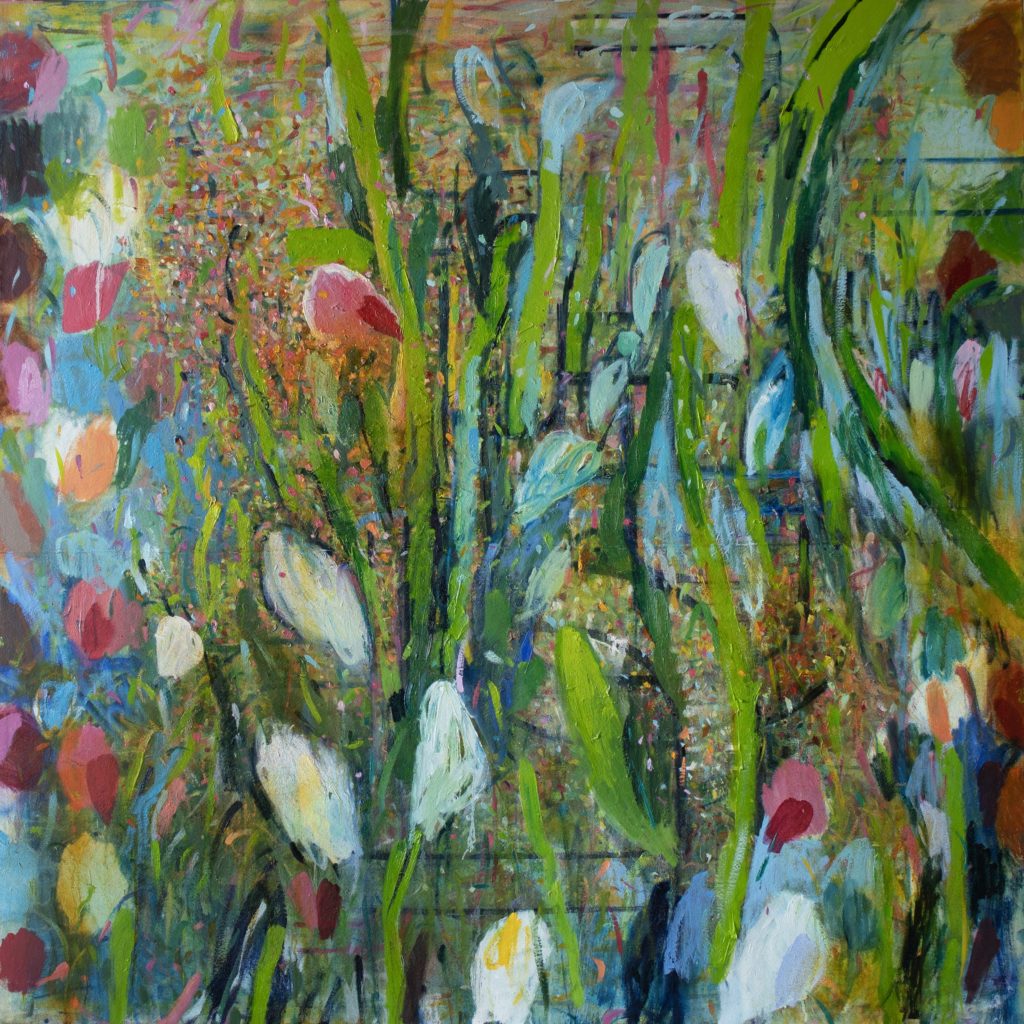
Deep Among The Grasses, 2025, oil and acrylic on canvas, 140cm by 140 cm, by Liz Foster
What made you choose York for your home?
“I don’t think I really chose York; it was never a plan to stay here this long. I did know it quite well already as my dad moved here in the late 1980s and I’d worked here, on and off, in my late teens and early twenties.
“I’ve always enjoyed moving around – and still have itchy feet – but about 20 years ago my then husband and I both started teaching jobs, and York sat at the mid-point between our workplaces, so it made sense.
“Priorities shift and families change, but my son started school (he’s now in sixth form) and he’s been really happy here, so I stayed put.”
What’s in a title, Liz?
“Titles can provide a way in, holding the door open for the viewer to enter the artist’s world. Personally, I like short titles. Ones that give you a flavour of what I’ve been thinking about, but without telling you what to think…it’s a balance.
“Sometimes a title comes while I’m working and just seems to land in my lap. On other occasions, it’s a real struggle to get the right phrase or word; it can feel harder than the actual painting process itself.
“After having decided on a few titles in this series, including Deep Among the Grasses, I went to poetry and literature – my reliable aids – to help me generate the words I needed. In The Waves, Virginia Woolf describes children playing in a garden before school: it encompasses the magic, wildness and timeless quality that I was reaching for in my own work. Green Air are just two words from a sentence in that book; the right two words.”
For more of Liz’s reflections on creating Green Air, visit https://www.lizfosterart.com/blog/the-story-of-a-painting-green-air.
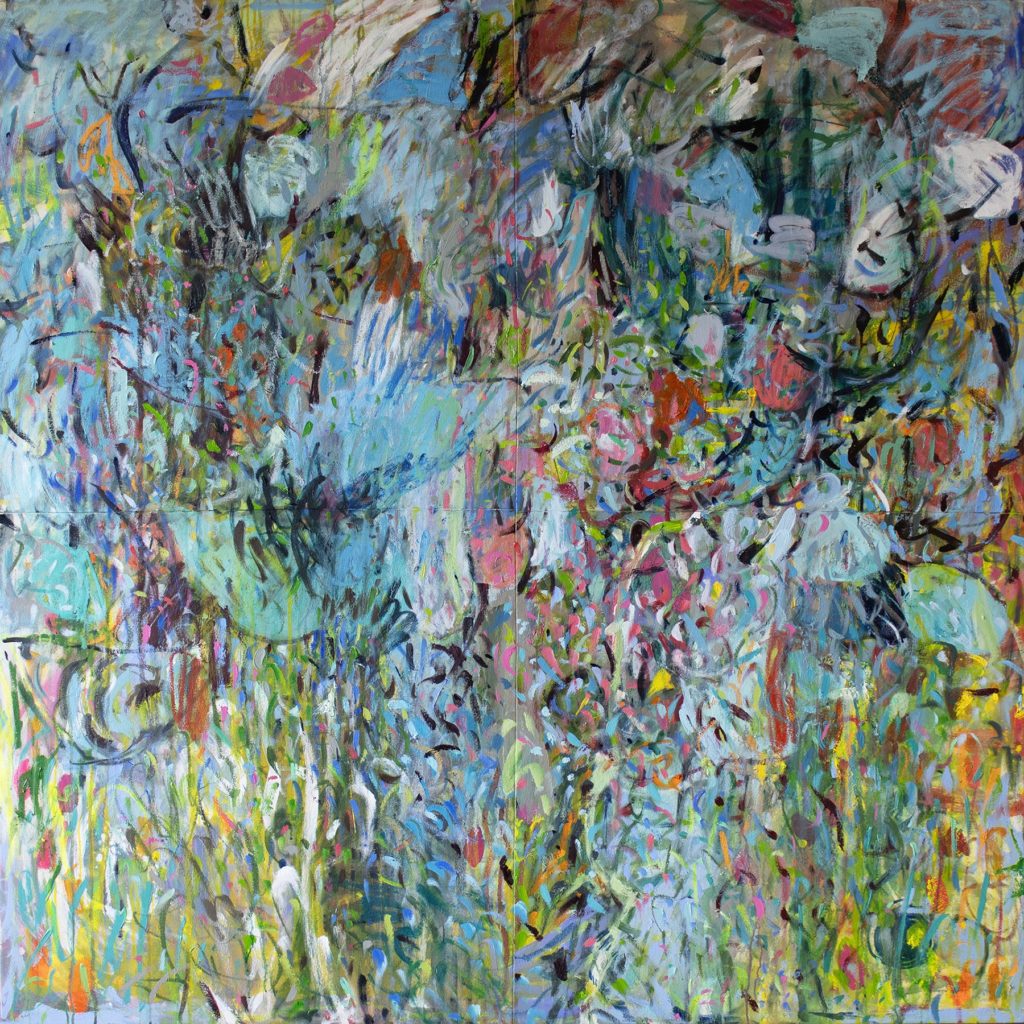
Green Air, 2025, oil and acrylic on canvas, 150cm x 150cm, by Liz Foster. “Green Air is constructed from four smaller panels, sewn together and then stretched to create one painting,” says Liz. “I’ve used a combination of acrylic and oil paint; both paints hold different qualities that add to the work”