REVIEW: I’m Sorry, Prime Minister, Grand Opera House, York, until Saturday ****

As smart as ever…or is he? Clive Francis’s Sir Humphrey Appleby in I’m Sorry, Prime Minister. Picture: Johan Persson

AS Harold Wilson once said, in the white heat of a lobby briefing to journalists in 1964, a week is a long time in politics.

As it turns out, it is a long time on a theatre tour too. Both the role of Prime Minister (imminent exit stage left Sir Keir Starmer) and of the former Prime Minister in I’m Sorry, Prime Minister have undergone a change since the tour opened.

Sir Keir resigned on June 22; the next night, Robert Kitson took over from Simon Rouse as Jim Hacker at Cheltenham Everyman, Rouse having had to withdraw from the rest of the itinerary through illness.

Kitson had understudied Griff Rhys Jones in the West End run and York marks his third week of working in tandem with Clive Francis’s Sir Humphrey Appleby: a partnership now well into its comic groove as the blustering Jim and erudite Sir Humphrey joust in familiar point-scoring mode.

Writers Jonathan Lynn and Antony Jay’s beloved BBC political satire, Yes, Minister and Yes, Prime Minister had run between 1980 and 1988, followed by the 2010 play, Yes, Prime Minister.

Robert Kitson: Taking over as Jim Hacker in I’m Sorry, Prime Minister

Now, writer-director Lynn picks up the solo baton for I’m Sorry, Prime Minister, a final chapter that began at The Barn Theatre in 2023 as I’m Sorry, Prime Minister, I Can’t Quite Remember, a title that indicated the vulnerabilities of ageing for the now venerable Hacker and Sir Humphrey.

This is no nostalgia trip for a treasured double act, however, but a freshly crafted comedy as politically sharp as ever in this age of cancel culture, with lessons to be learned by both the former political leader and his Civil Service nemesis, Cabinet Secretary Sir Humphrey.

Kitson’s Jim Hacker is now Lord Hacker, “older, but perhaps not wiser”, befuddled by the modern world, suffering from arthritis, back pain and congestive heart failure, and in need of a carer, as well as a stair lift.

“Care worker,” Princess Donnough’s Sophie corrects him at her interview to take on the role. It will not be his only politically incorrect utterance to meet her disapproval.

Indeed Jim’s indiscreet tongue is in trouble with rather more than former English Literature student Sophie at Hacker College, Oxford, where he is the long-serving Master after the college was set up in his name with a benefactor’s funding.
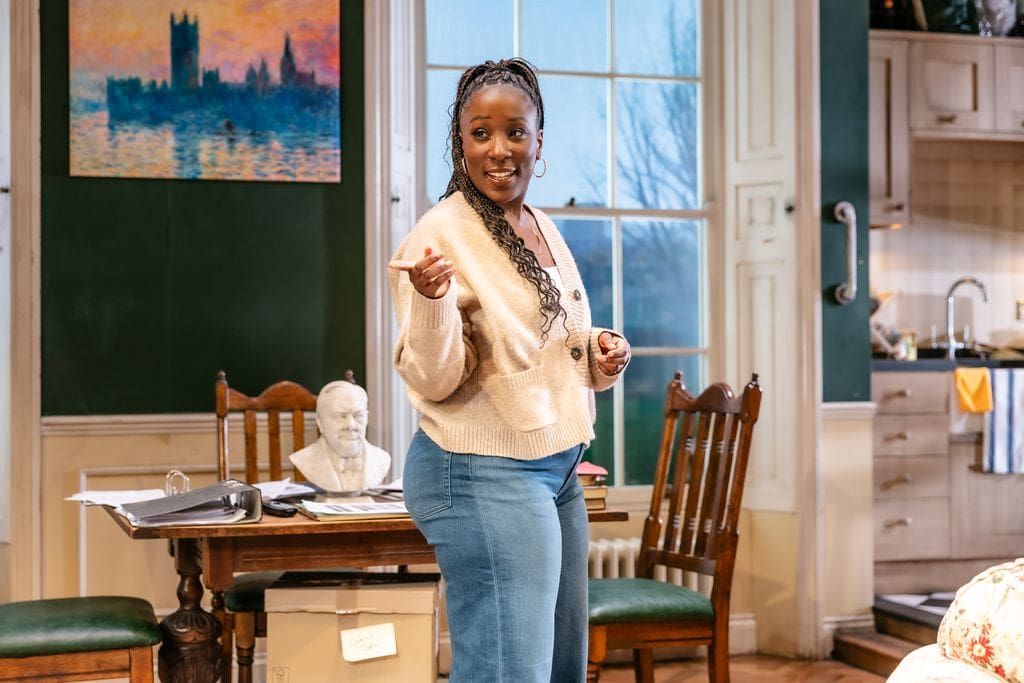
Princess Donnough’s care worker Sophie in I’m Sorry, Prime Minister. Picture: Danny Kaan

Since being forced to resign as Prime Minister, he has dabbled in journalism, written a book (6,000 sales in the first week, none since), turned up every so often for his attendance allowance and expenses at the House of Lords, but now he faces “the ultimate modern crisis: being cancelled by the college committee after his support of Cecil Rhodes’s statue staying in place, among other pronouncements against the tide of change.

Hostile students and equally hostile Fellows want him to be ousted: a P45 delivered by William Chubb’s gaunt college Visitor, Sir David, arriving in Grim Reaper black hood.

Jim will not go quietly into the night, re-establishing contact with Sir Humphrey, by now consigned to a “home for the elderly deranged” by his daughter-in-law, to draw on his skills of negotiation, eloquent, elaborate obfuscation and love of a Latin phrase.

Francis, reprising the role he first played at the Barn Theatre and then in the West End, is a master of comic timing, exquisite line delivery and tongue-twisting double-speak monologues, yet there are frayed edges to Sir Humphrey’s piercing intelligence and bureaucratic chess play. Immaculate suit, ever-present briefcase, superior air, are all present and correct, but could the first signs of dementia be kicking in as he loses the thread of his thinking in one of his magniloquent obstructive set-pieces.

Jim and Sir Humphrey must not only seek to outmanoeuvre Sir David but also face the modern thinking of Donnough’s formidable, frank and fearless Sophie. As well as politics, the world of education is dissected with a scalpel by Lynn as rising student fees and “offensive” words in literature come under fierce discussion.

Clive Francis’s Sir Humphrey Appleby and Simon Rouse’s Jim Hacker in a publicity shot for I’m Sorry, Prime Minister. Simon had to leave the tour through illness

Lynn has the measure of politics and education alike in the kind of wise, waspish and witty satire now all too rare on the British stage in a play as full of King Lear pathos as comedy, where there is a sadness to Jim and Sir Humphrey, now past their pomp.

Yet the comedy still prevails amid the melancholia, directed so astutely by Lynn and co-director Michael Gyngell in a high-class production where Lee Newby’s set design of Jim’s unkempt college rooms evokes academia, widower loneliness and a political past. Snow dusts the skyline in Leo Flint’s window video projections in a further nod to Jim and Sir Humphrey being in their winter years.

Physical comedy plays its part too, riffing on the ageing of the two protagonists, whether in a mobile-phone-going-off-in-a-pocket joke or the stair lift’s brief turn in the spotlight at the opening to Act Two.

Everything is so well balanced in I’m Sorry, Prime Minister, always giving both sides of the argument, showing the fault lines in Jim and Sir Humphrey alike, culminating in the warmth of the fitting finale – the recognition of the need for supportive friendship – that is genuinely moving.

The Barn Theatre presents I’m Sorry, Prime Minister, Grand Opera House, York, until Saturday; 7.30pm plus 2.30pm Thursday and Saturday matinees. Box office: atgtickets.com/york.

I’m Sorry, Prime Minister brings down curtain on Jim Hacker and Sir Humphrey’s clashes as Robert Kitson steps into role

Robert Kitson: Replacing Simon Rouse in the role of Jim Hacker in I’m Sorry Prime Minister

SIR Keir Starmer is not the only Prime Minister being replaced.

More precisely, ex-Prime Minister, in the case of the 2026 tour of I’m Sorry, Prime Minister after illness forced Simon Rouse out of the cast a fortnight ago, to be replaced by Robert Kitson, who is playing Jim Hacker for the remaining dates, including this week’s visit to the Grand Opera House, York.

“It’s very sad that Simon had to leave the show, and we send him our best wishes for a speedy recovery,” says Robert. “He was so loved by the company while he was here, but it’s now a fortunate opportunity for me.

“I wasn’t Simon’s understudy for the tour but I did understudy Griff Rhys Jones as Jim Hacker in the West End, and because I knew the part and we’d done an understudy run during the six months in London [at the Apollo Theatre), I was asked to take over.

“One of the other understudies did a couple of dates, before I arrived last Monday (June 22) to open at the Cheltenham Everyman that Tuesday. “

Robert continues: “I’m very delighted to be having this extended run, where I’ve played Cheltenham and Milton Keynes and York, Brighton, Southend and Malvern are still to come.

“I haven’t  appeared on the York stage before, but I love the city and I’m really looking forward to doing the play there.”

Written and directed by Jonathan Lynn and co-directed by Michael Gyngell, I’m Sorry, Prime Minister is the long-awaited final chapter of the British political satire that brought BAFTA awards for the television series Yes, Minister (1980 to 1984) and Yes, Prime Minister (1986 to 1988), when co-written with Antony Jay.

The Times, they are a’changing for Clive Francis’s Sir Humphrey Appleby in I’m Sorry, Prime Minister. Picture: Johan Persson

Jim Hacker is back, older, but perhaps not wiser, and still utterly baffled by the real world. Hoping for a quiet retirement from government as the master of Hacker College, Oxford, Jim instead finds himself facing the ultimate modern crisis: cancelled by the college committee.

Enter Sir Humphrey Appleby (played by Clive Francis, reprising his West End role), who has lost none of his love for bureaucracy, Latin phrases and well-timed obstruction in a finale replete with wit, nostalgia and more double-speak than a press briefing.

“Do you know what, you can really feel the affection the audiences have for the characters,” says Robert. “Before Sir Humphrey comes on, you can hear an ‘ooh’ from the audience when I mention his name.

“People loved the TV series, and the relationship between Sir Humphrey and Jim, but this play is set later and so the relationship is now different. A lot of the play is about these people re-finding themselves and coping with their lives now.

“It makes for a very different dynamic where the audiences are initially surprised but then they do get into it. This is only my personal opinion, but I think the re-discovery and re-defining of the relationship, when seeing each other again after a long time, is what works so well, as they’re now older men, infirm, and they no longer have the resources they did when they were in their peak years.”

Robert further elucidates: “There are two levels to it. They have to cope with the fact they don’t have the status they once did, and although Sir Humphrey was always the cleverer once, the more sly and conniving one, sometimes Jim got the better of him and that  now continues in old age where they still spar with each other.”

When on understudy duty in London, Robert had enjoyed watching Clive and Griff working together. “They were different in their styles, so it was like a masterclass observing them,” he says.

Clive Francis’s Sir Humphrey Appleby, left, and Simon Rouse’s Jim Hacker at the promotional photoshoot for I’m Sorry, Prime Minister. Simon has had to leave the tour through illness

“Clive is a master craftsman in his coming timing and delivery, and now that it’s the two us, I’m finding that just as important is how every performance is different because the audience laughter can come in different places, so there’s that the  unexpected element, which is the essence of live theatre.”

In addition, Robert has drawn on his experience of being present when writer-director Jonathan Lynn gave notes to the London cast both in rehearsal and after the early performances.

“I got the benefit of that as everything is written with particular weighting and he’s particular about how lines should be said,” he says, further praising the director and Michael Gyngell for their ability to bring the company together. “It’s been great for me to have all people around me, on or off the stage, who are so good at what they do.”

Sir Keith Starmer’s imminent departure from Number 10 could not be better timed for I’m Sorry, Prime Minister. “It’s really interesting because we’ve found the play has resonance that’s reflecting what’s going on at the moment,” says Robert.

“The fact that the Prime Minister’s post has changed over the past two weeks can’t help but have an echo on stage.”

One further factor is Jim Hacker’s politics and behaviour in 2026. “Jim says and does some awful things and has some unacceptable views – and that’s interesting for the audience too,” says Robert.

“You have to give it 100 per cent in rehearsals and on stage, leaving your own beliefs at the [dressing room] door.”

The Barn Theatre production of I’m Sorry, Prime Minister plays Grand Opera House, York, from tomorrow to Saturday, 7.30pm plus 2.30pm Wednesday, Thursday and Saturday matinees. Box office: atgtickets.com/york.

The Full Monty to play Grand Opera House, York, on 30th anniversary tour in July 2027. When do tickets go on sale?

Stripped back: The Full Monty to return in 2027 tour

THE 30th anniversary of Peter Cattaneo’s Sheffield stripping film The Full Monty will be marked by the 2027 tour of screenplay writer Simon Beaufoy’s spin-off play that will visit the Grand Opera House, York, from July 12 to 17.

The tour will be mounted by the Everyman Theatre, Cheltenham, and Buxton Opera House in association with Mark Goucher and David Pugh.

Tickets will go on sale to ATG+ members on Wednesday, March 11 at 10am, followed by general sales from Thursday, March 12 at 10am. Star casting will be announced in due course.

Beaufoy’s heartfelt play tells the story of an ordinary group of men in South Yorkshire’s Steel City striving to reclaim their dignity and pride. Fast paced and irresistibly humorous, it remains strikingly relevant today, resonating powerfully in an era marked once again by a cost-of-living crisis.

What happens in The Full Monty? Gaz and his mates find themselves down on their luck, cast aside and underestimated, but determined to fight back, even if it means revealing more than they ever imagined.

Beaufoy says: “A lot has changed in Britain since The Full Monty appeared 30 years ago. What hasn’t changed is our need for laughter, compassion and dignity. I’m so delighted the ‘Monty Men’ are back on the road with all their flaws, jokes and wobbly bits, bringing a bit of much-needed joy to audiences once again.”

Echoing the 1997 smash-hit film, next year’s touring production will deliver a rollercoaster of humour and heartbreak as audiences are invited to relive the iconic music of the 1990s, cheering on the unforgettable group of lads as they prepare to put on the show of their lives.

Beaufoy received an Academy Award nomination for Best Original Screenplay for The Full Monty, later winning  an Oscar for Best Adapted Screenplay for Slumdog Millionaire.

The Full Monty tour production will be directed by Michael Gyngell, with choreography and intimacy direction by Ian West, set and costume design by Jasmine Swann, lighting design by Andrew Exeter and sound design by Chris Whybrow. The casting director is Marc Frankum.

REVIEW: Friends! The Musical Parody, Grand Opera House, York, until Saturday

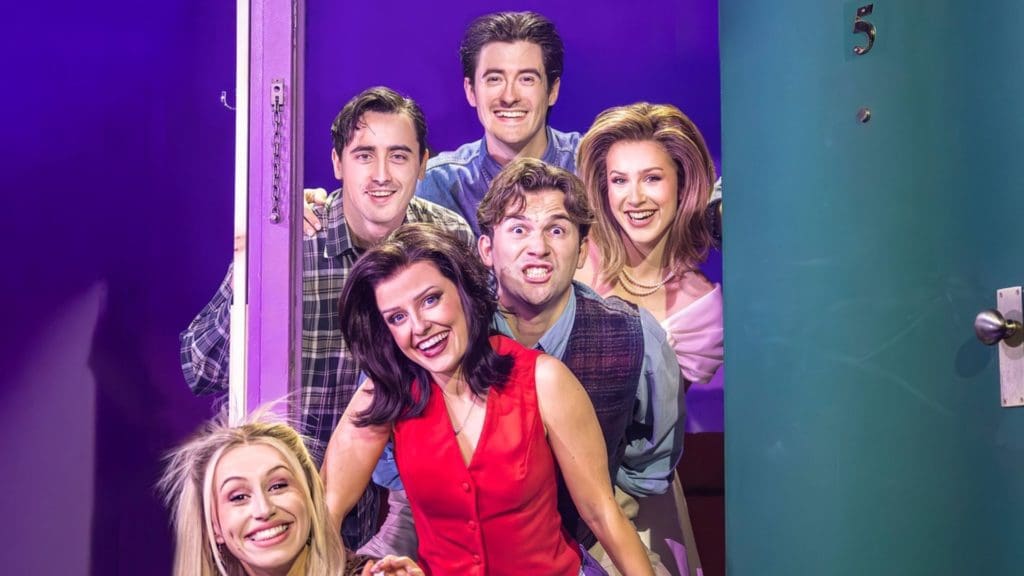
Amelia Atherton’s Phoebe, left, Ronnie Burden’s Joey, Alicia Belgarde’s Monica, Enzo Benvenuti’s Ross, top, Daniel Parkinson’s Chandler and Eva Hope’s Rachel in Friends! The Musical Parody. Picture: Pamela Raith

THIS is the one where you will know all the characters and iconic moments but none of the songs by book and lyric writers Bob and Tobly McSmith and composer Assaf Gleizner.

Worry not. Friends! The Musical Parody was a hit in New York and Las Vegas and those songs – and there are songs aplenty – more than punch their weight, adding to the familiar humour with character candour and knowing social commentary.

“Parody” is defined as a “humorous or mocking imitation, using the same form as the original to spoof or satirise”. How is it applied to Friends, the escapades of “the world’s most famous group of twenty-somethings” that ran for  ten seasons on NBC from September 22 1994 to May 6 2004 and is still watched the world over 21 years later?

Yes, it is a humorous imitation, and yes, it applies the same TV format of a studio recording with you as the audience, but rather than “mocking”, the tone is one of affectionate teasing. Not least in its Act Two references to the pre- and post-Friends years for the famous six, Jennifer Aniston, Courtney Cox, Lisa Kudrow, David Schwimmer, Matt LeBlanc and Matthew Perry (but understandably stopping short of mentioning his troubled death in October 2023).

As mentioned above, Andrew Exeter’s set and lighting design takes the form of a TV recording studio with cameras, information screens and wooden frameworks denoting Bathroom, Kitchen  and Joey or Monica’s Apartments.

On steps warm-up act Kip Kipperson in the first of multiple roles for chameleon Knaresborough actor Edward Leigh, later to appear as perky, bleach-blond Central Perk coffee-shop worker Gunther, Tom Selleck & his moustache and Italiano stalliono Paulo. Scene-stealing at its best, topped off by Gunther’s crestfallen rendition of Part Of Their Gang.

Where’s Eva Hope’s Rachel Green when we first encounter Daniel Parkinson’s Chandler Bing, Enzo Benvenuti’s Ross Geller, Alicia Belgarde’s Monica Geller, Amelia Atherton’s Phoebe Buffay and Ronnie Burden’s Joey Tribbiani in Friends Like Us and Typical Day At Central Perk? Ah, here comes Rachel in that wedding dress, and so the pattern is established of replaying favourite moments, leading into songs full of waspish wit, longing and reflective wisdom.

Edward Leigh’s Gunther: Serving coffee and pathos at Central Perk in Friends! The Musical Parody. Picture: Pamela Raith

That’s how to cram 236 episodes into two hours or ten minutes more on first night after an unexplained technical hitch in Act Two, but the show must go on, as the saying goes, and Friends! was at its best after play was resumed.

Writers, director Michael Gyngell and actors alike capture the ticks and tropes of each character, matched by Jennie Quirk’s costume-design precision. The more you watch Belgarde, Atherton, Burden, Benvenuti and especially Hope and Parkinson, the more you warm to characterisation that is faithful, rather than a caricature, but has room for send-ups. No mean feat. Seamlessly, they become funnier too as the rhythm of sketch and song settles satisfyingly.

Parkinson, spoiler alert, doubles up as Chandler’s “long-time on-off girlfriend”, Janice, setting him the impossible task of being two people at once in comedy mayhem tradition. Oh my god, Janice’s song OMG It’s Janice is particularly good.

So many Friends nuggets are here: Joey’s How You Doin’; Chandler and Monica trying to hide their relationship; Monica’s turkey; Ross’s incessant whining and Pivot; Phoebe’s mother-fixated, dire songs and triplet pregnancy; Joey and Chandler’s pets Chick and Duck (in singing-puppet mode), and Rachel’s airport finale. All done with just the right detail, in keeping with the trademark trim editing of the 22-minute TV episodes.

What lifts Friends! The Musial Parody beyond mere pastiche is the editorial input of Bob & Tobly McSmith, forever denying Gunther more than a line and commenting on the absence of black characters in the TV series; the friends never paying at Central Perk, never having money worries, and Monica and Ross Geller being Jewish “not being a thing”, as Ross puts it. Plus how, despite all the bedroom dynamics, Rachel and Monica are never seen naked (“but we know you want to”.

Friends! The Musical Parody works as a show for the initiated, rather than an initiation ceremony, but given Friends’ popularity among old fans and younger, this is the one that’ll  be there for you, when the York rain starts to pour this week.

Stars out of five? Pivoting from *** in the first half to **** for the second.

Mark Goucher, Matthew Gale and Oskar Eiricksson present Barn Theatre production of Friends! The Musical Parody, Grand Opera House, York, Thursday, 7.30pm; Friday, 5.30pm and 8.30pm; Saturday, 2.30pm and 7.30pm. Box office: atgtickets.com/york.

REVIEW: The Full Monty, Grand Opera House, York, leaving hats on until Sat ****

Bill Ward’s Gerald, left, Danny Hatchard’s Gaz, Nicholas Prasad’s Lomper and Neil Hurst’s Dave watch understudy Leyon Stolz-Hunter’s Horse go through his audition moves in The Full Monty. Picture: Ellie Kurttz

AT the midweek matinee, there appeared to be more men on stage than in the audience. It was very much the same febrile atmosphere that greeted the Chippendales on their York Barbican visits.

Outnumbered, dear reader, yes, but ironically The Full Monty is just as much a show for blokes too. Hence the link up with Menfulness, the York mental health charity.

Throughout this week’s run, the Grand Opera House will be collecting donations at bars and kiosk card payment points to provide funds towards urgent counselling for men at crisis point.

Men don’t talk to each other. Not about their problems, neither their own, nor each other’s. Just the football. But they do talk in this play. A lot. Men would benefit from doing it more often.

In the meantime, let’s talk about this terrific touring revival of The Full Monty, the spin-off play that the 1997 film’s scriptwriter, Simon Beaufoy premiered in 2013 in his first work for the stage.

In essence it is another strip off the same block, The Fuller Monty that goes even further, replaying the film’s greatest bits and greatest hits (Hot Chocolate, Donna Summer, Tom Jones finale), but with resonance anew and a political punch to the gut amid the cost-of-living crisis, rising rate of men’s suicides and a Tory government mired in long-reigning powerplays.

Just as was the case in the Sheffield of 1990s’ industrial strife, whose skyline forms the backdrop to Jasmine Swan’s fold-out set design of scaffolding and gauze.

Policemen’s drill: Nicholas Prasad’s Lomper, left, understudy Leyon Stolz-Hunter’s Horse, Jake Quickenden’s Guy, Bill Ward’s Gerald and Neil Hurst’s Dave in the finale to The Full Monty. Picture: Ellie Kurttz

The Republic of South Yorkshire’s steel industry had been knifed in the back, steelworkers stripped of their jobs, their dignity, their future. Men like former prisoner Gaz (Danny Hatchard, from EastEnders and Not Going Out) and his best mate, big Dave (Neil Hurst), who operated the steelworks crane.

The lads are now consigned to the scrapheap, the forlorn job club form-filling, and thieving from the foundry, where they have snuck into as the play opens, looking up at the crane, named Margaret after you know who, once mighty but now dormant in the damp, ever since the factory was shut down.

They will encounter insecure security guard Lomper (Nicholas Prasad), stuck in a dead-end job that he wants to end with a rope around his neck. Next will be Gerald (Bill Ward, from Coronation Street and Emmerdale), the jumped-up foreman with a sideline in dance tuition at the Conservative club and a free-spending wife (in Mrs Thatcher blue suits and stiff blonde hair), who is yet to tell he has lost his job. Six months ago.

On a night out at the Chippendales are Jean (Harrogate Theatre regular Katy Dean), Dave’s long-suffering yet devoted cleaner wife, and Mandy (Laura Matthews), Gaz’s ex-wife, who is threatening to cut off his links with son Nathan (Jack Wisniewski, sharing the role on tour with Cass Dempsey, Theo Hills and Rowan Poulton) as he falls further behind with the maintenance.

Ever the Billy Fisher dreamer, Gaz hits on the fundraising idea of forming a strip act, a Yorkshire fish-and-chips answer to the Chippendales’ T-bone steak, for one night only. Gerald will teach the routines, joined by Gaz, lovable, ever-dieting Dave, offbeat Lomper and who else?

The auditions, always a highlight, bring the first half to a double climax under Michael Gyngell’s perfectly weighted direction. First, step forward, a tad gingerly, Horse (Ben Onwukwe), with his James Brown/Northen Soul moves and dodgy hip.

Next, the moment the matinee hordes had been waiting for: the arrival to whoops and cheers of Jake Quickenden, last seen in York stripping down to his golden hot pants as a hunky cowboy in Footloose at the Theatre Royal. This time, Jake and his fabbadabbadoo abs are playing Guy, although audience members are quick to shout out Jake’s name, demanding rather more than a pound of flesh.  

The full package: Jake Quickenden’s Guy in The Full Monty. Picture: Ellie Kurttz

He takes it all in his stride, staying in character, gay, gorgeous but still coming to terms with a lost love, in keeping with Gyngell’s production playing the big tease, but always being true to Beaufoy’s original spirit.

For many, The Full Monty will be familiar, and that familiarity breeds contentment amid the discontent of the lives depicted, played here as if the for the first time.

The bare truths surround impotence, unemployment, loneliness and suicide attempts. You laugh because otherwise you would cry, and sometimes you do both at once, faced by comedy and pathos, mischief and melancholia in tandem, dealing with the stuff of life:  resilience, community, fighting back, and love, in whatever form, whatever shape. The Yorkshire of Keith Waterhouse, John Godber, Alan Plater.

This Cheltenham Everyman Theatre and Buxton Opera House touring production delivers the Fullest Monty yet, superbly cast, with spot-on lighting by Andrew Exeter, ace choreography by Ian West, and a soundtrack not only of the film favourites but Pulp, Primal Scream, The Verve and Chumbawamba too.

It feels wrong to pick out performances: Ward, Onwukwe and Prasad all shine, but partnerships are particularly strong in Gyngell’s company. Take your pick:  the friendship of Hatchard’s Gaz and Hurst’s Dave (with his echoes of York’s Mark Addy). The bond between Hatchard’s Gaz and Wisniewski as his canny-beyond-his-years son, at once amusing yet deeply moving too.

Or the ups and downs of Hurst’s Dave and Dean’s Jean, so been there, done that. And then there’s Quickenden’s Guy and his appendage, his Monty python, if you like.

Performances: 7.30pm tonight and tomorrow; 2.30pm and 7.30pm, Saturday. Box office: atgtickets.com/york