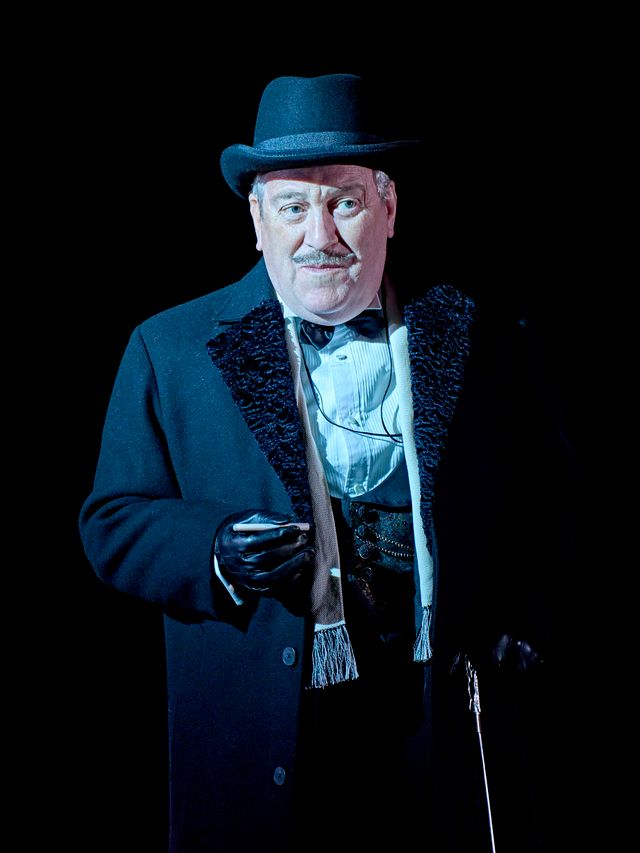
Mark Hadfield as Hercule Poirot in Death On The Nile, on tour at Grand Opera House, York, from March 3 to 7. Picture: Manuel Harlan
MARK Hadfield arrives at the Grand Opera House, York, next Tuesday to play legendary private detective Hercule Poirot in the European premiere of a new stage version of Death On The Nile, carrying the approval of none other than Sir Kenneth Branagh.
The two actors are friends. “He’s been incredibly encouraging,” says Mark of his conversations with Sir Kenneth, who has played Agatha Christie’s fastidious puzzle solver in three film outings marked by his moustache topiary.
Encouragement came from Michael Maloney too, another actor friend who took on the role of the Belgian sleuth in the tour of Murder On The Orient Express that visited York last March.
As with the UK and Ireland tour of Death On The Nile, that Fiery Angel production combined Ken Ludwig’s adaptation of a Christie novel by Ken Ludwig with direction by Lucy Bailey.
“They both encouraged me to do this because they said, ‘you will have so much enjoyment in bringing him to life’,” says Mark of Branagh and Maloney. “And I think Death On The Nile is one of Christie’s best stories, so that also drew me in.
“Poirot’s journey within it is fascinating to play, because he goes from being on what he thinks is a relaxing holiday to having to solve a murder.”
The killing in question happens in 1937 when Poirot is holidaying on a luxury steamer on the River Nile in Egypt, where a couple’s idyllic honeymoon is cut short by a brutal murder. Once secrets buried in the sands of time resurface, can the world-famous detective untangle the web of lies to solve the case?
On tour from last October in Salford to May 23 in Plymouth, Mark is following in the orderly steps of Maloney, Branagh, Albert Finney, Peter Ustinov and David Suchet in playing Poirot, a familiar character that has elicited myriad interpretations. “The challenge is to try and incorporate people’s expectations but also to bring in a few surprises,” he says.
“I’m not expecting people to say, ‘oh my God, that was the most original Poirot I’ve ever seen’ by giving him a punk hairdo or what have you. But I hope to find that balance of pleasing people while leaving them going, ‘we haven’t seen that before’.”
After solving a murder on the Orient Express, Poirot is heading into his later years. “He may even be thinking of retiring,” suggests Mark. “He talks about old age and life having passed him by. There’s more of a hint of melancholy than people might be used to from him.”
Mark hopes next week’s audiences will find Death On The Nile to be “delicious, like opening a two-tray box of chocolates where you enjoy the first layer so much that you have to have the second layer too.
Christie’s story combines escapism with a timeless theme. “It’s gloriously evocative of travel in that time, but it’s also about how we should nurture love and try to be as kind as we can,” says Mark. “That’s something we could learn from with everything that’s going on at the moment.”
Mark has performed at the West Yorkshire Playhouse and Sheffield’s Crucible and Lyceum theatres but never in York previously. “York’s theatres have eluded me, though I have visited the city. This will be my first time on a York stage, so I’m really looking forward to it,” he says.
Most memorably on a Yorkshire stage, “I did the original West Yorkshire Playhouse production of The 39 Steps with Fiery Angel in June 2005,” says Mark, who played myriad roles in the guise The Clown in Patrick Barlow’s adaptation, directed by Fiona Buffini.
In another first for Mark, “Death On The Nile is the first time I’ve worked on a production with Lucy [Bailey], though I’ve known her for a long time and I’ve done workshops with her on other projects.
“Very kindly Lucy was very keen for me to do it, and it does help a great deal that the director has seen you have the capability for the part, especially one as illustrious as Poirot.”
Mark continues: “I was desperate to do it, and knowing that Lucy was keen, I didn’t need much convincing, though I had an elderly mother to think about – when ruminating over whether I could do the tour.
“That’s why I met up with Kenneth [Branagh] and Michael [Maloney], the previous Poirots. We met up at a Tottenham match, as Kenneth is a devoted Spurs fan – I’m a Manchester United fan – and he said ‘you have to do it’. That helped with the decision because it was nice to have that support.
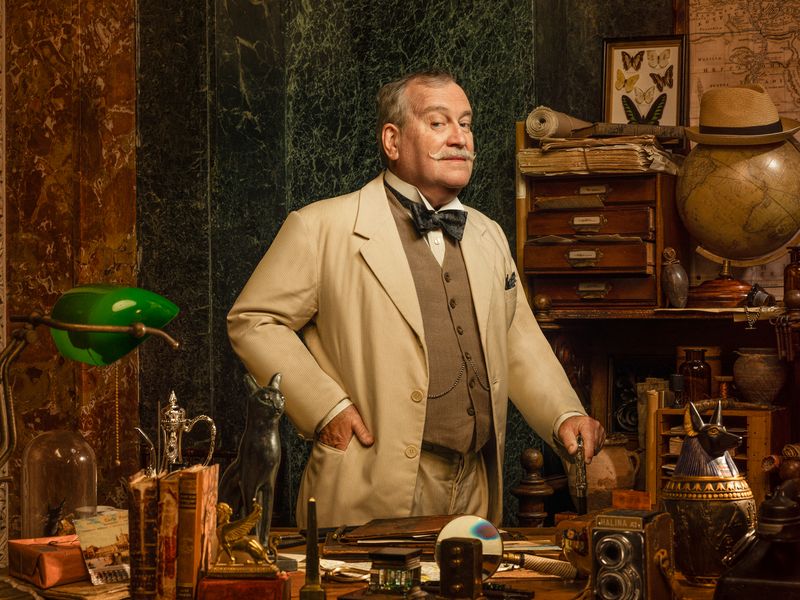
Mark Hadfield – with grey moustache – at the publicity photographic shoot for Fiery Angel’s tour of Death On The Nile. Picture: Jay Brooks
“When we met up again, Kenneth shared his research for the role, where he said the thing that struck him most about Poirot was his kindness – when there are so many facets you could pick out: his meticulous attitude, his aloofness. So that was something that stayed in my mind.”
As for Michael Maloney, “he said he loved creating characters and that Poirot had been a joy,” says Mark. “I’ve been finding that too, and I keep finding more, little things where I think, ‘I’ll try that’ as he’s a multi-faceted character and an absolute pleasure to play.”
Mark’s research had included reading film historian Mark Aldridge’s 2020 book Agatha Christie’s Poirot: The Greatest Detective In The World, covering the character’s evolution across novels, stage, radio and screen from 1920 to 2020, the centenary of his debut.
This informs his playing of a role that combines familiarity with flexibility. “I know all the performances that have been done on screen, apart from John Malkovich [in BBC One’s The ABC Murders in 2018],” he says.
“I’ve not ignored the likes of Peter Ustnov and Albert Finney, as well as David Suchet. Peter and Albert were so memorable, partly because they each had a very different look, like Albert going for Poirot’s vanity, whereas Peter’s Poirot was very charming and avuncular. With David Suchet, it was the precise, physical aspect.”
Mark’s research also took in reading Christie’s first detective novel, Poirot’s debut in The Mysterious Affair At Styles. “As it’s his first appearance, you get a bit of background, how he came over from Belgium in the First World War, in which he served and was injured, arriving here as a refugee, like Kenneth showed in Murder On The Orient Express.
“I’ve gone for the physicality of Poirot being in his sixties, with a slight limp, using the cane as a necessity, rather than as a fashion accessory. By Death In The Nile, he’s been through a lot, where he’s got to the point where, if he could, he would retire.
“The script backs this up, where he’s reflecting on his life and growing old, where the lovers on board seem incredibly young, whereas he’s an older man who’s seen too much and grown tired.”
Mark continues: “It’s a great leap for the audience to see this man who, in the first half, is looking forward to the trip with the colonel [Colonel Johnnie Race], going up the Nile for rest and recuperation, but then the murder occurs, and he has to revert to being the Poirot everyone expected him to, with him finding this murder particularly distasteful.”
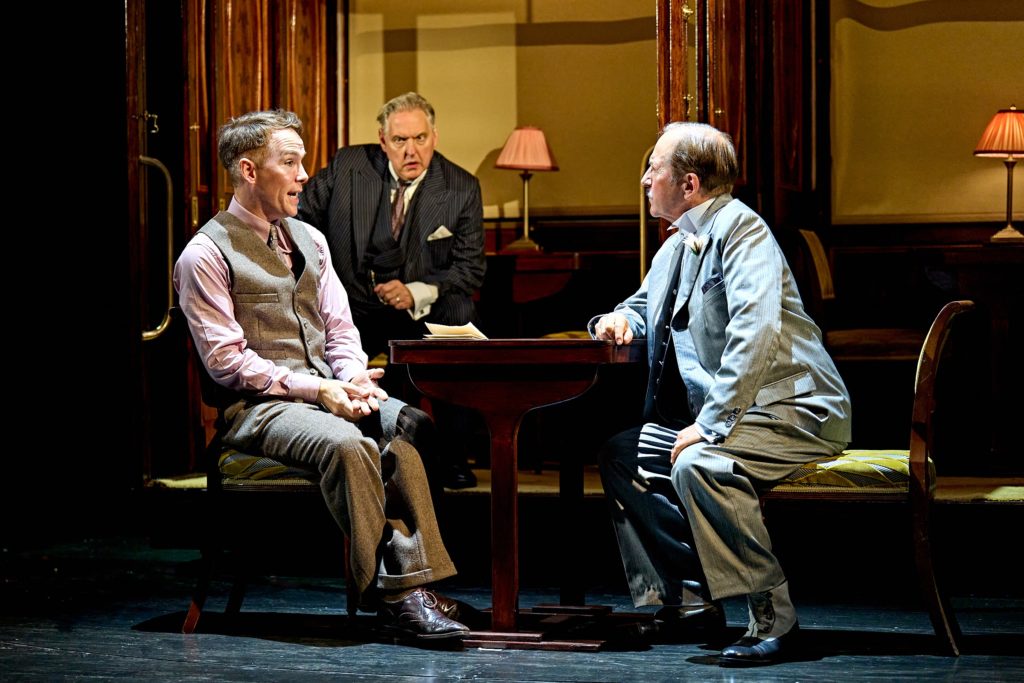
Mike Britton’s set design opens at the British Museum before the luxurious paddle steamer takes centre stage. “It’s a two-tier set with the lover dying on the upper deck,” says Mark. “What we want to achieve is a very claustrophobic feeling, where Mark creates such spaces as a cabin and a saloon by using sliders.
“Theatrically, you have to keep cranking up the tension until the denouement, where you know that everyone on board is a suspect and the intrigue builds as to who’s done it, as everyone has a back story in relation to the character who’s murdered. Everyone has a motive for committing the crime.
“The theatrical setting heightens that tension and suspense, as do the sound effects of Mic Pool, who I worked with previously at the West Yorkshire Playhouse.”
Britton’s set looks “absolutely gorgeous and sumptuous”, says Mark. “He’s done the fabulous costume designs too. He’s done a lot of research to capture the socialite world aboard the steamer in 1937. Everybody looks immaculate.”
Ludwig’s script is vital too. “He’s basically a writer of comedies, doing that very successfully, but here he’s managed to create the suspense and tension while making it witty too, with a nice strain of humour, even at the end,” says Mark.
“It’s a risk, but it works, as the audience goes through the excitement of wondering ‘whodunit’ and we can relieve all that tension with humour.”
Mark’s Poirot will, of course, have a moustache. “It’s quite a challenge as moustaches are mentioned a lot with Poirot, though I know there were films made in the 1930s where Poirot didn’t have a moustache, which caused confusion [Irish actor Austin Trevor’s Poirot in 1931’s Alibi, Black Coffee and Lord Edgware Dies],” he says.
“I haven’t gone for the severity of Kenneth or David’s moustache. I’m greying quite rapidly, and when we did the photos for the press releases, you can see mine is quite grey, but that doesn’t have a dynamic look on stage, where it has to be darker – and I did read that Poirot dyed his hair and moustache.
“I’m letting my moustache grow – so, yes, it’s genuinely attached! – and it’s become a smart, reverent gesture towards moustache twiddling . My wife complains ‘Will you stop playing with your moustache’, but I just can’t stop! It will grow even more, so it does have its own character.”
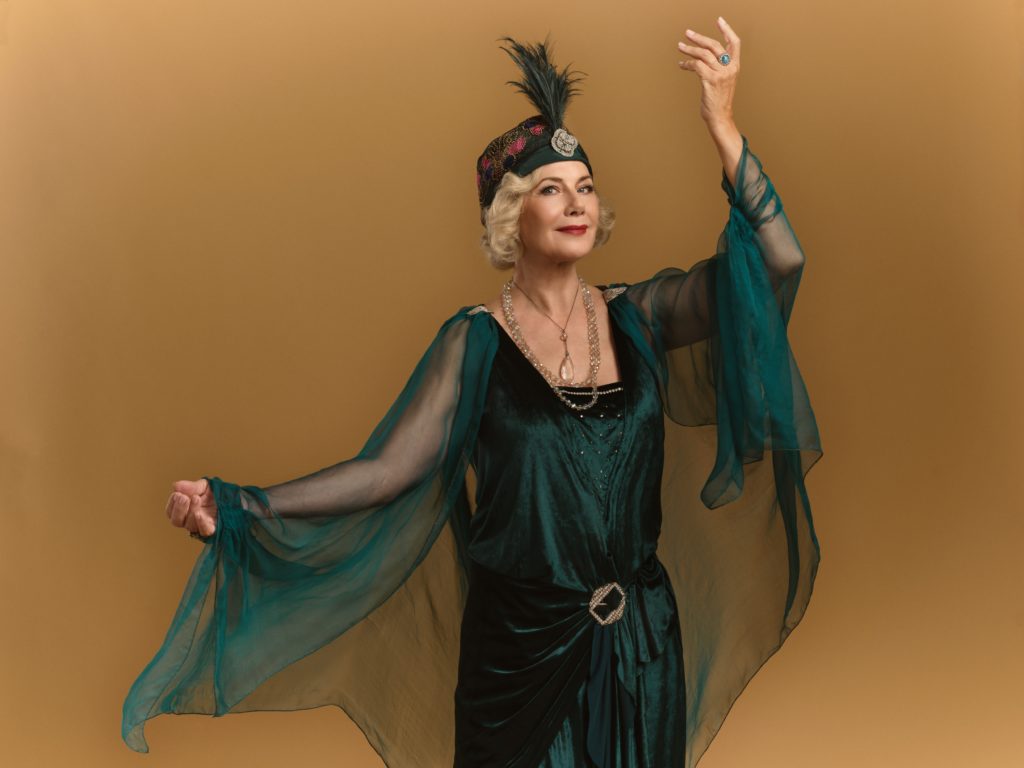
Glynis Barber’s romantic novelist Salome Otterbourne in Fiery Angel’s Death On The Nile. Picture: Jay Brooks
AMONG those joining Mark Hadfield’s Poirot on the steamer on the Nile will be flamboyant romance novelist Salome Otterbourne, played by Glynis Barber. “In the play, she’s very different to how she is in the book and in the various films – and she’s quite a character, which makes her fun to play,” she says.
“She is larger than life and she brings a lot of energy to the stage. She’s the loudest, bubbliest and most theatrical character, that’s for sure.”
A further draw for Glynis was the team behind Death On The Nile. “Lucy [Bailey] is a fabulous director and Fiery Angel is an amazing company. Plus this one hasn’t been done on stage before in the UK, so that makes it exciting,” she says.
A version of the play was staged in Washington, but now Ken Ludwig has rewritten it for its European premiere. “And the response has been phenomenal,” says Glynis. “I’ve had so many messages from people I know – and people I don’t know- going, ‘I definitely want to see that’. I’ve even got one friend who is flying in from Spain to Edinburgh to see it.”
Death On The Nile is her first theatre work since The Best Man in 2018 in London’s West End. “After the pandemic, I wasn’t sure if I wanted to return to it, because, after being isolated for all that time, I’d gotten cold feet,” says Glynis.
“But the fact that it’s a scary prospect is a good reason to do it, and I thought, ‘if I am going to go back to theatre, this is a really good play to do so with.”
Glynis understands the lure of a Christie story on stage. “The plots keep you guessing and they’re a very good way to escape the world for a couple of hours,” she says. “Who doesn’t want a bit of that, especially these days?”
Highlighting the central theme, Glynis says: “It’s about love, which is deeply pertinent for every age, and in this story it’s a very profound theme. Unless we all become AI bots, love is universal and that is something that will never change.”
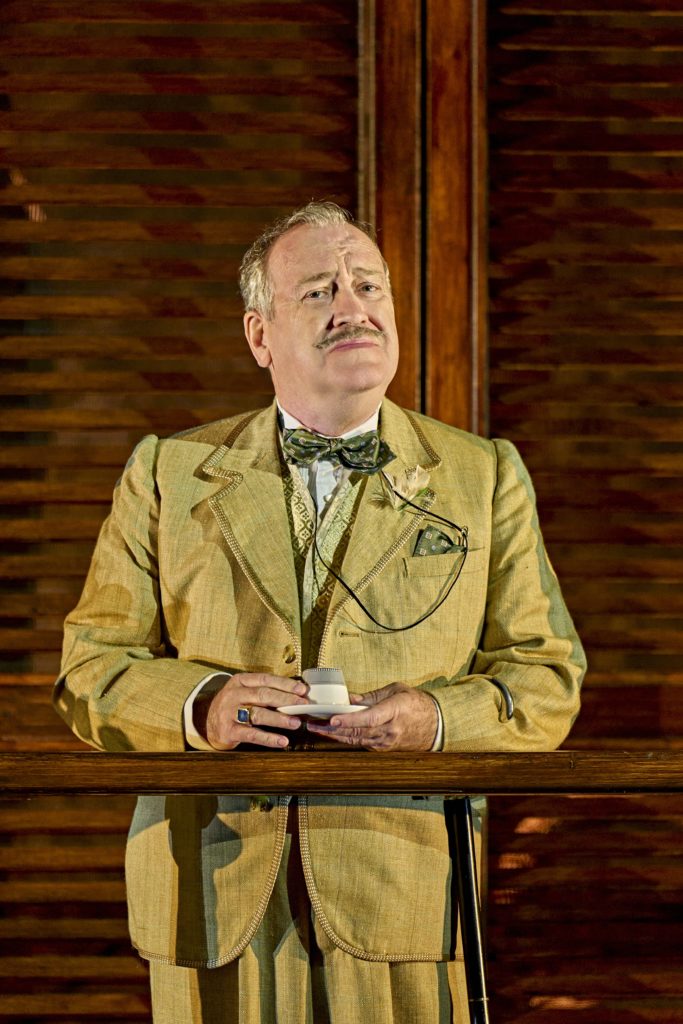
Mark Hadfield’s Hercule Poirot in a scene from Fiery Angel’s production of Agatha Christie’s Death On The Nile. Picture: Manuel Harlan
One last question for Mark Hadfield
How did you settle on your voice for playing Hercule Poirot?
“I worked with a lovely voice and dialect coach, Edda Sharpe. I did a Zoom meeting with her for an hour before rehearsals started, where I did the voice and she said, ‘it’s not far off’.
“All we had to do was make it more Belgian, where the French mouth is tighter and the Belgian mouth is more smiley, so whereas the French say ‘Ze’, the Belgian says ‘de’.
“I also worked with Edda in rehearsals, where she would give me little things to think about. Lucy [director Lucy Bailey] said the focus was to find the tonal range, which makes it interesting.
“That’s been a good challenge, bringing Poirot alive. All these things, we’ve looked at, worked on and reflected on on a daily basis – in case we go to Belgium!”
Fiery Angel presents Death On The Nile, Grand Opera House, York, March 3 to 7, 7.30pm plus Wednesday and Saturday matinees. Box office: atgtickets.com/york.