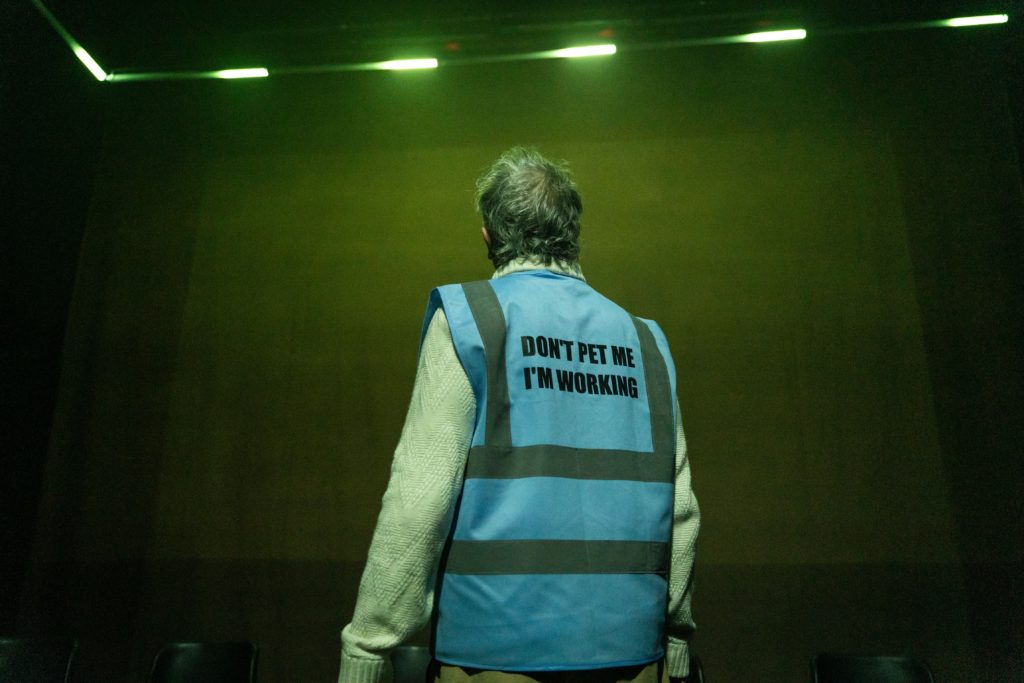
Robin Simpson’s Sam, the emotional support dog, in Catherine Dyson’s The Last Picture. Picture: S R Taylor Photography
“I CAN’T think of anyone better to play a dog than Robin,” said York Theatre Royal creative director Juliet Forster at Saturday night’s post-show discussion.
She is referring to West Yorkshire actor and storyteller Robin Simpson, best known in York for his six seasons as the Theatre Royal’s pantomime dame – and already confirmed for next winter’s Snow White & The Seven Dwarfs too.
Simpson’s ability to connect with audiences is “extraordinary”, said director and associate artist John R Wilkinson, an ability needed for both his panto role and now York Theatre Royal, English Touring Theatre and An Tobar and Mull Theatre’s world premiere co-production of Catherine Dyson’s one-act solo play.
In a nutshell, what links the two parts is the requirement for “direct address” to the audience. Here Simpson is playing Sam, an emotional support dog on a Year 9 school trip to a museum (unspecified but the Imperial War Museum in all but name).
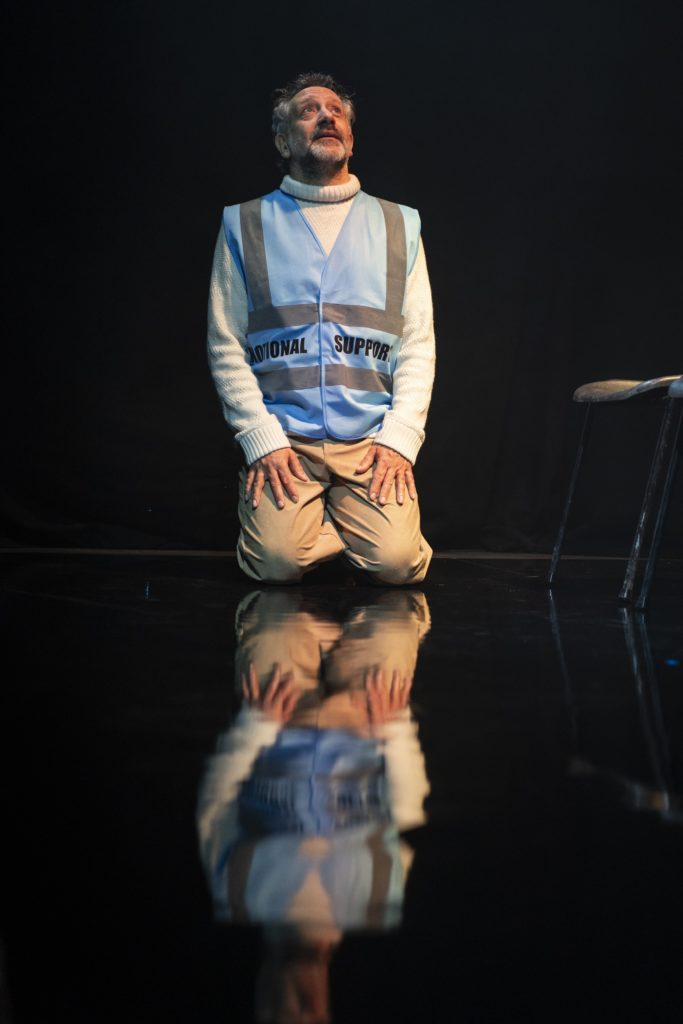
Robin Simpson: Storytelling prowess in The Last Picture. Picture: S R Taylor Photography
Simpson is not dressed as a canine, nor does he walk on all fours, but his tabard bears the message “Don’t Pet Me I’m Working” and his roll-neck jumper and trousers evoke the colours of a Golden Retriever or Labrador.
This dog talks, taking the narrator’s role, while evoking the school head of history and a particularly sensitive schoolboy, and taking the audience by the hand as he invites us to imagine being in a theatre in 2026,then the group of school children, on the bus trip and in the museum, and most hauntingly, the victims of the Nazi Holocaust in each Second World War picture.
Writer Dyson decreed only a few stage instructions, the most significant being that the pictures being described by Sam should never be shown. Instead, the images should be formed in our imagination – one of theatre’s most powerful tools – but such is the impact of Kristallnacht (the Night of Broken Glass), the children’s exodus from Poland, the Jewish ghettos and the concentration camps that, when combined with Dyson’s descriptions and Simpson’s storytelling prowess, we readily draw on imagery from history books, films and documentaries.
Dyson’s structure is methodical, building momentum all the while. A head count is taken as regularly as Simpson’s Sam asks us how we are feeling after each picture. Simpson’s narrator explains how Sam can sense our emotions, our distress, without having the capacity to understand the play’s greater question: Why?
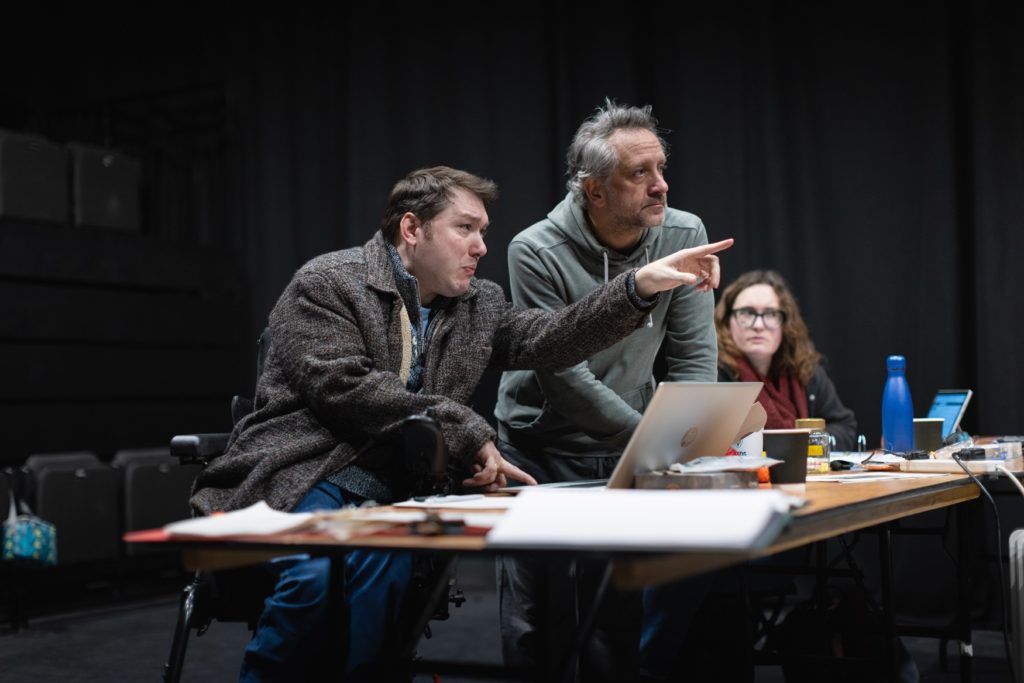
Director John R Wilkinson in rehearsal with actor Robin Simpson for the world premiere of The Last Picture
Gradually, we see teacher, breakaway 13-year-old pupil and dog all break down in reaction to what they are encountering, all conveyed so expressively by Simpson.
We learn too of other children’s reactions: wanting to know when lunch will be; wondering why something that happened so long ago in a different country should matter to them as they head from room to room, one marked Escalation, Deportation, Final Solution. They reach for the mobile phones at the earliest opportunity to flick through the latest posts.
Interestingly, contrary to myth, dogs do see in colour, but not in the same way we see colour, and here Wilkinson and set designer Natasha Jenkins complement Dyson’s descriptions of colour used by Sam to sum up the mood of each scene.
The back wall is covered with a plain cloth (an aid for us to build up a picture); the flooring has a metallic black sheen, framed by Isle of Skye lighting designer Benny Goodman’s strip lighting that changes from white to yellow. When the cloth drops suddenly, the stage is bathed in fiery orange.
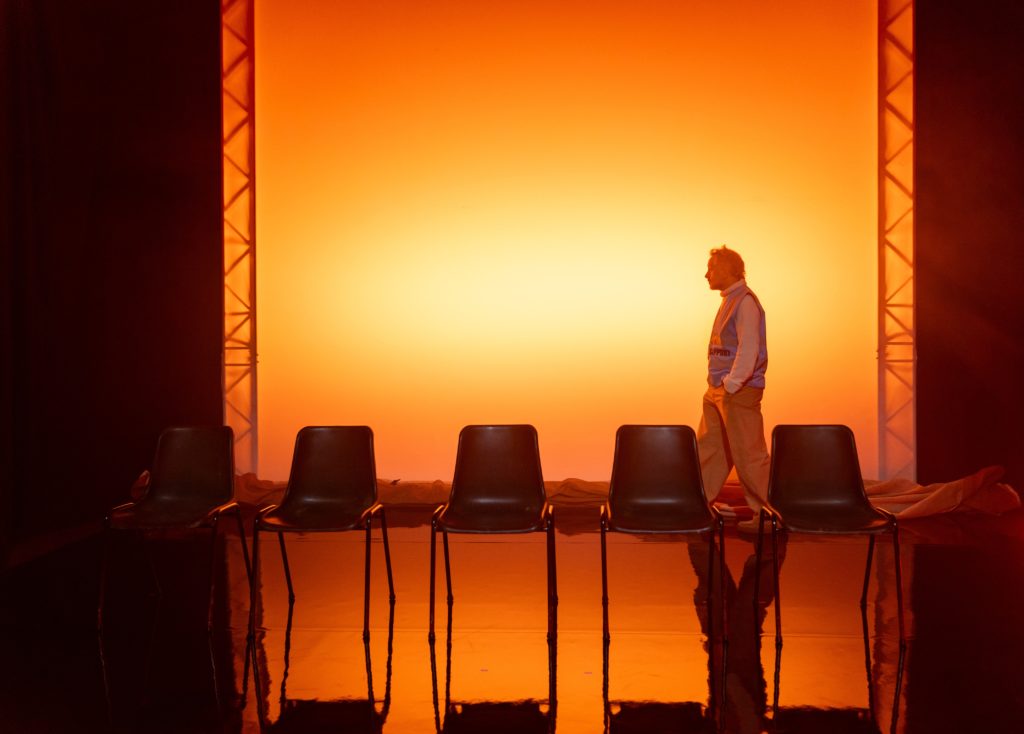
Natasha Jenkins’s set design for York Theatre Royal’s production of The Last Picture. Picture: S R Taylor Photography
The minimalism stretches to the props: one table to the side, with a water bottle marked Sam (for Simpson’s vocal lubrication) and five lecture hall/school room chairs that Simpson uses in differing ways, most disturbingly to portray dead children when lain on their side.
Every detail has been thought through to the max, honed in four weeks of rehearsals, a research visit to Holocaust Centre North in Huddersfield, and in Wilkinson’s bond with Dyson over the power of abstract, non-literal theatre and European drama, as well as in Simpson’s remarkably adroit performance.
The Last Picture had begun life as one of 37 new plays picked from 2,000 entries to mark the500th anniversary of Shakespeare’s First Folio in 2023 with a national playwriting initiative, when Wilkinson directed a rehearsed reading at York Theatre Royal and saw its potential for a full-scale production.
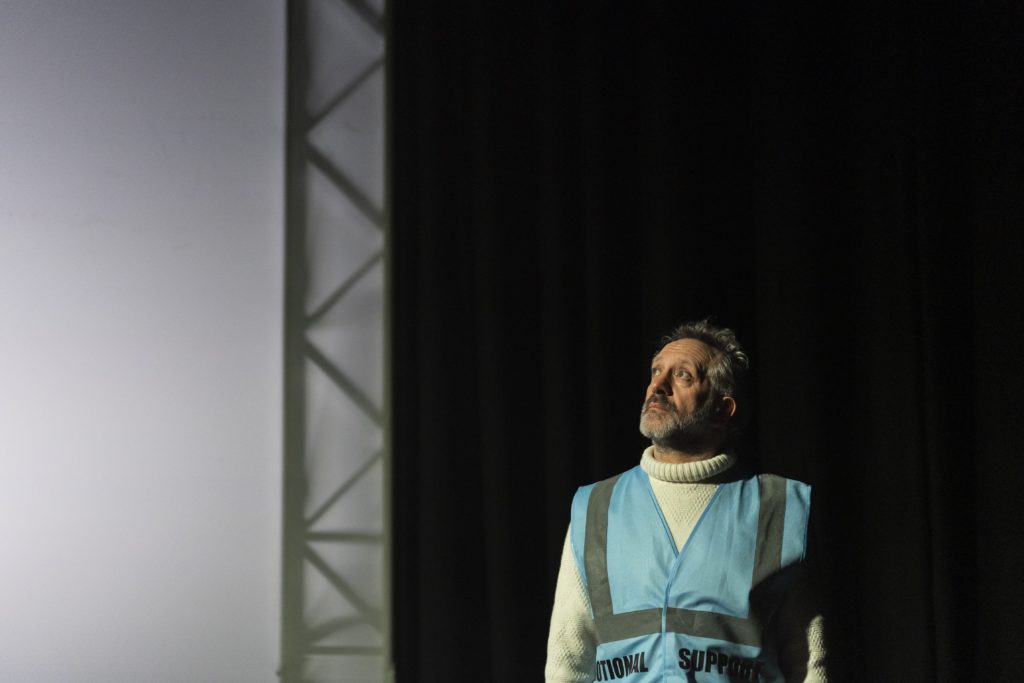
Robin Simpson’s Sam in a rueful moment in The Last Picture. Picture: S R Taylor Photography
This is that production, the full picture of The Last Picture, and what a fitting, moving first show for the Theatre Royal to make for the Studio space since the accursed Covid pandemic.
Add Max Pappenheim’s sound design, a devastating use of Mendelssohn’s music – deemed “degenerate” by the Nazis – and movement direction full of circular rhythm by Alexia Kalogiannidis, and Dyson’s play is unique, wholly original, thoroughly theatrical.
The Last Picture is unmissable, unforgettable, urgently needed theatre at its best.
The Last Picture, York Theatre Royal Studio, until February 14, 7.45pm plus 2pm Wednesday and Saturday matinees, then on tour. Box office: 01904 623568 or yorktheatreroyal.co.uk. The tour will visit HOME Manchester, February 18 to 21; Bristol Old Vic, February 24 to 28; Yvonne Arnaud Theatre, Guildford, March 5 to 7; Mull Theatre, March 11 and 12; Bunessan Village Hall, March 13; Iona Village Hall, March 14.