
REVIEW: York Actors Collective in Till The Stars Come Down, Theatre@41, Monkgate, York, ends Saturday ****

Chris Pomfrett’s Tony, left, Victoria Delaney’s Maggie, Clare Halliday’s Hazel, Darren Barrott’s Marek, Joy Warner’s Sylvia, Laura Haynes-Bury’s Leanne, Daniel Wilmot’s Uncle Pete and Neil Vincent’s John in York Actors Collective’s Till The Stars Come. Picture: John Saunders

FOUNDER and director Angie Millard has an eye and an ear for picking a play for York Actors Collective.

Already in place for October 28 to 31 at York Theatre Royal Studio is Stephanie Jacob’s three-hander The Strongbox, winner of the 2018 VAULT Origins Award for outstanding new work  for its story of domestic servitude and abuse of power, wherein authoritarian Kat, her ageing mother, Ma, and their teenaged slave, Maudie, jostle for power and affection in their dilapidated London home.

This week, Millard is staging the York premiere of another contemporary British domestic drama, Beth Steel’s Olivier Award-nominated Till The Stars Come Down, premiered at the National Theatre’s Dorfman Theatre as recently as January 2024.

She did not see that production, choosing it because she “liked the sound of the play”, and subsequently being impressed by its frank, earthy comedy, its pathos and home-and-away truths – and by its central structure of three sisters, matching her own upbringing in South Yorkshire.

Steel had set her play in a former mining village in Nottinghamshire, where the scars of the “scabs” who broke the picket lines when Margaret Thatcher took on the National Union of Mineworkers are still tender to the touch.

Those scars are no less raw in Yorkshire’s former mining communities, and so Millard, whose education began in a Catholic school in a pit village, has re-located Steel’s family conflagration further north. Ostensibly South Yorkshire, although some accents in her cast head farther north still to the Tyne & Wear.

Till The Stars Come Down is set on a single day, charting the pre-match, the match and the post-match discussions of Sylvia’s nuptials with Polish immigrant Marek, who now runs his own business.

Weddings make for heightened drama, for love’s blossom and blisters, for too much drinking, too much talking, leading to confessions, fall-outs, “inappropriate” behaviour, the exposure of prejudices and the re-opening of old wounds.

It could be the posh world of London society and country houses in Four Weddings And A Funeral or, in Steel’s case, the turbulence of a working-class family where “long-held secrets, passions, tensions and social changes transform the celebration into a chaotic blend of humour and tragedy”.

It opens with the three sisters, Clare Halliday’s bigoted Hazel, Victoria Delaney’s oft-married loose cannon Maggie (in riotous red) and Joy Warner’s phlegmatic Sylvia preparing for the big day – the routine of make-up, hairspray, dresses and endless cups of tea – alongside Lucinda Rennison’s ever-indiscreet, aspirational Aunty Carol and Laura Haynes-Bury’s Leanne, Hazel’s 16-year-old daughter, whose gaze is solely for scrolling her mobile phone.

The men will make their entries: the sisters’ father Tony (Chris Pomfrett), still grieving for his late wife; his brother Uncle Pete (Daniel Wilmot), Carol’s partner, who has never forgiven him for crossing the picket line, and Neil Vincent’s John, who has lost interest in wife Carol on account of his obsession with the woman in scarlet, Delaney’s Maggie.

The only man who is happy rather than dischuffed with his lot in life is Darren Barrott’s (CORRECT) Marek, but a can of worms marked “zenophobia” will be opened as the wedding day progresses.

Steel writes with observational wit, social commentary and, above all, a telepathic understanding of the relationship of sisters. Warner’s Sylvia is the solid, reliable one who has looked after mother and father alike; Delaney’s Maggie and Halliday’s Hazel are the ones at war, and together they deliver a brilliantly kinetic finale, reaffirming their status as two of the supreme actresses on the York circuit.

Delaney’s performance is all the more remarkable for her taking on the role at less than three weeks’ notice. Haynes-Bury impresses with her deadpan demeanour and Rennison rises to the challenge of drunken acting with aplomb.

Barrott, in his YSP debut after catching the eye with York Settlement Community Players, is outstanding as “outsider” Marek; Pomfrett’s Tony wears that hangdog expression he has made his trademark; Vincent’s John plays the villain’s hand well and Wilmot’s Uncle Pete is all bonhomie on the surface until the gripes of the past boil over anew.

Millard directs with admirably flowing movement and quick scene changes, while ensuring her cast lets the full flavour of Steel’s clashing, dysfunctional family flood out, bringing out the rising stress to the max and emphasising the power of the sisterhood too.

York Actors Collective presents Till The Stars Come Down, Theatre@41, Monkgate, York, 7.30pm tonight and tomorrow; 2pm and 6pm, Saturday. Box office: tickets.41monkgate.co.uk.
York Actors Collective delves into zero-hour contracts in Alexander Zeldin’s modern-day tragedy Beyond Caring at Theatre@41

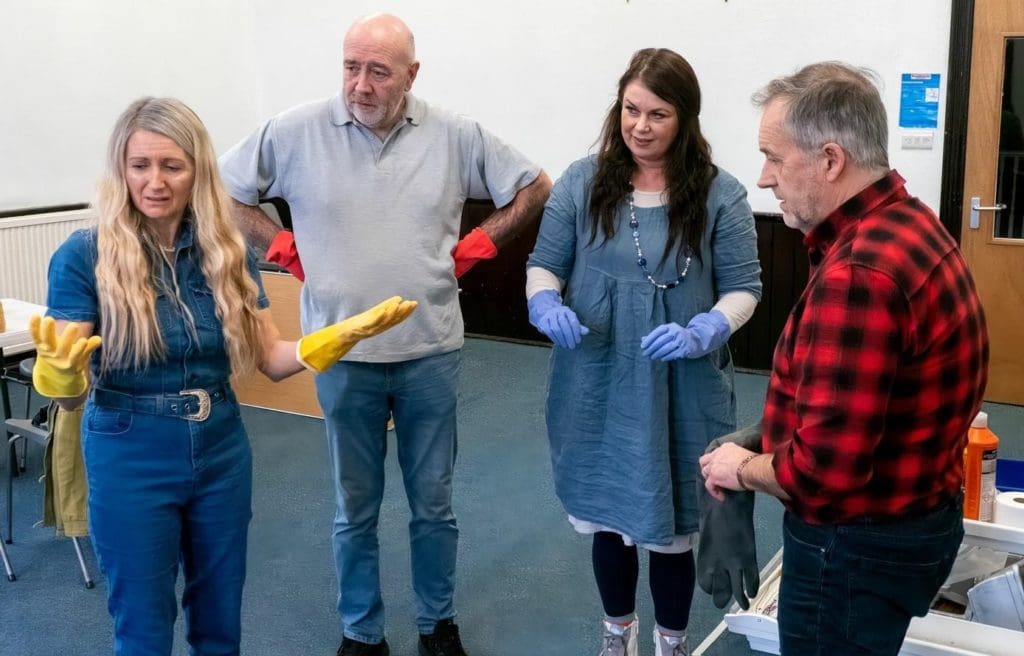
Clare Halliday, left, Chris Pomfrett, Victoria Delaney and Mick Liversidge in rehearsal for York Actors Collective’s Beyond Caring

YORK Actors Collective is following up March 2023’s debut production of Joe Orton’s risqué Sixties’ farce Entertaining Mr Sloane with Beyond Caring, a topical exposé of the social damage inflicted by zero hours contracts. 

Running at Theatre@41, Monkgate, York, from February 6 to 9, this “modern-day tragedy” was devised by Alexander Zeldin and the original Yard Theatre cast in East London in 2014, later transferring to the National Theatre.

Its story of agency cleaners at a meat-packing factory is being directed in York by former teacher Angie Millard, working with a cast of Victoria Delaney, Clare Halliday, Mick Liversidge, Chris Pomfrett and Neil Vincent.

Over 90 unbroken minutes, Beyond Caring follows two women, Becky and Grace, and one man, Sam (replacing Sarah from past productions in a directorial decision), as they confront the reality of minimum wage, zero-hour contract employment, never sure of how many hours they have to work, when they will be paid and whether their ‘job’ will continue.

“This play is remarkable in its structure and power,” says Angie. “It totally represents 2024 where many workers are on the breadline, trapped in employment with no guarantee of further work and no way to improve their position. 

“What drew me to the play, however, is the message it conveys about people surviving and keeping a sense of humour. I loved the intensity of the piece with its silences, its disappointments and its determination to determination to get pleasure out of the smallest things. It gave me hope.”

Beyond Caring was brought to Angie’s attention by fellow company co-founder Chris Pomfrett, who had played the self-aggrandising Ed in Entertaining Mr Sloane. “Following that debut show, our brief was to find something that would appeal to audiences as entertaining but also have an edge to it,” he says.

“I had a look at a lot of play synopses around particular subject matters, came across this one, bought a copy and was completely blown away by it. When it was first done in London, then at the National, it was described as ‘comically devastating’ and that’s absolutely right.”

Beyond Caring forms part of a series of Alexander Zeldin plays entitled The Inequality Triptych, addressing the theme of the impact of austerity. “This one deals with a group of people meeting for the first time to work the night shift cleaning a meat factory on zero-hours contracts, all employed through a temp agency with different arrangements for pay for each of them,” says Chris, who plays scarred, taciturn worker Phil.

“So they’re all strangers, and as happens when strangers meet, there are silences and awkward pauses, like in Harold Pinter’s plays, but they’re all full of meaning.

“Gradually, you see glimpses of their lives and their insecurities, and how that affects them and those around them, mostly adversely.”

Clare Halliday’s factory cleaner Becky and Neil Vincent’s manager Ian in a scene from the darkly humorous Beyond Caring

Chris continues: “I think it’s important for us to do plays that deal with these issues, as they’re still occurring. One of the things that has struck me, after Mr Bates vs. The Post Office is how a TV drama can have a massive impact on the Government’s actions, and that’s because people are confronted with real characters, and there’s an emotional response that you don’t get with news bulletins.

“The same goes for a play like this, and the great thing about all the characters is that in some ways you can see yourself in them.”

In Chris’s case, he can draw on his own experiences working in the community for the NHS (National Health Service) as part of the combined therapy multi-disciplinary team. “You can see the effects of the care system being shot to pieces,” he says.

Clare Halliday will be making her York Actors Collective debut after more than a decade of involvement in York community productions, such as the 2012 York Mystery Plays, when she first met Angie.

“I learned that Angie had created York Actors Collective and went to see Entertaining Mr Sloane, then heard they were doing Beyond Caring and auditioned for the role of Becky [one of the cleaners] after reading about the play and watching extracts from when it was at the National,” she says.

“Becky is a very resilient character, very tough on the exterior. I see her as a born survivor with ways and means of surviving, using her sexuality to get what she wants, in the only way she knows how. We assume she’s had very little education, and we know she’s a single mum, whose daughter is not living with her – she’s probably in care – but she’s trying to see her.

“I can relate to that, as I’ve had work insecurity and been on benefits, so at some points in my life I’ve walked similar steps.”

Clare now runs the Clare’s Kitchen mobile cookery school in York, being involved with schools since 2015.  “Before that, I was living in France, training as a chef, and I wanted to work with children, having been involved in cooking in the kitchen with my mum since the age of two or three,” she says.

“I work with Year One to Six children at Knavesmire Primary, Ralph Butterfield Primary, Haxby, Rufforth, Dringhouses and Lord Deramore’s. I’ve just taken on another lady to help as I’m so busy.”

York Actors Collective in Beyond Caring, Theatre@41, Monkgte, York, February 6 to 9, 7.30pm; February 10, 2.30pm and 5.30pm. Box office: tickets.41monkgate.co.uk.

Copyright of The Press, York

REVIEW: York Settlement Community Players in Ayckbourn’s Woman In Mind ****

Desperately seeking Susan, as she loses her mind: Victoria Delaney in the Settlement Players’ Woman In Mind. All pictures: John Saunders

Woman In Mind, York Settlement Community Players, York Theatre Royal Studio, until Saturday, 7.45pm and 2.45pm Saturday matinee. Box office: 01904 623568 or at yorktheatreroyal.co.uk

ANGIE Millard “seemed to have avoided Alan Ayckbourn” in her past directorial choices, but she had one play in mind for the Settlement Players’ return to York Theatre Royal after two years.

Ayckbourn’s sad, haunting, darker than dark-humoured psychological drama Woman In Mind had struck a chord in the pandemic climate of isolation and mental health issues.

Premiered in 1985 but still feeling present day in 2022, it remains Ayckbourn’s supreme study of a trapped woman, older than Nora in A Doll’s House but just as affecting as the desperate flight of Henrik Ibsen’s proto-feminist, Susan’s story being told from inside her woozy head.

The setting is 48 hours in her south London garden and beyond: the place where the world is refracted through the prism of Susan’s psyche.

Playing fantasy families: Victoria Delaney’s Susan raises a glass to husband Andy (Paul French), daughter Lucy (Amy Hall) and brother Tony (Neil Vincent)

Following in the footsteps of Julia McKenzie, Stockard Channing and Helen Mirren, in her first stage role since October 2019, Victoria Delaney opens the play on her back and never leaves the stage (interval aside).

Delaney’s suburban housewife is coming round from unconsciousness, after knocking herself out when stepping on a garden rake, as Chris Pomfrett’s cautious yet accident-prone family doctor, Bill Windsor, attends to her. In a brilliant Ayckbourn conceit, his words, like her vision, go from a gobbledygook blur to being clear.

With the bang on the head comes the comforting concern of her champagne-golden  family, as if torn from a Mills & Boon cover or a desirable clothes catalogue: first, handsome old devil husband Andy (Paul French); then tennis-playing brother Tony (Neil Vincent) and her auburn-haired darling of a daughter, Lucy (YSCP debutante Amy Hall).

Too, too perfect, surely, and yet played as straight down the line as Tony practising a backhand winner, they could – at first at least – be real. We see and hear them, just as Susan sees and hears them, but only she does so, just like only urbane novelist Charles Condomine and the audience see and hear his deceased first wife, Elvira, in Noel Coward’s Blithe Spirit.

Living on a prayer: Paul Toy as vicar Gerald

The grim reality is very different: husband Gerald (clergyman’s son Paul Toy) is a self-obsessed priggish vicar, always in another room writing his interminably dull, interminably long parish history since 1387. They have reached the separate bed stage already.

Live-in sister-in-law Muriel (Helen Wilson) is obsessed with reconnecting with her late husband and is forever making foul-tasting beverages and even fouler meals, defeated by the lack of labelling on kitchen ingredients.

Wastrel son Rick (YSCP newcomer Frankie-Jo Anderson) is estranged and strange, having joined a cult in Hemel Hempstead, but suddenly he arrives with news.

Where once Susan loved being a wife and mother, now she is neglected by husband and son alike and unfulfilled in her humdrum, loveless domestic domain, Symbolically, the garden plants in Richard Hampton’s design are reduced to twigs, with the only flowers being on the backdrop tapestries, Susan’s bench and Muriel’s cardigan. What lies ahead beyond Susan’s disillusioned forties, her days as frustrating and stuck as a buffering laptop screen?

Muriel (Helen Wilson) serves up another gruesome beverage to vicar Gerald’s (Paul Toy) distaste

Ayckbourn, and in turn Millard and Delaney, capture a “woman on the verge”, and as the real and unreal worlds collide increasingly beyond her control, so too do the ever-blackening humour and pathos, her sanity crumbling and the words returning once more to gobbledygook.

Delaney’s performance is deeply unsettling, her Susan being full of vulnerability, waspish of tongue, her mind grasping desperately at the cliff’s edge, happiness out of reach.

Pomfrett, in particular, provides the comedy, perfectly in step with Ayckbourn’s rhythms; Toy makes the supercilious vicar utterly unbearable but splendidly sets himself up for laughter at his expense; Wilson judges just right how to be annoying yet not annoying as the never-wanted-where-she-is Muriel. Anderson’s disingenuous Rick would fall out with anyone.

French, Hall and Vincent are perfectly well cast as the fantasy family that gradually turns into a nightmare and Woman In Mind becomes a woman out of her mind.

Angie Millard was right: Ayckbourn’s play has indeed taken on even more resonance under the pandemic microscope, where already unhappy marriages have cracked under the strain and the desire to escape has been heightened in enforced isolation.