The Gesualdo Six and Tableaux Vivants in Death Of Gesualdo
WE are witnessing the birth of a new art form. Bill Barclay’s “theatrical concert”, which he both created and directed, is by no means his first in this area – The Secret Byrd was seen here two years ago – but it is becoming a solid fixture in programmes worldwide.
Carlo Gesualdo flourished at the very moment when opera was beginning to take shape in Florence, although he had no direct contact with it, and wrote no operas himself. But the Baroque era loved theatrics and it makes sense to cloak Gesualdo’s colourful life in even more drama than is available through his music alone.
Gesualdo is regularly defined by the murder of his first wife and her lover, which he probably instigated, although may not have carried out personally. In his aristocratic circles it was classed as an ‘honour killing’ and he escaped punishment.
But it stained the remainder of his life and he descended into near-permanent melancholy and introversion – states of mind that may be heard in much of his later music, amply represented here.
His second marriage, into the musically adventurous Ferrara court, did nothing to improve his disposition, indeed it reinforced his penchant for extremes of harmonic dissonance.
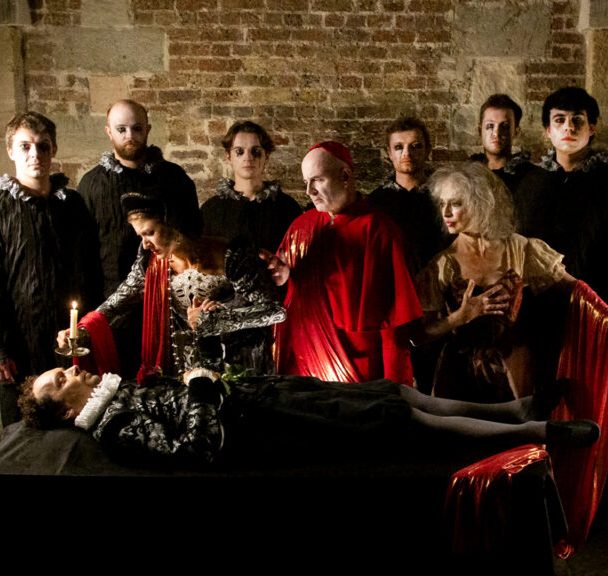
Barclay uses six unaccompanied male voices and six Tableaux Vivants mute actors to convey the essence of the composer’s life, not only his death. He also works with a life-size child puppet, created by Janni Younge, through which he hints that Gesualdo’s boyhood was far from ideal.
The action was a series of tableaux, elegantly held but broken intermittently by sweeping gestures and even the occasional dance to Will Tuckett’s choreography. With rich costumes by Arthur Oliver straight out of the era – again, the very start of opera – the various scenarios evoked nothing so much as oil paintings, with poses just slightly exaggerated for effect.
Barclay’s own lighting, especially eerie during Gesualdo’s descent into drugs and women, often came from torches held by the cast themselves.
Deliberately jarring with the theatrical smoothness was Gesualdo’s music, some 30 extracts from his motets and madrigals, interleaved and distinguishable only by the Latin or Italian texts, with tingling harmonies that defied all the normal conventions: impossible dissonances that kept aural nerve-endings on edge until eventual resolution brought catharsis all the sweeter for being delayed.
None of this would have worked had the singers not maintained incredibly accurate tuning. Gesualdo’s chromatic lines are notoriously difficult and littered with pitfalls, but the Six – with two countertenors often extremely high in the range and all underpinned by director Owain Park’s sterling bass – took it all in their considerable stride.
The show was jointly commissioned and produced by St Martin-in-the-Fields, the NCEM and New York’s Music Before 1800. It proved beyond doubt that Barclay’s new genre is here to stay.
Let us hope that next time there will be printed programmes – ‘carbon footprint’ is a lame excuse for posting everything on-line – and that there is at least a skeletal synopsis (the five ‘acts’ had no stated setting). None of which detracts from what was a supremely memorable 75 minutes. I would gladly see it again. Others should be given the chance.
Review by Martin Dreyer