
Katie Bird’s Maria in Opera North’s The Sound Of Music
IF your memories of The Sound Of Music come with the emotional baggage of the 1965 film starring Julie Andrews, you will be more than pleasantly surprised by this reconstituted stage version.
Miss Andrews was a huge talent and the film proved a blockbuster, but its sugar-rush has been supplanted in this Nikolai Foster production (revived here by Ollie Khurshid) by a great deal more substance, political, emotional and geographical.
First seen in Leicester’s Curve Theatre last November, it now has the benefit of a full-size (40-piece) professional orchestra and chorus. Operatic purists may recoil to learn that all the singers are miked – which certainly helps the children’s voices – but they will get over it.
Two numbers cut from the film are restored, How Can Love Survive? and No Way To Stop It. Both refer candidly to the Nazi backdrop. This musical has a serious side that the film version all but ignored.
When a messenger boy in uniform arrives with a telegram “from Berlin” and bellows a Nazi ‘Heil!’ salute, you can almost hear the audience gasp. It recalls the Anschluss (Germany’s annexation of Austria in 1938).
The message commands Captain von Trapp to join the German navy, which he is naturally loath to do. So it has a decisive effect – and gives us chilling context.
Michael Taylor’s set is exemplary. A nursery slope of the mountains around Salzburg, which are seen in the background – instantly paralleled by Maria’s “the hills are alive” at the start – has an angled path running down across the stage.
In the final scene, the nine members of the Trapp family, now refugees, are silhouetted against the night sky as they escape through the mountains to the New World. We understand at once: history never really changes.
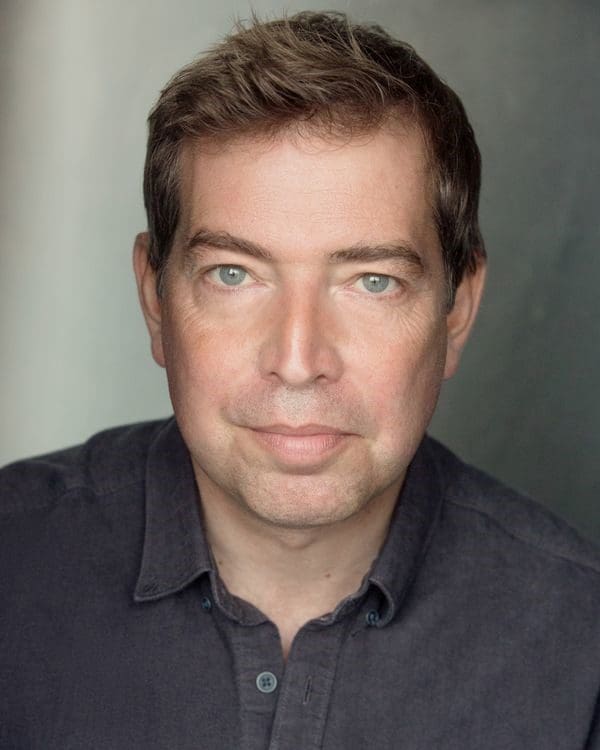
Edward Bennett: Playing Captain von Trapp in Opera North’s The Sound Of Music
When he needs to be in the abbey with the nuns, he lowers a great pointed ecclesiastical window-frame. In the castle, there are grand doors instead.
Needless to say, the musical side of the evening is stunning. Katie Bird makes Maria her own, conflicted over her true calling, firm in her principles, but tender with the children. ‘Do-Re-Mi’ is charming and ‘My Favourite Things’ is life-loving. She gives us all sides of a truly appealing character.
Edward Bennett is an actor rather than a singer, but his baritone is perfectly adequate for the role of Captain von Trapp, as in his duet with Maria, ‘Something Good’, and in Edelweiss’ with the family.
There is one truly glorious piece of singing from Katherine Broderick as Mother Abbess: she gives us full Wagnerian splendour in ‘Climb Ev’ry Mountain’ at the end of each act, soaring above the tumult.
The seven children – all are double-cast (this was the ‘Drop’ group) – sing with great conviction and clarity and they move with impressive discipline.
Amy Freston delivers a nicely haughty Baroness Elsa, whom the Captain discards for Maria, while other members of the pro-Nazi camp are neatly defined by Nicholas Butterfield as Max and Kamil Bien as Rolf. A variety of colourful cameos come from other members of the Opera North chorus, notably as nuns.
Ebony Molina’s choreography avoids traditional ‘song-and-dance’ routines in favour of more restrained and more engagingly lifelike dance. Oliver Rundell conducts with panache and his orchestra takes to the idiom like ducks to water, bursting with rhythmic pizzazz. The big choral numbers are thrilling.
This may not be The Sound Of Music as you imagined it, but it rings absolutely true. You dare not miss it.
Opera North in The Sound Of Music, Leeds Grand Theatre, until August 1. Box office: 0113 223 3600 or operanorth.co.uk.
Review by Martin Dreyer

