REVIEW: Alan Ayckbourn’s The Trial Of Romeo Oscar, Stephen Joseph Theatre, Scarborough, until October 3 ****

Frances Marshall’s Allistra Clay, left, Elizabeth Boag’s Devaney Dyer, Leigh Symonds’s Octavius and Richard Stacey’s RSDO 83 in Alan Ayckbourn’s The Trial Of Romeo Oscar. Picture: Tony Bartholomew

YOU might think it would be impossible for Alan Ayckbourn still to come up with a first in his seventh decade as a playwright.

Wrong! You should know better! Play number 92 is his inaugural courtroom drama, but one set in a dystopian future in a first of its own: the first murder trial of a non-human in the year 2194, with the undercurrent of a detective story bubbling away too.

In a riff on the infamous promotional tagline for Ridley Scott’s 1979 science-fiction horror movie Alien, Ayckbourn pronounces that “in space no-one can hear you dream”: the first indication of the play’s lament for the decreasing role of the arts, whether theatre or music, whether Shakespeare or Tchaikovsky, on the educational curriculum now, let alone 168 years henceforward.

Latterly, Ayckbourn has switched between writing about the past and the future, but all the while commenting on the present that constantly disappoints, even disturbs, him.

Richard Stacey’s RSDO 83 and Olivia Woolhouse’s Hermione Quinque re-enacting the the tomb scene from Shakespeare’s Romeo And Juliet in the courtroom in The Trial Of Romeo Oscar. Picture: Tony Bartholomew

Rather than the grouchiness of ornery old age, his writing remains vibrant, innovative, full of wit and wisdom, surprise and mischief, more sage than rage in delivery at 87.

You will hear his recorded voice too in his original soundscape for The Trial Of Romeo Oscar, whether pronouncing the request for mobile phones to be switched to mute or announcing the journey from the surface to Defence Suite 19 of the Subterranean Hub 19, 27 levels down in the Citrus Legal Complex, and later, for Act II, some days later, to Courtroom 3  on Level 3 of Kevin Jenkins’ futuristic set design.

The Citrus Corporation runs everything, both the lay of the parched land and the law of the land, now that central government has been replaced by big corporations. It is uncomfortably close to today’s march of AI, the rise of the tech brothers and Elon Musk brandishing his Doge chainsaw at the Conservative Political Action Conference.

On Earth, or Terra as it is now called, trees and house plants are confined to museums, music has been replaced by bleeps and beats (isn’t that happening already?!) and Shakespeare is no longer taught to the likes of Elizabeth Boag’s Devaney Dyer, the Firebrand Corporation’s Yorkshire-blunt chief engineer, whose skills are in her hands.

Alan Ayckbourn: First courtroom drama in his 92nd play. Picture: Tony Bartholomew, 2020

She is repairing Richard Stacey’s RSDO 83, a war hero from recent days, to prepare this battered military-issue android to face trial for killing a 13-year-old girl who had been in his care since her parents took their own lives. 

RSDO 83’s reconstruction is being overseen by Leigh Symonds’s Assistant Arbiter Octavius, a sanguine humanoid court official, who learns new words, aphorisms and phrases each day in a running joke by Ayckbourn that delights in the vagaries of the English language.

This is typical of the slower-than-usual release of accumulative humour in Ayckbourn’s script, where so much exposition is necessary to set up the milieu: a world outwardly unfamiliar and yet redolent of the woes and wars of today.

Once the characters and their characterisation, their tropes and mannersisms, become familiar, their interaction leads to drama that is both gravely serious and yet waspish in its wit underneath the troubled surface.

Leigh Symonds’s Assistant Arbiter Octavius, left, keeps his head down as Russell Richardson’s judge, Arbiter Jefferies, makes his point. Picture: Tony Bartholomew

RSDO 83 may be the accused in the legal landmark case, but humanity is on trial as Ayckbourn asks the question: What makes us human? Art, music, literature, as much as science, is the answer of a playwright who has long been fascinated by science fiction.

Allistra Clay (York actress Frances Marshall) is appointed RSDO 83’s defence counsel on the grounds that she will know nothing about the case, as she is from Titan. Titan, however, is milk and honey by comparison with the Earth. Not caught up in the war, it still values music and literature, and so she can call on her knowledge of Romeo And Juliet for this new tale of Romeo Oscar and a girl called Juliet that will mirror the tragic path of Shakespeare’s play.

The case for the defence will be laid out with the aid of Olivia Woolhouse’s Hermione Quinque, a waitress picked from multiple theatre trainees to play Juliet. This is the cue for Ayckbourn’s in-jokes about there being nothing new in most actors being unemployed or forming a company called Spare Parts.

Later, he will top those quips with Hermione saying she could do her part in the trial again as she had been better in rehearsal. You can sense Ayckbourn’s years of experience in the rehearsal room pouring out into this biting dialogue.

Hayden Wood’s prosecutor, Ronal Lime-Tyler, grills the defendant, Richard Stacey’s RSDO 83. Picture: Tony Bartholomew

Yet he is wearing the equivalent of a judge’s black cap in passing sentence on mankind’s failings in Act Two, where Russell Richardson’s jaunty judge, Arbiter Jefferies, and Hayden Wood’s smarmy, smug prosecutor, Ronal Lime-Tyler, come to the fore, pitched against Marshall’s eloquent, meticulous Clay.

Stacey’s RSDO 83 and Woolhouse’s Hermione play out Romeo And Juliet’s fatal tomb scene: a play within a play that adds to the devastating impact of both. When Symonds’s Octavius borrows the closing couplet from Shakespeare’s tragedy, ”For never was a story of more woe than this of Juliet and her Romeo”, its sentiment applies as much to Ayckbourn’s characters.

The poster, with its image of an android warrior holding the hand of young girl looking out over a desert, makes no mention of writer-director Alan Ayckbourn, but his name runs through every scene like a seaside stick of rock.  Once more, his writing will be music to your ears.

The Trial Of Romeo Oscar, Stephen Joseph Theatre, Scarborough, until October 3. Box office: 01723 370541 or sjt.uk.com.

ON the subject of names: here are the latest additions to Alan Ayckbourn’s notebook of nomenclatures across 92 plays: Octavius, Allistra, Ronal, Devaney, Romeo and Hermione are used for the first time in The Trial Of Romeo Oscar.

The poster for Alan Ayckbourn’s The Trial Of Romeo Oscar

REVIEW: Noises Off, Stephen Joseph Theatre, Scarborough, until Sept 6 *****

Cast adrift: Nothing On director Lloyd Dallas (Adam Astill), front, makes a sharp point to Selsdon Mowbray (Christopher Godwin); Garry Lejeune (Alex Phelps); Brooke Ashton (Olivia Woolhouse); Freddie Flowers (Andy Cryer); Belinda Blair (Valeria Antwi); Dotty Otley (Susan Twist) and Tim Allgood (Charlie Ryan) in Noises Off. Picture: Tony Bartholomew

IT was supposed to be Mission Impossible. No-one had ever staged Michael Frayn’s play within a play in the round in 43 years.

“Good luck!” said Frayn when told of director Paul Robinson and designer Kevin Jenkins’ meticulous but surely mad plan.

Well, the joke is now on all the naysayers – and you, dear readers, will be the ones having the last laugh if you head to the SJT.

Commotion in motion: Andy Cryer’s Freddie Fellowes and Susan Twist’s Dotty Otley in Noises Off. Picture: Tony Bartholomew

This, after all, is the Mecca for theatrical comedies, the home of myriad Alan Ayckbourn premieres, and who should be looking on from his familiar box but Sir Alan on Tuesday night (12/8/2025).

Frayn’s farce is so good that frankly it is indestructible, but Robinson and Jenkins’ thoroughly rounded production makes it even more joyous. Chaos conducted with precision and audacity.

The nature of theatre in the round is its 360-degree inclusivity. You can see everything, yet without being able to see everything (given the inevitability of actors having their back to you), and part of the pleasure is seeing the enjoyment of all around you.

Eternally exasperated: Adam Astill’s Lloyd Dallas, director of Nothing On, the farce within the farce in Noises Off. Picture: Tony Bartholomew

On top of that is the proximity of the actors: they and you are in the lion’s den; the amphitheatre on a not-so-Colosseum-sized scale. In this instance, you can see, hear and feel the fear of the play within the play going wrong, the heartbeat of Frayn’s classic farce – and the precursor to all that Mischief-making by The Play That Goes Wrong gang.

In a nutshell, in the round, your awareness of the physicality of acting is heightened and, in turn, your appreciation of the comedic skills of the likes of Ayckbourn stalwart Christopher Godwin, Andy Cryer and SJT debutant Alex Phelps, who has charmed  York audiences in the recent past with both his dexterity and the way he makes words dance.

Farce is all about doors – or doors and plates of sardines in the case of Noises Off, as exasperated director Lloyd Dallas (SJT debutant Adam Astill) reminds his hapless company as they prepare for a tour of the fractious and ever increasingly fractured farce Nothing On that will close, it just so happens, in Scarborough.

Christopher Godwin’s old soak, Selsdon Mowbray, in Noises Off. Picture: Tony Bartholomew

The SJT stage has three doorways, all put to maximum use with doors placed in  them, and then Jenkins adds the all-important mezzanine level, with its three doors, plus a trapdoor entry and exit in Act Two.

We join the never-still Astill’s Lloyd initially in the rehearsal room for Nothing On, a clunky, maladroit farce with a bizarre obsession with sardines.

This utterly actorly thespian, soon to give his Richard III in Aberystwyth, must somehow pull together Lloyd’s bank of has-beens (Godwin’s drunkard veteran Selsdon Mowbray and Susan Twist’s tour-backing Dotty Otley); touring plodders (Cryer’s over-thinking, physically fragile Freddie Fellowes and Valerie Antwi’s admirably unflappable Belinda Blair), and wannabes (Alex Phelps’s young buck Garry Lejeune and Olivia Woolhouse’s company ingenue Belinda Blair).

Annie Kirkman’s Poppy Norton-Taylor trying to keep Nothing On on track in Noises Off at the SJT. Picture: Tony Bartholomew

Then add the ever-harassed technical team, Charlie Ryan’s dogsbody Tim Allgood and Annie Kirkman’s equally overworked Poppy Norton-Taylor.

All the stage world is here: the luvvies and the loveless, the boozer and the philanderer, the sex, the drudgery and the rock’n’rollicking fallouts of a theatre tour, experienced in rehearsal room, then backstage mid-production run and finally on the tour’s catastrophic, calamitous last night.

While your reviewer would never dissuade anyone from partaking of a tipple in either interval, it is rewarding to watch the set changes conducted with a choreographic flourish as doors are reversed and the set turns inside out in the transition from backstage to stage. Ryan’s Tim and Kirkman’s Poppy stay in character to oversee the changes.

Thwarted by a door: Alex Phelps’s restless Garry Lejeune and Olivia Woolhouse’s Brooke Ashton in Noises Off. Picture: Tony Bartholomew

Robinson’s cast is wonderful, especially Twist’s dotty old-stager Dotty, Godwin’s scene-stealing Selsdon and, above all, Phelps’s Garry, with his stair tumbles and earnest air in never quite saying what he feels the need to express.

Simon Slater’s music is irresistibly perky, matching the desperate desire of Nothing On’s cast to prove the show must go on, no matter what befalls the warring players.

You will love the moment when Astill’s Lloyd, arriving for the final performance, is amazed to discover the staging is in the round: a soupcon of meta-theatre in a tour-de-farce masterpiece.

Noises Off, Stephen Joseph Theatre, Scarborough, until September 6, 7.30pm plus 1.30pm Thursday  and 2.30pm Saturday matinees. Box office: 01723 370541 or sjt.uk.com

REVIEW: Alan Ayckbourn’s 90th play, Show & Tell, Stephen Joseph Theatre, Scarborough, until October 5 ****

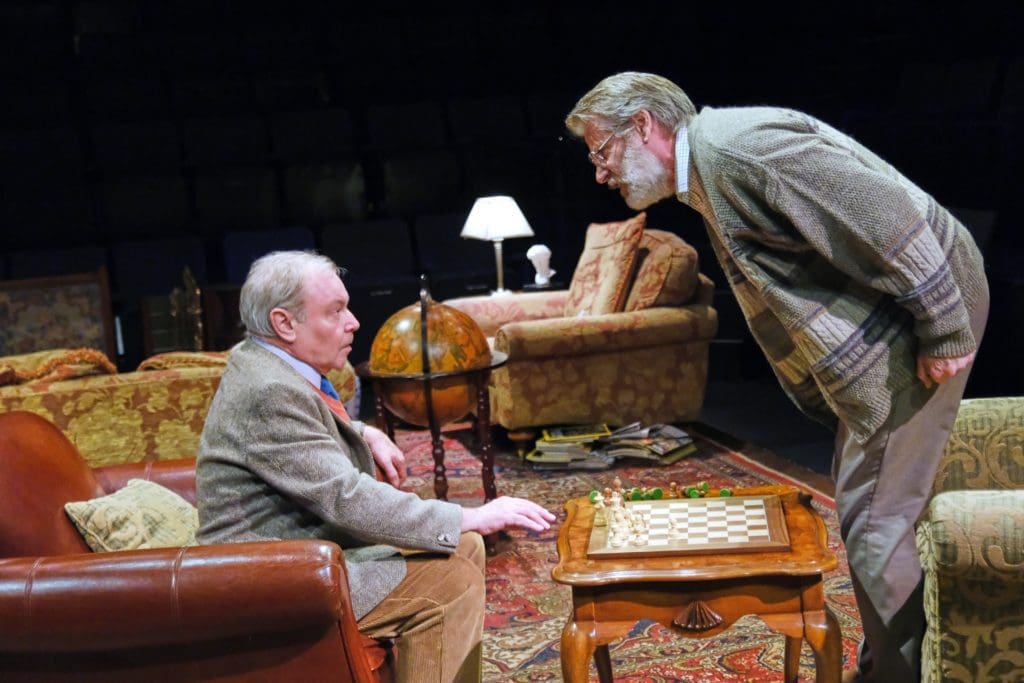
Check mate: Paul Kemp’s Ben Wilkes, left, cowers as Bill Champion’s Jack Bothridge terminates their chess match in Show & Tell. Picture: Tony Bartholomew

IN the words of Alan Ayckbourn, “Show & Tell is about something which has preoccupied me for the last 60 years and probably more – theatre.”

In those years, the Scarborough writer-director has chalked up 90 plays – and still more are on their way. His SJT play for 2026 is written already and he is part way through 2027’s premiere too.

Play number 90, Show & Tell, is a “love letter to theatre”: the joy of theatre, the pleasure of writing and directing for Ayckourn at 85; the abiding delight for his audience in his abiding wit, social and cultural observation, foresight and insight, mischief-making and rug-pulling darker undercurrents.

Show & Tell is among his most playful in its celebration of the possibilities presented by ‘the play’ as an artform, here refracted through a backward glance at its back pages and his own too. A play full of play and full of plays, and indeed a play within a play.

All this is wrapped up in dark farce that “lifts the lid on the performances we act out on a daily basis,” as Sir Alan puts it. How much do we “show and tell”; how much do we conceal?

In this case, retired West Yorkshire managing director Jack Bothridge (grizzled, irascible Ayckbourn regular Bill Champion) has invited Homelight Theatre Company actor Peter Reeder (Richard Stacey) to the Bothridge family hall to tie up arrangements for a birthday party performance for his wife.

Unfortunately, belligerent Jack has no recollection of making any arrangements, mistaking the unnerved Peter Reeder for a meter reader. What’s more, Jack is not so much forgetful as in the incipient stages of dementia, in a hinterland between assertive clarity and confusion, as Ayckbourn exposes the misogyny, gruff bluntness, delusion and self-entitlement born of running a family business often on a capricious whim.

Champion is in terrific form here as a latter-day Lear, while Ayckbourn’s study of the generation that soils and spoils a family business is spot on in a nod to Ibsen and Arthur Miller. Look at Jack’s bullying treatment of Ben Wilkes (Paul Kemp), who ran his formal clothing department and is now his carer, outwardly as loyal as Lear’s Gloucester.

Writer-director Alan Ayckbourn in the Stephen Joseph Theatre poster for his 90th play, Show & Tell

However, there is much more to the reserved Wilkes than first meets the eye, caught wonderfully by Kemp, the essence of the gradual “show and tell” in Show & Tell. His shattering revelation, told to the sympathetic ear of actress and company manager Harriet ‘Harry’ Golding (Frances Marshall) is a gem of a quietly detonating scene.

Kemp’s Wilkes becomes embroiled in the other side of the story: Ayckbourn’s depiction of the world of theatre, past and present. Through the tribulations of the ailing Homelight Theatre Company, desperately in need of Jack’s booking, Ayckbourn hones in on the dramas faced by companies post-Covid, the struggle to draw an audience, the battle between artistic ambition and exigency.

He comments too on the fad for changing a company name to meet changing times, in this instance from the pioneering Front Room Theatre to the more inclusive-sounding Homelight. He duly recalls the groundbreaking days of Centre 42, the radical project of Arnold Wesker and Charles Parker, one said to have “inflicted the most damage on theatre since Cromwell”.

Act Two recalls Ayckbourn’s 1984 play A Chorus Of Disapproval in going behind the scenes, but  crucially too it draws on Ayckbourn’s earliest days at the Stephen Joseph Theatre, directing a French farce in 1961 when artistic director Stephen Joseph told him his budget was “technically nothing…and if you push me, £5”.

In theatre tradition, by now joined by Olivia Woolhouse’s insouciant actress Steph Tate, Kemp’s Wilkes steps in when needs must, the cue for Stacey’s exasperated Reeder to act like a spoiled child in the readthrough and Kemp to scene-steal gloriously. 

What follows this character-revealing shenanigans is the play within the play: a full-scale French farce, A Friend Indeed, in Ayckbourn’s knowing pastiche of the artform, played straight but inherently over-the-top in full period costume.

Theatre laid bare, life laid bare, warts and all, yet delivered with a love of the stage that never dims.

Alan Ayckbourn’s Show & Tell, Stephen Joseph Theatre, Scarborough, until October 5. Box office: 01723 370541 or sjt.uk.com.

Secret Link