REVIEW: Black Treacle Theatre in Poor Clare, Theatre@41, Monkgate, York ****

Isabel Azar’s Clare, centre, with her family servants, Clare Meadley’s Peppa and Emily Hansen’s Alma, in Black Treacle Theatre’s Poor Clare. The bowl containing her hairpins will reappear later in Jim Paterson’s production as a begging bowl. Picture: John Saunders

FIRST, the history bit. The Franciscan order of the Poor Clare Colettines was based at St Joseph’s Convent, in Lawrence Street, York, founded in 1865 by nuns from Bruges. Where once it housed 40 nuns, now the site provides student accommodation. How very York in 2026.

The original Poor Clare is the subject of American playwright Chiara Atik’s 2021 play, premiered in Los Angeles and given its European debut at the Orange Tree Theatre, London, in 2025.

Black Treacle Theatre founder and director Jim Paterson read a review and then the script ,“intrigued by the description of the play’s deliberately anachronistic use of modern, ‘Gen Z’ dialogue and attitudes in the telling of the lives of these religious figures in 13th century Italy.”

Hot on the heels of York Settlement Community Players’ staging of Sarah Gordon’s irreverent re-telling of the Brontë Sisters’ literary lives, Underdog: The Other Other Brontë, with its frank and fruity language and modern sensibilities, Theatre@41 plays host to another conflation of old and modern in its York premiere. This one, however, is as much reverent as irreverent. 

PJ Gregan’s zealous but never pious Francis in Black Treacle Theatre’s Poor Clare. Picture: John Saunders

Paterson’s cast is in medieval costumes, complemented in Richard Hampton’s design by a plain white backdrop. Then, the first time you hear each and every actor speak with an American accent straight out of Hollywood’s rom-coms or Frank Zappa’s satirical song Valley Girl, you will be puzzled.

Think Legally Blonde. Every second word, like, is ‘like’. Hey you guys, give us a break. But wait, Atik’s script is so smart and sharp and wise that you are soon wholly on board.

As it happens, Clare is played by an American actress, Isabel  Azar, from Memphis but now extending her studies in York to opera singing with a view to a career embracing acting, writing and opera. She is Catholic too, drawing her even closer to St Clare, founder of the Poor Clare order of nuns.

In Atik’s faithful re-telling, Clare is a young noblewoman in 13th century Assisi, where she is preparing for marriage to an aristocrat and a life of even more wealth and privilege than she has already as part of the second most wealthy family in the central Italian town – even if younger sister Beatrice (Eleanor Stephenson) and their mother Ortolana (Victoria  Delaney) will argue over whether they are rich or not.

Isabel Azar’s Clare in her putative wedding dress with her high-society mother, Victoria Delaney’s Ortolana. Picture: John Saunders

Yes, of course they are: at the start, Azar’s Clare is idling the day away with her droll servants, Emily Hansen’s Alma and Clare Meadley’s Peppa, endlessly titivating her hair. Stephenson’s Beatrice cares only about clothes. Such superficiality is rife in this high society.

Yet the presence of Ben Reeves-Rowley’s Beggar, bowl in hand, is a haunting reminder that poverty besets Assisi too. Into the town strides Francis (yes, that Saint Francis of Assisi, played by PJ Gregan), who has turned his back on his privileged upbringing to campaign tirelessly for the poor and the redistribution of wealth. A man of bare feet and facts laid bare. Zealous, yes, pious, no.

Azar’s Clare finds herself drawn to rather more than the beautiful robe and golden locks of Gregan’s Francis, as he sets her on her way to a life of devotion to the cause of caring for the needy. Yet she has a long way to go when she initially assures him she will still give to charity after her marriage.

Eleanor Stephenson’s Beatrice, left, Victoria Delaney’s Ortolana and Isabel Azar’s Clare looking delightedly at one of her wedding presents, a book, in Black Treacle Theatre’s Poor Clare. Picture: John Saunders

Atik’s play moves with such pace and vigour that past productions have eschewed an interval, but here the break was a perfect chance at Wednesday’s performance to ask each other questions. “It’s not what I expected,” was the most common reaction, but uttered with approval and excitement at what was to follow.

Reeves-Rowley will reappear in modern clothing, linking with the modern world, as he begs for money from the front row while spinning his life story.

Azar’s Clare will find herself in discussions with bewildered sister and bemused mother and Gregan’s Francis alike. The more the two converse, and indeed clash in the high point of Paterson’s production, the more she feels compelled to reject aristocratic airs for service to the poor. By now, she is wearing a scratchy hair shirt to remind her constantly of the suffering, while his robe is no longer ostentatious blue but dull brown.

Come the finale, Azar’s Clare is in nun’s habit, addressing the ills of the modern world directly. The play was doing that already, albeit indirectly, but this monologue seeks to trigger more to follow Clare’s lead.

Eleanor Stephenson’s Beatrice, Victoria Delaney’s Ortolana and Isabel Azar’s Clare bathe their feet in the company of servants Alma (Emily Hansen) and Peppa (Clare Meadley). Picture: John Saunders

Paterson’s cast all enjoy the wit and fizz of Atik’s dialogue. Stephenson’s Beatrice is a riot, spoilt, blinkered but amusing; Gregan’s Francis has weight and authority but boyish charm too. Azar’s Clare combines impish humour and quiet intelligence with rising defiant steel as radiance settles on her. 

Azar’s mother was in Wednesday’s audience, all the way from Memphis. She was not the only one whose face was wreathed in smiles after encountering such a bravura play.

Black Treacle Theatre in Poor Clare, Theatre@41, Monkgate, York, until November 7, 7.30pm plus 2.30pm Saturday matinee. Box office: https://tickets.41monkgate.co.uk.

P.S. Should you be wondering, if you attended Poor Clare, in keeping with the play’s meeting ground of modern and medieval, director Jim Paterson chose “medieval bardcore” renditions of songs by the likes of Lady Gaga, performed by such artists as Hildegard von Blingin’ and Beedle The Bardcore, each as magical as a madrigal, for the scene changes.

PJ Gregan’s Francis and Isabel Azar’s Clare finding common ground – and clothing – on Richard Hampton’s set, with its wheel-on chapel, in Black Treacle Theatre’s Poor Clare. Picture: John Saunders
REVIEW: Northanger Abbey, Stephen Joseph Theatre, Scarborough, till April 13 **

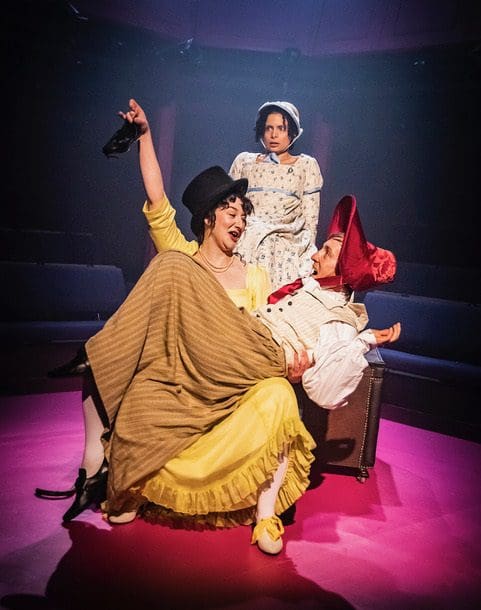
Rebecca Banatvala’s Cath, back, AK Golding’s Iz and Sam Newton’s Hen in Northnager Abbey

THE journey from page to stage is familiar, well trodden, but still unpredictable for classic novels. Sometimes it works, sometimes it tries too hard, when a book remains better read than said.

This co-production by the SJT, Scarborough, Orange Tree Theatre, Richmond, Octagon Theatre, Bolton, and Theatre by the Lake, Keswick, is one such occasion.

We have seen many adaptations in this manner: a small, busy-as-Heathrow cast working with more imagination than props in Hannah Sibai’s design, breaking down theatre’s fourth wall from the start,  speeding between roles and  differing theatre styles, but here falling short of the best work of Tilted Wig, Wise Children and Nick Lane’s adaptations.

Writer Zoe Cooper defines Jane Austen’s coming-of-age satire of Gothic novels as “a book about invention that revels in layers of fictionality, of imagination”, one that she first read at 19, roughly the same age as lead character Catherine Morland when she leaves behind her claustrophobic northern family to join the smart set in Bath.

In her programme note, Cooper recalls how she felt out of place, awkward and grubby in her posh university town. Austen’s Catherine Morland (Rebecca Banatvala’s Cath) is a bookworm who feels that same discomfort and disconnection after being drawn to Bath by books and dreams.

Cooper and Banatvala express Cath’s tendency to over-excitement and bad behaviour, ending up in difficult situations that she navigates by warping reality with fiction amid the balls and parties.

Cooper draws on another recollection of her English Literature studies, how her tutorials were “generally male, very white, and very heterosexual”. Her reading of Northanger Abbey was rather different: she liked the book because “it felt a little bit naughty” in the friendship of Catherine and society sophisticate Isabella.

That plays out passionately in this account, where the loving bond between impressionable Cath and worldly Iz (AK Golding) runs deeper than Cath’s relationship with Hen (Sam Newton).

Tessa Walker’s production, however, needs to be more humorous, darker in its Gothic climax, but that requires sharper writing by Cooper. The performances have to swim against the tide, too much work to do.

Matt Haskins’ lighting is a delight, but that should never be the stand-out feature. An Audience with Lucy Worsley on Jane Austen, with “new research and insights into a passionate woman who fought for her freedom”, at York Barbican on October 14 will be more enlightening.

Box office: 01723 370541 or sjt.uk.com.

Foxglove Theatre’s young blades head for dark side to shake up York’s stage scene

Too much paper work: Sam Jackson as teacher Nick in Foxglove Theatre’s The Brink

NEWLY formed York company Foxglove Theatre aim to “fill the blind spot” of York’s theatre scene by producing thought-provoking, dark and contemporary work.

First up – after an initial February staging circa St Valentine’s Day at University of York DramaSoc – will be their debut at Theatre@41, Monkgate, from June 30 to July 2 with Welsh writer Brad Birch’s The Brink: a comedy replete with blood, murder and death, sexual imagery and ephebophilia (sexual attraction to post-pubescent adolescents and older teenagers, aged 15 to 19).

Formed by producers Ione Vaughan, 21, and Ivy Magee, 20, and director Nathan Butler, 21, Foxglove’s vision is to create and promote thrilling theatre that encourages audiences to engage with live performance as naturally and readily as with their favourite television and streaming platforms.

“Amazing effects and chilling performances are not bound solely to our screens but can be enjoyed to the fullest live on stage as well,” reasons production manager and lighting designer Ivy.

Sam Jackson’s Nick, a school teacher on the brink, is confronted by Abel Kent’s Mr Boyd, the troublesome head teacher who plays with his already fragile sense of reality

“Our company believes in preserving theatre in an age of multi-media, not by binding ourselves to tradition but through adapting the stage alongside the screen.”

Cue The Brink, suitably provocative, dark and contemporary, with unsettling time shifts to boot, premiered at the Orange Tree Theatre, Richmond, in June 2016.

History teacher Nick is a normal person, working a normal job, who lives a normal life, but he is stuck in an everlasting cycle of stasis at 27. Caught up in a downward spiral fuelled by dreams and whispers of a bomb buried under the school, he begins to lose control in a play with survival at its heart.

“The Brink is a psychological thriller and dark comedy that’s impossible to summarise in just one word,” says Ivy. “But if I had to: explosive!” 

Sam Jackson’s Nick recounts his recurring nightmare

Why stage The Brink, Nathan? “Thrilling, turbulent, unconventional, it encapsulates everything we want to bring to the York theatre scene,” he says. “It’s an unwavering dive into dark and prominent subject matter, alien to the established York stage.

“So, if you’re a Black Mirror, Love, Death And Robots or simply a psychological thriller fan, this is certainly the play for you. By utilising technology and special effects as additional storytellers, we invite you to celebrate the unique capabilities of contemporary theatre.”

You might expect the burgeoning talents of Foxglove Theatre to want to head to this summer’s Edinburgh Fringe, but Nathan says: “In my mind, I’d rather do it here – York has a good theatre scene – rather than taking the 50,000 steps needed to go to the Edinburgh Fringe. Let’s take one step: let’s play York – and our Crowd Funding goals have been reached and exceeded already.”

Nathan admires the work of Brad Birch, an award-winning playwright and screenwriter with plays such as Missing People, Black Mountain, Gardening For The Unfulfilled and Alienated, as well as The Brink, to his name.

“I saw The Brink when it premiered at the Orange Tree, when I was part of National Theatre Connections, and I fell in love with it. Then I acted in it in 2018 for the In Yer Face Company, when we took it to Leatherhead Festival, and it was my favourite thing I did with them.

Sam Jackson’s Nick confides in Harshavardhini Pareek’s Jo, his fellow teacher

“There’s just something about it: it starts off so accessible, you feel you could be watching a TV show or a film – but on stage – where you’re in that comfortable space, feeling like you could be having popcorn!

“But then there are these little hints that something isn’t right and you start feeling differently about what’s going on as Nick’s mental health deteriorates. You’re thrust into this visceral world where you see someone’s descent in front of you.”

Nathan is using a cast of four featuring Sam Jackson, 21, as Nick; Zoe Freeman, 21, as girlfriend Chloe/Jessica; Harshavardhini Pareek, 20, as teacher Jo, and Abel Kent, 22, as head teacher Mr Boyd/Martin.

“There’s so much competition for Sam; everyone wants him for DramaSoc shows,” says Nathan, “We thought, ‘we’re not going to get him’, but thankfully he said yes. The reason he’s so amazing is that my vision for Nick is that ‘this could go anywhere’, and from the very beginning Sam’s portrayal was amazing.”

Grim reaping: Sam Jackson’s teacher Nick imposes a different form of school cuts in The Brink

Birch’s play will be performed on an end-on set designed by Lily Ball, 21, with costume designs by Emily Youngson, 21, sound design by Kai Tangaki, 22, and stage management by Charlotte Powell, 21.

The running time will be two hours without an interval. No interval, Nathan? “It’s a play that gets faster and faster as it goes on. It’s very accessible, as I say, and by the end you’ll be clinging to your seat, I promise.”

Given the amateur status of the company, no-one is being paid, but the Crowd Funding campaign has covered the production costs. “Our long-term goal is that if this goes well, it will only be the start for Foxglove Theatre – and I just love York!” says Nathan.

Foxglove Theatre in The Brink, Theatre@41, Monkgate, York, June 30 to July 2, 7.30pm. Tickets: £8, general admission; students, £6; Crowd Funding donators, £5. Box office: tickets.41monkgate.co.uk.

Copyright of The Press, York

‘I wanted to be able to write about women of different ages and backgrounds,’ says Michele Lee. Cue Rice at York Theatre Royal

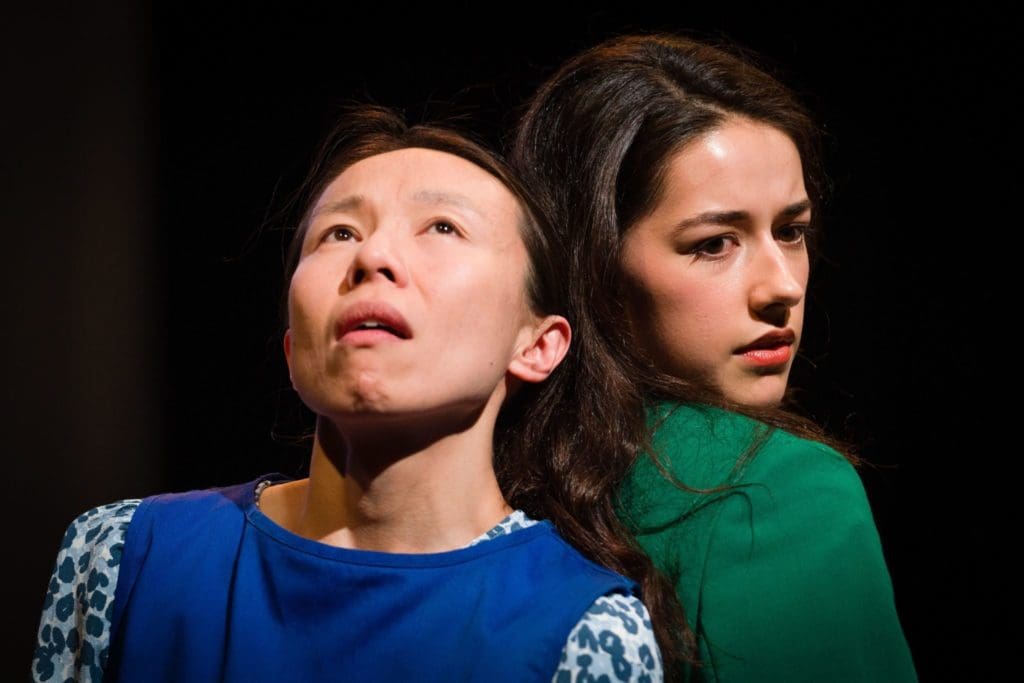
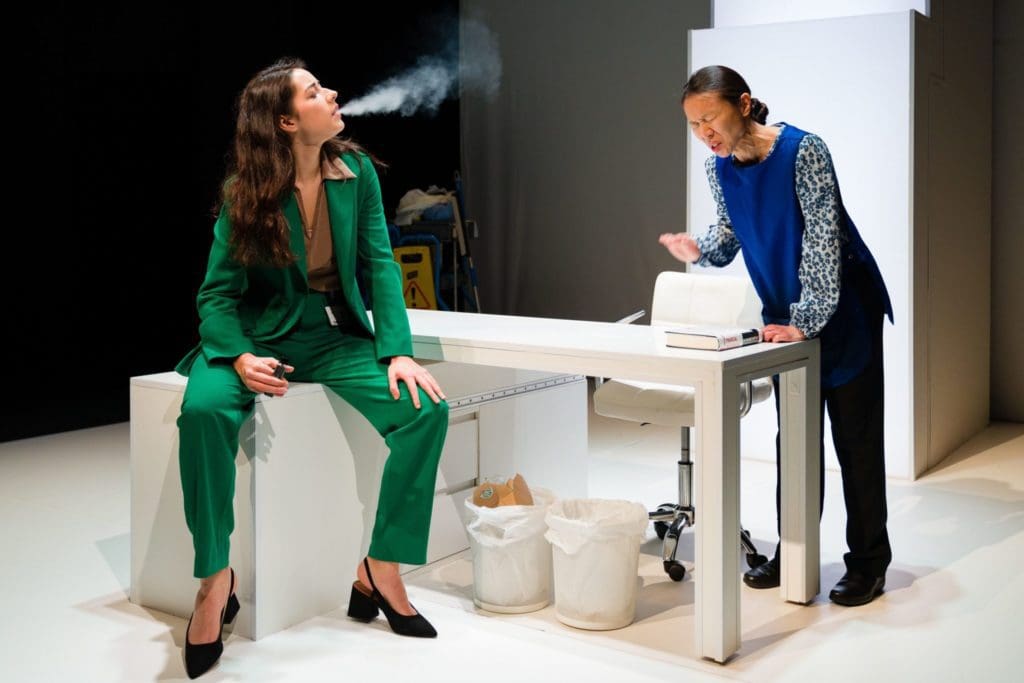
From antipathy to friendship: Angela Yeoh, as Yvette, left, and Anya Jaya-Murphy, as Nisha, in Michele Lee’s Rice

RICE, Michele Lee’s humorous observation on gender, globalisation, family and friendship, plays York Theatre Royal tonight and tomorrow.

Winner of the Australian Writers’ Guild Award for Best Original Stage Play, Lee’s story focuses on the powerful – if unlikely – bond between an ambitious young businesswoman and her office cleaner as they navigate the complexities of their lives and the world at large.

Nisha (Anya Jaya-Murphy), a headstrong hotshot executive at Golden Fields, Australia’s largest producer of rice, is determined to become the first female Indian chief executive officer in Australia.

She is close to sealing a contract with the Indian government in a secret deal worth billions that would see her company take over India’s national rice distribution system.

Working late nights in the office, she encounters Yvette (Angela Yeoh), an older Chinese migrant, who cleans up her mess. Yvette has her own entrepreneurial ambitions, but her daughter faces court after participating in a protest against the unethical practices of a national supermarket chain.

“I’ve always wanted to centre a story around two strong female actors of colour and that was my starting point,” says Michele. “In this play their characters traverse a range of identities and jump between and transform across many different roles.

“I feel exhilarated that this drama is being staged on opposite sides of the world and hope its universal themes around gender, ambition and friendship will resonate with audiences in the UK.”

The British production is being mounted by Actors Touring Company and Orange Tree Theatre, Richmond, in association with Plymouth Theatre Royal, under the direction of ATC artistic director Matthew Xia.

“Maybe maybe I’m kind of hopeful because ultimately the play ends in a mostly hopeful way,” says playwright Michele Lee

“It feels fantastic after this pandemic-enforced hiatus to finally be back touring shows again,” he says of a tour that already has visited Scarborough’s Stephen Joseph Theatre on March 4 and 5 in its first North Yorkshire showcase.

“I’m looking forward to introducing this dynamic and expansive drama, which stays true to ATC’s mission in bringing fresh dialogue and perspectives from different cultures and intersections to audiences up and down the country.”

Hmong-Australian writer Michele Lee tells stories through theatre, live art, audio and on screen, exploring otherness, Asian identity and found families, usually through “contemporary narratives that privilege the experiences of women and people of colour”.

“The play began with me thinking about these roles of power that don’t tend to be diverse,” she says. “When I was beginning to write plays, it was against a backdrop of people of colour being limited in what they could be cast for because, in the plays that were being written, they were never more than the side role.

“Whereas I wanted to be able to write about women of different ages and different backgrounds, and with Rice, it’s not too much of a stretch of the imagination to consider what could connect people in different ways.”

Michele did “heaps of research”. “I went to India; I met a farming advocacy group; an Australian crop baron, who had a variety of crops, not just rice, and he was interesting because he was educated in agricultural science,” she says.

“His parents were farmers but had studied the business side and this was indicative of how things had changed from when people who farmed lived in villages pre-industrial revolution.

“The play is an exposition of some of the real-world issues, focusing on two women who are spiky and that really resonated with me.”

Addressing universal themes around gender, ambition and friendship: Anya Jaya-Murphy’s businesswoman Nisha, left, and Angela Yeoh’s cleaner Yvette in Rice

Michele is a writer of Southeast Asian descent. “My background is Hmong, a diaspora of stateless people, with that diaspora being due to war,” she says. “My dad came out to Canberra as a student on an Australian government scholarship, and my mum was allowed to join him on a humanitarian visa. After the Hmong were exposed as ‘anti-Communist for supporting the Americans’ in the Vietnam war, she had fled to a refugee camp.”

Born into 1980s’ Australia, Michele grew up in Canberra as one of only 4,000 Hmong people in Australia. “I’m an Australian citizen, and I’ve written stuff that’s autobiographical, but with Rice I’m writing about people who are ‘absented’ in Australia,” she says.

“They are two women from different Asian backgrounds with differences in how they appear and the cultures they come from, but they overlap more than they don’t, and though it starts off with their antipathy, maybe I’m kind of hopeful because ultimately the play ends in a mostly hopeful way when they’d started off not being friendly.

“The cynic in me says that would never happen, but there’s a wider hope and aspiration to allow them to look for friendship.”

Michele enjoyed writing for the two-hander format. “There’s no relief because there’s no-one providing a third voice,” she says. “It heightens the intensity, and though there are moments of levity, it allows for frank discussions.”

She did not make it to the London run but travelled over to Britain from her Melbourne home last month when the regional dates were underway with a different cast and new touring set. “I got to Liverpool on the Friday, feeling very zonked, and saw it on the Saturday, feeling less zonked. I enjoyed it,” she says.

“It’s hard to separate my inner critic, always looking for something wrong about it, when I should be thinking, ‘what do I like about it?’, and there’s plenty!”

Actors Touring Company and Orange Tree Theatre present Michele Lee’s Rice, York Theatre Royal, tonight (13/4/2022) and tomorrow at 7.30pm. Box office: 01904 623568 or at yorktheatreroyal.co.uk.

Secret Link