
Sheila Gold: Frank, incensed and muddying the truth in The Psychic at York Theatre Royal. Picture: Manuel Harlan
THIS critique comes with a personally signed request from theatre makers Jeremy Dyson and Andy Nyman, paperclipped to the programme for their world premiere of The Psychic.
“Whilst we know it makes your job a little harder, we would love it if your review could steer clear of spoilers of any of the twists or secrets that you are about to learn,” they ask.
The Psychic has been up and running for a week of previews before Wednesday’s press night – with Jonathan Ross and actor Tim McInnerny among the high-spirited full house – and no doubt those twists and secrets are being shared already, but your reviewer’s lips are sealed on the minutiae of what unfolds.
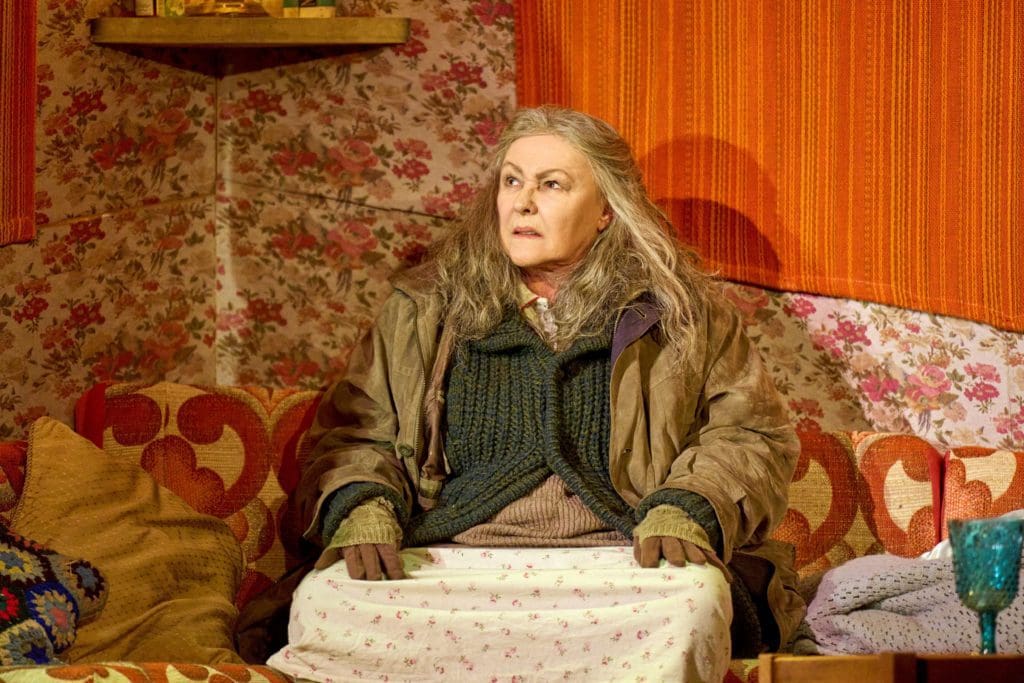
Frances Barber’s prickly Rosa in The Psychic. Picture: Manuel Harlan
The north and south writer-director combo of Dyson (from Ilkley) and Dyson (from London) made the same request for Ghost Stories, their audacious spooky conceit that is still freaking out audiences after 16 years (and played the Grand Opera House, York, in March 2020).
After the paranormal scares and shrieks of Ghost Stories, Dyson, alumnus of the deeply, madly, darkly twisted League Of Gentlemen, teams up anew with regular creative co-pilot Nyman, actor, director, writer and collaborator with psychological illusionist Derren Brown for two decades, who played Winston Churchill in Peaky Blinders, by the way.
Illusions and disillusion play their part in The Psychic, a twisted dark thriller of jet black humour wrapped inside a state-of-the-nation study of fame and the corrosive impact of the Fourth Estate and radio shock-jocks, delivered with a theatrical sleight of hand in tandem with illusions designer Chris Fisher, lighting designer Zoe Spurr, sound designer Nick Manning, video designer Duncan McLean and, above all, set and costume designer Rae Smith, whose scene-setting is outstanding and well worth the longer-than-usual interval wait for the revelation of the gaudy interior of a Spanish villa.

Writer-directors Andy Nyman and Jeremy Dyson in rehearsal for The Psychic’s world premiere at York Theatre Royal. Picture: Manuel Harlan
Dyson and Nyman were delighted to team up with the Theatre Royal in York, a city “drenched in the supernatural” as Nyman described it, for the torrid tale of TV’s most famous psychic, Sheila Gold (Eileen Walsh) in the immediate aftermath of losing a high-profile court case, costing her not only her reputation but also £500,00 in legal fees.
We join her as the audience on the first night of her latest tour, fighting back against the charge of being a charlatan with her golden Irish brogue and “gift” for contacting the other side.
It will not be an easy ride: heat-seeking, scandal-stirring, slick and slimy radio presenter Robert Hamm (Mischief Theatre regular Dave Hearn) is out to give her a hard time; niece Tara (Megan Placito, in her professional stage debut) demands she trains her in her showman skills and won’t take ‘No’ for an answer.

Showing her the ropes: Eileen Walsh’s Sheila Gold working with her “protege”, Megan Placito’s Tara in The Psychic. Picture: Manuel Harlan
Enter a wealthy couple, Deepak (Jaz Singh Deol) and Nisha (Nikhita Lesler), with a desperate request for Sheila to conduct a séance to attempt to make contact with their late child. Sheila duly snatches at the opportunity to bleed them for money.
In the words of Dyson and Nyman, “what follows makes Sheila question everything she ever believed and leads her on a journey into the darkest corners of her life”. Occupying the darkest corner of all is her dysfunctional relationship with her mother, the anything-but-rosy Rosa (Frances Barber), her spiteful spiritualist forebear as a fortune teller on the Blackpool pier.
Central to The Psychic is the question: “Is any of it real?”, not only asking whether TV and stage show psychics are fakes, but also what is the truth of such lives beyond the TV screen, as Dyson and Nyman question “what really matters in life”.

Dave Hearn’s arch cynic of an investigative radio presenter, Robert Hamm, in The Psychic. Picture: Manuel Harlan
Can you trust what you are watching amid Fisher’s illusions and McLean’s videos, and who is deceiving who in the fractured mother-and-daughter relationship of Rosa and Sheila? The greater truth here, beyond the price of fame, is the cost of greed and jealousy, as captured in the terrific performances of Walsh’s Sheila, Barber’s waspish, embittered Rosa and impressive debutant Placito’s aspirational Tara (Placito having grown up in a travelling showman family).
Dyson and Nyman serve up moments of shock-horror and utilise a disorientating sound pool – much in the manner of Danny Robbins’s 2: 22 A Ghost Story – but for all the supernatural intrigue, at its heart The Psychic mirrors Greek tragedies in its study of mortality and morality, the maternal and the matriarchal, the eternal and the material, the ethereal and the real, the heaven and the hell.
Jeremy Dyson and Andy Nyman’s The Psychic, York Theatre Royal, until May 23. Box office: 01904 623568 or yorktheatreroyal.co.uk.

Seeking contact with their late child: Jaz Singh Deol’s Deepak and Nikhita Lesler’s Nisha in The Psychic. Picture: Manuel Harlan