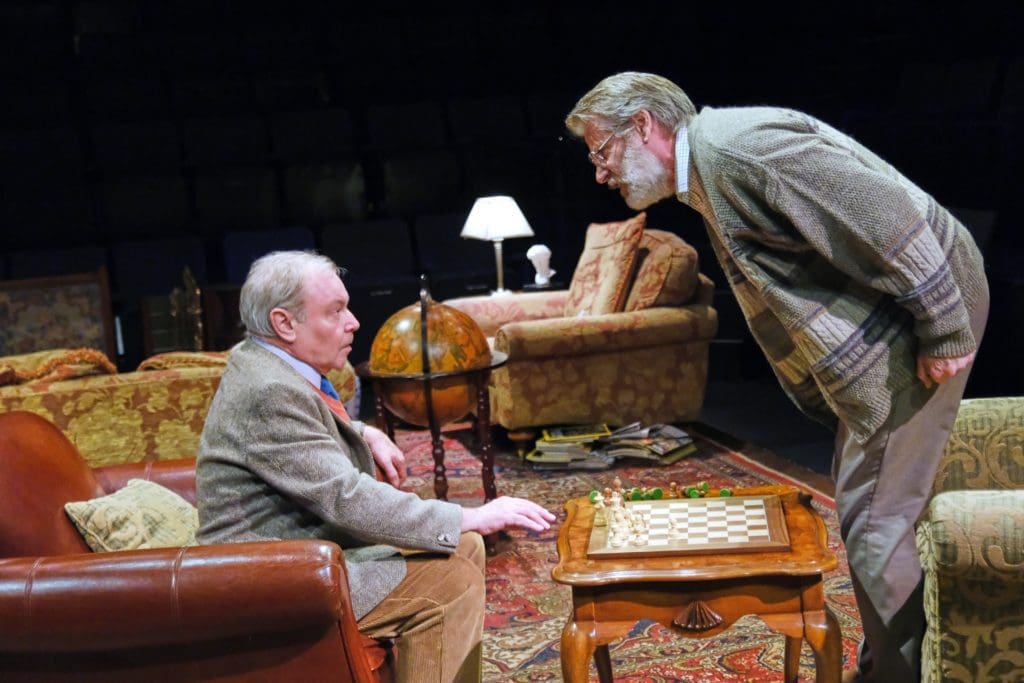

Frances Marshall’s Allistra Clay, left, Elizabeth Boag’s Devaney Dyer, Leigh Symonds’s Octavius and Richard Stacey’s RSDO 83 in Alan Ayckbourn’s The Trial Of Romeo Oscar. Picture: Tony Bartholomew
YOU might think it would be impossible for Alan Ayckbourn still to come up with a first in his seventh decade as a playwright.
Wrong! You should know better! Play number 92 is his inaugural courtroom drama, but one set in a dystopian future in a first of its own: the first murder trial of a non-human in the year 2194, with the undercurrent of a detective story bubbling away too.
In a riff on the infamous promotional tagline for Ridley Scott’s 1979 science-fiction horror movie Alien, Ayckbourn pronounces that “in space no-one can hear you dream”: the first indication of the play’s lament for the decreasing role of the arts, whether theatre or music, whether Shakespeare or Tchaikovsky, on the educational curriculum now, let alone 168 years henceforward.
Latterly, Ayckbourn has switched between writing about the past and the future, but all the while commenting on the present that constantly disappoints, even disturbs, him.

Richard Stacey’s RSDO 83 and Olivia Woolhouse’s Hermione Quinque re-enacting the the tomb scene from Shakespeare’s Romeo And Juliet in the courtroom in The Trial Of Romeo Oscar. Picture: Tony Bartholomew
Rather than the grouchiness of ornery old age, his writing remains vibrant, innovative, full of wit and wisdom, surprise and mischief, more sage than rage in delivery at 87.
You will hear his recorded voice too in his original soundscape for The Trial Of Romeo Oscar, whether pronouncing the request for mobile phones to be switched to mute or announcing the journey from the surface to Defence Suite 19 of the Subterranean Hub 19, 27 levels down in the Citrus Legal Complex, and later, for Act II, some days later, to Courtroom 3 on Level 3 of Kevin Jenkins’ futuristic set design.
The Citrus Corporation runs everything, both the lay of the parched land and the law of the land, now that central government has been replaced by big corporations. It is uncomfortably close to today’s march of AI, the rise of the tech brothers and Elon Musk brandishing his Doge chainsaw at the Conservative Political Action Conference.
On Earth, or Terra as it is now called, trees and house plants are confined to museums, music has been replaced by bleeps and beats (isn’t that happening already?!) and Shakespeare is no longer taught to the likes of Elizabeth Boag’s Devaney Dyer, the Firebrand Corporation’s Yorkshire-blunt chief engineer, whose skills are in her hands.

She is repairing Richard Stacey’s RSDO 83, a war hero from recent days, to prepare this battered military-issue android to face trial for killing a 13-year-old girl who had been in his care since her parents took their own lives.
RSDO 83’s reconstruction is being overseen by Leigh Symonds’s Assistant Arbiter Octavius, a sanguine humanoid court official, who learns new words, aphorisms and phrases each day in a running joke by Ayckbourn that delights in the vagaries of the English language.
This is typical of the slower-than-usual release of accumulative humour in Ayckbourn’s script, where so much exposition is necessary to set up the milieu: a world outwardly unfamiliar and yet redolent of the woes and wars of today.
Once the characters and their characterisation, their tropes and mannersisms, become familiar, their interaction leads to drama that is both gravely serious and yet waspish in its wit underneath the troubled surface.

Leigh Symonds’s Assistant Arbiter Octavius, left, keeps his head down as Russell Richardson’s judge, Arbiter Jefferies, makes his point. Picture: Tony Bartholomew
RSDO 83 may be the accused in the legal landmark case, but humanity is on trial as Ayckbourn asks the question: What makes us human? Art, music, literature, as much as science, is the answer of a playwright who has long been fascinated by science fiction.
Allistra Clay (York actress Frances Marshall) is appointed RSDO 83’s defence counsel on the grounds that she will know nothing about the case, as she is from Titan. Titan, however, is milk and honey by comparison with the Earth. Not caught up in the war, it still values music and literature, and so she can call on her knowledge of Romeo And Juliet for this new tale of Romeo Oscar and a girl called Juliet that will mirror the tragic path of Shakespeare’s play.
The case for the defence will be laid out with the aid of Olivia Woolhouse’s Hermione Quinque, a waitress picked from multiple theatre trainees to play Juliet. This is the cue for Ayckbourn’s in-jokes about there being nothing new in most actors being unemployed or forming a company called Spare Parts.
Later, he will top those quips with Hermione saying she could do her part in the trial again as she had been better in rehearsal. You can sense Ayckbourn’s years of experience in the rehearsal room pouring out into this biting dialogue.

Hayden Wood’s prosecutor, Ronal Lime-Tyler, grills the defendant, Richard Stacey’s RSDO 83. Picture: Tony Bartholomew
Yet he is wearing the equivalent of a judge’s black cap in passing sentence on mankind’s failings in Act Two, where Russell Richardson’s jaunty judge, Arbiter Jefferies, and Hayden Wood’s smarmy, smug prosecutor, Ronal Lime-Tyler, come to the fore, pitched against Marshall’s eloquent, meticulous Clay.
Stacey’s RSDO 83 and Woolhouse’s Hermione play out Romeo And Juliet’s fatal tomb scene: a play within a play that adds to the devastating impact of both. When Symonds’s Octavius borrows the closing couplet from Shakespeare’s tragedy, ”For never was a story of more woe than this of Juliet and her Romeo”, its sentiment applies as much to Ayckbourn’s characters.
The poster, with its image of an android warrior holding the hand of young girl looking out over a desert, makes no mention of writer-director Alan Ayckbourn, but his name runs through every scene like a seaside stick of rock. Once more, his writing will be music to your ears.
The Trial Of Romeo Oscar, Stephen Joseph Theatre, Scarborough, until October 3. Box office: 01723 370541 or sjt.uk.com.
ON the subject of names: here are the latest additions to Alan Ayckbourn’s notebook of nomenclatures across 92 plays: Octavius, Allistra, Ronal, Devaney, Romeo and Hermione are used for the first time in The Trial Of Romeo Oscar.
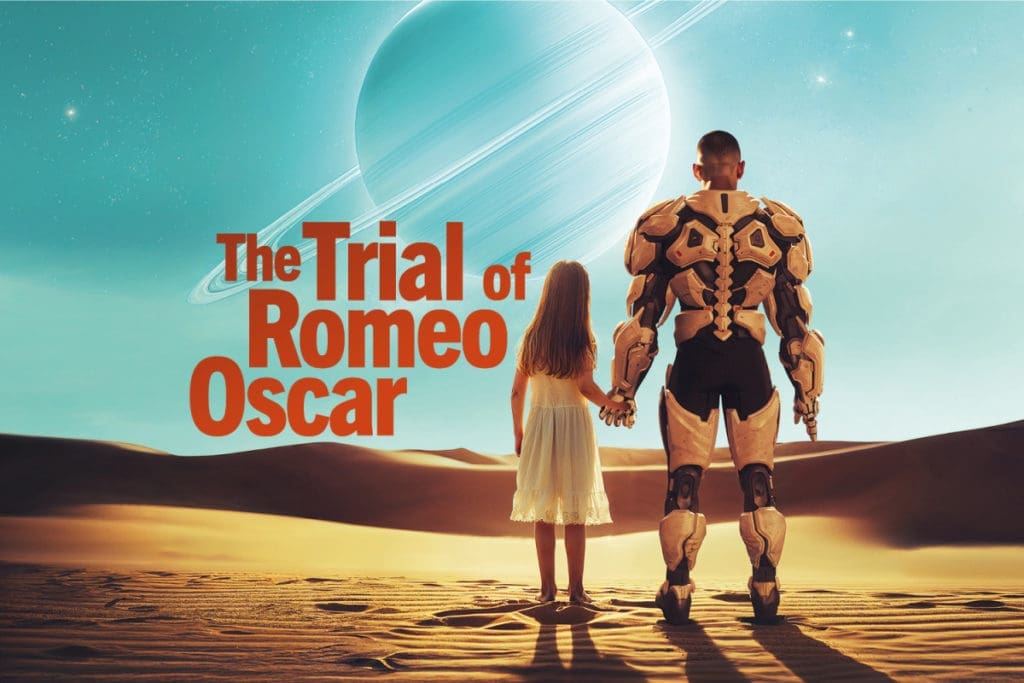
The poster for Alan Ayckbourn’s The Trial Of Romeo Oscar