REVIEW: Martin Dreyer’s verdict on Royal Liverpool Philharmonic Orchestra/Corderoy at Ryedale Festival, St Peter’s Church, Norton, July 18

Conductor Charlotte Corderoy. Picture: Ryedale Festival

THE oldest professional orchestra in Britain in the world premiere of a flugelhorn concerto, alongside two classical symphonies, together constituted a mouth-watering opportunity. It offered precisely the kind of adventure for which Ryedale Festival has become renowned.

Although still in her 20s, Charlotte Corderoy is a conductor of considerable promise. All sides of her musical personality were on view here. At first, she took a cautious approach to Weber’s Second Symphony, meticulously strong on detail. The tension in her body language, however, did not always reflect the moods she was attempting to capture.

By the second slow movement, she had shaped some fine ensemble in the woodwinds, allowing the solo bassoon to shine. The busy final Scherzo was neatly clipped, with important attention to the composer’s telling rests – and his throwaway ending.

Gabriel Jackson built his new Flugelhorn Concerto, with accompaniment for strings, harp and percussion, around the numerical positions in the alphabet of the letters in ‘Roy Anthony Hargrove’, a trumpeter and flugelhornist in whose memory it was written.

The result, as he freely admits, is a pastoral reminiscence, but his method came across as something of a straitjacket, allowing very little room for any type of virtuoso display from the soloist, Imogen Whitehead.
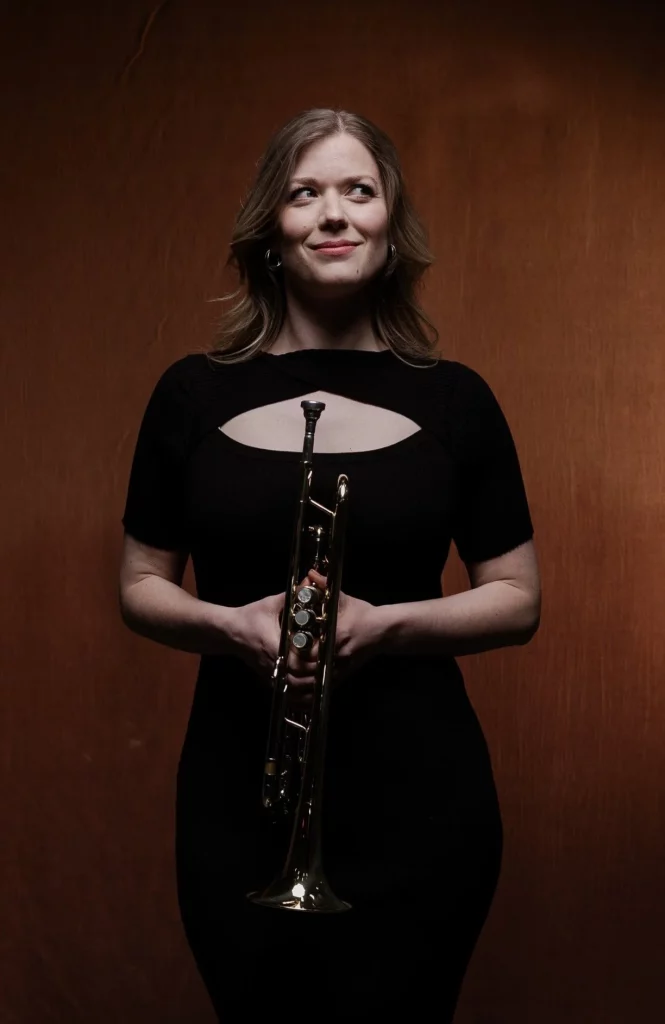
Trumpet and flugelhorn soloist Imogen Whitehead. Picture: Matthew Johnson

It got off to a strong start, with some leaping string figures that recalled Britten, but these were barely recalled later. He soon toned things down by muting his soloist, in company with long, elegiac phrases to which Whitehead brought a lovely legato.

It is true that there were some fanfare-like moments and even string syncopation, but these soon dissipated into a duet between flugelhorn and vibraphone in full warble mode.

Much of what followed was similarly dream-centred, built around a dominant pedal, with only fleeting moments of activity in the strings. There was full-blown trumpeting at the very end. Whitehead had added some tightly decorative little roulades to her otherwise slow lines and was in admirable control throughout, but the piece as a whole never quite caught fire.

In Beethoven’s Fourth Symphony, Corderoy was right in her element and altogether more relaxed. After a suitably weird opening Adagio, the entry into the Allegro was truly exciting, with syncopation taut and accents fierce. Some of the fortes in the slow movement were a touch forceful for the context, but the succeeding Scherzo was light and airy by contrast.

Excitement returned in the finale, where the composer’s ma non troppo was effectively ignored and Corderoy chose a cracking pace. The orchestra stayed right with her and the return of the main theme was absolutely gripping.

Review by Martin Dreyer

REVIEW: Martin Dreyer’s verdict on Ryedale Festival, Dame Imogen Cooper, St Peter’s Church, Norton, July 26

Dame Imogen Cooper: “Held her audience in rapt admiration”. Picture: Sussie Ahlburg

BEETHOVEN’S last three piano sonatas represent the most free-wheeling in the classical repertory and there is no performer better suited to them than Dame Imogen Cooper. On the penultimate evening of the festival she held her audience in rapt admiration.

There is a special intimacy to these three works. Their early movements lure us into their web before finales that explore the very depths of emotion. Cooper caught at once the rhapsodic feel of Op 109 in E major, with its tempo changes but – as so often in this programme – managing all the while to maintain its overarching melodic contour, no easy feat.

There was immediate drama, too, in the Prestissimo that follows: she took this as her scherzo, although for Beethoven it was no joke. Only Beethoven would think of ending with a slow theme and variations, but Cooper brought to it a wonderful serenity, and when the theme returned in all its simplicity at the close, it was hard to hold back the tears.

The songful opening of Op 110 in A flat is marked con amabilità (sanft), an oddly bilingual statement. She took its ‘gentle amiability’ to mean something personal and allowed it to breathe, almost to excess, in her pauses and rests. But there was compensation in the way she attacked the second movement, balancing its percussion with its melody. Her measured arioso was followed by an equally smooth fugue

Beethoven’s final word on the piano sonata, Op 111 in C minor, is a kaleidoscope of contrasts, not least between minor and major. Cooper was alive to every nuance. The angry three-note motif emerged trombone-like in her left hand at the start, contrasted by the ethereal effect of the delicate high traceries in the closing Arietta and variations.

In between, she had plenty in reserve for when the going got active, including remarkable clarity in the fugue. National treasure is an overused title but Imogen Cooper undoubtedly qualifies.

Ryedale Festival, Royal Liverpool Philharmonic Orchestra/Chloe Rooke, Hovingham Hall, July 27

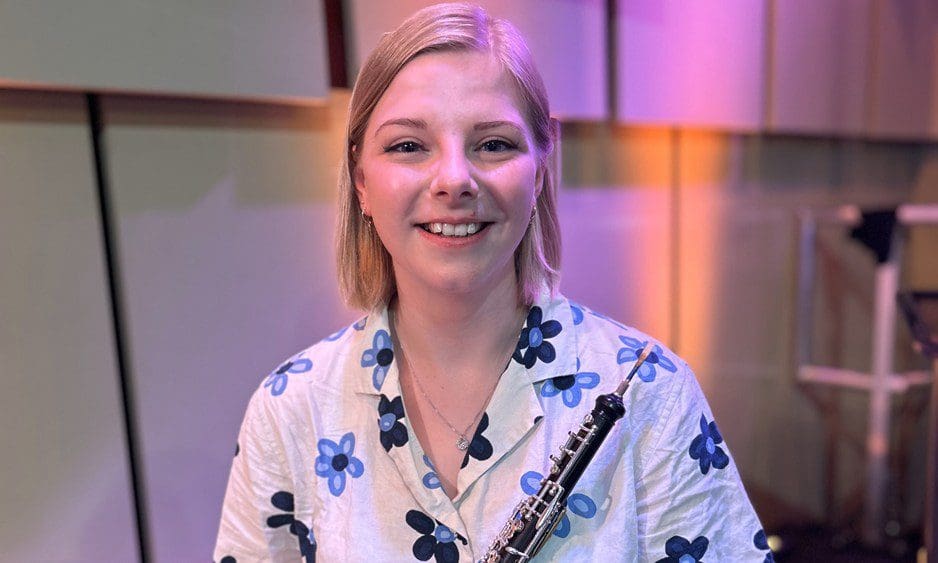
Oboe player Helena Mackie: “Breath control to spare”

HAVE we reached a watershed where we can acknowledge the female of the species as at least as potent as the other half of humankind? At the very moment when the Lionesses were bringing home the bacon in Basel, two equally gritty young ladies were carrying all before them right here in Ryedale.

Chloe Rooke conducted a chamber orchestra of members of the Royal Liverpool Philharmonic Orchestra with immense verve and boundless conviction. Her partner as soloist in Mozart’s Oboe Concerto was the RLPO’s principal, Helena Mackie, who showed similar confidence and enthusiasm. Both are still in their twenties.

Rooke positively bounced onto the platform for Mendelssohn’s Fourth Symphony (Italian) and it showed in her brisk conducting. What mattered, however, was that the orchestra responded to her with precision that spoke volumes for her direction.

There was a suspicion of deceleration when the dynamic level subsided but equally a renewal of tempo with every crescendo. But her acceleration towards the end was absolutely right.

The slow movement has sometimes been called the “Pilgrims’ March”; certainly there is a plodding character to its first theme. But the suaveness of the second theme suggested some happy walkers, topped off by the serenity of the closing pizzicato. The minuet was notable for the superb ensemble of horns and bassoons in its trio.

It is doubtful whether even Italians could dance the whirling saltarello at Rooke’s lightning pace. But the gutsy strings gave it their all and hung on gamely, a sure sign of their respect for her commands.

Mozart’s only surviving oboe concerto does not get the currency it deserves, perhaps because it may have been originally intended for the flute and is more often heard in that guise. But if Helena Mackie continues to promote it, that may well change. Her very opening phrase dazzled by its sheer length: she had breath control to burn. The first cadenza brought a pin-drop moment, so captivated was the arena.

There was a lovely cantabile to her line in the slow movement, which remained untrammelled when she engaged in dialogue with the orchestra. The closing rondo really danced, thanks to her twinkling fingers. With the orchestra keeping in close attendance, this was a thoroughly delightful adventure for which we had our two young ladies to thank.

The second half was French. After a calm, rather stately account of Fauré’s Pavane, without the optional chorus, it was left to Poulenc’s Sinfonietta, a full symphony in all but name, to round off the festival.

Poulenc’s endless capacity for fun, for pulling off tricks and pulling our legs, makes him a modern-day Haydn. Rooke captured the first movement’s jack-in-the-box quality right away. Poulenc’s colourful orchestration lent a Falstaffian quality to the scherzo, where the timpanist had a field day.

There was a nice lilt to the slow movement, alhough the woodwinds were allowed to upstage the strings. They, however, had their revenge in the finale, delivering pronounced rhythms among the circus thrills and spills. Its two themes were cleverly contrasted in the coda. Rooke may be an “Emerging Artist” in Holland but on this showing she has already emerged.

Reviews by Martin Dreyer