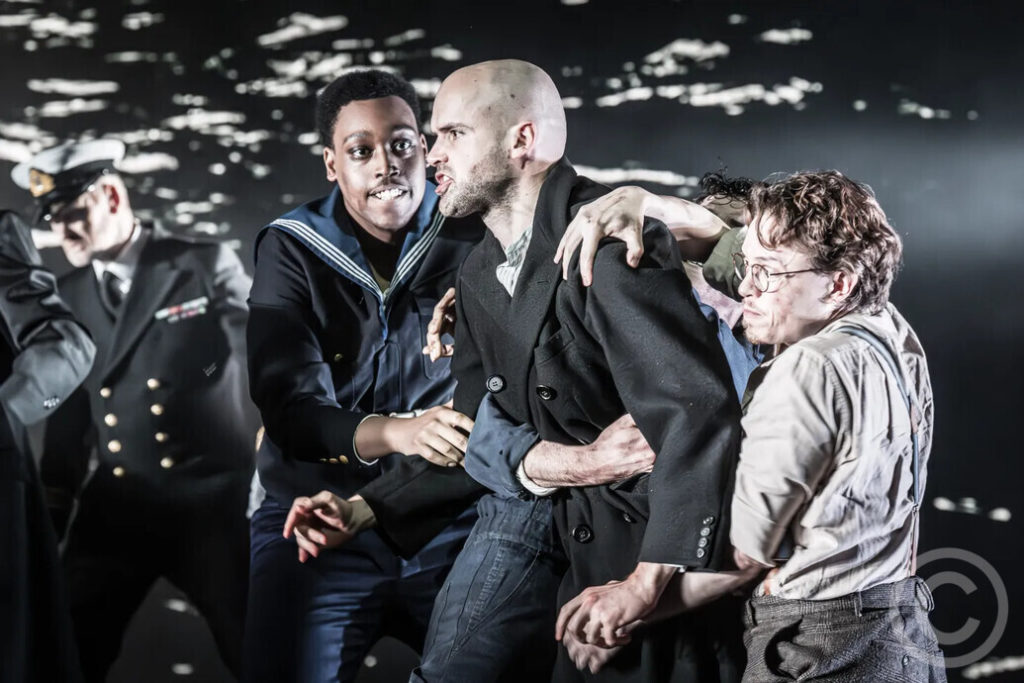
Djibril Ramsey’s Barnardo , Ralph Davis’s Hamlet and Colin Ryan’s Horatio in the Royal Shakespeare Company’s Hamlet. Picture: Marc Brenner
THE Royal Shakespeare Company will present multi award-winning Rupert Goold’s touring production of Hamlet at York Theatre Royal from April 14 to 18.
“Hamlet is a play about the inevitability of death: the death of fathers, the death of kings, the mortality facing each and everyone of us, but it is also a play about how to live, what makes a good life and a just one too, however brief our allotted time,” says Goold.
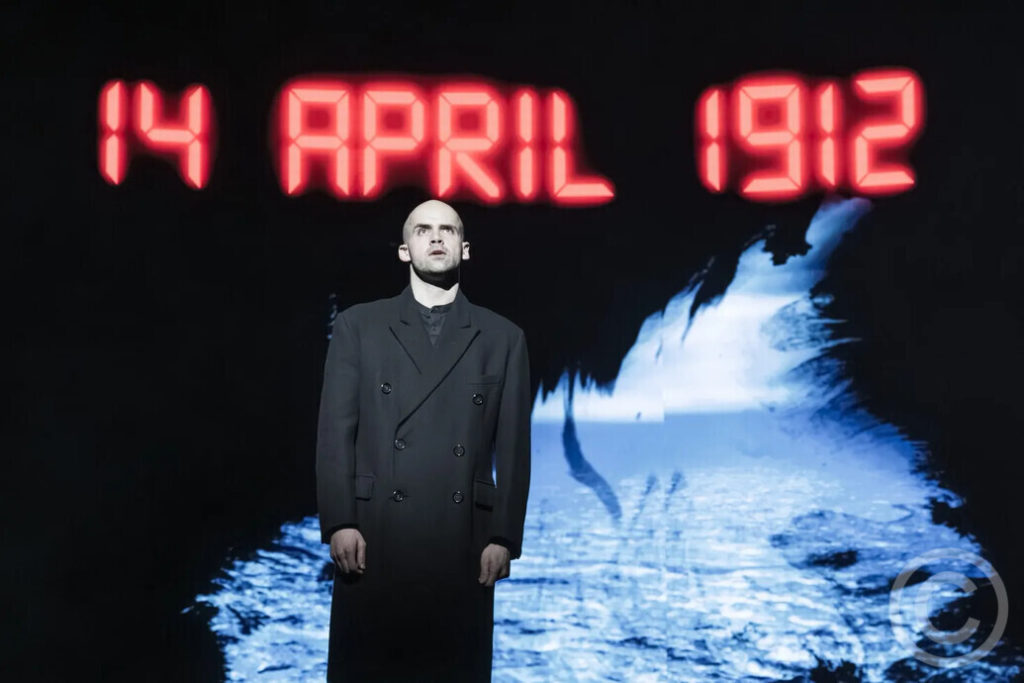
The York run will coincide with the 114th anniversary of the sinking of the RMS Titanic on the night of April 14-15 in 1912.
“Our production is set aboard a ship but one that is soon to founder, going down with all hands,” says Goold. “Its inspiration comes from the most famous sinking in history, and just as that icy tragedy came to pass in a little over two and a half hours, our play takes place in real time and for about as long, as much catastrophic thriller as poetic meditation. It’s a production that asks what it means to be human and decisive when time is running out.”

Georgia-Mae Myers’ Ophelia. Picture: Marc Brenner, Royal Shakespeare Company
Shakespeare’s epic family drama of deceit and murder will feature classical actor Ralph Davis in the title role of Hamlet. He was nominated for the 2023 Ian Charleson Award for his performance as Benedick in Much Ado About Nothing, appeared as Edmund in King Lear, both at Shakespeare’s Globe, and played Iago in Othello at the Sam Wanamaker Playhouse, for which he came second in the 2025 Ian Charleson Awards.
As well as theatre credits at the Almeida, Chichester Festival Theatre, Ustinov Studio and elsewhere, Davis’s RSC credits include Tamburlaine, Timon Of Athens, Richard III and King John.
Davis co-wrote, created and starred in Film Club for the BBC in 2025. His other screen credits include House Of The Dragon for HBO, Big Boys for Channel 4 and SAS: Rogue Heroes, Life After Life and Steve McQueen’s Small Axe for the BBC.

Ship shape: Rupert Goold’s cast in the Royal Shakespeare Company’s Hamlet. Picture: Marc Brenner
Alongside Davis’s Hamlet in the RSC cast will be Rob Alexander-Adams (Voltemand); Richard Cant (Polonius); Kat Collings (Ensemble); Raymond Coulthard (Claudius); Maximus Evans (Marcellus); Ian Hughes (Ghost/Player King); CJ Johnson (Player Queen); Julia Kass (Guildenstern); Poppy Miller (Gertrude); Georgia-Mae Myers (Ophelia); Mark Oosterveen (Cornelius/Priest); Djibril Ramsey (Barnardo); Colin Ryan (Horatio); Jonathan Savage (Ensemble); Jamie Sayers (Rosencrantz); Leo Shak (Francisco) and Benjamin Westerby (Laertes).
Goold directed Dear England for the National Theatre and Romeo And Juliet and The Merchant Of Venice (RSC). This year he will take up the role of artistic director of The Old Vic after 13 years at the Almeida Theatre.
He has received Olivier, Critics’ Circle and Evening Standard awards for best director twice and won a Peabody Award in 2011 for Macbeth. In 2017 he received a CBE in the New Year’s Honours for services to drama.
Joining Goold on the creative team are revival director Sophie Drake; set designer Es Devlin; costume designer Evie Gurney; lighting designer Jack Knowles; composer and sound designer Adam Cork; movement director Hannes Langolf; video designer Akhila Krishnan; fight director Kev McCurdy; dramaturg Rebecca Latham and casting director Matthew Dewsbury.
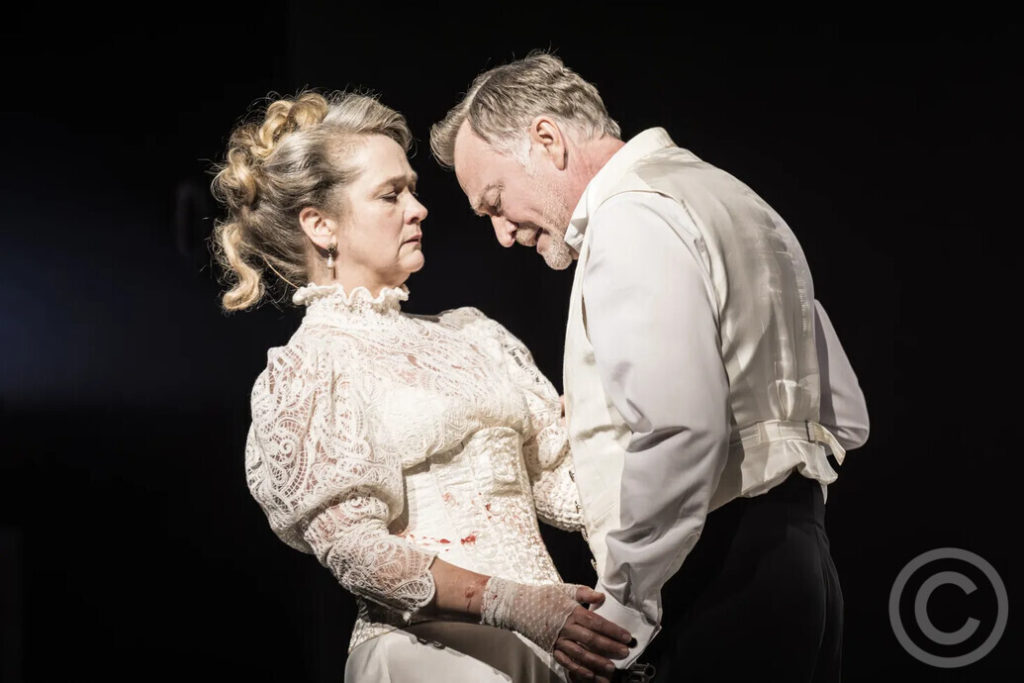
Poppy Miller’s Gertrude and Raymond Coulthard’s Claudius in the Royal Shakespeare Company’s Hamlet. Marc Brenner
Sophie says: “I’m so looking forward to taking this exciting show on the road. We’ve assembled a wonderful cast, led by Ralph Davis, who promises to make a great Hamlet. It’s probably Shakespeare’s most famous play, but I’m sure no-one will have seen a Hamlet like this before. I can’t wait for audiences to see it.”
The Hamlet tour is supported by the National Lottery through Arts Council England, whose funding makes it possible for the RSC to expand its tour to work in partnership with more places across England.
Royal Shakespeare Company in Hamlet, York Theatre Royal, April 14 to 18, 7pm plus 1.30pm, April 16 and 2pm, April 18. Post-show discussion, April 17. Box office: 01904 623568 or yorktheatreroyal.co.uk.
Hamlet is touring to Truro, Bradford, Norwich, Nottingham, Blackpool, Newcastle, York and Canterbury, from February to April 2026.
Here Ralph Davis discusses his role as Hamlet and why Shakespeare is “the best”.
What can audiences expect from this particular production of Hamlet, Ralph?
“They can expect something epic and cinematic. We’re doing it on a scale that will be very exciting to watch but also relatable. The play deals with a deeply human experience – Hamlet has to deal with the fallout of his father being murdered, and everything that spirals from that. So yes, I hope audiences will be both riveted and moved.”
Where is Rupert Goold’s production set?
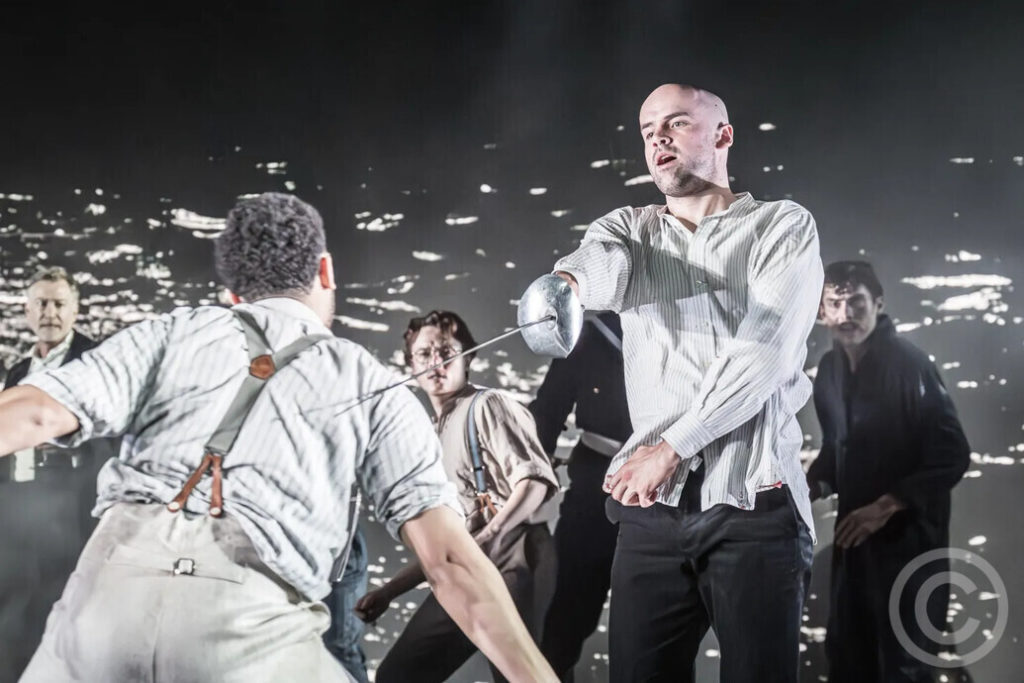
“It’s set on a sinking ship, which is reminiscent of a particular disaster that happened in 1912. It will be a real spectacle. We’ve got these amazing projections of the sea and storms, and a huge, raked stage.
“Hamlet is a play that feels big, and putting it right in the middle of the sea on a ship takes the audience to a very exciting place.
“That said, we’re not literally setting it on the Titanic: I don’t see all these characters as sinking and drowning. The play deals with the theme of justice, and the point of it when we’re all dying anyway.
“So the setting Rupert has chosen feels appropriately dangerous, with death and disaster all around whilst Hamlet is trying to work out what he should do when he’s told that his uncle has killed his father.”

Ralph Davis’s Hamlet clashing with Raymond Coulthard’s Claudius in the RSC’s Hamlet. Picture: Mark Brenner
How did you feel when you were picked to play Hamlet, probably the most famous stage role of all?
“I found out when I was sitting alone in my flat in Camberwell. It had been a few days since the audition, and I thought I’d given a fairly good account of myself, and I had a good feeling about things.
“Anyway I found I’d got the role, and, to use Hamlet’s words, I was ‘struck so to the soul’. I couldn’t believe it. I was so giddy and excited.
“Partly because I’ve already done quite a lot of Shakespeare, people have always asked me if Hamlet was a role I wanted to play. And I’d always said ‘no, it wasn’t something I was interested in’. But I know I was just saying that in case it never happened!
“I found out that I’d got the part quite a long time before rehearsals began, so I had a while to be excited about it. Of course I then read the play again, and thought, ‘God. What am I going to do with this?’”
How are you approaching it?
“I’m trying to approach it like any other role. It is different, of course, because it’s so iconic, and there are so many different preconceived ideas about what the part is and what the play is.

Skull’s out: Ralph Davis’s Hamlet contemplates once knowing Yorick well in Hamlet. Picture: Marc Brenner
“I’m stripping all of that away, getting rid of all of that noise, and reading it like it is a new play. And trusting my instinct of what I think the role is.
“So I’ve been very resistant to knowing how anyone else has done it in the past. I’m just working from the words on the page – what’s happening in this scene? What’s this relationship about? Why is he saying these words at this point? I’m treating it like it’s a new play.”
What was your route into acting?
“My mum dropped me off at Playbox, a theatre company for young people, in Warwick when I was literally 18 months old. I don’t think you’re capable of acting at 18 months, but I was there for some sort of storytelling session.
“That place became a second home to me. It was a tremendously professional and exciting environment for a young person to be in, and I just did play after play after play there.
“And then I was at the RSC as a child actor. At the age of ten, I was in King John alongside actors like Richard McCabe and Tamsin Greig. Then, still as a boy, I was in Richard III, directed by Michael Boyd and with Jonathan Slinger in the lead.

“I’m treating it like it’s a new play,” says Ralph Davis of playing Hamlet. Picture: Marc Brenner
“I also did lots of plays at Warwick School. I actually played Hamlet at school. That was set on a ship as well, although it was set pre-World War Two, so a bit later than the show we are touring. I think I was probably terrible because I was trying to do my A-levels at the same time!
“I went straight to RADA from school, and since then I’ve done a lot of Shakespeare, including a season at the RSC, and I’ve played Edmund in King Lear, Benedick in Much Ado and Iago in Othello at the Globe.”
Does Shakespeare particularly interest you?
“Yes. I’m just very old fashioned, or I’m just influenced by the people I would watch growing up. Those actors that I saw on stage would do a lot of Shakespeare until they were in their 40s, and then they’d make the leap to TV. And that’s what I wanted to do. And that’s sort of what I’ve done.
“I think my life was changed and shaped by the Shakespeare I saw at the RSC growing up, particularly Michael Boyd’s productions of the History plays. I think watching Jonathan Slinger in those plays probably did change my life.
“I thought, ‘that is something worth doing’. I find Shakespeare easier to do than modern texts sometimes because Shakespeare’s writing is the best there is.”

Ralph Davis’s Hamlet and Poppy Miller’s Gertrude in the RSC’s Hamlet. Picture: Marc Brenner
What were the highlights from the roles you have played?
“I enjoyed playing Benedick in Much Ado. I was 26, which is a young age to be playing that part, but I was leading a company at the Globe. It was shortly after Covid, during which I thought my dream of playing lead roles was perhaps over.
“Both Benedick and Iago were a real test of my abilities. And now, in rehearsals for Hamlet, I feel – and I know this might sound pretentious – that this part is going to change me. It’s such a challenge. Shakespeare really stretched the actor who played the role originally, because I think the play meant so much personally to Shakespeare.
“I also had a great time when I was in A Streetcar Named Desire at the Almeida, alongside the likes of Paul Mescal and Patsy Ferran. I had quite a small role, but it was such a fun company.
“What’s so nice about Hamlet is that I haven’t been on stage for about a year, and it’s lovely to be back in a company putting on a play.”
As well as acting, you write…
“Yes, I spent all of last year writing. I feel very fulfilled by making something and putting it in front of an audience. At RADA it was understandably all about acting, but I knew I also wanted to create things.
“I think Shakespeare’s stories are the best stories,” says Ralph Davis. Picture: Marc Brenner
“I co-wrote the BBC show Film Club. There’s a lot of work in getting something on TV, pitching it is a really tough process. But then you end up making it with all these talented people pulling in the same direction. I really like that feeling.
“In the future I’d like to direct as well. All of that said, I certainly feel fulfilled now working on Hamlet.”
How would you persuade audiences to see this production if they think Shakespeare is not for them?
“What I’m seeing in the rehearsal room is people speaking Shakespeare’s words, which really are words that we use nowadays, but just put in a more poetic and perfect order. People speaking the language like you and I are speaking now. And when actors harness those words and make them real, then I think there’s nothing more thrilling.
“And there’s no reason for anyone to be scared about the play, or feeling that they won’t be able to follow the story.
“I think people sometimes feel alienated because they hear words like ‘thee’ and ‘thou’ and certain words that are a little strange to the ear, but they make perfect sense when an actor delivers them right. And I think Shakespeare’s stories are the best stories. They are stirring and have fantastic characters.
“I’m really pleased that we’re taking this show on tour and reaching lots of different parts of the country, and perhaps people who’ve never seen Shakespeare before. I hope they find the experience as exciting as I did when I saw my first Shakespeare. Just don’t be scared of it – Shakespeare’s the best.”
Ralph Davis: Actor and writer