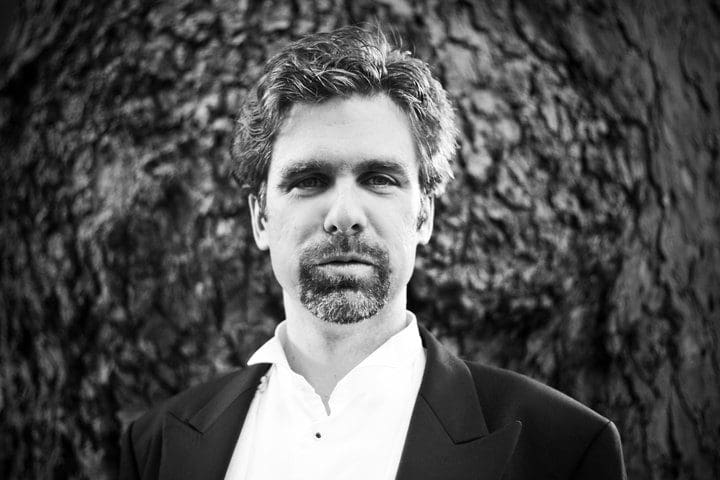
Bass-baritone soloist Alex Ashworth. Picture: Debbie Scanlan
THE opening “Kommt, ihr Töchter, helft mir klagen” – scored for double choir and double orchestra – set the performance tone impeccably.
The beautifully judged slow processional unfolding – surely one of the most distinguished openings in all music – allowed the textures to breathe. Bach immediately establishes the Passion’s grand dramatic architecture: public narrative and crowd commentary interwoven with moments of intensely personal reflection.
The performance used an English translation; original German titles are used here when referring to individual movements.
The simple question-and-answer phrases of the two choirs acted as dramatic crowd commentary, while the soprano ripieno choir (from St Peter’s School) sang the floating chorale “O Lamm Gottes, unschuldig” impeccably. The YMS orchestra provided the dotted rhythmic processional underpinning.
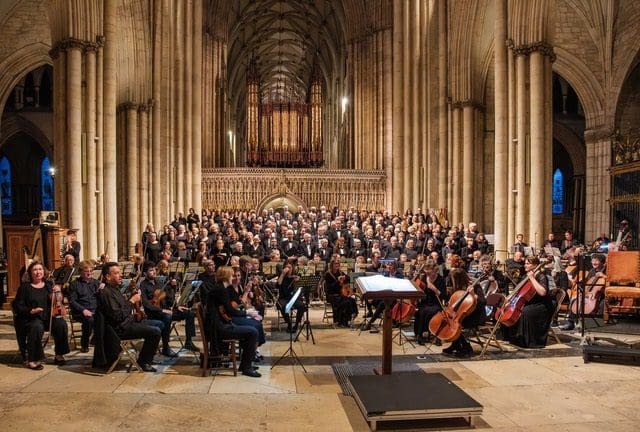
This antiphonal, call-and-response writing was further exploited by director David Pipe in the positioning of the six soloists. Bass-baritone Alex Ashworth, singing the role of Jesus, performed from the elevated pulpit, while tenor Gwilym Bowen, as the Evangelist, was placed on the left-hand side of the performance space.
The remaining soloists – soprano Clare Lloyd-Griffiths, mezzo-soprano Marie Elliott, tenor Daniel Joy and bass Jack Comerford – were positioned on the right-hand side.
For listeners seated on the left-hand side of the nave, however, clarity proved problematic. From that position it was difficult to hear the soloists with any real degree of definition, particularly the soprano and mezzo-soprano voices.
For example, although Clare Lloyd-Griffiths brought depth of interpretation to “Wenn ich einmal soll scheiden,” some detail – especially in the lower register – was lost in “Jesu, deine Passion will ich jetzt bedenken.”
Similarly, Jack Comerford’s singing in “Der Heiland fällt vor seinem Vater nieder” and “Gerne will ich mich bequemen” suffered from the same loss of textual and musical clarity.
Fortunately, Daniel Joy overcame the acoustic challenges in his performance of the reflective aria “Ich will bei meinem Jesu wachen”. The relatively spare texture – tenor line, single oboe obbligato (Jane Wright) and short choral interjections – comes through with admirable clarity. Consequently, it proved one of the highlights of Part I.
No such acoustical difficulties troubled Gwilym Bowen’s Evangelist or Alex Ashworth’s Jesus. The clarity of their delivery could hardly have been greater.
Particularly moving was Ashworth’s “Ihr seid ausgegangen als zu einem Mörder”. Bach’s characteristic halo of sustained strings often surrounding the words of Christ added an extra layer of expressive warmth.
The closing Part I chorale “O Mensch, bewein dein Sünde groß” – one of Bach’s most expressive chorale settings – provided a beautifully judged musical conclusion to the first half.
Matters improved noticeably in Part II. The reason, I suspect, lies in Bach’s scoring. Whereas Part I is often monumental and choral – with large crowd scenes and dramatic exchanges – such textures can become dense in a very resonant space.
By contrast, Part II is more introspective, with arias frequently accompanied by smaller instrumental groups and prominent obbligato lines, allowing individual vocal and instrumental details to emerge more clearly.
Mezzo-soprano Marie Elliott sang “Erbarme dich, mein Gott” – one of Bach’s loveliest arias and arguably the emotional heart of the Passion – with touching expressiveness. The aria was beautifully enhanced by the lyrical violin obbligato (Sarah Reece), creating a moment to treasure.
Clare Lloyd-Griffiths was heard to particularly good effect in “Aus Liebe will mein Heiland sterben”. The absence of a continuo bass line – highly unusual in Bach – together with the delicate scoring for flutes (Della Blood and Ruth O’Brien) and oboes da caccia (Jane Wright and Alex Nightingale), created an atmosphere of striking purity and stillness.
Jack Comerford brought conviction to the dramatic aria “Gebt mir meinen Jesum wieder,” protesting at Christ’s arrest, with strong support from energetic strings and continuo.
Bach’s gentle closing chorus, “Wir setzen uns mit Tränen nieder,” brings the work to one of the most serene endings in all sacred music. What a work — and what an impressive performance.
The choir sang their hearts out and held fast throughout; the orchestral playing, with excellent obbligato contributions, was consistently musical; the sopranos of St Peter’s School sang beautifully; and the soloists, although sometimes hampered by the acoustic, were consistently excellent.
Shaun Turnbull (chamber organ) and Lindsay Illingworth (continuo cello) were the evening’s unsung heroes – but the Oscar surely goes to director David Pipe, whose assured direction balanced both the drama and the inward reflection at the heart of Bach’s St Matthew Passion, even in the vast acoustic of York Minster.
Review by Steve Crowther