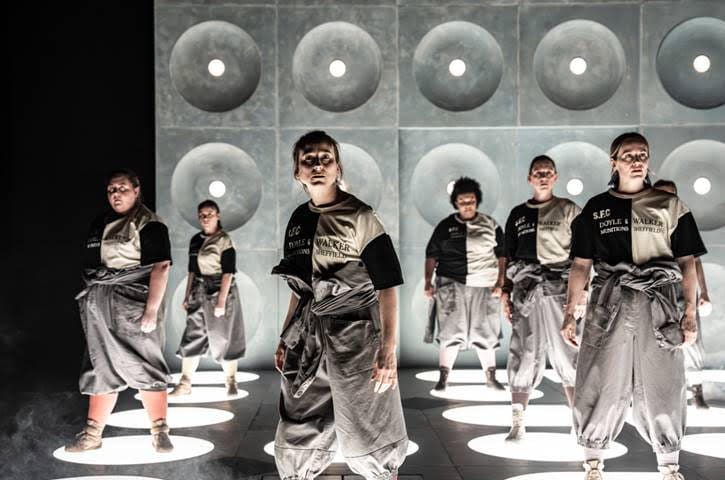
Last chance to see: The Ladies Football Club, Crucible Theatre, Sheffield ****

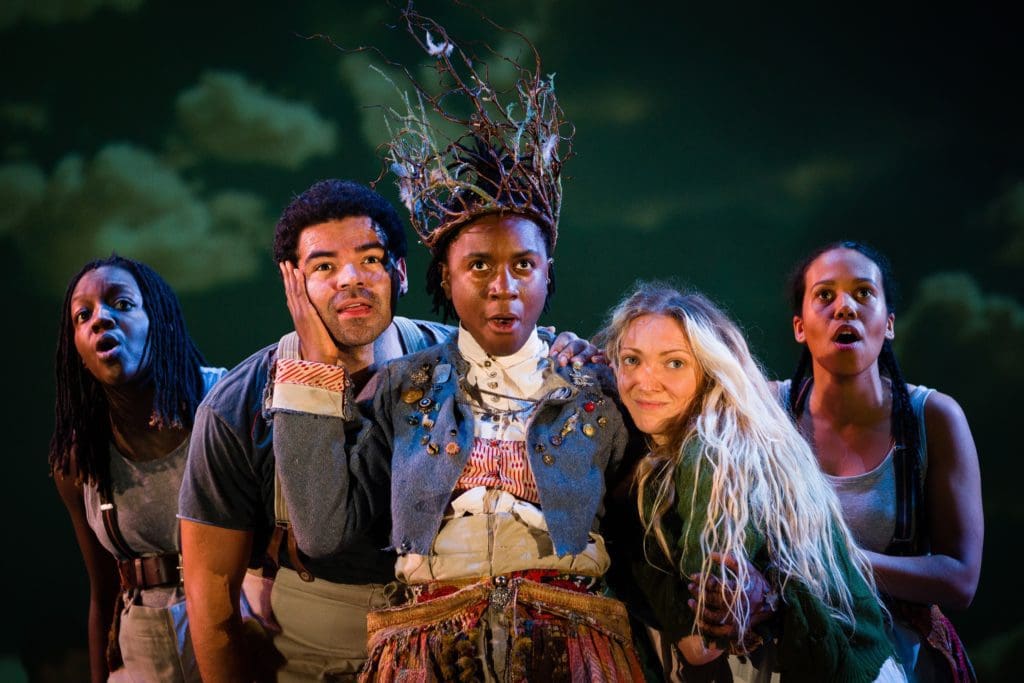
The women factory works – and footballers to boot – in The Ladies Football Club. Picture: Johan Persson

GO Firth and multiply the possibilities. In the wake of BAFTA and Olivier Award winner Tim Firth being asked to write the book for the Madness musical Our House and adapting his Calendar Girls film script for the stage version and subsequently the musical with composer Gary Barlow, now he puts the Sheffield into Stefano Massino’s 2019 Italian play Ladies Football Club, adding “The” to become the definitive version.

One accompanied in the city known as the “Home of Football” by foyer panels of information on the history of the women’s game, from Dick, Kerr’s Ladies FC and legendary gay star winger Lily Parr to Hope Powell and beyond.

Parr’s story, incidentally, has been told theatrically in Benjamin Peel’s Not A Game For Girls and Sabrina Mahfouz and Hollie McNish’s Offside, a play about football, feminism and female empowerment: themes in common with Firth’s premiere.

In the amphitheatre of the Sheffield Crucible, a theatrical sporting venue more associated with the multi-coloured ball-manoeuvring skills of snooker’s world championship, Sheffield Theatres’ artistic director Elizabeth Newman teams up with Frantic Assembly counterpart Scott Graham, whose trademark storytelling through movement was so crucial to the National Theatre’s The Curious Incident Of The Dog In The Night-Time.

Jessica Baglow’s goalkeeper Rosalyn leaps into action in The Ladies Football Club. Picture: Johan Persson

Bringing football alive on stage has been expressed in myriad forms, from the game enacted in the heat of Celtic-Rangers sectarianism in avant-garde ballet maverick’s Michael Clark & Company’s punk liaison with Mark E Smith’s The Fall in I Am Curious, Orange, at Sadler’s Wells Theatre in 1988, to the masks and mannequins for the “Dirty Leeds” players in Anders Lustgarten’s Brian Clough psychodrama The Damned United.

More recently, Amanda Whittington turned the spotlight on the early days of women’s football in Mikron Theatre’s four-hander Atalanta Forever in 2021 and James Graham essayed the state-of-the-nation treatise wrapped inside the so-close-but-no-cigar reinvention of England’s football team under thoroughly decent Gareth Southgate, premiered by the National Theatre in 2023 and now being stretched into a four-part BBC One series.

You could argue that theatre’s best evocation of physical combat on the sports field comes in John Godber’s Up’N’Under, wherein Rugby League’s bruising encounters are played out by actors wearing shirts with one team’s colours on the front and the opponent’s strip on the back. So simple, so economical, so effective, so Godber.

Here, in The Ladies Football Club, no football is kicked with a satisfying thud, although we still feel every lunging tackle, every meaty header, as the cut and thrust, the tension and drama, of a game is evoked by Graham through largely balletic movement, sometimes freeze-frame in the manner of Roy Of The Rovers comic strips, sometimes in cartoonish slow motion, other times with sudden circular bursts of energised running.

“Offside, ref!”: The Doyle & Walker Ladies players protest in The Ladies Football Club. Picture: Johan Persson

There are 11 players on the “pitch”, sometimes fewer, depending on factory resources available, but all representing only the one team. Opponents are a ghostly blur, conjured in your imagination, as the Sheffield foundry team go through their motions and emotions.

Just as the opposing teams are absent, so too are the steel city’s men folk, sent to the front in the Great War. The women take over their Doyle & Walker factory labours, making the munitions for all that senseless fighting and bombing.

We see them on the factory floor, with their banter, their sandwiches and their rivalries, and we see them starting up lunchbreak kickabouts, with their banter, their sandwiched tackles and their rivalries, before progressing from playing with prototype explosives for a ball to local pitches and ultimately to famous stadia.

Teamwork is captured in Graham’s ensemble movement; individual stories are played out in Firth’s script, 11 stories in all, one for each player, each with a back story to tell.

Anne Odeke’s Justine celebrating victory in The Ladies Football Club. Picture: Johan Persson

That requires Firth to emphasise one trait or trope to encapsulate a character, a device that is at risk of making them 2D, rather than 3D, but aids the humour in the clashes of personality, beliefs and habits, also brought out in the way each plays the game. The fiery Marxist activist of the team plays, where else, but on the left wing.

Firth and director Newman have to squeeze in too much, but the accumulative effect is to bring the speed and momentum of a match into the storytelling, matched by Joe Ransom’s playful video designs, using projections rather than jumpers for goalposts, as the walls and floor come alive, in tandem with the ‘cabinets’ in Grace Smart’s smart set design, from which the factory work stations are pulled out.

United in defiance in the team line-up are Jessica Baglow’s stoical goalkeeper, Rosalyn; Cara Theobold’s workforce leader, Violet; Leah Brotherhead’s idealist militant, Hayley; Lesley Hart’s minister’s daughter, Berenice; Bettrys Jones’s Olivia, first with the news from the family newsagency, Ellie Leach’s Brianna, Claire Norris’s late-blooming outsider, Melanie; Krupa Pattani’s Cheryl, reluctant player-turned-captain; Cheryl Webb’s Abigail; Chanel Waddock’s Penelope, and, most amusing of all, Anne Odeke’s loud and proud Justine, never short of a salty quip.

How rare and exhilarating it is to see an entirely female cast – and of this number too – as they fight to break out of the strictures of prescribed roles for women.

Playing for more than kicks: Chanel Waddock’s Penelope in The Ladies Football Club. Picture: Johan Persson

When Red Ladder staged The Damned United, artistic director Rod Dixon summed up the play’s attributes thus: “As a story, it has it all – passion, power struggles, tragedy and a classic anti-hero – which lends itself brilliantly to theatre.” In the case of The Ladies Football Club, passion, power struggles and the tragedy of war play out. As for an anti-hero, the Football Association banned women’s football from 1921 to 1971 on the grounds of safety risks (to their anatomy). In a nutshell, the beautiful game was deemed “quite unsuitable for females and ought not to be encouraged.”

And so, women received the red card from both the post-war factory floor and playing pitch. Amanda Whittington wrote Atalanta Forever as her revenge play; Firth concludes The Ladies Football Club with a triumphant coda, celebrating the Lionesses’ victories and welcoming the next generation of young players on stage in full England kit (in a role shared by Evie-Rose Drake, Cristina La Roca, Bonnie Hill and Sophie tanner).

The audience cheers rise all the louder, honouring the wartime past of the foundry’s first flame of players while holding a torch for the future too. Football is indeed coming home…to Sheffield.

Sheffield Theatres in The Ladies Football Club, Crucible Theatre, Sheffield, today, kick-off at 7.15pm. Box office: 0114 249 6000 or sheffieldtheatres.co.uk.

Explosive drama: Claire Norris’s Melanie, centre, discovering the football is a prototype bomb in The Ladies Football Club. Picture: Johan Persson

Tom Bird bids farewell to York Theatre Royal after 5 years of momentous change

Tom Bird: Goodbye York Theatre Royal, hello Sheffield Theatres. Picture: Esme Mai

CHIEF executive Tom Bird is leaving York Theatre Royal after five years on February 3 to take up the equivalent post at Sheffield Theatres, England’s largest producing theatre complex outside London.

Head hunted for a post he “just couldn’t turn down”, he will migrate southwards to replace Dan Bates, who exited Sheffield last year after 13 years to become executive director of Bradford’s UK City of Culture 2025 programme.

From February 6, North Easterner (and Newcastle United fan) Tom he will be in charge of the South Yorkshire trio of Sheffield’s Crucible, Lyceum and Tanya Moiseiwitsch Playhouse (formerly the Studio), working closely with artistic director Robert Hastie and interim chief exec Bookey Oshin, who will stay on as deputy CEO, and the senior team.

He leaves behind a York Theatre Royal where he has overseen an emphasis on community productions and the showcasing of York talent; the departure of innovative artistic director Damian Cruden after 22 years and Britain’s longest-running pantomime dame, Berwick Kaler, after 41; the promotion of Juliet Forster to creative director with a programming team, and new partnerships with Emma Rice’s Wise Children company (and in turn the National Theatre) and Evolution Productions for the pantomime’s new chapter.

Such change could be planned, but then there was Covid, a shadow cast from March 2020, one that not only shut down the theatre in lockdown but led to redundancies and later the loss of £250,000 takings in a flash when the Christmas and New Year week of Cinderella last winter fell foul to a glut of positive tests.

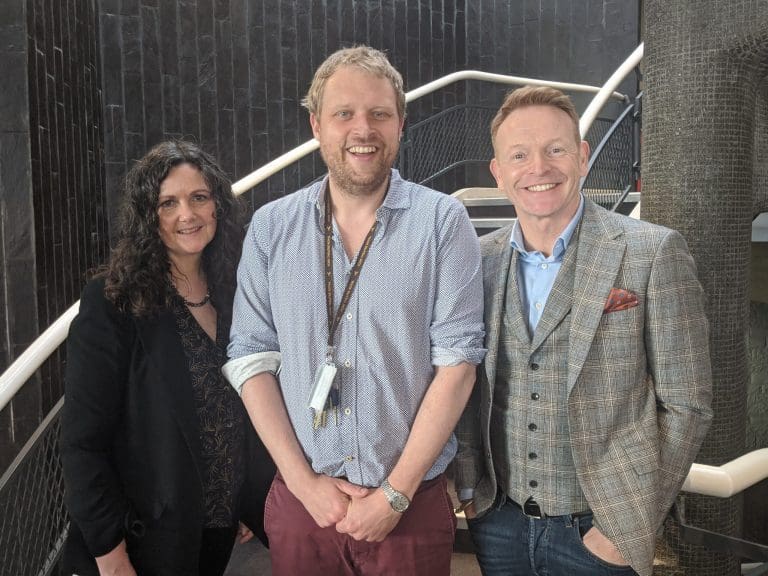
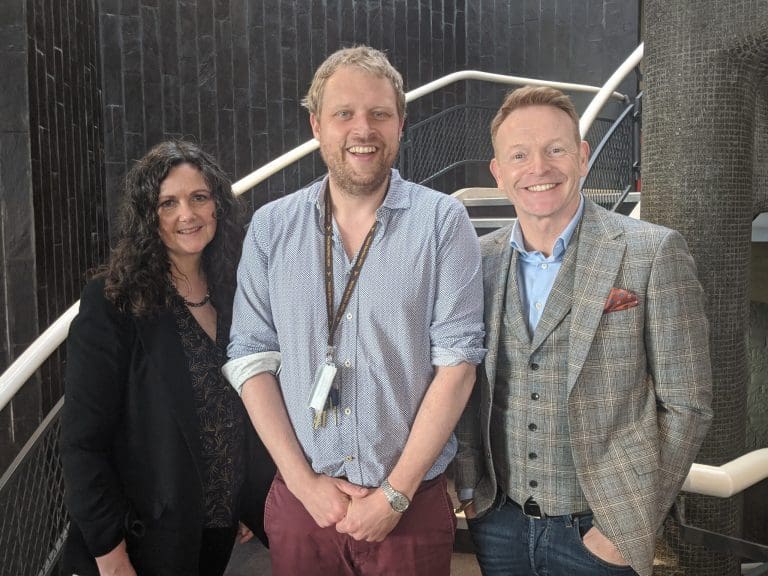
York Theatre Royal chief executive Tom Bird, centre, with creative director Juliet Forster and Evolution Productions director and pantomime writer Paul Hendy

“We were on to our fourth Cinderella by then,” recalls Tom. “It was impossible to continue. It couldn’t have happened in a worse week. Losing those performances was awful, even though we  got going again for the last performances.”

Twelve months on, Tom bids farewell with the Theatre Royal in a healthy position. “There’s money in the bank; there’s a great team working here; the pantomime is reinvigorated; the programming is good; there are excellent partnerships in place. I’m really proud of everything we’ve done,” he says.

“I don’t think I’ve ever had a mission as such as I guess I wanted to learn that mission as I went along, and I certainly think the Theatre Royal is in a strong position. The relationship with Arts Council England is so important, and to still be on the NPO scheme [for National Portfolio funding for £1.8 million for 2023-2026) is so important.

“If I have one regret – and I couldn’t turn down the opportunity to run Sheffield – it is that it would have been nice to now have had two or three ‘normal’ years at York Theatre Royal as it’s such a wonderful place.”

Looking back on becoming the Theatre Royal’s executive director at 34 – he would later change the title to chief executive – after he and his family moved to York in December 2017, Tom says: “It was a massive change because my unofficial title at the Globe [Shakespeare’s Globe in London] was ‘Mr International’, producing a tour of Hamlet to 189 countries, but my personal circumstances had changed already.

A scene from The Coppergate Woman, York Theatre Royal’s 2022 community play. Picture: Jane Hobson

“We’d moved out to Kent; I’d been working as executive producer nationally and internationally, and though there was a lot of gloom about regional theatre at the time, I just thought, I’d love to get back north, to run a theatre.

“We’d co-produced plays to York, and there’s just something about the Theatre Royal, the building; the gorgeous auditorium.”

Nevertheless, Tom admits he was in for a surprise. “At first I thought, if you just transplanted London theatre here, it would work, but that was not the case,” he says. “York is a city of inequality, not the city that you would expect, and therefore not the theatre you would expect. You need to offer a cultural menu that caters for everyone. You have to fully fit in with the needs of the community, which is an exciting thing to do.

“After Damian left (in summer 2019), we wanted to make sure that we would be programming in a more collaborative way than we’d done before.  I think there’s since been the same amount of co-producing of shows, but we also said we wanted to do ‘very Yorkshire’ productions, like The Coppergate Woman community play and David Reed’s world premiere of Guy Fawkes last autumn.

“We’ve created the programming team, led by Juliet Forster, with associate director John R Wilkinson and resident artists, that naturally produces a wide range of voices and makes sure everything is rigorously tested as to what we will put on that stage and why.”

Wise Children’s co-production of Wuthering Heights with the National Theatre and York Theatre Royal

Community theatre is crucial, Tom says: “It’s what audiences want. It’s absolutely what people in the community say they want to see. The audiences for our community plays are phenomenal. July’s production of CJ Sansom’s Sovereign is already on track to sell out. York wants theatre shows that tell stories of the city and we’ve always tried to do that in an experimental way, which leads to us taking risks.”

For all the weight of its history, York needs to be averse to standing still. “The city has to make sure it’s always being dynamic in its culture and outlook, otherwise it will take on the profile of being frozen in aspic,” warns Tom.

“That’s why we did a hippy-trippy, Covid-influenced Viking story [The Coppergate Woman] and a dark comedy version of Guy Fawkes that people didn’t expect. You have to be ambitious and surprising. That’s a word we use all the time: the reward for York audiences is to be pleasantly surprised.”

As for the changing of the old guard in the pantomime, Tom says: “I’m conscious that it’s what I’ll be remembered for here, which is a shame. Bringing down the curtain on something is not what I want to be remembered for, but, to an extent, whoever had my job at the time, was going to have to deal with it in some way.

“Maybe someone else would have taken a different route, or taken it earlier, but I worked on three of Berwick’s pantomimes, so it wasn’t as though I didn’t know what I was dealing with, but there was an issue coming down the road in ten to 15 years’ time , maybe earlier: family audiences were not coming to the panto in2017-2018, so what was going to happen in future years?

“I’d grown an affinity with the company in those three years, as everyone does; you realise the exceptional quality of performers like David Leonard, but in all conscience, I could not responsibly leave the situation as it was.

Berwick Kaler playing Molly Motley in his last York Theatre Royal pantomime, The Grand Old Dame Of York, in 2018-2019. He co-directed and wrote the next year’s show, Sleeping Beauty, his last involvement with the Theatre Royal panto after 41 years

“I got a lot of public criticism – and a lot of private criticism too – and really there was a lack of understanding of what I was trying to achieve in making the change, which may have been my fault as I could have it explained it earlier, but everything I said at the time still stands.

“The audiences were declining and there was no obvious way of turning it around with that product still in place, and I would say that the decision to go into a partnership with Evolution Productions has been proved to be the right one.

“The new pantomime is still growing and we know there’s still work to do, but we’re really happy with how it’s going.”

After such highlights as The Travelling Pantomime’s socially distanced performances to York neighbourhoods in the first winter of Covid, the Love Bites and Green Shoots showcases for York professional theatre-makers, the Wise Children/National Theatre/York Theatre Royal co-production of Emily Bronte’s Wuthering Heights, and Tom’s groundwork for Kyiv City Ballet’s first ever British visit in June, he moves to Sheffield in the year he turns 40.

In the words of Lord Kerslake, chair of Sheffield Theatres Trust board: “We have appointed a driven, experienced and creative leader who will help shape the next chapter of this world-class organisation.”

Just as Tom Bird has shaped York Theatre Royal’s future too.

York Theatre Royal chief exec Tom Bird to leave after five years for Sheffield Theatres

Tom Bird: Leaving York Theatre Royal for Sheffield Theatres

YORK Theatre Royal chief executive Tom Bird is flying off to take up the equivalent post at Sheffield Theatres.

He will migrate southwards from York in early 2023, replacing Dan Bates, who left Sheffield earlier this year after 13 years to become executive director of Bradford’s UK City of Culture 2025 programme.

“York Theatre Royal has been such a special part of my life,” says North Easterner Tom, who moved back north in December 2017 from his role as executive producer at Shakespeare’s Globe in London. “I’m enormously grateful to everyone at this outstanding theatre, and the wider community, for their support over the past five years.”

In South Yorkshire, he will work closely with artistic director Robert Hastie, interim chief exec Bookey Oshin, who will stay on as deputy CEO, and the senior team, pulling the strings of the Crucible, the Lyceum and the Tanya Moiseiwitsch Playhouse (formerly the Studio).

Together, these theatres make up the largest producing theatre complex outside London, presenting both in-house and touring productions.

Kyiv City Ballet dancers Nazar Korniichuk and Anastasiia Uhlova reading well-wishers’ messages at York Mansion House when invited to York by Theatre Royal chief executive Tom Bird

“I’m totally thrilled to be joining Sheffield Theatres as chief executive,” says Tom, who was headhunted for a post he “just couldn’t say ‘No’ to”. “For many years, I’ve admired these daring and beautiful theatres, and the wonderful city they’re at the heart of. I can’t wait to work with Rob, Bookey and the whole of Sheffield’s exceptional team.” 

In London, he directed the Globe to Globe Festival for the London 2012 Cultural Olympiad, before becoming executive producer at Shakespeare’s Globe, where he produced a tour of Hamlet to 189 countries.

In York, Bird ruffled feathers by implementing the Theatre Royal’s transition from the long-running Berwick Kaler era of pantomime to co-productions with Evolution Productions and met the challenges of the Covid lockdowns to staff, performers and theatregoers alike, while also changing his job title from executive director to chief executive.

On stage in York, in June, he arranged the first ever visit of Kyiv City Ballet to Great Britain, the dancers travelling over from France, where they had been based since Russia’s invasion of Ukraine.

In the first winter of Covid, he and creative director Juliet Forster oversaw The Travelling Pantomime, a socially distanced show taken by van to every York neighbourhood in December 2020, and his Globe years with Emma Rice led to the forging of a partnership with her new company, Wise Children, and in turn the Theatre Royal’s first co-production with the National Theatre for Rice’s adaptation of Emily Bronte’s Wuthering Heights.

Changing of the panto guard at York Theatre Royal: Chief executive Tom Bird, centre, with creative director Juliet Forster and writer-producer Paul Hendy, of Evolution Productions. Evolution, by the way, are Sheffield Lyceum Theatre’s partner in pantomime too

What’s in store for Tom in Sheffield? Between them, the three stages welcome 400,000 people on average to performances each year. In addition, Sheffield Theatres runs community engagement and artist development programmes, notably the Sheffield People’s Theatre and Young Company, as well as the Bank Programme, whose purpose is to develops creative talent on a yearly basis.

Looking forward to Bird’s arrival, artistic director Robert Hastie says: “Tom Bird joining Sheffield Theatres as chief executive is great news. He brings a wealth of experience, most recently with our fellow Yorkshire theatre, York Theatre Royal, where he has led with ambition and aplomb. I can’t wait to work alongside him in Sheffield.

“Tom joins us at an exciting time, following our special 50th anniversary year and having welcomed so many people back through our doors to experience the magic of these very special theatres. As we look ahead, I know Tom will make such a positive impact on our work, both on our stages and beyond our walls.”

Lord Kerslake, chair of Sheffield Theatres Trust board, adds: “Sheffield Theatres is renowned for the quality and ambition of its work. It’s an organisation determined to serve its audiences, to deliver bold and brilliant theatre, to innovate, invest in talent and collaborate with its communities.

“In Tom we have appointed a driven, experienced and creative leader who will help shape the next chapter of this world-class organisation. Tom brings huge passion to this role, for the work on and off our stages. I’m excited to see what he, together with Rob and Bookey, and the fantastic Sheffield Theatres team, will achieve together.”

Wuthering Heights: York Theatre Royal’s first co-production with the National Theatre in tandem with Emma Rice’s Wise Childen company in 2021

REVIEW: Everybody’s Talking About Jamie, the Sheffield musical, not the film, in Leeds

Shobna Gulati’s Ray, Amy Ellen Richardson’s Margaret and Layton Williams’s Jamie New in Everybody’s Talking About Jamie at Leeds Grand Theatre

Everybody’s Talking About Jamie, Sheffield Theatres/Nica Burns, at Leeds Grand Theatre, until Sunday. Box office: 0113 243 0808 or at leedsheritagetheatres.com. *****

EVERYBODY’S been talking about Everybody’s Talking About Jamie coming to the Leeds Grand for ages: a two-year wait for early bookers after Covid shut down fun.

“The hit musical for today” began life at Sheffield Crucible Theatre in 2017 and finally makes the 44-mile trip to Leeds after West End success and a screen conversion to film release in September.

Inspired by the Firecracker documentary Jamie: Drag Queen At 16, composer Dan Gillespie Sells (from the pop band The Feeling) and writer/lyricist Tom MacRae worked their magic from an original idea by director and co-writer Jonathan Butterell.

What emerged was the completion of a populist trilogy of Sheffield comedy dramas: the defiant spirit and sheer balls of The Full Monty, the classroom politics and fledgling frustrations of Alan Bennett’s The History Boys, and now Everybody’s Talking About Jamie, the unapologetic story of the boy who sometimes to be wants to be a girl, wear a dress to the school prom and be a drag queen.

Now you can throw in the sass, the too-cool-for-school dress sense and the multi-cultural diversity of Sex Education, the Netflix binge-watch through lockdowns, as another barometer of Jamie’s topicality for our changing times and attitudes towards gender, bigotry, bullying, homophobia, absentee fathers and the right to self-expression.

Take a chance, if you have the time pre-show, to cast an eye over the programme’s pocket-profiles of Mayfield School Class of 2020, asking Jamie and his classmates: What do you want to be when you grow up? What’s your favourite thing about school? It could be any comprehensive classroom of 16-year-olds, capturing hopes, aspirations and realities with wit and spot-on social awareness. Another testament to just how switched on, relevant, yet boldly humorous this show is.

“Jamie”, on the one hand, is a classic teen rebel story, told from the teen perspective of Jamie New (Bury-born Layton Williams, reprising his West End role), but it is not merely a down-with-the-kids high-school musical.

Class act: Layton Williams’s Jamie New and his Mayfield School classmates in Everybody’s Talking About Jamie

Even more so than in Hairspray, it gives the adult viewpoint too, whether Jamie’s world-weary but ever supportive mum Margaret (Amy Ellen Richardson, expressed powerfully through her belting ballads, If I Met Myself Again and He’s My Boy); gobby best friend Ray (Shobna Gulati, wonderful);  Jamie’s stay-away Dad (Cameron Johnson); narrow-minded teacher Miss Hedge (Lara Denning), or dress-shop boss Hugo/veteran drag act Loco Chanelle (special guest Shane Richie as you have never heard or seen him before but will want to again!).

Serious points are made, confrontations have both poignancy and punch, but what’s not to love about the sheer bl**dy Yorkshireness of it all: from the frank, no-nonsense humour that mocks the ridiculous careers advice offered at schools to the raucous, rough-rouge glamour, tattoos and all, of Sheffield drag queens Sandra Bollock (Garry Lee), Laika Virgin (JP McCue) and Tray Sophisticay (Rhys Taylor), as musical pizzazz meets kitchen-sink drama.

The songs are a knock-out, led off by the immediately infectious And You Don’t Even Know It, through the irresistible title number and Jamie’s heartfelt Ugly In This Ugly World, to the show-closing defining statement of Out Of The Darkness (A Place Where We Belong). Sam Coates’s band have a ball with Gillespie Sells’ orchestrations.

Matt Ryan’s direction, Kate Prince’s choreography and Anna Fleischle’s designs are all fast-moving and slick but with room for grit too amid the glitter. You will note the brick designs on the side of the desks, for example.

Not only Williams’s Jamie scores high marks among the classroom performances, so too do George Sampson’s everybody-hating, self-loathing bully Dean Paxton and Sharan Phull’s self-assured, doctor-in-waiting Pritti Pasha.

Yet, of course, everyone is talking about Williams’s Jamie New, so restless at sweet 16 to be “something and someone fabulous”. His Jamie is a mover, a peacock groover, a fantabulous fusion of lip and lip gloss, high heels and higher hopes, outwardly confident yet naïve, in that teenage way, and vulnerable too. What a performance.

Yorkshire has given us Billy Liar’s Billy Fisher, Kes’s Billy Casper, and now Jamie New, disparate young dreamers in need of escape from the grey grime, but this time the story is so, so uplifting, emerging from darkness into the spotlight (and mirroring the return of live theatre from Covid quarantine to boot).

Review by Charles Hutchinson

Remaining performances: tonight, 7.30pm; tomorrow and Sunday, 2.30pm and 7.30pm.