REVIEW: I’m Sorry, Prime Minister, Grand Opera House, York, until Saturday ****

As smart as ever…or is he? Clive Francis’s Sir Humphrey Appleby in I’m Sorry, Prime Minister. Picture: Johan Persson

AS Harold Wilson once said, in the white heat of a lobby briefing to journalists in 1964, a week is a long time in politics.

As it turns out, it is a long time on a theatre tour too. Both the role of Prime Minister (imminent exit stage left Sir Keir Starmer) and of the former Prime Minister in I’m Sorry, Prime Minister have undergone a change since the tour opened.

Sir Keir resigned on June 22; the next night, Robert Kitson took over from Simon Rouse as Jim Hacker at Cheltenham Everyman, Rouse having had to withdraw from the rest of the itinerary through illness.

Kitson had understudied Griff Rhys Jones in the West End run and York marks his third week of working in tandem with Clive Francis’s Sir Humphrey Appleby: a partnership now well into its comic groove as the blustering Jim and erudite Sir Humphrey joust in familiar point-scoring mode.

Writers Jonathan Lynn and Antony Jay’s beloved BBC political satire, Yes, Minister and Yes, Prime Minister had run between 1980 and 1988, followed by the 2010 play, Yes, Prime Minister.

Robert Kitson: Taking over as Jim Hacker in I’m Sorry, Prime Minister

Now, writer-director Lynn picks up the solo baton for I’m Sorry, Prime Minister, a final chapter that began at The Barn Theatre in 2023 as I’m Sorry, Prime Minister, I Can’t Quite Remember, a title that indicated the vulnerabilities of ageing for the now venerable Hacker and Sir Humphrey.

This is no nostalgia trip for a treasured double act, however, but a freshly crafted comedy as politically sharp as ever in this age of cancel culture, with lessons to be learned by both the former political leader and his Civil Service nemesis, Cabinet Secretary Sir Humphrey.

Kitson’s Jim Hacker is now Lord Hacker, “older, but perhaps not wiser”, befuddled by the modern world, suffering from arthritis, back pain and congestive heart failure, and in need of a carer, as well as a stair lift.

“Care worker,” Princess Donnough’s Sophie corrects him at her interview to take on the role. It will not be his only politically incorrect utterance to meet her disapproval.

Indeed Jim’s indiscreet tongue is in trouble with rather more than former English Literature student Sophie at Hacker College, Oxford, where he is the long-serving Master after the college was set up in his name with a benefactor’s funding.
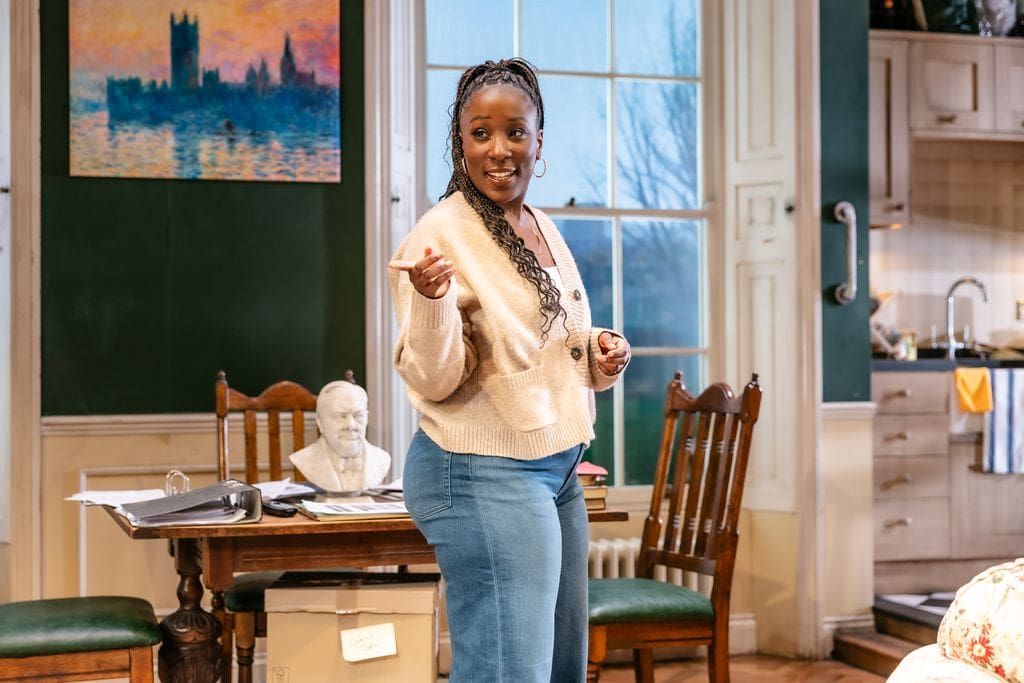
Princess Donnough’s care worker Sophie in I’m Sorry, Prime Minister. Picture: Danny Kaan

Since being forced to resign as Prime Minister, he has dabbled in journalism, written a book (6,000 sales in the first week, none since), turned up every so often for his attendance allowance and expenses at the House of Lords, but now he faces “the ultimate modern crisis: being cancelled by the college committee after his support of Cecil Rhodes’s statue staying in place, among other pronouncements against the tide of change.

Hostile students and equally hostile Fellows want him to be ousted: a P45 delivered by William Chubb’s gaunt college Visitor, Sir David, arriving in Grim Reaper black hood.

Jim will not go quietly into the night, re-establishing contact with Sir Humphrey, by now consigned to a “home for the elderly deranged” by his daughter-in-law, to draw on his skills of negotiation, eloquent, elaborate obfuscation and love of a Latin phrase.

Francis, reprising the role he first played at the Barn Theatre and then in the West End, is a master of comic timing, exquisite line delivery and tongue-twisting double-speak monologues, yet there are frayed edges to Sir Humphrey’s piercing intelligence and bureaucratic chess play. Immaculate suit, ever-present briefcase, superior air, are all present and correct, but could the first signs of dementia be kicking in as he loses the thread of his thinking in one of his magniloquent obstructive set-pieces.

Jim and Sir Humphrey must not only seek to outmanoeuvre Sir David but also face the modern thinking of Donnough’s formidable, frank and fearless Sophie. As well as politics, the world of education is dissected with a scalpel by Lynn as rising student fees and “offensive” words in literature come under fierce discussion.

Clive Francis’s Sir Humphrey Appleby and Simon Rouse’s Jim Hacker in a publicity shot for I’m Sorry, Prime Minister. Simon had to leave the tour through illness

Lynn has the measure of politics and education alike in the kind of wise, waspish and witty satire now all too rare on the British stage in a play as full of King Lear pathos as comedy, where there is a sadness to Jim and Sir Humphrey, now past their pomp.

Yet the comedy still prevails amid the melancholia, directed so astutely by Lynn and co-director Michael Gyngell in a high-class production where Lee Newby’s set design of Jim’s unkempt college rooms evokes academia, widower loneliness and a political past. Snow dusts the skyline in Leo Flint’s window video projections in a further nod to Jim and Sir Humphrey being in their winter years.

Physical comedy plays its part too, riffing on the ageing of the two protagonists, whether in a mobile-phone-going-off-in-a-pocket joke or the stair lift’s brief turn in the spotlight at the opening to Act Two.

Everything is so well balanced in I’m Sorry, Prime Minister, always giving both sides of the argument, showing the fault lines in Jim and Sir Humphrey alike, culminating in the warmth of the fitting finale – the recognition of the need for supportive friendship – that is genuinely moving.

The Barn Theatre presents I’m Sorry, Prime Minister, Grand Opera House, York, until Saturday; 7.30pm plus 2.30pm Thursday and Saturday matinees. Box office: atgtickets.com/york.

I’m Sorry, Prime Minister brings down curtain on Jim Hacker and Sir Humphrey’s clashes as Robert Kitson steps into role

Robert Kitson: Replacing Simon Rouse in the role of Jim Hacker in I’m Sorry Prime Minister

SIR Keir Starmer is not the only Prime Minister being replaced.

More precisely, ex-Prime Minister, in the case of the 2026 tour of I’m Sorry, Prime Minister after illness forced Simon Rouse out of the cast a fortnight ago, to be replaced by Robert Kitson, who is playing Jim Hacker for the remaining dates, including this week’s visit to the Grand Opera House, York.

“It’s very sad that Simon had to leave the show, and we send him our best wishes for a speedy recovery,” says Robert. “He was so loved by the company while he was here, but it’s now a fortunate opportunity for me.

“I wasn’t Simon’s understudy for the tour but I did understudy Griff Rhys Jones as Jim Hacker in the West End, and because I knew the part and we’d done an understudy run during the six months in London [at the Apollo Theatre), I was asked to take over.

“One of the other understudies did a couple of dates, before I arrived last Monday (June 22) to open at the Cheltenham Everyman that Tuesday. “

Robert continues: “I’m very delighted to be having this extended run, where I’ve played Cheltenham and Milton Keynes and York, Brighton, Southend and Malvern are still to come.

“I haven’t  appeared on the York stage before, but I love the city and I’m really looking forward to doing the play there.”

Written and directed by Jonathan Lynn and co-directed by Michael Gyngell, I’m Sorry, Prime Minister is the long-awaited final chapter of the British political satire that brought BAFTA awards for the television series Yes, Minister (1980 to 1984) and Yes, Prime Minister (1986 to 1988), when co-written with Antony Jay.

The Times, they are a’changing for Clive Francis’s Sir Humphrey Appleby in I’m Sorry, Prime Minister. Picture: Johan Persson

Jim Hacker is back, older, but perhaps not wiser, and still utterly baffled by the real world. Hoping for a quiet retirement from government as the master of Hacker College, Oxford, Jim instead finds himself facing the ultimate modern crisis: cancelled by the college committee.

Enter Sir Humphrey Appleby (played by Clive Francis, reprising his West End role), who has lost none of his love for bureaucracy, Latin phrases and well-timed obstruction in a finale replete with wit, nostalgia and more double-speak than a press briefing.

“Do you know what, you can really feel the affection the audiences have for the characters,” says Robert. “Before Sir Humphrey comes on, you can hear an ‘ooh’ from the audience when I mention his name.

“People loved the TV series, and the relationship between Sir Humphrey and Jim, but this play is set later and so the relationship is now different. A lot of the play is about these people re-finding themselves and coping with their lives now.

“It makes for a very different dynamic where the audiences are initially surprised but then they do get into it. This is only my personal opinion, but I think the re-discovery and re-defining of the relationship, when seeing each other again after a long time, is what works so well, as they’re now older men, infirm, and they no longer have the resources they did when they were in their peak years.”

Robert further elucidates: “There are two levels to it. They have to cope with the fact they don’t have the status they once did, and although Sir Humphrey was always the cleverer once, the more sly and conniving one, sometimes Jim got the better of him and that  now continues in old age where they still spar with each other.”

When on understudy duty in London, Robert had enjoyed watching Clive and Griff working together. “They were different in their styles, so it was like a masterclass observing them,” he says.

Clive Francis’s Sir Humphrey Appleby, left, and Simon Rouse’s Jim Hacker at the promotional photoshoot for I’m Sorry, Prime Minister. Simon has had to leave the tour through illness

“Clive is a master craftsman in his coming timing and delivery, and now that it’s the two us, I’m finding that just as important is how every performance is different because the audience laughter can come in different places, so there’s that the  unexpected element, which is the essence of live theatre.”

In addition, Robert has drawn on his experience of being present when writer-director Jonathan Lynn gave notes to the London cast both in rehearsal and after the early performances.

“I got the benefit of that as everything is written with particular weighting and he’s particular about how lines should be said,” he says, further praising the director and Michael Gyngell for their ability to bring the company together. “It’s been great for me to have all people around me, on or off the stage, who are so good at what they do.”

Sir Keith Starmer’s imminent departure from Number 10 could not be better timed for I’m Sorry, Prime Minister. “It’s really interesting because we’ve found the play has resonance that’s reflecting what’s going on at the moment,” says Robert.

“The fact that the Prime Minister’s post has changed over the past two weeks can’t help but have an echo on stage.”

One further factor is Jim Hacker’s politics and behaviour in 2026. “Jim says and does some awful things and has some unacceptable views – and that’s interesting for the audience too,” says Robert.

“You have to give it 100 per cent in rehearsals and on stage, leaving your own beliefs at the [dressing room] door.”

The Barn Theatre production of I’m Sorry, Prime Minister plays Grand Opera House, York, from tomorrow to Saturday, 7.30pm plus 2.30pm Wednesday, Thursday and Saturday matinees. Box office: atgtickets.com/york.