On the stretch: Jamie McKeller’s Lionel and Stuart Lindsay’s Charles limbering up for a doubles match in Summer Sonnets’ What The Deuce? at Holy Trinity Churchyard. Picture: John Saunders
ROSY Rowley and Stuart Green, partners off court, are the new doubles partnership for York Shakespeare Project’s tennis-themed 2026 Summer Sonnets.
Familiar figures on the York stage, they have switched to directing and writing YSP’s regular summer enterprise, wherein ten of the Bard’s sonnets are performed within a framework that changes each year.
Courtly love takes on a new meaning in Summer Sonnets: What The Deuce?, set in the summertime, when the weather is fine at the Goodramgate Lawn Tennis Club as four doubles teams compete for the chance to play in a Wimbledon amateur tournament.
Ace partnership: What The Deuce? director Rosy Rowley and script writer Stuart Greenputting top spin on York Shakespeare Project’sSummer Sonnets with novel tennis theme
Sporting endeavour clashes with unsporting behaviour when partnerships and rivalries on court undermine partnerships off court, taking rivalries to break point in a surfeit of subterfuge and sabotage. “Who has the advantage? Who is at fault? Will the score be love?” ask Green and Rowley, who duly reach for a volley of tennis puns, put away with the flourish of a Federer.
Free drink in hand – alas not Robinsons Lemon Barley Water, but then again Robinsons’ partnership with Wimbledon ended after 86 years in 2022 – the audience settled into seating repositioned by 90 degrees in the Holy Trinity Churchyard.
The cast now performs with the sound of the Chinese restaurant kitchen fans on Goodramgate now behind or to the side of them: an excellent decision that ensures vocal clarity. In addition, Rowley has her actors delivering from closer to the audience, again ensuring no line is lost.
Alan Sharp’s groundsman (in a change of rock band T-shirt from the one referenced in this review) receiving the first of multiple instructions from the tennis club chair, Christine Bramwell’s Elizabeth, in Summer Sonnets: What The Deuce? Picture: John Saunders
York tour guide Alan Sharp is no stranger to speaking on the move, above street noise, and here he does so as the phlegmatic, weather-beaten, worldly-wise groundsman Graham, whose every line is either delivered in iambic pentameter in Stuart Green’s script or is one of the Bard’s smattering of tennis references (or real tennis as it would have been at that time), from Henry V to Hamlet.
In his System Of A Down Mine Is Bigger Than Yours T-shirt and shorts, Sharp’s Graham will open and close the show and make regular interjections to carry out handyman tasks, reappearing with a plunger, rubber gloves, replacement barley water bottle and finally an old-school groundsman’s line marker (with the obligatory squeak). It is a standard-fit line marker, by the way, rather than bigger than yours.
The churchyard grass is not converted into a tennis court (games are conducted as ‘noises off’), but serves as the club grounds where all the shenanigans take place.
Drinks break: Oscar Langford’s Harry, left, and James Robert Ball’s Tony sip the barley water in a joke that will run and run in Summer Sonnets: What The Deuce? as Stuart Lindsay’s Charles looks on. Picture: John Saunders
Each time the drama heightens, invariably in a heated discussion, rather than bursting into song in opera or musical theatre, a protagonist moves seamlessly into sonnet mode, and come the 50-minute mark, all ten will have unburdened themselves in Shakespeare’s silver tongue.
We meet Christine Bramwell’s ever-enthusiastic club chair Elizabeth; her doubles partner, Helen Clarke’s Margo, wife to Jamie McKeller’s ageing club champ, whose doubles partner, Stuart Lindsay’s Charles, is wont to hiding behind trees, desperate to win Margo rather more than his matches.
Of the young things, Oscar Langford’s Harry is a loyal partner to James Robert Ball’s Tony, in more ways than tennis as it becomes increasingly apparent, but Lionel and Margo’s spoilt-brat, posh and pushy daughter Chessie (Effie Warboys, whose birthday falls tomorrow) wants Harry to hurry up in his affections for her. “I’m practically club royalty,” she scoffs, making a racket at every toss and turn.
Squash on the tennis court: Effie Warboys’ insufferably spoilt Chessie, front left, pushing around her doubles partner, Alexa Williams’s Belle. In the background are Oscar Langford’s Harry, left, and James Robert Ball’s Tony. Effie will be celebrating her birthday tomorrow. Picture: John Saunders
Her long-suffering best friend Belle (Alexa Williams) has the hots for Harry too. Meanwhile, club newcomer Vic (Sarah McKeagney), in jeans and Gorillaz T-shirt, is on the lookout for a partner, as we watch everything play out game, set and match, fair game, re-set and mis-match, with delightful mischief in Green’s plot and Rowley’s direction alike.
“Only in tennis does ‘love’ mean you are losing,” laments Lindsay’s Charles in Green’s best line, although Charles’s “I had Brazilian last night,” prompting a misunderstanding Lionel to enquire “Chafing?” is a peach too. Easy mis-steak to make!
All the familiar Shakespeare comedy tropes are present and freshly spun from mistaken identity to a potion in the barley water, cross-dressing to mistaken identity; revenge to lust and unrequited love. You will be rushing home to check whether Mexican Donkey Laxative actually exists.
Sarah McKeagney: One of eight York Shakespeare Project debutants in Summer Sonnets: What The Deuce?, playing tennis club newcomer Vic at Holy Trinity Churchyard. Picture: John Saunders
What The Deuce is YSP’s ninth season of summertime sonnets and third at Holy Trinity, where Rowley and Green have certainly supplied new balls, please, with their rallying call enticing eight of the cast to make both their Sonnets and YSP debut.
Whether Sonnet Walks or Sit-Down Sonnets, Sonnets at the Bar [Convent], Sonnets in Bloom in 2025 or tennis fun and games in 2026, this event remains one of the joys of the York outdoor theatre year for performers, audience and venues alike. You cannot be serious? Very much so.
York Shakespeare Project presents 2026 Summer Sonnets: What The Deuce?, Holy Trinity Churchyard, Goodramgate, York, play resumes tomorrow until Saturday, 6pm and 7.30pm plus 4.30pm Saturday show. Box office: tickets.41monkgate.co.uk.
Doubles troubles ahead: Helen Clarke’s Margo and her husband, Jamie McKeller’s Lionel, the ageing club champ in Summer Sonnets: What the Deuce? Picture: John Saunders
Director Rosy Rowley and writer Stuart Green, on the bench at Holy Trinity Church, Goodramgate, rehearsing with Summer Sonnets cast members and producer Maurice Crichton (arms folded, at the back). Picture: John Saunders
DIRECTOR Rosy Rowley and writer Stuart Green are the new doubles partnership for York Shakespeare Project’s tennis-themed 2026 Summer Sonnets: What The Deuce?
New balls, please, will be served on the grass of Holy Trinity Churchyard, in Goodramgate, York, from Friday to August 15, with a rest day on August 11.
Should you be wondering “Why tennis?”, the game features in no fewer than seven Shakespeare plays: Hamlet, Act II, Scene 1; Henry IV, Part 2, Act II, Scene 2; Henry VIII, Act I, Scene 3; Much Ado About Nothing, Act III, Scene 2; Pericles, Act II, Scene 1; The Two Noble Kinsmen, Act V, Scene 2, and most notoriously in Henry V, Act I, Scene 2.
In that scene, the French Dauphin mocks King Henry by sending him a gift of tennis balls to besmirch his youthful reputation as a frivolous playboy. Henry responds by threatening to turn the balls into cannonballs to play a set as explosive as McEnroe against the French crown.
Ready to serve: Tennis fan William Shakespeare in York Shakespeare Project’s poster for Summers Sonnets: What The Deuce?
Now comes What The Deuce?, where summertime at the Goodramgate Lawn Tennis Club finds four doubles teams competing for the chance to play in a Wimbledon amateur tournament, whereupon partnerships and rivalries lead to sabotage and break point. Who has the advantage? Who is at fault? Will the score be love?
Cue further tennis puns aplenty as Rowley directs Green’s script that asks a new collection of ten characters to play out this new sporting and unsporting situation, where each finds a way to share a Shakespeare sonnet.
Pulling on the traditional and not-so-traditional Wimbeldon tennis whites for York Shakespeare Project (YSP) will be Alan Sharp’s Graham; Christine Bramwell’s Elizabeth; Helen Clarke’s Margo; Jamie McKeller’s Lionel; Stuart Lindsay’s Charles; Oscar Langford’s Harry; James Robert Ball’s Tony; Alexa Williams’s Belle; Sarah McKeagney’s Vic and Effie Warboys’ Chessie.
“Stuart has been wanting to write and I’ve been wanting to direct,” says Rosy. “I’d directed a Direct Approach play for Settlement Players – Night Secrets – so I just wanted to get back into it, and I suppose YSP have taken a bit of a punt on us.”
James Robert Ball, left, and Oscar Langford in rehearsal for Summer Sonnets: What The Deuce? Picture: John Saunders
It should be pointed out that Rosy and Stuart tread the boards regularly in York, first meeting when performing in the York Theatre Royal community play Sovereign in 2023. “We’ve done a few plays together, such as A Kingdom Jack’d in April, and theatre is the thing that brought together as a couple,” says Rosy.
“We’ve now got one of those bricks on the wall at Theatre@41, Monkgate, where we both volunteer, that says ‘Theatre together’.”
Stuart and Rosy settled on 80 per cent of the sonnets before Stuart set to work on the script that weaves ten sonnets into the tennis plotline. “We’ve had great fun putting the story together with classic Shakespeare tropes and then putting them in a tennis setting,” says Rosy.
“We’ve crammed a lot into our 50-minute play,” says Stuart. “We have cross-dressing; mistaken identity; poisoning, revenge; lust; unrequited love…
Director Rosy Rowley and writer Stuart Green in the Holy Trinity Churchyard, the setting for courtly love with a difference in their tennis-themed Summer Sonnets. Picture: Maurice Crichton
… “and of course lots of tennis,” says Rosy. “What’s been really important to us is not making the sonnet just something they recite but part of a conversation, which is the case in all but two of them that will be done as monologues.”
Stuart adds: “We wanted to incorporate the sonnets into conversations in the play, thinking how could a sonnet fit with a particular character? The aim is that the audience doesn’t notice they’ve gone into a sonnet because it makes the sonnets really accessible by putting them in a narrative, where suddenly they make more sense.”
Not all of Shakespeare’s 154 sonnets focus on romantic love. Death, political vexation, artistic rivalries, human flaws and the passage of time are significant themes too, alongside desire and love.
“We thought how could we interpret sonnets in ways that fit with our play, and the beautiful thing is that there are so many ways to interpret them, not just romantic love,” says. “For example, Christine Bramwell’s sonnet reflects her love for the tennis club and the game.
Belle of the ball:Alexa Williams playing the role of Belle in York Shakespeare Project’s tennis-punned Summer Sonnets: What’s The Deuce. Picture: John Saunders
“Right at the start of rehearsals, I had one-to-one table sessions with each actor to see how we could make their sonnet work with the character.”
Stuart adds: “I think it helps that both Rosy and I are actors because we know what each actor can bring to the part.”
Stuart and Rosy have been delighted by the response to this summer’s sonnet project. “We had 30 people applying to take part, which was a record number,” says Stuart. “Then 24-25 auditioned, and we cast ten, where only two of them – Stuart Lindsay and Effie Warboys – had done Summer Sonnets before.
“A lot of them are new to YSP. It wasn’t a conscious decision; it was just that they were the best to put themselves forward.”
Helen Clarke, left, Oscar Langford, Stuart Lindsay and Sarah McKeagney rehearsing with Summer Sonnets: What The Deuce? script writer Stuart Green. Picture: John Saunders
One other new element will be the positioning of the actors in the Holy Trinity churchyard. “We’ve shifted it 90 degrees so that the Chinese restaurant, on Goodramgate, with its fan noise and smells, will now be behind the actors, rather than the audience,” says Rosy. Good decision.
Green by name, green keeper by profession, Stuart first wrote screenplays in his teens and 20s. “I wanted to get into films, but the chances were non-existent, so I became a green keeper, initially at Bushey Hall Golf Club in Watford, then went to college and ended up at Gleneagles for four years,” he says.
“Now I teach green-keeping: I’m a grass nerd! I used to be based at Askham Bryan, where I taught apprentices at the agricultural college. Now I work for Train Together, teaching green keepers and cricket, football and rugby groundsmen.
“There’ll be a groundman as one of the characters in our Summer Sonnets, Alan Sharp’s Graham. I couldn’t resist it! I’ve called on one of my old York Cricket Club contacts to lend us an old line marker – and one of my stipulations was that it had to be squeaky as they generally are!”
Helen Clarke, left, Oscar Langford and Sarah McKeagney rehearsing a scene from Summer Sonnets: What The Deuce? Picture: John Saunders
Tennis gear will carry significance in Rosy and Stuart’s production. “What they’re wearing denotes their status at the club, whether it’s all white or not,” says Rosy. “There has to be a bit of a social statement in that.”
No tennis pun has been resisted. “We realised we didn’t have enough tennis innuendo at first, so I’ve had fun writing some absolute ‘tennis filth’,” says Rosy. “Now it’s unashamedly Carry On Tennis,” says Stuart.
“And of course we had to crow-bar ‘You cannot be serious’ in there too,” says Rosy.
Lara Stafford in her Premium Eclipse Viewer glasses in readiness for August 12’s solar eclipse during the 6pm performance of Summer Sonnets: What The Deuce? Pairs are available for free for Sonnets audience members
Not to be eclipsed…
ON Wednesday, August 12, the UK will experience its deepest solar eclipse since 1999, with up to 96 per cent of the Sun covered by the Moon.
Across North Yorkshire, the partial eclipse will begin at 6.12pm, peak at 7.08pm and finish at 8.02pm. That day’s 6pm and 7.30pm performances of Summer Sonnets: What The Deuce? will go ahead as planned, but do come prepared for the eclipse experience.
Quick question: Do sunglasses protect eyes in a solar eclipse? NO!The official advice is: Never look directly at the Sun.
Why? The Sun can burn the retinas in the eyes, leading to permanent damage or even blindness. This can occur even if your eyes are exposed to direct sunlight for only a few seconds.
Proper eye protection is the only safe option, not sunglasses. The only way to view the Sun safely – eclipsed or not – is to either project or filter the Sun’s rays.
Suggestion: Make your own box projector or acquire safe solar eclipse glasses. NASA also recommends welder’s glasses rated 14 or higher, to be found at welding supply stores.
Lara Stafford demonstrating the benefit of wearing Premium Eclipse Viewer glasses for August 12’s partial eclipse of the Sun
YORK actress, Physics teacher and Theatre of Science communicator Lara Stafford is teaming up with York Shakespeare Project for a special offer for Summer Sonnet audience members. “August 12’s 6pm show coincides with the solar eclipse: the best one to happen to the UK until 2090, with over 90 per cent of the Sun covered by the Moon,” she says.
“It’ll begin just after 6pm and peak an hour later, just after the performance. A £10 Summer Sonnets ticket has always come with a free drink, but to celebrate this cosmic coming together, we’re going to give out a free pair of eclipse glasses with every ticket sold for performances up to the 6pm show on August 12.”
Lara continues: “I buy them in for work anyway, so I’m just ordering a few more! It’s quite difficult to get eclipse glasses cheaply and guarantee they’re not fakes, and you can ‘only’ watch the eclipse with your eyes if you’re wearing eclipse glasses. So it’s an easy way for us to spread the eclipse excitement around York and spread awareness of the sonnets.”
Should you be wondering, a reference to an eclipse can be found in Sonnet No. 35, one that does not feature in Rosy and Stuart Green’s choices for Summer Sonnets: What The Deuce? So here is the quote:
“No more be grieved at that which thou hast done. Roses have thorns, and silver fountains mud; Clouds and eclipses stain both moon and sun, And loathsome canker lives in sweetest bud.”
UPDATE: 11/08/2026
THOSE four lines from Sonnet No. 35 WILL now feature in Wednesday’s 6pm and 7.30pm performances of Summer Sonnets, adding to Alan Sharp’s Shakespeare quotes in his guise as groundman Graham. Every line uttered by the phlegmatic Graham in Stuart Green’s script is either in the rhythm of iambic pentameter or one of the Bard’s references to tennis.
Still shielding their eyes! The Brontë Sisters in York Settlement Community Players’ poster for Underdog: The Other Brontë at Theatre@41, Monkgate
ECLIPSE glasses removed, Lara Stafford will be shining next on the York stage as Charlotte Brontë in Claire Morley’s production of Sarah Gordon’s 2024 play Underdog: The Other Brontë for York Settlement Community Players at Theatre@41, Monkgate, York, from October 13 to 17.
The plot? Charlotte Brontë has a confession about how one sister became an idol and the other became known as the third sister. You know the one. No, not that one. The other, other one…Anne.
Underdog presents an “irreverent retelling of the life and legend of the Brontë sisters like you’ve never seen them before”. This is not a story of well-behaved women but of the power of words, sisters and sisterhood, love and jealousy, support and competition. Tickets for the 7.30pm evening performances and 2.30pm Saturday matinee are on sale at https://tickets.41monkgate.co.uk/.
Harry Summers’ Reverend Planter and Stuart Lindsay’s Doug O’Graves in York Shakespeare Project’s Sonnets In Bloom at Holy Trinity, Goodramgate, York. All pictures: John Saunders
SONNETS In Bloom 2025 is the ninth iteration of York Shakespeare Project’s summer sonnet celebration. Make that Sonnets In Full Bloom at the flower fete in the churchyard of Holy Trinity, Goodramgate, where the emphasis is on the new.
New director, Josie Connor; new scenario writer Natalie Roe; nine debutants among the 12 sonneteers; seven Shakespeare sonnets making their YSP bow among the 13 featured here.
Welcomed with a complimentary drink, the audience takes its place on benches and seats arranged in circular fashion around the churchyard, to the muffled accompaniment of evening street sounds from Goodramgate’s restaurants and bars.
Oliver Taylor’s broken-hearted forager Arti Choke
YSP’s Sonnets have taken myriad forms: sonnet walks around the city centre and Dean’s Park; sit-down sonnets under Covid social distancing; sonnets in the Bar Convent gardens. Holy Trinity, favourite York church of the loved-up Anne “Gentleman Jack” Lister, has been a regular host, and this time war, more than love, is in the air.
More specifically, an alternative version of the war of the roses breaks out among the competitors in a fractious regional leg of Summer In Bloom. Given the profusion of puns among Roe’s humorous character names, perhaps it could be renamed Punfight At The OK Floral. Hoe hoe.
First of those horticultural names is the cactus-loving Reverend Planter (Sonnets’ debutant Harry Summers in genial mood), who will oversee the “arrival of participants with their prized entries, some more competitive than others. But where is the special guest? And who will win the People’s Vote?” All in good time, all in good time, although all will be revealed within a fast-moving hour.
Difference of opinion: Tom Langley’s Ally Lottment, left, and Benjamin Rowley’s Pete Shoveller clash in Sonnets In Bloom
Under YSP’s format, each colourful character will move seamlessly from amusing introductory scene/mood/motive-setting chatter – either with a fellow character or breaking down theatre’s fourth wall in direct address to Rev Planter’s flock – to performing an apt sonnet from Shakespeare’s repertoire of 154. In the vicar’s case, “When I Consider Everything That Grows”.
The sonnets, the characters, the names, keep a’coming. Next, James Tyler’s Tom Martow, proud Yorkshire marrow connoisseur (“to marrow, and to marrow, and to marrow”). Then Stuart Lindsay’s gravely serious Scottish sexton Doug O’Grafves, dour digger of depths and confirmed misanthropist.
Next comes the interplay of returnee Grace Scott’s May Blooms, fantastic flower arranger and generational rose grower; Lily Geering’s Lily White, unfailing friend to May; Benjamin Rowley’s Pete Shoveller, poet and patient but tongue-tied pursuer of Lily, and Sonnets returnee Emilie Knight’s Rose Thorn, May’s ruthless rival. Annie Dunbar’s Blossom Springs, conscience-stricken apprentice to Rose, becomes entangled in the floral furore too.
Tipsy-topsy-turvy encounter with wine: Xandra Logan’s Inny Briation
Bubbling away is the intrigue of the appearance/non-appearance of Stuart Green’s Freddie Firm-Carrot, celebratory gardening superstar. In a running joke, Tom Langley’s Ally Lottment, disdainful PA to Firm-Carrot, keeps being mistaken for his absent boss, before Firm-Carrot turns up at last, his lack of interest in his brief for the day indicated by calling Goodramgate “Goodramsgate”.
Debutant Oliver Taylor catches the eye with his lovelorn Arti Choke, kitchen warlock and broken-hearted forager, while returnee Xandra Logan makes the most of the boozed-up indiscretions of Inny Briation, home winemaker and anywhere, anytime wine-drinker.
Connor directs with momentum and a sense of mischief, matching the fun in Roe’s script, and fittingly the whole cast assembles for the final sonnet, delivering one line each of “That Time Of Year Thou May’st In Me Behold”, book-ended by a joint first and last line in a communal floral finale.
Celebrity selfie: Grace Scott’s May Blooms with Stuart Green’s gardening superstar Freddie Firm-Carrot
Coming next from YSP after this summer’s display of flower power will be Thomas Kyd’s The Spanish Tragedy, “the play that outsold Shakespeare”, at Theatre@41, Monkgate, York, from October 22 to 25 (box office, tickets.41monkgate.co.uk
York Shakespeare Project in Sonnets In Bloom, Holy Trinity churchyard, Goodramgate, York, tonight, 6pm and 7.30pm; tomorrow, 4.30pm, 6pm and 7.30pm.
Going One Step Beyond: left to right, Liz Quinlan, Chris Meadley, Stuart Green, director Jon Mills, Jess Murray and Pamela Gourlay
THE Direct Approach is York Settlement Community Players’ scheme to support first-time or emerging directors, but in this case it is giving a boost to the writer too.
Jon Mills steps into the director’s chair after making his mark already as a filmmaker, script writer, theatrical prop and set designer and producer of promo videos for YSCP shows.
Likewise, fellow polymath Miles Salter adds play writing to his skills as a poet, songwriter, band frontman, journalist, podcaster and festival director.
One Step Beyond has its roots in Salter’s application for a York Theatre Royal commission for its Love Bites showcase of York creative talent when lockdown was lifted. His monologue, It Must Be Love, was rejected but central character Steve re-emerges in a 45-minute play – it just had to be 45 or 33 – that again takes its title from a Madness hit.
Steve (Stuart Green) goes nuts for the Nutty Boys, still the nuttiest sound around, collecting rarities obsessively, but this could be the vinyl countdown for his marriage to Kerry (Pamela Gourlay), who is doing her nut. Welcome to the house of no fun. The Madness and the maddening.
Married in 1999, the couple is in a rut of routine, now that the children have flown the nest. Steve does pretty much what he likes: she doesn’t like what he does. He feels the same, because each day she packs him off to work with the same sandwiches; every night, she lines up two crackers, little chunks of cheese and a dab of pickle for his final nibble before bed. Steve sees this metronomic behaviour as being controlling. Kerry carries on regardless.
Steve likes to go to record fairs and meet up at the pub with his steady Eddie of a friend, Boring Ryan (Chris Meadley), so named because he is, well, boring.
Taking his next step:One Step Beyondwriter Miles Salter
Except that maybe he isn’t because he is full of facts that he is wont to drop into the conversation in the quiet moments. Such as? Did you know that the elephant is the mammal that requires the least sleep? You’ll sleep better for knowing that one.
Salter’s play has a stock of such minutiae, coupled with an observant eye that he brings to his poetry too with a humorous flourish that had him worrying that maybe One Step Beyond is too much of a nod to John Godber’s combative northern plays and Nick Hornby’s culturally savvy southern books. Yes, he shares their ear for fractious dialogue and eye for telling detail, but Salter’s humour is his own.
Boring Ryan, for example, is a collector of trouser presses, forever advocating their value and recommending their purchase to all and sundry. Cue a Baggy Trousers gag that is beautifully timed.
Steve is essentially contented; Kerry, discontented, because he is contented. She is sharper of mind, unfulfilled, bored, and, truth be told, Steve would annoy any partner.
This can go only one way: off to the marriage guidance counsellor they trudge, Steve more reluctantly, but at least he turns up. Counsellor Marcia (Liz Quinlan) emerges as the one-woman Greek chorus of the piece, stepping out of scenes to break down the fourth wall in candid direct address. She’s a realist, but one drawn to the bright side of the road like Van Morrison.
Some of Salter’s best writing comes from this ostensibly dispassionate observer, whose role is to steer discussion, to keep order, to ensure equal say, but not to judge (but passes her thoughts on to the audience instead). He wrote the part initially for a Marcus, not a Marcia, but it wholly suits being played by Quinlan – a boon for smart casting by Mills.
Faced by such negativity, like batteries connected the wrong way, Marcia seeks to find a way for Steve and Kerry to re-energise the lost spark, only for them to explode. Comedy on a tightrope, always better that way, when something is at stake.
The poster artwork for York Settlement Community Players’ One Step Beyond
Time for a time out, a re-set. Kerry takes up pottery, the cue for a lovely, calming cameo in stripes, polka dots and headband by Jess Murray’s ceramics tutor Jen, “exuding warmth – like a Zen hot water bottle,” as Salter put it in his character profile. Steve, meanwhile, writes a poem: the cue for another dip into Madness.
Salter manages that trick of making the dislikeable and unreasonable – selfish nerd Steve, overbearing Kerry – very watchable in Green and Quinlan’s performances, and as can be the case with writers, there is something of him in each of the characters, even the Zen Jen.
Ultimately, the Marcia/Marcus and Zen Jen in him win out, encouraging us to do exactly what the title says: go that One Step Beyond, as he applies the writer’s principles of “Make’em laugh (plentifully); make’em cry (not so much here); make’em wait (for that closing pay-off line).
Mills’s direction is suitably playful, not least in his use of cartoon imagery on a screen that depicts a row of houses for domestic scenes and the football scores on rotation on the pub telly.
I could say it would be madness to miss One Step Beyond, but given that all three performances have sold out, let’s say you will be mad at yourself for not booking earlier if you have missed out on a ticket.
York Settlement Community Players present One Step Beyond, The Wolfe Room, Black Swan Inn, Peasholme Green, York, tonight, 7.30pm, SOLD OUT.
The next Direct Approach plays will be in September at the Black Swan Inn. More details to follow.
Who’s conning who? Emily Carhart’s Fay, Jack Mackay’s Hal, centre, and Stuart Green’s Truscott in a scene from York Settlement Community Players’ Loot. Picture: John Saunders
THE monochrome cover to York Settlement Community Players’ programme for Joe Orton’s dark farce Loot takes the form of a death notice. Rest in Peace Mary McLeavy. Born 1916, called home 1966. Remembrance services will be held: 18th – 27th February 2025.
For “Remembrance Services”, read performances that raise Orton’s scandalous, scabrous first farce from the grave, directed by the “young (and probably) angsty” Katie Leckey with brio and brains, fresh from completing her MA in Theatre-making at the University of York.
Already she and lead actor Jack Mackay have made their mark on the York theatre scene with their company Griffonage Theatre, latterly swapping the roles of hitmen Ben and Gus for each performance of Harold Pinter’s menacing 1957 two-hander The Dumb Waiter at Theatre@41, Monkgate, last July.
Jack Mackay’s Hal, trying not to look alarmed in Loot. Picture: John Saunders
Now Mackay forms part of another “double act” on the wrong side of the law: bungling thieves Hal (Mackay) and Dennis (Miles John), in essence representing Orton’s lover Kenneth Halliwell and Orton, in Loot.
Sixty years on from its Cambridge Arts Theatre premiere, when Orton deemed the play to be “a disaster” and the Cambridge News review called it “very bad”, it remains a shocking play. Not shockingly bad, but a shock to the system, still carrying a content warning.
It reads: “The show contains adult themes and offensive language (including sexism and xenophobia). There are also sexual references and references to sexual assault (including rape and necrophilia) and references to smoking on stage.” Sure enough, Stuart Green’s inspector, Truscott, hiding behind his smokescreen of being “from the Water Board”, smokes without fire, never lighting his pipe.
Emily Carhart’s nurse, Fay, and Miles John’s arch thief, Dennis, in Loot. Picture: John Saunders
Loot remains an iconoclastic play, even angrier than those Angry Young Men that preceded him, John Osborne, Harold Pinter, Kingsley Amis, John Braine, Alan Sillitoe, John Wain, et al. You might call it ‘odd’, or ‘strange’, but its audacious humour tugs persuasively at your arm, its attacks on convention beneath its conventional farce format landing blows on those cornerstones of the state, the (Catholic) church and the police force, as well as undermining the nuclear family.
It makes you ask what has changed since the 1965 premiere, as Leckey highlights in her programme note, drawing attention to the continuing prevalence of violence, racism, homophobia and misogyny.
She quotes Orton, who wrote “I’m too amused by the way people carry on to give in to despair”. There, in a nutshell, is the role of comedy, to home in on the warts and all and laugh at our failings and foibles. The bigger shock here is that we have not moved on, but on second thoughts, in the week when every new Trump utterance trumps the last one, maybe not.
Loot director Katie Leckey
Orton was once castigated for his play’s immoral tone, but it is the behaviour that is immoral, not Orton. Don’t shoot the messenger. Laugh, instead, at our failure to clean up our act, especially those in authority.
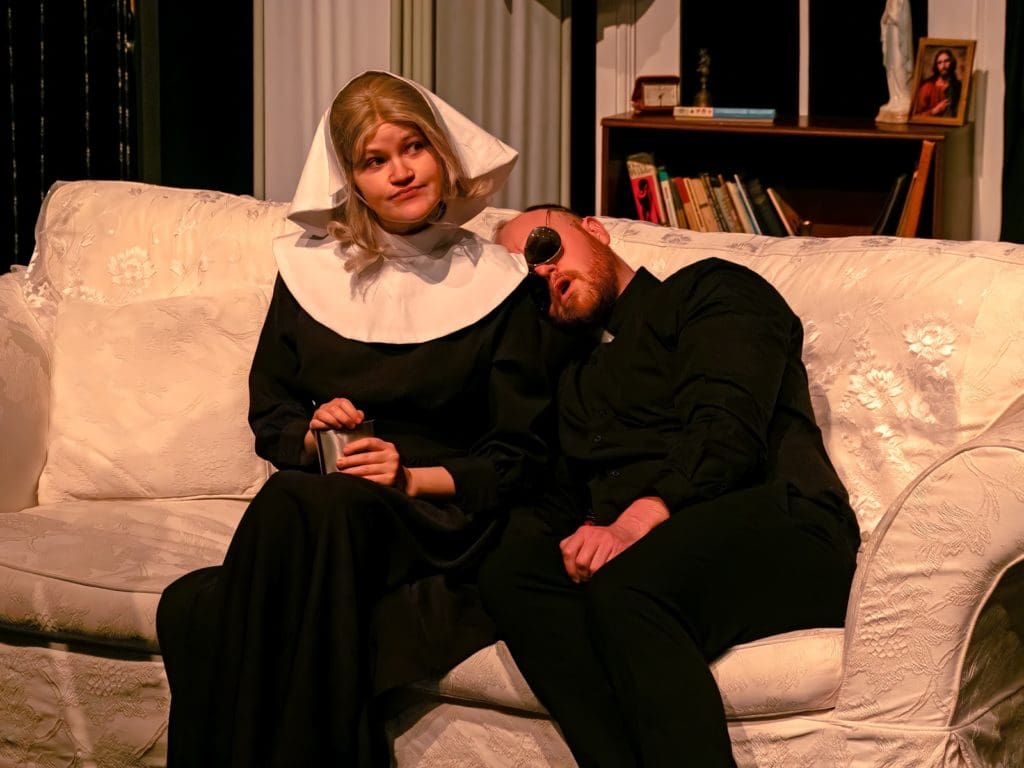
Leckey has not edited Orton’s text, letting it stand or fall in all its bold affronts, not least on life’s ultimate taboo: death. Preceded by Ortonian fun and games by a six-pack of support players, from a drunken priest (James Wood) to an excitable nun (Xandra Logan), Loot begins with an open coffin. Inside rests the aforementioned Mary McLeavy (a dead body played by a live actor [Caroline Greenwood] with Orton irreverence). Today is her funeral.
In the room, designed with kitsch Sixties’ detail by Wilf Tomlinson and Richard Hampton, matched by Leckey’s soundtrack, are widower Mr McLeavy (played with suitable befuddlement by Paul French) and Mrs McLeavy’s nurse, Fay, (Emily Carhart in her impressive Settlement debut). She may wear a cross, but Fay has an unfortunate of seeing off her husbands, seven in seven years, and now she has her eye on Mr McLeavy.
Eyeball to eyeball: Stuart Green’s Truscott carries out a close inspection in Loot. Picture: John Saunders
Enter Mackay’s Hal, who protests he is too upset to attend the funeral, and John’s Dennis, whose heart is lost to Fay. Rarely for a farce, there is only one door into the sitting room, but a second door is all important: the cupboard door, behind which they have hidden their stash from a bank job.
A glass eye, a set of teeth and the constant movement of Mrs McLeavy’s body will follow, involving the cupboard, the coffin and the stash, in classic farce tradition, with rising irreverence and desperation as the investigations of Green’s Truscott mirror the impact of Inspector Goole in JB Priestley’s An Inspector Calls, written 20 years earlier, but this time with humorous results.
Green, in his Settlement debut after returning to the stage in 2023 from an hiatus, has spot-on comic timing, a twinkle in his eye and the over-confidence of Bottom in A Midsummer Night’s Dream.
Paul French’s Mr McLeavy, left, Stuart Green’s Truscott, Jack Mackay’s Hal, Emily Carhart’s Fay (seated) and Emily Hansen’s Meadows in Loot. Picture: John Saunders
Mackay and John evoke the Sixties in looks, acting style and attire, playing to the Orton manner born as the hapless thieves, somehow negotiating their way through a farce with a farce with aplomb and insouciance.
York Settlement Community Players in Loot, York Theatre Royal Studio, until February 27, 7.45pm nightly except February 23, plus 2pm matinee, February 22. Age guidance: 16 plus. Box office: 01904 623568 or yorktheatreroyal.co.uk. Post-show discussion tomorrow (21/2/2025).
TAKING part in pre-show and interval Orton-style vignettes, devised by James Lee, are: Xandra Logan (Sister Barbara); Chris Meadley (Sergeant Timothy Carruthers); Victoria Delaney (Mrs Edna Welthorpe); Helen Clarke (Edith, the church organist); James Wood (Priest) and Serafina Coupe (Keith Kevin O’Keefe).
Xandra Logan’s Sister Barbara and James Wood’s inebriated Priest in an interval vignette in York Settlement Community Players’ Loot at York Theatre Royal Studio. Picture: John Saunders
York Settlement Community Players’ Stuart Green’s inspector, Truscott, left, and Miles John’s thief, Dennis, rehearsing a scene from Joe Orton’s Loot
LOOT, Joe Orton’s scandalous first farce, opened at the Cambridge Arts Theatre on February 1 1965 with Kenneth Williams and Geraldine McEwan in the cast.
“The play is a disaster,” the iconoclastic Leicester playwright wrote in a letter to his lover, Kenneth Halliwell. “A very bad play,” sniffed the Cambridge News review. Ouch!
Loot would close after 56 performances and three re-writes, the cast declining the chance to transfer to London, but…Orton’s provocatively controversial, free-wheeling and ferocious dark farce about life’s ultimate taboo – death – is very much alive and kicking up a storm 2025, still suited and booted to shock, amuse and entertain in Orton’s signature scabrous style.
…And still carrying a Content Warning, to be found when booking tickets for Katie Leckey’s production for York Settlement Community Players, running at York Theatre Royal Studio from February 18 to 27.
It reads: “The show contains adult themes and offensive language (including sexism and xenophobia). There are also sexual references and references to sexual assault (including rape and necrophilia) and references to smoking on stage.”
Jack Mackay’s Hal, left, Emily Carhart’s Fay and Miles John’s Dennis in the rehearsal room for York Settlement Community Players’ production of Loot
All this, 60 years since Orton premiered his two-act satire on the Roman Catholic Church, social attitudes to death and the integrity of the police force, wrapped in the story of the fortunes of two thieves, Hal and Dennis, as they navigate the ridiculous farce they find themselves in. Cue such props as rolling eyeballs, flying false teeth and a live actor playing a dead body.
“We made the choice to set the production in the time it was produced, so that audiences can see what has changed about ideas of ‘Britishness’, religion and institutional tyranny since then (if anything) and what still shocks and outrages us today,” says Katie, a Northern Irish actor and director, who completed her Masters degree last year at the University of York, where she set up Griffonage Theatre with co-artistic director Jack Mackay, now cast as Hal in Loot.
“Are we still homophobic, are we less Catholic? The fact that we have to warn people that it’s still a shocking and scandalous play speaks volumes. The thing is this: we do need to give some sort of warning because some of the content is so abhorrent, mostly what Hal says.
“It’s about setting expectations fairly, but I still think the play should be shocking and done as written, so there are insidious lines that I have kept in that I don’t like, but it shows how people were thinking at that time – and still do today, especially men.
Loot director Katie Leckey
“Interestingly, we had 45-50 people auditioning, mostly men wanting to play the inspector, Truscott, although there’s pretty much an equal split of male-female characters in our production.”
The strongest voice of all in Loot belongs to Orton, suggests Katie. “That’s what fascinates me: the more I do the play, the stronger his voice becomes. He’s the most authorial writer. There’s something vicious in everything that is said, but it punches up,” she says.
“Orton was so angry about so many things and that’s why the viciousness is so poignant. Like how he was treated by the police, especially as a gay man who had to adapt. So the play is performative to an extent, but it is situated in lived experience.
“I can’t not speak to my actors about him, I can’t not contextualise, Hal is essentially Halliwell and Dennis is Joe. The more you read about his life, the more you can’t separate it from what he’s written.
“I try to get some distance as a director, but I don’t think you can with this, because of how Orton’s life ended [he was murdered, aged 34, by Halliwell in 1967] and how he wrote.
Paul French’s Mr McLeavy, left, and Stuart Green’s Truscott in rehearsal for Loot
“If you had interviewed Orton in 1965, he would have said Loot is a serious play, why is everyone finding it funny? But it absolutely is a farce, rigid in its form as a farce, going through the motions of a farce, which is funny in itself.”
Katie continues: “But what makes it one of the funniest plays is the language. If he had written it as a ‘normal farce’, it would instead have been a tragedy, but he has this flamboyant way of writing, partly upper class, partly colloquial. Using obtuse language deliberately too, where the rhythms sound so ridiculous.”
Translating Orton’s assertion of Loot’s seriousness to her actors, “everything has to be done with conviction in my direction,” she says. “It has to be done that way, with believability. I’m not into breaking ‘the fourth wall’. The characters have to come across as desperate.
“The only difference between tragedy and farce, Orton, said was the treatment of themes. If you made a play about police brutality and homophobia, you could do that as a tragedy, but what makes it funny here is how Orton has singed those subjects with his fire.”
Katie is delighted to be directing a Settlement show for the first time, having first performed with the company in Government Inspector in October 2023. “I went to the group audition and I was shocked and excited by how talented everyone was! I wheedled my way in and I’ve stayed because there’s something rewarding about working with a long-established company,” says Katie. “I felt I wanted to work with these guys as much as possible.”
On finishing her Masters degree, Katie “needed to do something or I will go bananas”. “I saw that Settlement had put out a call for directors and I thought, ‘it’s my time to do something similarly wacky and wild as Griffonage do, and luckily they said ‘yes’.”
York Settlement Community Players in Loot, York Theatre Royal Studio, 7.45pm nightly, February 18 to 27, except February 23; 2pm matinee, February 22. Age guidance: 16 plus. Box office: 01904 623568 or yorktheatreroyal.co.uk.
Who’s in York Settlement Community Players’ cast for Loot?
JACK Mackay, as Hal; Miles John, Dennis; Paul French, Mr McLeavy; Caroline Greenwood, Mrs McLeavy; Stuart Green, Truscott; Emily Hansen, Meadows, and Emily Carhart, Fay.
Helen Clarke, Xandra Logan, James Wood, Chris Meadley, Victoria Delaney and Serefina Coupe will feature too in Orton-inspired vignettes before the show and in the interval, penned by James Lee.