York Actors Collective delves into battle of wills in the all-female white heat of Stephanie Jacob’s The Strongbox

Victoria Delaney’s Kat, left, Beryl Nairn’s Ma and Clare Halliday’s Maudie in York Actors Collective’s The Strongbox

YORK Actors Collective returns to York Theatre Royal Studio next week to stage the York premiere of The Strongbox, Stephanie Jacob’s powerful study of freedom, control and servitude.

First performed in 2018 at the VAULT18 Festival at Charing Cross, London, where it won the Origins Award for Outstanding New Work, was Pick of the Festival and Jacob played the role of Kat, this 75-minute three-hander charts the changing dynamics of a mother and daughter keeping a homeless woman as a slave in their London home. Power starts to shift when the daughter becomes distracted by business and the mother falls ill.

In her sixth production since setting up York Actors Collective in 2023, Angie Millard directs a highly experienced York cast of Beryl Nairn as Ma, Victoria Delaney as daughter Kat and Clare Halliday as Maudie.

“Three women learn how to live and survive by making their own rules, but at what cost?” ponders Angie. “As Ma says, ‘if you do and do and do and do to someone, can it be undone?’ That’s the question the play explores with honesty and some humour.”

In keeping with presenting Alexander Zeldin’s Beyond Caring in 2024, Nina Raine’s Tiger Country in 2025 and Beth Steel’s Till The Stars Come Down at Theatre@41, Monkgate, in April 2026, Angie has picked a play new to York audiences.

“That’s my bag. That’s one of the things I try to do,” she says. “If there are plays you haven’t seen or by new writers, when there are too many productions of shows you already know, I want to do works that make people think, and as long as you choose carefully…”

Describing the play, Angie says: “This one is a chamber piece, about a relationship between three women with a lot of cruelty in it, but with a sad acknowledgement that that’s what life can be about.

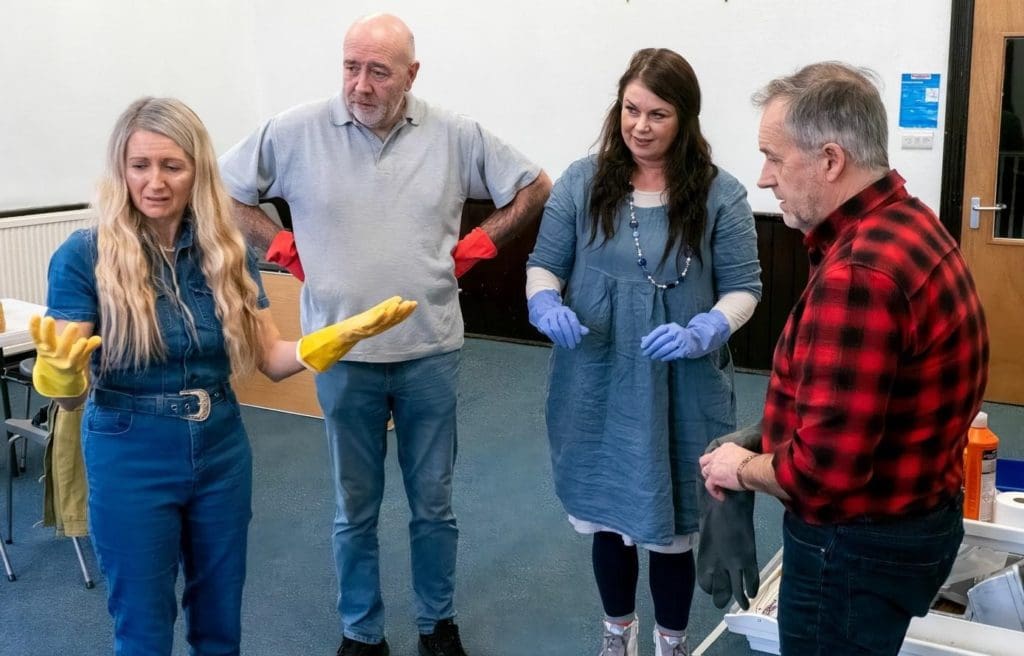
Beryl Nairn, left, Clare Halliday and Victoria Delaney in rehearsal for Stephanie Jacob’s three-hander The Strongbox

“It’s an intense drama – 75 minutes where there’s no breathing space – and the cast really understands the intensity of their characters.  They’re three very talented actresses who are very much up for the job. It would be impossible to have an interval because the intensity of the emotions wouldn’t tolerate it.”

Angie homed in on The Strongbox after researching Stephanie Jacob’s work. “I read a couple of things she’d written and loved her style. I wrote to her to ask, ‘why can’t I get a script for The Strongbox?’, and she explained it was out of circulation as a festival play in London, but she said I could have the script rights for £10 as she’s pleased that someone wants to have a go at it.

“I’ve since had phone conversations with her, though not recently, because the author, I think she would agree, needs to butt out!”

One significant change Angie has made is to change Maudie from a teenager [aged 17] to an older woman in her 30s. “I think the play is richer for that, because Maudie’s lived through a lot, and I feel an older character suits that better,” she says. “I’m sure Stephanie would not object to that change.”

After making that alteration, “one of the things I’ve been working on with the cast since we started rehearsals in early September is the ‘status’ of the characters, thinking about where I should place them on stage, which is as important as in a Harold Pinter play,” says Angie. “There’s this constant jostling for power, where it’s a life and death struggle for them.”

The set design will play into that power struggle. “There’s a bed, a table and two chairs – minimal – which will be great for Studio where there’s not much room!”

Introducing her character of Maudie, Clare says: “She’s a northerner who’s been through the care system and is used to living on the streets. She’s basically ‘rescued’ by Ma and Kat and she’s just trying to survive.”
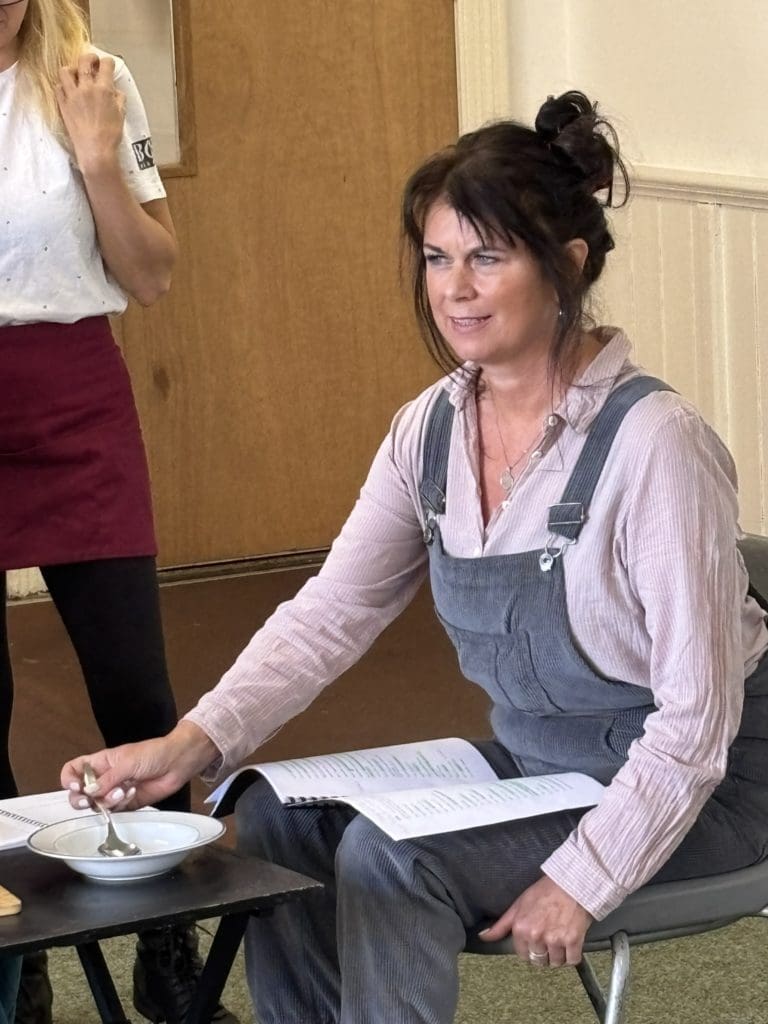
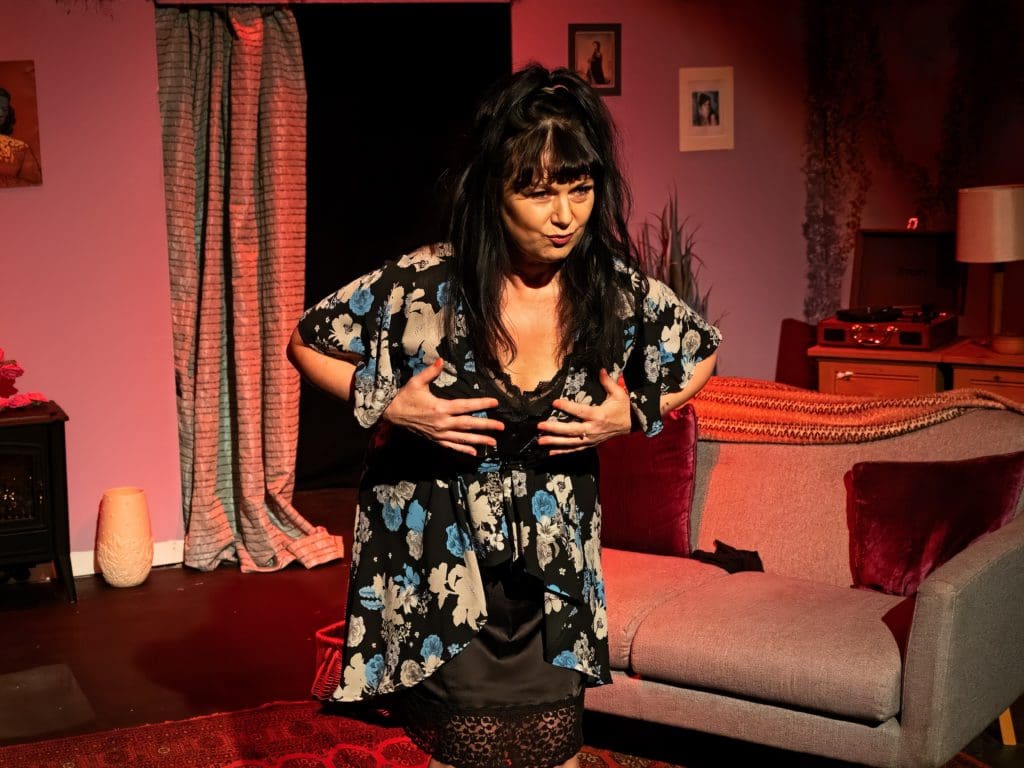
Victoria Delaney rehearsing her role as “power-hungry” Kat in The Strongbox

“Kat is really tough,” says Victoria, “I’m going to play her as quite androgynous, but also a woman of the world who is power hungry.”

Beryl comments: “To say Ma and Kat are not close would be an understatement, yet they’re welded together. Ma is top dog…at the moment…but she’s being very closely followed her daughter, who want to be top dog. There are lots of dark secrets that are then shockingly revealed – with the odd laugh too.”

Whereupon Victoria chips in: “Every spine-chilling play has to have an element of horror. There are some disturbing things in the play and one of them is modern-day slavery, which is not often explored in contemporary dramas.”

Playing the 80-year-old Ma, Beryl notes: “One of the other important aspects is that it’s a play about women. Tough women. Ma and Kat have this empire in chauffeur-driven cars and want to accumulate more business.”

Clare says: “Maudie is the ‘victim’ at their house but she’s waiting for her chance.”  “There’s no lead role here; they each come to the fore as the dynamic changes,” says Victoria. “They’re all fighting for power in a battle of wills, and it’s fair to say Ma and Kat hate each other but need each other.”

“There’s no trust but there is co-dependency,” says Beryl. “Everything is transactional, including the relationships.”  

York Actors Collective presents The Strongbox, York Theatre Royal Studio, October 29, 2.30pm & 7.45pm; October 30, 7.45pm; October 31, 2pm. Box office: 01904 623568 or yorktheatreroyal.co.uk. Age guidance: 14 plus.

REVIEW: York Actors Collective in The Strongbox, York Theatre Royal Studio, 29/10/2026 ****

THREE women. Two chairs. One table. One trolley. One bed. Later, one wheelchair. One set of pliers. One bottle of vodka. One power struggle. Only one winner, but who?

On the wall is the message Home Sweet Home. Oh, the irony. Next to it, pinned up, is a tea towel depicting butterflies gradually fluttering away. How poetic. Come meal times, it’s fennel with everything. Chuffin’ fennel.

This could be the dingy abode of a claustrophobic Harold Pinter play, such as The Birthday Party, but Stephanie Jacob’s The Strongbox is an even more concentrated psychological drama, a battle of wills done and dusted in 75 minutes. Don’t dare ask if there will be an interval. That’s for the birds, although you will need a drink at the end.

Ma (Beryl Nairn) is 80, ill, either in bed, slumped at the table, or in her wheelchair, but still the top dog, the matriarch. She is in pain but equally a pain in the neck to ambitious, unloving daughter Kat (Victoria Delaney), who has her steely eye on that pooch perch, keen to expand their London chauffeur car business, picking at the bones of rivals till procurement is guaranteed.

Toughened and spat out by the care system, homeless northerner Maudie (Clare Halliday) was picked off the London streets and is now their slave, doing chores, being abused by Ma and Kat in tandem, subjected to a punishment regime for “crimes” recorded in the ledger. Hence the pliers…for tooth extraction.

Yet when Kat is out of the house, pre-occupied with business, Maudie makes her play to shift the power dynamics, capitalising on Kat’s absence by tending to the fragile Ma’s needs, whether singing to her or brushing her hair. Bide her time, then add vodka and…? That would be telling.

York Actors Collective director Angie MiIllard has made a habit of picking plays either in need of re-discovery or discovery in her six productions since founding the company in 2023. The Strongbox falls into the latter category.

Premiered in 2018 at the VAULT18 Festival at Charing Cross, London, where it won the Origins Award for Outstanding New Work and Pick of the Festival too, it was now out of circulation. Angie, however, tracked down the writer, who gave her the script rights for £10 as “she’s pleased that someone wants to have a go at it”.

The Strongbox is a chamber piece, “one with a lot of cruelty but with honesty and humour too,” as Angie puts it. Make that the darkest humour, the starkest honesty, as each of the unholy trinity plays by her own rules while seeking to impose those rules on the others.

Millard’s triumvirate of highly experienced York talents, Nairn, Delaney and Halliday, maximises the compressed atmosphere of the Studio stage in a cut-and-thrust production where you can see the whites of their eyes and feel the white heat of such a toxic cauldron.

Jacob’s dialogue fizzes, sometimes with menace, sometimes with misery, sometimes with mystery, and the intensity is all the greater for being wrought by three women. Think of Macbeth’s trio of Witches, then watch the toil and trouble bubble up here.

REVIEW: York Actors Collective in Till The Stars Come Down, Theatre@41, Monkgate, York, ends Saturday ****

Chris Pomfrett’s Tony, left, Victoria Delaney’s Maggie, Clare Halliday’s Hazel, Darren Barrott’s Marek, Joy Warner’s Sylvia, Laura Haynes-Bury’s Leanne, Daniel Wilmot’s Uncle Pete and Neil Vincent’s John in York Actors Collective’s Till The Stars Come. Picture: John Saunders

FOUNDER and director Angie Millard has an eye and an ear for picking a play for York Actors Collective.

Already in place for October 28 to 31 at York Theatre Royal Studio is Stephanie Jacob’s three-hander The Strongbox, winner of the 2018 VAULT Origins Award for outstanding new work  for its story of domestic servitude and abuse of power, wherein authoritarian Kat, her ageing mother, Ma, and their teenaged slave, Maudie, jostle for power and affection in their dilapidated London home.

This week, Millard is staging the York premiere of another contemporary British domestic drama, Beth Steel’s Olivier Award-nominated Till The Stars Come Down, premiered at the National Theatre’s Dorfman Theatre as recently as January 2024.

She did not see that production, choosing it because she “liked the sound of the play”, and subsequently being impressed by its frank, earthy comedy, its pathos and home-and-away truths – and by its central structure of three sisters, matching her own upbringing in South Yorkshire.

Steel had set her play in a former mining village in Nottinghamshire, where the scars of the “scabs” who broke the picket lines when Margaret Thatcher took on the National Union of Mineworkers are still tender to the touch.

Those scars are no less raw in Yorkshire’s former mining communities, and so Millard, whose education began in a Catholic school in a pit village, has re-located Steel’s family conflagration further north. Ostensibly South Yorkshire, although some accents in her cast head farther north still to the Tyne & Wear.

Till The Stars Come Down is set on a single day, charting the pre-match, the match and the post-match discussions of Sylvia’s nuptials with Polish immigrant Marek, who now runs his own business.

Weddings make for heightened drama, for love’s blossom and blisters, for too much drinking, too much talking, leading to confessions, fall-outs, “inappropriate” behaviour, the exposure of prejudices and the re-opening of old wounds.

It could be the posh world of London society and country houses in Four Weddings And A Funeral or, in Steel’s case, the turbulence of a working-class family where “long-held secrets, passions, tensions and social changes transform the celebration into a chaotic blend of humour and tragedy”.

It opens with the three sisters, Clare Halliday’s bigoted Hazel, Victoria Delaney’s oft-married loose cannon Maggie (in riotous red) and Joy Warner’s phlegmatic Sylvia preparing for the big day – the routine of make-up, hairspray, dresses and endless cups of tea – alongside Lucinda Rennison’s ever-indiscreet, aspirational Aunty Carol and Laura Haynes-Bury’s Leanne, Hazel’s 16-year-old daughter, whose gaze is solely for scrolling her mobile phone.

The men will make their entries: the sisters’ father Tony (Chris Pomfrett), still grieving for his late wife; his brother Uncle Pete (Daniel Wilmot), Carol’s partner, who has never forgiven him for crossing the picket line, and Neil Vincent’s John, who has lost interest in wife Carol on account of his obsession with the woman in scarlet, Delaney’s Maggie.

The only man who is happy rather than dischuffed with his lot in life is Darren Barrott’s (CORRECT) Marek, but a can of worms marked “zenophobia” will be opened as the wedding day progresses.

Steel writes with observational wit, social commentary and, above all, a telepathic understanding of the relationship of sisters. Warner’s Sylvia is the solid, reliable one who has looked after mother and father alike; Delaney’s Maggie and Halliday’s Hazel are the ones at war, and together they deliver a brilliantly kinetic finale, reaffirming their status as two of the supreme actresses on the York circuit.

Delaney’s performance is all the more remarkable for her taking on the role at less than three weeks’ notice. Haynes-Bury impresses with her deadpan demeanour and Rennison rises to the challenge of drunken acting with aplomb.

Barrott, in his YSP debut after catching the eye with York Settlement Community Players, is outstanding as “outsider” Marek; Pomfrett’s Tony wears that hangdog expression he has made his trademark; Vincent’s John plays the villain’s hand well and Wilmot’s Uncle Pete is all bonhomie on the surface until the gripes of the past boil over anew.

Millard directs with admirably flowing movement and quick scene changes, while ensuring her cast lets the full flavour of Steel’s clashing, dysfunctional family flood out, bringing out the rising stress to the max and emphasising the power of the sisterhood too.

York Actors Collective presents Till The Stars Come Down, Theatre@41, Monkgate, York, 7.30pm tonight and tomorrow; 2pm and 6pm, Saturday. Box office: tickets.41monkgate.co.uk.

York Actors Collective stages York premiere of Beth Steel’s mining family drama Till The Stars Come Down at Theatre@41

Newly wedded bliss amid wedding-day blisters: Darren Barrott as Marek and Joy Warner as Sylvia in York Actors Collective’s Till The Stars Come Down

YORK Actors Collective founder and director Angie Millard moved quickly to acquire the amateur performing rights for Beth Steel’s Till The Stars Come Down.

“The West End run only closed at the end of last September, after transferring from the National Theatre,” she says as she prepares to present this contemporary British family drama at Theatre@41, Monkgate, York, from April 14 to 18.

“I applied very early, because I liked the sound of the play, but didn’t think I’d get the rights, but no touring company jumped on it, so my application was successful.”

Premiered at the National Theatre’s Dorfman Theatre from January 2024, the Olivier Award-nominated Till The Stars Come Down is set at the wedding of Sylvia and Marek in a former mining town in Steel’s exploration of the tumultuous dynamics of a working-class family.

Long-held secrets, passions, tensions and social changes transform the celebration into a chaotic blend of humour and tragedy in a play with “themes of racism and xenophobia, reference to suicide, scenes of a sexual nature and depictions of mild violence”.

“When I started reading the play, it resonated with me, because not only am I one of three sisters – like in the play – but also there’s very little I haven’t come across at weddings or funerals, such as deciding who should sit at the top table,” says Angie. “So, in one rehearsal, I did a game of ‘Status’, asking each of the cast to say what they thought their character’s status was.

“The other thing that resonated the most was the emotional problems that happen in the family – and I’ve encountered all of them in the emotional conflicts of sisters.”

Clare Halliday in the role of eldest sister Hazel – the bigoted one- painting her toe nails in Till The Stars Come Down

Angie continues: “There are a lot of things to think about in this play, and as everything in set out in the first half, the audience will have plenty to reflect on in the interval.

“There is stress throughout, which is covered by the humour that the cast are finding ever more ways to express, but because Sylvia is marrying a Polish man, it brings out racial issues.

“They are a dysfunctional family, though they think they’re not, but the sisters come together at the end, turning their back on their relationships to put the sisters first, which makes it even more dysfunctional. It’s a little bit like Alan Ayckbourn in style because it embraces farce as well as the clever use of language.”

Angie did not see the London production – “I purposely never do that,” she says – but was aware that it was staged in the round with a revolving stage. “I thought, ‘put that to one side, look at the text’. That was my first job.

“I wanted to do it with a rake stage, with everyone looking in the same direction, as frankly I’ve been to too many productions where I haven’t been able to see all the actors’ faces, seeing them with their back to you or in profile. I wanted to do it ‘old style’ and make it work that way.

“I thought, why should how it was done in the West End stop me from doing such a well-written play?’. I was determined to see the play staged my way, starting with getting ready in the house for the wedding, with one door for that, then the pub for the wedding breakfast, in the middle, and then Hazel’s house at the end, with two doors because you can get to the kitchen via the sitting room.”

Three sisters: Clare Halliday’s Hazel, left, Joy Warner’s Sylvia and Victoria Delaney’s Maggie lining up for York Actors Collective’s Till The Stars Come Down

Angie adds: “I also had to re-think some of the characterisation as Beth [who grew up in the colliery town of Shirebrook, near Mansfield] set the play in Nottinghamshire but we’ve moved it to Yorkshire, because I’m from Sheffield originally and went to a Catholic primary school in a mining village, Spinkhill, and found myself speaking two languages, one at school, one at home. So I’ve set it in South Yorkshire, 30 years on from Thatcher’s dispute with the miners.”

Angie’s cast includes three actors new to the company: Laura Haynes-Bury as Leanne, Leeds actor Darren Barrott as Marek and Daniel Wilmot as Uncle Pete. “Laura has just finished her drama degree in York and she’s so dynamic,” says the director.

“This is the first time she’s worked with non-student adults and she brings so much to this play. I’ve never worked with someone so young and so talented. She has this wonderfully expressive non-expressive face, if you know what I mean.

“Darren caught the eye in Settlement Players’ Party Piece last October. We’re seeing an actor who’s just open to trying anything and his own personality doesn’t come into it at all. He’s fitted in very well with us.

“Daniel is a York actor and writer who has his own company, Baron Productions,  and he’s joining us to play the small role of Uncle Pete, a miner who didn’t cross the picket line.”

Together they add to expanding roster of York Actors Collective in Angie Millard’s fifth production, one that she will mine to its deepest seam.

York Actors Collective presents Till The Stars Come Down, Theatre@41, Monkgate, York, April 14 to 18, 7.30pm, Tuesday to Friday; 2pm and 6pm, Saturday. Box office: tickets.41monkgate.co.uk.

Lucinda Rennison’s Aunty Carol and company debutante Laura Haynes-Bury’s Leanne in rehearsal for York Actors Collective’s Till The Stars Come Down

Who is in York Actors Collective’s cast for Till The Stars Come Down?

DARREN Barrott, as Marek; Victoria Delaney, Maggie; Clare Halliday, Hazel; Laura Haynes-Bury, Leanne; Chris Pomfrett, Tony; Lucinda Rennison, Aunty Carol; Neil Vincent, John; Joy Warner, Sylvia, and Daniel Wilmot, Uncle Pete.

Victoria, last seen in York Settlement Community Players’ Blue Remembered Hills at York Theatre Royal Studio in February, has taken over the role of Maggie in a late change of cast. “As always, Vic has proved to be a wonderful replacement,” says director Angie Millard.

York Actors Collective founder and director Angie Millard, left, with stage manager Em Peattie

Angie Millard: Back story

INVOLVED with theatre since her teens, this continued as a drama student at Warwick University and at Jim Haine’s Arts Lab in Drury Lane, London.

Worked in Theatre in Education groups at Phoenix Theatre, Leicester, and Greenwich Theatre,  London.

After moving north 20 years ago, she joined the casts of many York Theatre Royal community productions and the York Mystery Plays. Then, via York Settlement Community Players, she returned to directing, launching York Actors Collective in 2023.

This independent group has come together to perform plays and to offer thought- provoking and entertaining theatre, staging Joe Orton’s Entertaining Mr Sloane in 2023, Alexander Zeldin’s Beyond Caring in 2024 and Nina Raine’s Tiger Country last year at Theatre@41, Monkgate, as well as J. M. Barrie’s Mary Rose at York Theatre Royal Studio in Autumn 2024.

REVIEW: Black Treacle Theatre in The Watsons, finishing Austen business at Joseph Rowntree Theatre, York ****

Sisters doing it for themselves? Jennifer Jones’s Elizabeth Watson, left, Livy Potter’s Emma Watson and Florence Poskitt’s Margaret Watson in Black Treacle Theatre’s The Watsons. Picture: Dave Lee

WHEN studying semiotics and semantics in year three of Cardiff University’s English Literature degree more than 40 years ago, one discussion point was ‘Who’s in control of a novel’. The writer?  The characters? Or the reader?

Roll forward to York company Black Treacle Theatre’s York premiere of The Watsons, where writer Laura Wade and indeed the characters ask that same question. The reader is replaced by audience members, whose control here is whether to laugh or not at Wade’s ever more anxious comedy.

The question is heightened by the playwright’s challenge. Wade penned Posh (the Royal Court one about the Oxford University dining club of Cameron and BoJo notoriety) and Home, I’m Darling (the darkly comic one about sex, cake and the quest to be the perfect 1950s’Welwyn Garden City housewife): two social studies of English behaviour. The Watsons is a third such study, but with a difference.

Not a fan: Victoria Delaney’s oft-disapproving Lady Osborne. Picture: Dave Lee

Wade picks up the unfinished business of a Jane Austen novel with all the familiar tropes of young sisters desperately having to seek husbands as the only way to improve their circumstances from a pool of unsuitable cads and awkward aristocrats, but with one sister demanding to do it on her own terms. For Pride And Prejudice’s  Lizzy Bennet, read The Watsons’ Emma Watson (Livy Potter).

Emma is 19, new in town in 19th century English society, but promptly cut off by her rich aunt and consigned back to the family home with her sisters, the more earnest  Elizabeth (Jennifer Jones) and ever excitable Margaret (Florence Poskitt).

Into Austen’s whirl spin the irresistible cad, Nick Patrick Jones’s Tom Musgrave, the tongue-tied toff, Cameron O’Byrne’s Lord Osborne, and his grandstanding mother, Victoria Delaney’s  Lady Osborne, with daughter Miss Osborne (Effie Warboys) in tow. A vicar is on the marital march too, Andrew Roberts’s awfully nice Mr Howard.

Livy Potter’s 19th century Emma Watson looks startled as Sanna Jeppsson’s Laura uses her 21st century phone in The Watsons. Picture: Dave Lee

So far, so Austen, if  Austen mini, and then…enter Laura (Sanna Jeppsson in her stage return after time out for yoga-teaching studies). Laura, wearing period costume when first seeking to fit in, turns out to be Laura Wade, wading in to explain that Austen’s story went no further (beyond notes to her sister containing advice on who Emma should not marry).

What happens when the writer loses the plot? Jeppsson’s Laura takes over, but it is not as straightforward as that. She does not merely grab Austen’s reins and gallop to the finishing line as the affairs of their heart play out. Instead, The Watsons becomes a piece of meta-theatre, exploring the role, the motives and the creative process of a writer, who, spoiler alert, ends up losing the plot herself.

What’s more, Laura will not have it all her own way. Potter’s feisty Emma speculates: what if she decides what she wants to do, rather than going along with Laura’s plotlines. Trouble is brewing, trouble accentuated by Emma’s fellow abandoned Austen characters rebelling too. Time for a breather, plenty to discuss.

Livy Potter’s Emma Watson puts Andrew Roberts’s clergyman, Mr Howard, to use carrying parcels in The Watsons. Picture: Dave Lee

Re-enter Jeppsson’s Laura, mobile phone in pocket and by now wearing jeans. Re-enter Austen’s increasingly errant characters as The Watsons heads ever further off-piste.

Not everything works – after all, this a reactivated novel in progress with room for trial and error – and you will not be surprised when Jeppsson’s Laura has an exhausted, exasperated meltdown, but you will surely love the characters’ philosophical discussions on Thomas Hobbes and Jean-Jacques Rousseau, led by Matt Pattison’s scene-stealing Robert Watson.

What begins as stilted Regency period drama becomes free-form modern theatre of the absurd, mischievous yet smart, like the works of Austentatious, wherein Wade examines the art of storytelling, the right to free will and who has the final say on our finales.

Cry havoc: Effie Warboys’ Miss Osborne, centre, leads the battle charge in Black Treacle Theatre’s The Watsons. Picture: Dave Lee

Under Jim Paterson’s playful yet still sincere direction, The Watsons keeps the surprises coming, the energy dynamic, the intellect busy and the humour unpredictable. All the while, Jeppsson’s vexed Laura is the serious one, coming up with a theory to Potter’s Emma as to why Austen put the pen down on her.

Amid the social commentary, the parallels with today’s values, the ever dafter comedy, this union of writer, character and audience hits its peak.  

Black Treacle Theatre in The Watsons, Joseph Rowntree Theatre, York, tonight, 7.30pm; tomorrow, 2.30pm and 7.30pm. Box office: York, 01904 501935 or josephrowntreetheatre.co.uk.

REVIEW: York Actors Collective, Tiger Country, Theatre@41, Monkgate, York ****

Medical matters: Mick Liversidge, left, and Chris Pomfrett in discussion in York Actors Collective’s Tiger Country

TIGER Country is drama on the cutting edge, taking its title from the term used by a surgeon when conducting an operation near a major blood vessel.

Hospital dramas are two a penny on TV, whether made in the UK or imported from the USA and beyond. They are, however, a lesser spotted breed of theatre: York Actors Collective director Angie Millard could recall Peter Nicholls’s 1969 black comedy The National Health, but nothing since.

It would be too much of a stretch to include the 1997 musical version of Jekyll & Hyde or Dr Frank N Furter in Richard O’Brien’s The Rocky Horror Picture Show.

Director Angie Millard and stage manager Em Peattie

What’s more, Nina Raine’s focus falls on the doctors and nurses, rather than the patients, whose stories tend to be front and centre in the TV shows.

Premiered at the Hampstead Theatre in 2011, and last performed at the same London theatre in 2014, Tiger Country receives its belated York premiere this week, reaffirming Millard’s knack for reactivating works that may otherwise have escaped our attention,  in her desire to bring more political, thought-provoking theatre to the York stage.

After Joe Orton’s Entertaining Mr Sloane, Alexander Zeldin’s slice of agitprop Beyond Caring and Millard’s adaptation of J M Barrie’s rediscovered 1920 supernatural drama Mary Rose, now Millard matches Raine’s meticulous research in her theatrical representation of operations and procedures.

Sri Lanka-born actor and nursing care assistant Madusha Fernando in Tiger Country

She calls them “mimes”, but they have the feel of authenticity, albeit making allowance for being in a theatre, not a hospital theatre.

Millard has drilled into her cast the need for speed at all times, on entries and exits, to match the hectic day in a life of a hospital for her “most challenging production” to date.

Drawing on her extensive research observing daily practice in hospitals in London, West Sussex, Staffordshire and Oxford,  and her interviews with candid doctors, Raine favours quick scenes, in keeping with TV and film editing.

Glove story: Victoria Delaney, left, and Clare Halliday in Tiger Country

In turn, Millard uses hospital signs, and sometimes video footage, to denote a change from  A & E to the Doctors’ Mess to the Consultant’s Room with the minimum fuss on an open-plan set where beds, a desk, mess chairs, a wheelchair and a CPR dummy are whizzed on and off.

All human life (and death) is here amid the badinage and the bandages. As Millard observes in her programme note, “what shines through is the humanity needed to be an NHS worker in today’s world”, one she she updated to post-Covid times. Humanity is shown in both a good and a bad light, not least in the machinations of the NHS, where medics and surgeons argue over procedure and protocol, to the detriment of patients.

Victoria Delaney’s consultant, uncompromising and demanding in a male-dominated  environment, stands out. Friction sparks in the mess, especially between Laurence O’Reilly’s cynical medic and Xandra Logan’s restless trainee doctor, whereas Chris Pomfrett’s unflappable consultant always suggests a good night’s sleep is the solution to any problem.

The impatience of being earnest: Xandra Logan’s trainee doctor, anxious to learn on the job in Tiger Country

Lucinda Rennison, Mick Liversidge and Clare Halliday multi-role play with impressive diversity, and Madusha Fernando brings humour when most needed.

Teamwork is everything in the play and performance alike, but with individual will having a huge impact too, both positive and negative. When Delaney’s consultant has to inform Liversidge’s cancer patient that he is dying, a chill stillness takes over Theatre@41. Theatre at its most powerful, when even medicine is powerless to change life’s path.

York Actors Collective in Tiger Country, Theatre@41, Monkgate, York, until May 31. 7.30pm tonight, Thursday and Friday; 2.30pm and 6pm, Saturday. Box office: tickets.41monkgate.co.uk.

York artist Karen Winship’s painting from the Tiger Country programme cover, painted for her series of Covid portraits in 2020

REVIEW: York Actors Collective in J M Barrie’s Mary Rose, York Theatre Royal Studio ****

Xandra Logan’s Mary Rose and Laurence O’Reilly’s Simon, her husband, in the island picnic scene in York Actors Collective’s Mary Rose. Picture: Clive Millard

ALFRED Hitchcock wanted to turn “the strangeness” of J M Barrie’s supernatural drama Mary Rose into a film with Tippi Hedren in the title role (but Universal Studios thwarted him).

The 1920 drama featured in the Guardian theatre critic Michael Billington’s list of Forgotten Plays. “I still think the play is due for rediscovery,” he wrote in August 2020, having seen the Hebridean ghost story 48 years earlier starring Mia Farrow in Manchester.

Now York Actors Collective grant him his wish in their third production, adapted and directed by artistic director Angie Millard for their York Theatre Royal Studio debut.

Angie’s mother called it one of her favourite plays, drawn to the “beautiful, charming story” at a long-gone performance in Sheffield. In turn, Angie wanted to explore why.

Here is the result, wherein she has, in her words, “severely adapted” Barrie’s text. “I have adapted the piece to suit contemporary audiences and offer a little more explanation than JM Barrie provided,” she explains in her programme note.

CharlesHutchPress is delighted to report that every decision was right, starting with the haunted manor house being relocated to Yorkshire, from Sussex, to bring it uncomfortably close to home for York audiences.

Millard has changed the structure too, from three acts with two intervals to three scenes pre-interval, then two more after the break, tightening the running time to increase the dramatic tension of a ghost story timed to coincide with Halloween. [On that theme, the lighting designer could not have a more apt name than Peter Howl!]

Spanning 41 years, taking in two World Wars and major changes in British society, Millard’s dramatisation opens in the Yorkshire house in 1950, where the furniture is covered in dust sheets and Beryl Nairn’s Mrs Ottery looks as white as one of those sheets as she leads Chris Pomfrett’s grizzled former soldier, Harry, into the drawing room.

He is the “lost boy” of the piece, needing to settle matters in his troubled mind from his past before returning to Australia (the ever-detailed Pomfrett giving him Aussie inflexions to acknowledge his time spent there), but Mrs Ottery is reluctant to let him into the next room. Is she in there, he asks. The aforementioned ghost.

The ashen Mrs Ottery departs, Harry falls asleep in the corner chair, whereupon the past comes alive, opening in 1909 as pipe-smoking Tony Froud and Victoria Delaney’s ever-so Edwardian Mr and Mrs Morland are discussing daughter Mary Rose (Xandra Logan), who has taken to her regular hiding place, the apple tree.

We shall learn that Mary Rose is young for her age, always wanting to play games. Her behaviour would now be called autistic, suggested Millard in her CharlesHutchPress interview, and when Simon (Laurence O’Reilly), a man in his 40s, seeks her hand in marriage at 18, the Morlands feel the need to reveal her past. Namely her childhood disappearance on an Hebridean island, returning out of thin air a month later with no recollection or explanation.

She will vanish again on a visit with her husband, only to turn up at the Morland house years later. Everyone else has aged, but she looks the same. (Whereas Barrie’s Peter Pan refuses to grow up, his Mary Rose simply doesn’t.)  

Your reviewer last saw Xandra Logan (or ‘Alexandra’ as she was credited in the cast list) as un uppity fledgling actress, Lily, in York Shakespeare Project’s Summer Sonnets in August, and here she comes on leaps and bounds as Mary Rose, outwardly young in physical appearance and manner but internally damaged by the loss of her young son in Barrie’s intense study of mother-love (drawing on his own experience as a neglected child).

 Millard has cast well throughout, from Nairn’s haunted figure in black to Joy Warner’s ever-concerned, philosophical Scottish gillie, Cameron; O’Reilly’s stern, earnest Simon to Clare Halliday’s Molly, the Morland’s supportive friend.

As much through what is not said as is said, Froud and Delaney capture the frictions and schisms of a couple struggling with parenting skills behind their Edwardian airs.

Pomfrett, delightfully irascible as a shamelessly corrupt police chief in Black Treacle Theatre’s Accidental Death Of An Anarchist only a fortnight ago, is a darker soul here, restless and questing as he bookends Barrie’s disturbed time play.

His closing scene of reconciliation with Logan’s Mary Rose is beautifully judged in tone by both players, bringing to a close this classy production of Barrie’s intriguing, strange, beguiling tale of liminal mystery, mother-and-son bonds, the burdens of loss and laying ghosts to rest.

What a shame that Hitchcock’s film plans hit a hitch but thankfully York Actors Collective have brought this Mary Rose back to the surface, revealing anew its  hidden treasures.

York Actors Collective in Mary Rose, York Theatre Royal Studio, today at 2pm and 7.45pm. Box office: 01904 623568 or yorktheatreroyal.co.uk.

York Actors Collective delves into zero-hour contracts in Alexander Zeldin’s modern-day tragedy Beyond Caring at Theatre@41

Clare Halliday, left, Chris Pomfrett, Victoria Delaney and Mick Liversidge in rehearsal for York Actors Collective’s Beyond Caring

YORK Actors Collective is following up March 2023’s debut production of Joe Orton’s risqué Sixties’ farce Entertaining Mr Sloane with Beyond Caring, a topical exposé of the social damage inflicted by zero hours contracts. 

Running at Theatre@41, Monkgate, York, from February 6 to 9, this “modern-day tragedy” was devised by Alexander Zeldin and the original Yard Theatre cast in East London in 2014, later transferring to the National Theatre.

Its story of agency cleaners at a meat-packing factory is being directed in York by former teacher Angie Millard, working with a cast of Victoria Delaney, Clare Halliday, Mick Liversidge, Chris Pomfrett and Neil Vincent.

Over 90 unbroken minutes, Beyond Caring follows two women, Becky and Grace, and one man, Sam (replacing Sarah from past productions in a directorial decision), as they confront the reality of minimum wage, zero-hour contract employment, never sure of how many hours they have to work, when they will be paid and whether their ‘job’ will continue.

“This play is remarkable in its structure and power,” says Angie. “It totally represents 2024 where many workers are on the breadline, trapped in employment with no guarantee of further work and no way to improve their position. 

“What drew me to the play, however, is the message it conveys about people surviving and keeping a sense of humour. I loved the intensity of the piece with its silences, its disappointments and its determination to determination to get pleasure out of the smallest things. It gave me hope.”

Beyond Caring was brought to Angie’s attention by fellow company co-founder Chris Pomfrett, who had played the self-aggrandising Ed in Entertaining Mr Sloane. “Following that debut show, our brief was to find something that would appeal to audiences as entertaining but also have an edge to it,” he says.

“I had a look at a lot of play synopses around particular subject matters, came across this one, bought a copy and was completely blown away by it. When it was first done in London, then at the National, it was described as ‘comically devastating’ and that’s absolutely right.”

Beyond Caring forms part of a series of Alexander Zeldin plays entitled The Inequality Triptych, addressing the theme of the impact of austerity. “This one deals with a group of people meeting for the first time to work the night shift cleaning a meat factory on zero-hours contracts, all employed through a temp agency with different arrangements for pay for each of them,” says Chris, who plays scarred, taciturn worker Phil.

“So they’re all strangers, and as happens when strangers meet, there are silences and awkward pauses, like in Harold Pinter’s plays, but they’re all full of meaning.

“Gradually, you see glimpses of their lives and their insecurities, and how that affects them and those around them, mostly adversely.”

Clare Halliday’s factory cleaner Becky and Neil Vincent’s manager Ian in a scene from the darkly humorous Beyond Caring

Chris continues: “I think it’s important for us to do plays that deal with these issues, as they’re still occurring. One of the things that has struck me, after Mr Bates vs. The Post Office is how a TV drama can have a massive impact on the Government’s actions, and that’s because people are confronted with real characters, and there’s an emotional response that you don’t get with news bulletins.

“The same goes for a play like this, and the great thing about all the characters is that in some ways you can see yourself in them.”

In Chris’s case, he can draw on his own experiences working in the community for the NHS (National Health Service) as part of the combined therapy multi-disciplinary team. “You can see the effects of the care system being shot to pieces,” he says.

Clare Halliday will be making her York Actors Collective debut after more than a decade of involvement in York community productions, such as the 2012 York Mystery Plays, when she first met Angie.

“I learned that Angie had created York Actors Collective and went to see Entertaining Mr Sloane, then heard they were doing Beyond Caring and auditioned for the role of Becky [one of the cleaners] after reading about the play and watching extracts from when it was at the National,” she says.

“Becky is a very resilient character, very tough on the exterior. I see her as a born survivor with ways and means of surviving, using her sexuality to get what she wants, in the only way she knows how. We assume she’s had very little education, and we know she’s a single mum, whose daughter is not living with her – she’s probably in care – but she’s trying to see her.

“I can relate to that, as I’ve had work insecurity and been on benefits, so at some points in my life I’ve walked similar steps.”

Clare now runs the Clare’s Kitchen mobile cookery school in York, being involved with schools since 2015.  “Before that, I was living in France, training as a chef, and I wanted to work with children, having been involved in cooking in the kitchen with my mum since the age of two or three,” she says.

“I work with Year One to Six children at Knavesmire Primary, Ralph Butterfield Primary, Haxby, Rufforth, Dringhouses and Lord Deramore’s. I’ve just taken on another lady to help as I’m so busy.”

York Actors Collective in Beyond Caring, Theatre@41, Monkgte, York, February 6 to 9, 7.30pm; February 10, 2.30pm and 5.30pm. Box office: tickets.41monkgate.co.uk.

Copyright of The Press, York

REVIEW: York Settlement Community Players in The Real Thing, York Theatre Royal Studio, until Saturday ****

Alan Park’s playwright Henry and Alice May Melton’s actress Annie in York Settlement Community Players’ The Real Thing. All pictures: John Saunders

IS a play ever the real thing or just playing? What is love? What is art? What is truth? What is artifice? Can Tom Stoppard write good roles for women? Can you even trust this review? So many questions, and none of them will be answered conclusively.

He may be considered one of the greatest, smartest of British playwrights, knighted for his clever, clever dramas with their iridescent, intellectual language and adroit structures. But Tom Stoppard is not British by birth and nor is it his original name.

He was born Tomás Straüssler in Zlín, Czechoslovakia, and was raised in Singapore and India, taking the name Stoppard from his stepfather before moving to England in the post-war aftermath. He quit school (Pocklington School, by the way), becoming a journalist…and you know what they say about journalists and their relationship with the truth.

Written in 1982, The Real Thing revels in confusion, confusion that becomes even greater at the finale, or does it? Trust me, it certainly considers the nature of honesty in a play full of dishonesty and infidelity, where you may well not be able to tell when it is being a play within a play or a play being re-written within the play within the play or just a play.

Charlotte (Victoria Delaney) has a word with errant husband Henry (Alan Park) in The Real Thing

Stoppard’s protagonist is a playwright, Henry (Alan Park, performing on a Theatre Royal stage for the first time since playing Jack in Pilot Theatre’s Lord Of The Flies 19 years ago).

He is married to Charlotte (Victoria Delaney), an actress, who is playing an actress, also called Charlotte as it happens, opposite Max (Mike Hickman) in Henry’s new play. Charlotte reckons he never writes her a decent role (an in-joke from Stoppard about his own writing).

Max in the play within a play is being played by an actor also called Max (Hickman), who is married to an actress, Annie (Alice May Melton).

Soon Henry and Annie are shacking up; dischuffed Charlotte and free-spirited daughter Debbie (Hannah Waring) moving on. Into the story come Billie (Rebecca Harrison), a lesbian young actress with a thing for Annie, and Brodie (Livy Potter), a troubled young writer whose frank and frankly badly written play is taken up by Annie. At least, I think that is what you are watching.

Alice May Melton’s Annie and Rebecca Harrison’s Billie in The Real Thing

For sure, two years pass between Act and Act II, because the programme note says so, but Oxford School of Theatre graduate, professional actor and former Theatre Royal youth theatre fledgling Jacob Ward revels in the deliberate complexities in his first full-length production as director.

Betwixt scenes, actors move three door frames into different configurations – on Richard Hampton’s open-plan set design – that may or may not signify what is real and what isn’t.

A multitude of doors traditionally denotes we are in the presence of a theatrical farce, but here it is more a case of moving the goalposts or rearranging the deckchairs on the Titanic as the grip on reality sinks.

Park’s playwright Henry has the best lines (of course he does!), and what he says carries the greatest weight as effectively Stoppard’s voice on stage in this heavily autobiographical drama.

Mike Hickman’s Max

What is reality, what is merely appearance, applies to the relationships within the play, where fronts keep being put up and lies told.

Ironically, such is the language he uses, Stoppard’s characters are often not wholly believable, being conduits for his own cleverness or point-making, but the greater truth here is a writer’s struggle to express love in his writing: the gap between Henry’s feelings for Annie and putting them on the page.

Amid the obfuscation of a multi-storey of levels on stage, Stoppard’s grasp of the complications of love is the one real thing in this Tony Award-winning romantic comedy that is more romantic in spirit than action.

Whatever the truth within, Ward’s cast is the real deal, Park a powerhouse of opinion and conviction, Melton full of intrigue and resolve, mysterious and elusive too; Delaney delightfully forthright; the rest wholly committed to spinning plates ever faster.

York Settlement Community Players present Tom Stoppard’s The Real Thing, York Theatre Royal Studio, 7.30pm nightly until Saturday, plus 2.30pm Saturday matinee. Box office

REVIEW: York Actors Collective, Entertaining Mr Sloane, Theatre@41, Monkgate, York ****

Adjusting to new circumstances: Victoria Delaney’s Kath in York Actors Collective’s Entertaining Mr Sloane. Picture: John Saunders

York Actors Collective in Joe Orton’s Entertaining Mr Sloane, Theatre@41, Monkgate, York, tonight at 7.30pm; tomorrow at 2.30pm and 7.30pm. Box office: tickets.41monkgate.co.uk

YORK Actors Collective is a new group of like-minded actors whose aim is to produce entertaining and thought-provoking theatre.

Launched by director Angie Millard, with actors Chris Pomfrett and Victoria Delaney in tandem, YAC is looking to fill a gap by staging plays that might otherwise sit gathering dust.

One such is Joe Orton’s 1964 farce Entertaining Mr Sloane, controversial in its West End day and still as discomfiting as a punch in the gut.

Coming to an arrangement: Ben Weir’s Mr Sloane and Chris Pomfrett’s Ed in York Actors Collective’s Entertaining Mr Sloane. Picture: John Saunders

It is not a farce to call it a farce – trousers are removed, and yes, there’s sex, please, despite being British – but this is not farce of the cosy, comfy Brian Rix variety. Orton is an iconoclast, a rule breaker, an agent provocateur, an even angrier young man than those Angry Young Men that seethed before him: Osborne, Amis, Braine, Sillitoe, Wain, Braine and co. This is farce as jet-black comedy and psychological drama, all normality refracted through a writer’s absurdist lens.

Orton’s play has a psychopath, physical abuse and sibling squabbling; homosexuality, still illegal in 1964, hovers beneath the surface as the love that dare not speak its name (not least to beat the censor’s scowl). Its humour is savage, cruel, awkward, the kind that in 2023 has you thinking, “is that funny?”. Just as Harold Pinter’s The Homecoming, likewise premiered in 1964, had the same effect when revived on tour at York Theatre Royal last May.

Orton’s play is not quite as shocking in impact as Ben Weir’s hair – dyed three times on Millard’s instruction to make it look so obviously bleached (and disturbingly reminiscent of angels in a Renaissance religious painting) – but it does shock, especially in its brutality to Mick Liversidge’s Dada Kemp, the old man who knows too much, and its treatment of the vulnerable, needy, highly sexualised Kath (Delaney).

Weir is an exciting young talent from York St John University and here he makes his mark in very good, experienced York company: Liversidge, Delaney and Pomfrett. A tall, lean north easterner, he has an unnerving presence beneath his burning bright hair, his cocksure, amoral lodger Sloane being the house guest yet the cuckoo’s egg in the nest. The Sloane danger.

Chris Pomfrett’s Ed, left, Victoria Delaney’s Kath, Mick Liversidge’s Dada Kemp and Ben Weir’s Mr Sloane at the finale to Entertaining Mr Sloane. Picture: John Saunders

Liversidge’s Dada shuffles around pitiably, caught in the crossfire as Weir’s Sloane plays Delaney’s desperate-to-please seductress, Kath, off against her brother, Pomfrett’s Ed, his self-aggrandising new employer, as they pursue his affections.

The humour tends to stick in the throat rather than be “laugh out loud” funny, but Millard’s cast is all the better for playing it straight, even confrontational, to emphasise how selfish and shameless everyone is.

As Millard says, Orton winds his characters up like toys and then watches what happens. Pomfrett, Liversidge, Weir and Delaney are happy to do exactly the same, their characters beyond control like dodgem cars.

“Our challenge is to attract an audience but shake up their expectations a little,” says Millard in her programme notes. Job done in this disturbing debut.

Victoria Delaney at the double as she takes on Joe Orton and Tom Stoppard comedies

Victoria Delaney’s Kath in York Actors Collective’s production of Joe Orton’s Entertaining Mr Sloane. Picture: John Saunders

YORK actress Victoria Delaney will be appearing in two plays in quick succession, all on top of her daytime job and being a mum.

From tonight until Saturday, she plays Kath in York Actors Collective’s debut production of Joe Orton’s savage 1964 farce Entertaining Mr Sloane at Theatre@41, Monkgate.

From April 5 to 15, this will be followed by her turn as in York Settlement Community Players’ staging of Tom Stoppard’s 1982 exploration of love and infidelity, The Real Thing, at York Theatre Royal Studio.

Entertaining Mr Sloane launches director and tutor Angie Millard’s new company. “After Angie directed Alan Ayckbourn’s Woman In Mind for Settlement Players last February, we were mulling over a few ideas about starting up a company, and what to do, and we settled on Entertaining Mr Sloane,” says Victoria, who had played the lead, housewife Susan, in Ayckbourn’s dark comedy.

“It’s a highly pressurised play for the cast, especially for the young actor playing Sloane. Angie has chosen Ben Weir, from York St John University, who appeared in Pick Me Up Theatre’s Shakespeare In Love last April.”

In Orton’s fractious farce, Delaney’s Kath, who lives with her father Dada Kemp, brings home a lodger, the amoral and psychopathic Mr Sloane, a face familiar to the father from his past.

When her brother Ed arrives, complications crank up when the siblings become embroiled in a tense sexual struggle for Sloane as he plays one off against the other while Dada Kemp is caught in the crossfire.

“I think it’s still a radical play as it’s such a dark comedy, but people need to remember that they’re permitted to laugh because it is really funny. People are drawn to looking at the scene of a car crash and that’s a bit like what watching really dark comedy is like,” says Victoria.

She is delighted to be appearing in a cast featuring Chris Pomfrett as Ed and Mick Liversidge as Dada Kemp alongside Weir’s Sloane. “I’m really lucky to be working with Chris, who played the doctor in Woman In Mind, and Mick, who was Vanya in Vanya And Sonia And Masha And Spike, the last play Settlement did last year. It’s great to be back with them as there’s a lot of trust there.”

Victoria Delaney in rehearsal for her role as actress Charlotte in Tom Stoppard’s The Real Thing

That trust is essential when performing a play of extreme behaviour. “It’s misogynistic, there are racist comments in there, and Kath’s character is vulnerable and highly sexualised. Feminists will be up in arms,” says Victoria.

“But isn’t theatre supposed to be thought-provoking and aren’t we supposed to learn from the mistakes of the past, like how we now look at Dada Kemp’s racist comments?

“Also, some of the terminology shows how different society was at that time, like Kath’s illegitimate baby, when she was young, was ‘born on the wrong side of the blanket’. It’s good to dip your toe into different times to show how it was.”

Victoria has a preference for Entertaining Mr Sloane over Orton’s most performed work, What The Butler Saw. “Maybe it’s more gritty, and I like that,” she says. “If I had to choose a modern-day drama to perform, I would pick something gritty and British that has wit as well, and Entertaining Mr Sloane does.

“If you have a powerful plot, then you really have the chance to up your acting game and show your skills. At times, it’s also important to remember it’s a comedy, but there are some scenes that however you approach them, they’re not going to be funny, but what you do next has to be funny to lift the mood.”

Coming next will be her first experience of performing a play by Pocklington School alumnus Tom Stoppard, The Real Thing. “It’s my first Stoppard and my first time of working with director Jacob ward, who I met when we did The Coppergate Woman last year at York Theatre Royal, where he played one of the gods,” says Victoria. “He came to see me in Vanya And Sonia And Masha And Spike, liked what I did, and that  helped with the audition.”

In Stoppard’s typically witty and adroit play within a play, Henry is married to Charlotte, Victoria’s character. Max is married to Annie. Henry – possibly the sharpest playwright of his generation – has written a play about a couple whose marriage is on the brink of collapse. Charlotte and Max, his leading couple, are soon to find out that sometimes life imitates art, as Stoppard has everyone questioning,  “What is the real thing?”

“Charlotte’s husband has written a play for her to star in, but she hates him and the play as he’s written a really weak woman character, which is something that Stoppard was accused of doing in the past. So this is Stoppard taking the mick out of himself,” says Victoria.

York Actors Collective in Entertaining Mr Sloane, Theatre@41, Monkgate, York, tonight (15/3/2023) to Saturday, 7.30pm plus 2.30pm Saturday matinee. Box office: tickets.41monkgate.co.uk.

York Settlement Community Players in The Real Thing, York Theatre Royal Studio, April 5 and 6, 7.30pm; April 11 to 15, 7.30pm plus 2.30pm Saturday matinee. No performances from April 7 to 10. Question-and-answer session after the April 12 peformance. Box office: 01904 623568 or yorktheatreroyal.co.uk.

Jacob Ward: Directing York Settlement Community Players in Tom Stoppard’s The Real Thing this spring

Jacob Ward to direct York Settlement Community Players in Tom Stoppard’s deceptive comedy The Real Thing

YORK thespian Jacob Ward is directing York Settlement Community Players for the first time in Tom Stoppard’s play within a play, The Real Thing, at York Theatre Royal Studio from April 5 to 15.

First performed in 1982, this award-winning beguiling play of surprise and wit follows Henry, possibly the sharpest playwright of his generation, who is married to Charlotte, an actress. Max is married to Annie.

Henry has written a play about a couple whose marriage is on the brink of collapse. Charlotte and Max, his leading couple, are soon to learn that sometimes life imitates art in Stoppard’s study of love and infidelity that ponders: “What is the real thing…?”

Settlement Players’ last production was New Jersey playwright Christopher Durang’s relationship comedy Vanya And Sonia And Masha And Spike at Theatre@41 in November 2022.

The Real Thing marks their return to the Theatre Royal Studio after presenting Alan Ayckbourn’s Woman In Mind last February.

Alan Park’s Henry and Alice Melton’s Annie rehearsing a scene from The Real Thing

Director Jacob Ward says: “I’m very excited for an audience to interact with our modern-day version of Stoppard’s play. Its subject seems simple but, as we see through the eyes of various characters, we realise its complexity, and enjoy having our views on love and relationships broadened.

“The writing is nothing short of genius – it really is. Even after 20-plus times of reading, I’m still finding impossible connections and meaning. It’s a joy to direct and will be a thrill to watch: hilarious, heart-warming and thought-provoking all in one.

“We have a brilliant cast to take you on the journey and a truly dedicated production team to bring the play to life. I can’t wait to add the audience.”

Alan Park, chair of Theatre@41, takes on the role of Henry. Alice Melton, last seen in York Mystery Plays Supporters Trust’s 2022 production of A Nativity Of York last December, plays Annie. They are joined by Settlement regulars and newcomers: Victoria Delaney as Charlotte; Mike Hickman as Max; Rebecca Harrison as Billy; Hannah Waring as Debbie and Alexandra Logan as Brodie.

Secret Link