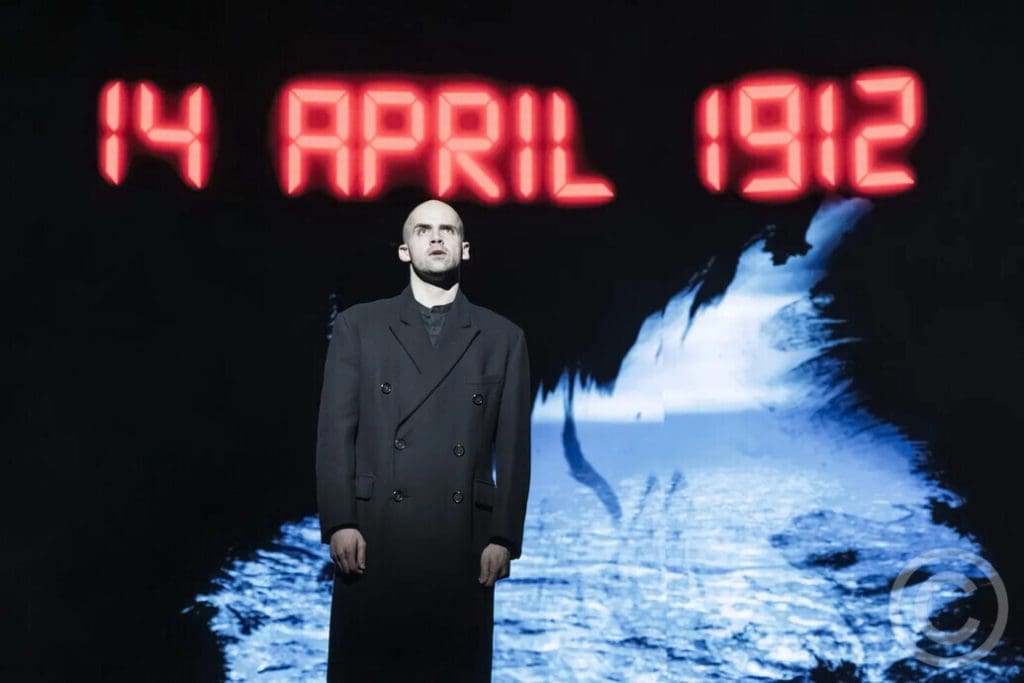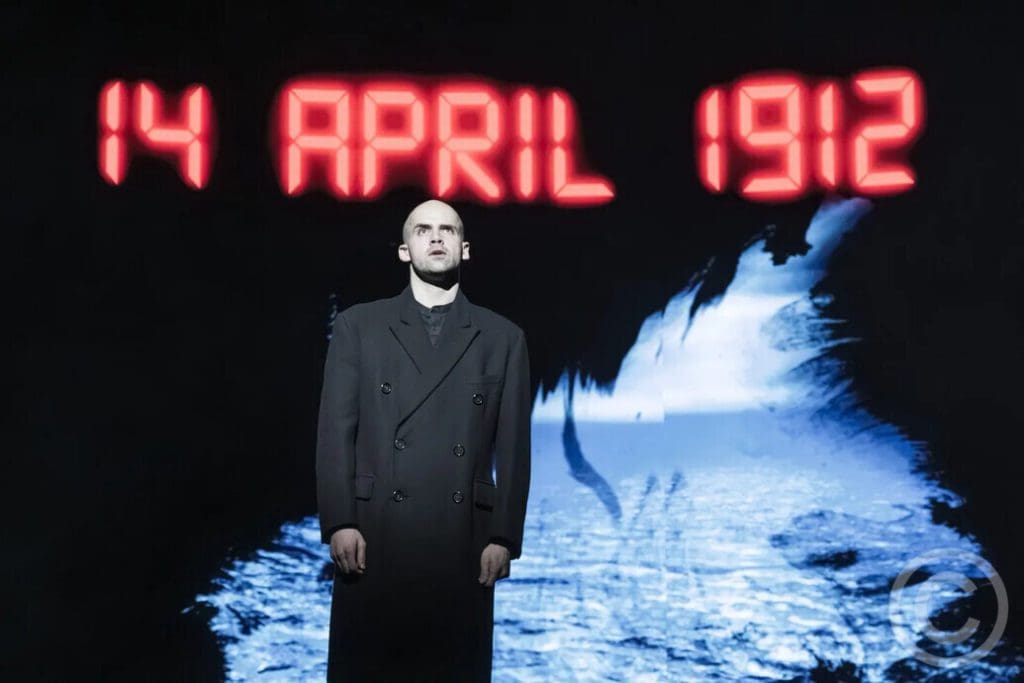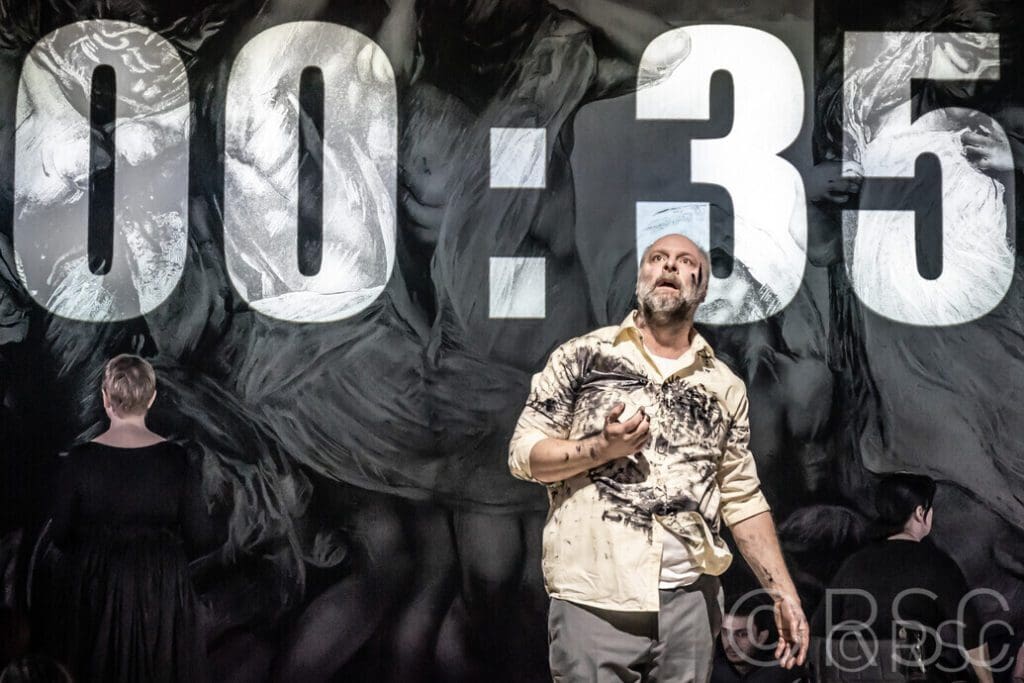
All aboard for the Royal Shakespeare Company’s Hamlet, set on a sinking ship in 1912. Picture: Marc Brenner
SOMETHING is still rotten in the state of Denmark, but now on board a sinking – not stinking – ship in 1912, rather than at Kronborg Castle, Elsinore.
Steered on tour by revival director Sophie Drake (what a good surname for nautical adventures), Rupert Goold’s Royal Shakespeare Company production takes to the seas on April 14 as the clocks to each side of the stage click round to midnight and beyond, marking the 114th anniversary of the demise of the RMS Titanic.
As chance would have it, the York Theatre Royal run opened that night, adding to the poignancy of the occasion. Hamlet is played out in Es Devlin’s design on an expansive deck that restores a spectacular rake to the Theatre Royal stage for the first time since the 2016 renovation, recalling the days when nervous touring companies and repertory shows alike used anti-rake furniture to defy the steep incline.
Complemented by Adam Cork’s sound design of the sea’s swirling motions and hum of the engine, the ship’s bow crests the waves in Akhila Krishnan’s video projections of the ever-rising, whirling, freezing waters, into which the coffin of King Hamlet is tossed, wrapped in the flag of Denmark.
“Hamlet is a play about the inevitability of death: the death of fathers, the death of kings, the mortality facing each and every one of us, but it is also a play about how to live, what makes a good life and a just one too, however brief our allotted time,” says Goold, in a concise summary of Shakespeare’s greatest play.
As happened on the Titanic, Hamlet’s tragedy will “come to pass in a little over two and a half hours”, taking place in real time, lending urgency to Goold and Shakespeare’s quest to answer the question of “what it means to be human and decisive when time is running out”.
In doing so, Goold achieves his desired balance of catastrophic thriller and poetic meditation, a wish made flesh in Ralph Davis’s Hamlet, who is as physical in the sound of speech as he is in movement.
Shaven head meets skull as Ralph Davis’s Hamlet recalls his childhood encounters with late jester Yorick in the RSC’s Hamlet. Picture: Marc Brenner
On occasion, you need to suspend disbelief and go with the flow instead, bathing in the innovation and imagination of an audacious production that is shipshape and Bristol fashion in its delivery. Georgia-May Myers’ Ophelia still dies by drowning; Davis’s Hamlet kills Richard Cant’s delightfully camp, theatrical Polonius with a pistol (referred to as a “rapier”) but fights Benjamin Westerby’s hot-headed Laertes with a sword.
Hamlet will be sent off to England as usual, only to return minutes later, but that is fine. The claustrophobia of a ship from which he cannot escape is a physical manifestation of his mental descent into Elsinore being a prison. Such constraints compound his “madness”.
Davis’s tall, lithe, shaven-headed Hamlet, often bare footed and in rolled-up trousers, is a chameleon in appearance, matching his mood, whether in dark coat, baggy white shirt, red jumper and shorts, ship’s captain’s cap or bowler hat and tails.
His voice keeps shifting gear and accent too, poised and reflective in his set-piece soliloquies; quick to anger with mother Gertrude (Poppy Miller) and murderous Claudius (Raymond Coulthard); haunted in his encounter with the Ghost of his father (Ian Hughes); sometimes playful yet earnest too with best friend Horatio (Colin Ryan) and the Player King (Ian Hughes); ever-changing in tone with Ophelia.
He can be mocking too, mimicking the American accents of dandy, cloth-headed old school friends Rosencrantz (Jamie Sayers) and Guildenstern (Julia Kass). Further impersonations bring out the theatrical in Hamlet (who commissions the incriminating play The Mousetrap), whether in mannerism or voice. At one point, Davis seems to assume a Belgian accent to say “murder” in the manner of David Suchet’s Poirot.
The auditorium may have felt as hot as the ship’s engine room, but setting a play full of water imagery on an icy ship is a voyage of re-discovery that brings out that sinking feeling, the depths of despair in Hamlet to full fathom five. If ‘to sea or not to sea’ is the question, the answer is See It Now.
Royal Shakespeare Company in Hamlet, York Theatre Royal, 7pm tonight; 2pm and 7pm tomorrow. Box office: 01904 623568 or yorktheatreroyal.co.uk.
Depths of despair: Ralph Davis’s Hamlet, adrift at sea in an undertaker’s coat in the RSC’s Hamlet. Picture: Marc Brenner
Cassi Roberts, left, Grace Scott and Vicky Hatt rehearsing for York Shakespeare Project’s Love’s Labours Lost. Picture: John Saunders
ANNA Gallon is directing York Shakespeare Project for the first time in Love’s Labour’s Lost as Shakespeare meets the 1990s’ club scene in an exciting new take on the Bard’s early comedy.
Her immersive production, set in the heat and heighted passions of urban nightlife, will run at Theatre@41, Monkgate, York, from next Wednesday to Saturday as part of the 2026 York International Shakespeare Festival.
“We are absolutely delighted to welcome Anna as our director,” says YSP chair Tony Froud. “She emerged from an outstanding group of applicants, since when she has brought energy and excitement into the rehearsal room. This promises to translate into a totally memorable and entertaining show.
“York is very fortunate to have so many outstanding young directors. This production will show Anna as a key member of that group.”
Anna is co-founder and artistic director of York theatre company Four Wheel Drive, perhaps best known for its 2023 production of The Trial Of Margaret Clitheroe in the Guildhall. She also appeared as Lucetta in YSP’s The Two Gentlemen Of Verona, directed by Tempest Wisdom in 2024.
Love’s Labour’s Lost director Anna Gallon: “I want this comedy of discipline versus desire to play out not in a palace, but in a bar, where vows are as fragile as your morals after one too many tequila shots,” she says
“I’m thrilled to be directing Love’s Labour’s Lost for YSP,” she says. “It’s a dazzling, witty play about language, love and self-discovery – and I can’t wait to bring it to life in a way that feels vibrant and connected to the world we live in today.”
Set firmly in the here and now, Anna’s Love’s Labour’s Lost will re-imagine Shakespeare’s sparkling comedy of wit, wordplay, vows and romantic mischief on the nocturnal tiles. Her playful reinvention promises to mix verse, rhythm, dance and striking visuals to create a fresh and contemporary celebration of love, temptation and folly.
The King of Navarre and his three companions are re-imagined by Anna as the DJs who once ruled York’s club scene but have now renounced the wild world of drink, dance and late nights, committing themselves instead to a retreat of abstinence: no women, no drink and definitely no dance floors.
However, when the Princess of France and her entourage arrive, their solemn vows begin to unravel, as Anna explores with mischievous glee. “I want this comedy of discipline versus desire to play out not in a palace, but in a bar, where vows are as fragile as your morals after one too many tequila shots,” she says.
Ben Reeves Rowley: Progressing from Summer Sonnets to principal role in York Shakespeare Project’s Love’s Labour’s Lost. Picture: John Saunders
“My interpretation uses Shakespeare’s original language but finds playful, recognisable parallels for modern audiences: ageing players try to resist temptation, while nightlife culture collides with wellness culture and the irresistible force of love.”
As a key element of Anna’s production, the audience will find Theatre@41’s John Cooper Studio transformed from black box into a nightclub. “The bar setting will place Shakespeare into a familiar social space,” she says. “Instead of watching from a distance, theatregoers will find themselves inside the comedy: vows made across tables, love confessions unfolding on dance floors. It will be a shared night out for all.”
Anna’s cast features many faces familiar to York audiences, such as Ian Giles as Don Adriano de Armado, Tempest Wisdom as his page Moth, Harry Summers as Longaville and Nick Patrick Jones as Berowne, complemented by six actors new to YSP, Nason Crone’s Dumaine, Vicky Hatt’s Katherine, Helen Clarke’s Boyet, Elizabeth Duggan’s Costard, Stephen Huws’ Holofernes and Sarah McKeagney’s Sir Nathaniel.
Tony enthuses: “We are very excited that Anna’s production has attracted so many actors who are working with us for the first time. Only three of this cast appeared in our last show, Thomas Kyd’s The Spanish Tragedy, at Theatre@41 last October. It’s a very healthy and invigorating mix.
Ian Giles rehearsing the role of Don Adriano de Armado
“In a very strong cast, it’s particularly pleasing to YSP to see Grace Scott and Ben Reeves Rowley in the central parts of Rosaline and the King of Navarre. Both first appeared in our annual Summer Sonnets show and it’s great to see them progressing to major parts in a full production.”
Love’s Labour’s Lost is the latest staging post in York Shakespeare Project’s 25-year programme to perform all 37 plays, plus plays by his contemporaries, in innovative and engaging ways from 2023 to 2048. Coming next will be the autumn production of The Comedy Of Errors, Shakespeare’s shortest play, the chaotic one with two sets of identical twins separated at birth that accidentally end up in the same city.
More immediately, why should you see YSP’s Love’s Labou’rs Lost? Let veteran cast member Ian Giles entice you: “Off the scale for daring entertainment, one of Shakespeare’s most verbal comedies is set in King’s Night Spot in 2005 with a soundtrack of Nineties and Noughties’ belters – what could possibly go wrong (or should that be right)? Come and find out.”
York Shakespeare Project presents Love’s Labour’s Lost, Theatre@41, Monkgate, York, April 22 to 25, 7.30pm plus 2.30pm Saturday matinee. Box office: tickets.41monkgate.co.uk.
Tempest Wisdom’s Moth in rehearsal for Love’s Labour’s Lost
Who’s in the cast for York Shakespeare Project’s Love’s Labour’s Lost
BEN Reeves Rowley, Ferdinand, King of Navarre; Nick Patrick Jones, Berowne; Harry Summers, Longaville; Nason Crone*, Dumaine; Charlie Barrs, The Princess of France; Grace Scott, Rosaline; Cassi Roberts, Maria; Vicky Hatt*, Katherine; Helen Clarke*, Boyet; Ian Giles, Don Adriano de Armado; Tempest Wisdom, Moth; Elizabeth Duggan*, Costard; Stephen Huws*, Holofernes; Sarah McKeagney*, Sir Nathaniel; James Tyler, Dull/Marcade; Pearl Mollison, Jaquenetta, and David Lee, Forrester
* New to York Shakespeare Project
York Shakespeare Project’s mirror-ball poster for Love’s Labour’s Lost
Depths of despair: Ralph Davis’s Hamlet in the Royal Shakespeare Company’s Hamlet, docking at York Theatre Royal from April 14 to 18. Picture: Marc Brenner
THE Royal Shakespeare Company’s visit to York Theatre Royal with Rupert Goold’s production of Hamlet, set on a sinking ship, will coincide with the 114th anniversary of RMS Titanic’s demise on the night of April 14-15 in 1912.
Around 1,500 people perished at sea that night from the estimated 2,240 on board. Death stalks Shakespeare’s tragedy too, Polonius, Ophelia, Rosencrantz, Guildenstern, Queen Gertrude, Laertes, King Claudius and Hamlet himself joining his already dead father, King Hamlet.
“Hamlet is a play about the inevitability of death: the death of fathers, the death of kings, the mortality facing each and every one of us, but it is also a play about how to live, what makes a good life and a just one too, however brief our allotted time,” says Goold.
“Our production is set aboard a ship but one that is soon to founder, going down with all hands,” says Goold. “Its inspiration comes from the most famous sinking in history, and just as that icy tragedy came to pass in a little over two and a half hours, our play takes place in real time and for about as long, as much catastrophic thriller as poetic meditation. It’s a production that asks what it means to be human and decisive when time is running out.”
Among those joining Ralph Davis’s Hamlet in Goold and revival director Sophie Drake’s touring cast in Shakespeare’s epic family drama of deceit and murder is Royal Shakespeare Company regular Ian Hughes in the roles of King Hamlet’s Ghost and the Player King.
From April 14 to 18, he will be returning to York Theatre Royal, 38 years since he made his professional debut in the 1988 pantomime Peter Pan, in the days when Frank Barrie played the dame. “Frank had made his debut there too in 1959 in Henry IV, Part 2, the play that marked my debut for the RSC in the 1990s – and I’ve learned that Frank had played Hamlet at the Theatre Royal in [March] 1974,” says Ian.
Ian Hughes, front, in the Royal Shakespeare Company’s Hamlet. Picture: Marc Brenner
“In another Yorkshire connection, Harrogate Theatre artistic director Andrew Manley saw me in Peter Pan and said afterwards, ‘do you fancy joining my Harrogate rep company?’. “I was a Kit Kat Girl in Cabaret; we also did Mrs Warren’s Profession, the regional premiere of Caryl Churchill’s Serious Money, Alan Bennett’s Forty Years On and the panto.
“Because I didn’t go to drama school, those Harrogate shows with Andrew were effectively my drama school after starting with the Theatre Royal panto, when I played John Darling, the boy with the top hat and the round glasses – and we got to ‘fly’!
“The Theatre Royal was beautiful, and it was so lovely to play there, when Frank made me so welcome. He was marvellous, dry-humoured company with his wonderful anecdotes of who he had worked with as an actor from an earlier time, when he had performed with [Laurence] Olivier.”
Ian was born in the South Wales Valleys, growing up in Merthyr Tydfil and joining the National Youth Theatre of Wales at 16 to work under director Alan Vaughan Williams, who nurtured the talents of Rob Brydon, Michael Sheen and Ruth Jones too. “Alan took no prisoners, treating us like professionals,” he recalls. “It was invaluable for me. I loved it.”
Only seven years later, Ian would be understudying Kenneth Branagh’s Hamlet in Adrian Noble’s production at the RSC. “I was 23, so I have a long connection with the play. I had to learn every line of the Second Quarto version, which runs to more than four hours [making Hamlet the role with the most lines in Shakespeare’s 37 plays] – and I never went on once!
“Kenneth kept saying ‘people are flying in to see me, I have to go on’, so I never had the chance, despite learning all those lines.”
That sinking feeling: The Royal Shakespeare Company staging Hamlet on a ship in 1912. Picture: Marc Brenner
Instead, Ian had to content himself with playing Polonius’s servant Reynaldo and Fortinbras. “Part of the reason that I joined the RSC was because I’d just won the inaugural Ian Charleson Award for my [title] role in Johann Wolfgang von Goethe’s Torquato Tasso at the Lyric Hammersmith,” he says.
“I didn’t know anything about the award. I got asked to go to the National Theatre and found I was up against Simon Russell Beale in the RSC’s Edward II, thinking ‘I’m just this young actor from South Wales’. I won £5,000 and was presented with the award by Sir Alec Guinness. What a wonderful start to a career.”
Ian has gone on to play multiple parts for the RSC, most recently appearing in The Merry Wives Of Windsor two summers ago. Now he returns as the Ghost and Player King. “These parts appealed to me as a character actor,” he says. “I thought, ‘I fancy a go at these’, because of the interest in Hamlet, and the short tour appealed too.”
Analysing the impact of setting Hamlet on a ship,” Ian says. “In a nutshell, it brings out the claustrophobia. That exacerbates Hamlet’s feeling of frustration that he can’t escape. The sinking of the ship is effectively the metaphor of Denmark being a prison for Hamlet, and I think that works very well. Shakespeare’s plays are open to reinterpretation, and this reinterpretation is very powerful, with all its technical accomplishments too.
“Because Hamlet has so many water and sea references, you could be drowning in the play.”
Royal Shakespeare Company in Hamlet, York Theatre Royal, April 14 to 18, 7pm plus 1.30pm, Thursday, and 2pm, Saturday. Box office: 01904 623568 or yorktheatreroyal.co.uk.
Six members of Paul Toy’s cast of 17 rehearsing a scene from Thomas Kyd’s The Spanish Tragedy. Picture: John Saunders
THOMAS Kyd’s The Spanish Tragedy is “the Elizabethan play that outsold Shakespeare”, but then was lost to the professional stage for 300 years and is now performed only rarely.
One such performance will be at Theatre@41, Monkgate, York, from Wednesday to Saturday when Paul Toy directs York Shakespeare Project for the fourth time (and first since Troilus And Cressida in 2011).
YSP chair Tony Froud said of his appointment in June: “Paul emerged from a very strong field of applicants with an exciting vision for this remarkable play. The Spanish Tragedy was the most popular play of the Elizabethan era, outselling Shakespeare. Kyd’s play set out the blueprint for a whole dramatic genre, ‘Revenge Tragedy’. Without it, there may have been no Hamlet, no The Duchess Of Malfi.”
The chance to present such a landmark drama in tandem with all of Shakespeare’s plays was exactly why York Shakespeare Project launched its second 25-year cycle of productions in April 2023, with a view to performing the likes of Christopher Marlowe, Ben Jonson…and Thomas Kyd.
“This is one of the plays that I would have been on the lookout to see had I not been directing it,” says Paul, who had directed The Taming Of The Shrew in 2003 and Titus Andronicus in 2004, as well as Troilus And Cressida, “in the first canter through all Shakespeare’s canto”.
“You would need to go a little below the headlines, though not be a connoisseur or scholar, to know his work. Jonson still crops up, so does Marlowe, but not Kyd, who’s unlucky in that this is his only play that has survived, apart from a translation of a French play and may be an “Ur-version” [the original or earliest version] of Hamlet from around 1589 that preceded Shakespeare’s play, but really The Spanish Tragedy is the only one of significance”
Kyd would die at the age of 36 in 1594, only two years after The Spanish Tragedy was premiered, “He shared a writing room with Marlowe in London, but because Marlowe was under the eyes of the authorities, on account of his atheism and his homosexuality, Kyd was tortured, simply because he was in the wrong place at the wrong time, but was released without charge.
The Spanish Tragedy director Paul Toy
“Marlowe died in a tavern brawl in Deptford in May 1593, not long before Kyd, who didn’t survive as long as Jonson and Shakespeare but was under a cloud through no fault of his own.”
Nevertheless, The Spanish Tragedy was groundbreaking. “If you say you haven’t ever seen it, if I talked to you afterwards, I bet you would recognise all the tropes that it set down for ‘Revenge Tragedy’, like the ghost coming back to demand revenge; a hero deliberating over whether to seek revenge; madness and a play within a play,” says Paul.
Scholarly speculation has it that Will the Quill may even have penned passages of Kyd’s play. “You will see the precursor to Shakespeare’s Hamlet there, but Kyd doesn’t have the depth that late Shakespeare plays had. What you see is what you get in Kyd, and what you get is laid down pretty clearly,” says Paul.
In a nutshell, a play suffused with treachery, deceit and disguise that now carries the warning: “Contains depictions of self-injury, murder and suicide”. All delivered by Toy with masks, music and dance.
“I would say it’s plot driven, rather than character driven, and poor old Kyd, we all now know the tropes, the tricks of the trade, of revenge plays, but no-one did it before him. But the problem with being the pioneer is that it doesn’t have what others then built on,” says Paul.
His production has “a Spanish look rather than being full-on Spain”. “It’s suggestive of things like the Day of the Dead and other processions, the Counter-Reformation, but it’s also rather obsessive in its tone,” says Paul.
“It involves both the human and the supernatural, and if you’ve seen the York Mystery Plays, you’ll see where aspects of his work will have come from. It’s almost the definition of a play on the San Andreas Fault, pitched between the medieval and the early modern. If you know The Last Judgement from the Mystery Plays, there’s quite a lot that’s familiar.
Harry Summers and Emma Scott in rehearsal for York Shakespeare Project’s The Spanish Tragedy
“Our production acknowledges it’s not modern, it’s recognisably ‘period’, but culturally it still goes through to modern times.”
Paul describes Kyd’s text as a “very rhetorically minded play, full of people arguing the case for themselves or maybe for someone else, so it’s like a collection of closing statements that barristers give to the judge”.
“With some of the past plays I’ve directed, I’ve enjoyed the visual elements, the modernisation elements or the physical elements, but because the text of this play isn’t familiar, I thought it was important to concentrate on the text, doing it as a ‘language play’.
“But we also have the advantage of it being an old play that we can treat like a new, modern play because it’s not well known, whereas it’s very difficult to do that with Shakespeare because you’re so bombarded by his plays.”
As for The Spanish Tragedy’s violent reputation, come the end, spoiler alert, there are “as many people horizontal as there are in Hamlet”, says Paul. “But partly because of the laundry bill, I’ve gone for only one big ‘bloody’ death. The rest are by other means, hopefully more unexpected, and if it takes you by surprise, all the better!”
York Shakespeare Project in The Spanish Tragedy, Theatre@41, Monkgate, York, October 22 to 25, 7.30pm. Box office: tickets.41monkgate.co.uk.
York Shakespeare Project’s cast for The Spanish Tragedy
Ghost of Andrea – David Lee Revenge – Vivian Wilson King of Spain – Tony Froud Cypriana, Duchess of Castile – Emily Hansen Lorenzo – Tom Jennings Bel-imperia – Emma Scott General – Alan Sharp Viceroy of Portugal – Nick Jones Balthazar – P J Gregan Alexandro – Ben Reeves Rowley Villuppo – Tim Holman Ambassador – Cassi Roberts Hieronimo – Harry Summers Isabella – Sally Mitcham Horatio – Yousef Ismail Pedringano – Isabel Azar Serberine – Martina Meyer Christophil – Phil Massey Watchmen 1, 2, 3 – Alan Sharp, Nick Jones, Tim Holman Messenger – Cassi Roberts Deputy – Martina Meyer Hangman – Alan Sharp Maid – Martina Meyer Servant 1 and 2 – Martina Meyer, Ben Reeves Rowley Old Man – Tim Holman Nobles 1 and 2 – Martina Meyer, Ben Reeves Rowley Minos, Aeacus, Rhadamanth – PJ Gregan, Nick Jones, Tim Holman
Alan Sharp, proprietor of White Rose York Tour, comedian and The Chase winner, will be playing a trio of roles in The Spanish Tragedy. Picture: John Saunders
Great Ayton photographer Joe Cornish, left, and Gisborough counterpart Simon Baxter at last Saturday’s launch of All The Wood’s A Stage at Nunnington Hall. Picture: Celestine Dubruel
NORTH Yorkshire photographers Joe Cornish and Simon Baxter’s exhibition All The Wood’s A Stage takes its inspiration as much from Shakespeare as nature.
The title is a spin on All The World’s A Stage, the opening line of Jacques’ Seven Ages Of Man soliloquy in As You Like It, prompting Joe and Simon to mirror theatre’s format by present their show in four acts, or four ages/stages of trees, in three top-floor rooms and the linking corridor against the backdrop of Nunnington Hall’s gardens and trees in late-summer seasonal change.
“Trees and woodland may seem sedate, but drama unfolds slowly, staged over seasons, years, decades, even centuries,” reads one statement on the exhibition walls, where the photographs are divided into Emergence, Interference, Transience and Performance.
Joe, from Great Ayton, and Simon, from Gisborough, present trees as “actors on the woodland stage”, representing the three forms of Shakespeare’s plays: comedy in their branch formations; history in their rings of life; tragedy in their fate, whether deforestation, heat stress, climate change, or the crass felling of the Sycamore Tree Gap near Hadrian’s Wall in September 2023 that led to prison sentences for Daniel Graham and Adam Carruthers.
“We must learn to reconnect with nature, and woodland is a good place to start,” say the photographers. “Trees are critical actors in nature whose time on this planet far exceeds our own.” 360 million years, to be precise.
All The Wood’s A Stage, by Simon Baxter
Joe and Simon had first used the term “All The Wood’s A Stage” in their Woodland Sanctuary exhibition at the Moors Centre, Danby, in 2022. This time their focus spreads beyond Yorkshire to take in the South, Snowdonia, the Lake District and Scotland too in “celebration of the beauty and vital significance of trees, woodland and forests across the UK”.
Exhibition curator Laura Kennedy, Visitor Experience and Programming Manager at Nunnington Hall, says: “All The Wood’s A Stage invites us to see trees as silent performers on nature’s stage – inviting us to observe, listen and reflect.
“Trees provide joy, peace, and inspiration; they are the lungs of the Earth, guardians of biodiversity, and a crucial part of our mental and physical well-being. Through changing seasons, they symbolise life, death, and renewal.
This exhibition promises a truly uplifting experience, inviting visitors to fall in love with woodland life all over again.”
Both photographers attended last Saturday’s launch of 65 photographs for sale, complemented by two short films, to the noises-off accompaniment of the day’s incessant downpours. They work on their exhibitions and accompanying books in tandem – they live ten miles from each other – discussing potential themes, selecting each other’s photographs for the shows, printing together, but always photographing separately, even on joint excursions.
Dancing Trees, by Joe Cornish
“We think it’s important to listen to nature, and to express empathy, which comes from knowledge, but to have access to knowledge has to come from experience. For me, being in nature, among trees, has helped with my wellbeing,” says Simon.
“Through my photography, I’m doing justice to the woods, as a celebration of what they’ve done for me through their power to heal. It’s a celebration to say I love this natural world so much, not because it creates a great photograph but because I feel better among trees, and I want to share that wonder – and if nature can revert you to a different state of mind, it’s a very powerful thing.”
Joe and Simon see their work as holistic. “We know of the performative aspect of trees, sometimes as leading characters, sometimes as supporting cast, and if trees are the primary actors, where do we fit in? We are the audience,” says Joe.
He is delighted to be exhibiting at Nunnington Hall. “To have our work on show in this beautiful place, it’s like a sanctuary,” he says. “The National Trust has been very supportive of the arts, and I really hope that the trust can continue to play its leading role in providing spaces for artists to show their work.
“I see photography as a political act, and I slightly bristle at the thought that we just take pretty pictures. What we do is take pictures to offer a sense of hope.”
Woodland wanderers Joe Cornish, left, and Simon Baxter
Joe has experienced has own drama when filming for an exhibition with a theatrical structure. “I broke my neck falling off a mountain at Assynt [north of Ullapool in the Northwest Scottish Highlands],” he says. “I was hit by a gust of wind so hard that, even with my camera equipment on my back, I was knocked off my feet and fell quite a long way,” he recalls. “It was such a dangerous place, I had to walk for a mile but then the pain became unbearable.”
Joe was taken to hospital by mountain rescue helicopter. “Luckily I hadn’t damaged my spinal cord,” he says. “I’ve camped on the top of that mountain since then, which felt like an act of redemption.”
The trees, the woods, their theatre of life, will keep calling him and Simon back again and again.
Joe Cornish and Simon Baxter, All The Wood’s A Stage, on show at Nunnington Hall, Nunnington, near Helmsley, until March 29 2026. Opening hours: 10.30am to 5pm daily; last entry, 4pm; from October 1, closed on Mondays.
Normal admission prices apply, including entry to the exhibition, with free entry for National Trust members and under-fives. To book tickets, go to: www.nationaltrust.org.uk/nunnington-hall.
Cornish and Baxter’s self-published accompanying book, All The Wood’s A Stage, is on sale at £30 at Nunnington Hall, along with copies of Woodland Sanctuary. Visitors can buy prints on display too.
Black Sheep Theatre Productions’ poster for The Tempest at Theatre@41, Monkgate
YORK company Black Sheep Theatre Productions are to present The Tempest with live music at Theatre@41, Monkgate, York, from March 26 to 29.
William Shakespeare’s timeless tale of power, love and redemption will be directed by company founder and composer Matthew Peter Clare in an innovative adaptation that blends traditional Shakespearean drama with a dynamic theatrical approach.
Known for bold and impactful storytelling, Black Sheep will seek to bring an exciting new vision to Shakespeare’s melting pot of mistaken identity, magic, intrigue, murderous schemes, comedy and romance.
“The Tempest is famously Shakespeare’s last play, focusing on family and love, subjugation and bloody plots, reconciliation and forgiveness, euphoria and despair,” says Matthew.
“It is a play that has been performed numerous times in as many ways. With Black Sheep Theatre Productions’ version at Theatre@41, we aim to marry a more Brechtian theatre style for some of our more absurd characters with a grounded, naturalistic approach for the more plot-driven characters.”
Director and composer Matthew Peter Clare
Matthew continues: “We have also utilised my musical background, alongside the incredible talent of Gregory Harper, to create a musical score for a live six-piece band, featuring strings, guitar, and harp, that will accompany the show and highlight the characters and their choices throughout.
“This will perfectly complement the singing of the island spirits, as well as our featured leading singers, such as Gemma-Louise Keane as Ariel and Josh Woodgate as Caliban.”
Both are well-known figures in York’s theatre and music scene, with Gemma-Louise being the lead singer of KissKissKill and Josh regularly performing with Inspired By Theatre, starring in Green Day’s American Idiot last year and now rehearsing for Rent.
“The strength of this production lies in the juxtaposition of absurd comedy and serious drama,” Matthew says. “The comedic energy of Charlie Clarke as Trincula, Molly Whitehouse as Stephana, Dan Poppitt as Alonso and Rocks Smith as Francisca is sharply contrasted against the more sinister and thought-provoking portrayal of Mark Simmonds’s Prospero.”
Mikhail Lim: Collaborating with Matthew Peter Clare in the Black Sheep Theatre production team for a second show in succession
The cast comprises: Mark Simmonds as Propsero; Freya McIntosh, Miranda; Gemma-Louise Keane, Ariel; Dan Poppitt, Alonso, Spirit; Megan Conway, Antonia; Chloe Pearson, Ferdinanda; Isaac McAndrews, Gonzalo; Rosie Stirling, Sebastian: Josh Woodgate, Caliban; Charlie Clarke, Trinculo; Molly Whitehouse, Stephano: Mickey Moran, Adrian, Spirit; Ellie Carrier, Francisco, Juno, Spirit; Rocks Smith, Boatswain, Ceres, Spirit, and Justine Hughes, Master of Ship, Iris and Spirit.
Matthew will be joined in the production team by Mikhail Lim, as he was for Black Sheep’s production of Jason Robert Brown’s Songs For A New World at the National Centre for Early Music, York, last October.
“Our adaptation of The Tempest is set to be an unmissable experience, blending Shakespeare’s genius, innovative staging and an evocative live musical score to bring the story to life in a bold, fresh, and deeply engaging way,” concludes Matthew.
Black Sheep Theatre Productions in The Tempest, Theatre@41, Monkgate, York, March 26 to 29, 7.30pm plus 2.30pm Saturday matinee. Box office: tickets.41monkgate.co.uk.
Effie Warboys’ Silvia, Nick Patrick Jones’s Proteus, right, and Thomas Jennings’s Valentine in York Shakespeare Project’s The Two Gentlemen Of Verona. Picture: John Saunders
AMERICAN writer, director, performer and teaching artist Tempest Wisdom [they/them] headed to York to pursue a Masters degree in theatre-making at the University of York in 2021.
Itinerant from the days of their father serving in the Marine Corps., always moving every couple of years, like so many before however, once here they never left, first setting up York’s variation on Seattle’s Bard in a Bar, the Shakespeare karaoke night Bard at the Bar in The Den at Micklegate Social.
Now, after directing Anorak in Next Door But One’s Yorkshire Trios in the Theatre Royal Studio earlier this year, Tempest is at the helm of York Shakespeare Project for the first time for the rarely performed The Two Gentlemen Of Verona: “possibly the first play Shakespeare ever wrote and certainly the only one with a part for a canine,” they say.
Tempest has re-set Shakespeare’s 1593 comedy of cross-dressing, mistaken identity and courtly love as a play within a play, staged by Monkgate Music Hall, “a bawdy, raucous place” peopled by a host of Victorian variety acts.
Liz Quinlan’s sharp-shooting Speed, left, and Lara Stafford’s comedy act Launce. Picture: John Saunders
On the piano throughout is musical director Stuart Lindsay in a dapper waistcoat beneath a luxuriant moustache. On the piano too is a portrait of Queen Victoria, her face as “not amused” as ever. Determined to amuse, however, is Jodie Mulliah’s Chairwoman. No stranger to steering talent in the right direction as a secondary school drama teacher, she keeps her gavel busy in introducing act after act.
Their task is to deliver both their speciality act and lines of Shakespeare’s text, be it the North America golden gunslinger Speed (multi-disciplinary theatre-artist-turned scientist Liz Quinlan, in her YSP debut and first theatrical adventure for seven years), or Lara Stafford’s Launce in a comedy double act with canine companion Crab (a wooden puppet handled with the aid of a drawer handle on its besuited back by puppeteer Wilf Tomlinson).
Stuart Green, who returned to the stage after 35 years last year as The Torturer in York Theatre Royal’s community play Sovereign, has particular fun sending up furniture-chewing acting skills as the pompous Antonio. Forever looking for his Hamlet, his performance appears to be torn from Michael Green’s book The Art Of Coarse Acting.
For “proper” acting, look no further than Mark Payton’s Duke of Milan. Once part of Riding Lights Theatre Company before becoming an English teacher, he is belatedly treading the boards anew, every last vowel the thespian in resonance and intonation.
Dapper pianist Stuart Lindsay and the portrait of Queen Victoria in the Monkgate Music Hall. Picture: John Saunders
The sparring of Charlie Barrs’ Panthino and Four Wheel Drive director Anna Gallon’s Lucetta and later the antics of the Outlaws (Pearl Mollison, K Maneerot and Celeste North Finocchi) add to the merriment and mayhem.
What of the ‘Two Gents’, you ask. Ah yes, there’s the play. Step forward, in dapper straw hats and clowns’ rouge cheeks, the gentlemanly, but not very gentlemanly, all too arrogant and deceitful Proteus (Nick Patrick Jones) and Valentine (Thomas Jennings), not born a gentleman, but definitely as romantic as his name.
Proteus should be focusing on love-struck Julia (Lily Geering) but has his wandering eye on his friend Valentine’s secret love, Silvia (Effie Warboys), who the Duke of Milan has earmarked for the socially superior but unctuous Thurio (Charlie Spencer in circus ringmaster attire).
Jones’s programme profile speaks of having “no experience of music hall or vaudeville, but in many ways his whole life is an extended Buster Keaton routine”. As it happens, it is Jennings who reminds you more of the “Great Stone Face” of American silent cinema, but Jones is suitably duplicitous, dark beneath the light air.
Warboys, one of the best discoveries of York Shakespeare Project’s recent years and now studying for a Masters at the Shakespeare Institute, gives her best performance yet as Silvia. As a bonus, she returns to her musical roots to reveal a delightful singing voice in The Lass Of Richmond Hill.
Tempest Wisdom: Directing York Shakespeare Project for the first time
Geering is in fine form too, righteous in Julia’s indignation at Proteus’s deceptions, but canny, mischievous and nimble when taking on a disguise.
Jonathan Cook gives the requisite strong performance as the strongman variety act (Sir Eglamour) in a show full of such cameos, but amid so much physical comedy and clowning, with bursts of song too (Champagne Charlie et al), Tempest ensures Shakespeare’s expose of bad behaviour still hits home
Tempest’s cast makes use not only of Vivian Wilson’s set design but the stairs, doorways and mezzanine level too for a frantic climactic chase around the auditorium in Benny Hill style. Make that chase after breathless chase. Everyone then assembles, like a baying public gallery, to see Proteus being put in his place: wiping the smile off comedy’s face, if only briefly.
Shakespeare’s plays have a habit of running to three hours, and this production is no different, but comedies would always benefit from a shorter running time, for all the fast pace here.
Tempest Wisdom’s show, however, is full of original ideas, bags of energy, not-so-courtly romance, topical sexual politics, music hall ribaldry and slapstick aplenty.
York Shakespeare Project in The Two Gentlemen Of Verona, Theatre@41, Monkgate, York, tonight at 7.30pm; tomorrow, 2.30pm and 7.30pm. Box office: tickets.41monkgate.co.uk.
Nick Patrick Jones’s Proteus and Lily Geering’s Julia in disguise in The Two Gentlemen Of Verona. Picture: John Saunders
Jessa Liversidge: Two bards, one songbird; two performances, two workshops. Picture: David K Newton
EASINGWOLD singer and choir leader Jessa Liversidge presents her celebration of song inspired by two bards, William Shakespeare and Robert Burns, from her native Scotland, in York tomorrow and Helmsley next Saturday.
Her heartfelt performance spans traditional folk, pop and musical theatre, sung to her piano accompaniment with judicious use of a loop pedal to layer melodies and sounds.
At each concert, at Theatre@41 and Helmsley Arts Centre, audience suggestions are invited to enable Jessa to improvise a new song around a Shakespeare/Burns quotation.
At both venues, from 4pm to 6pm, she will be hosting a harmony-singing workshop for participants to sing in the evening show. Box office: York, tickets.41monkgate.co.uk; Helmsley, helmsleyarts.co.uk.
The poster for Two Bards And A Songbird
Here, Jessa discusses Shakespeare, Burns, songs, poems and her next show with CharlesHutchPress
What part did Robert Burns and Shakespeare play in your education, being brought up in Scotland?
“I was brought up and went to school in Dundee, and in my younger years we all had to learn a Burns song to take part in a competition called the Leng Medal. This was my first experience of Burns’s songs, and of course we learned several of the poems in school too.
“At this young age, I didn’t really appreciate the poetry and power of his words, and certainly didn’t fully appreciate the speeches from Macbeth and Hamlet as I crammed them the night before my Higher English exam! I wouldn’t have predicted that years later I’d be improvising songs around those same words.”
How did you first come to participate in the Durham Fringe Festival?
“Durham is quite a young Fringe, and I’ve been involved since it started in 2021. Mick [actor husband Mick Liversidge] and I had put a show together inspired by our outdoor lockdown singing and poetry reciting called Fields and Lanes, and this was featured in an afternoon showcase the Fringe put on, alongside aerial artistes and dancers! A great experience and a friendly bunch of volunteers running the festival.
“It has grown since then, and I performed my Songbirds show there in 2022, then Two Bards And A Songbird in 2023. My inspiration to put this show together was a callout by Durham Fringe for Shakespeare-inspired shows, to celebrate the 400th anniversary of the First Folio.”
Sum up the show in a nutshell…
“It’s a musical exploration of work inspired by the two bards. Just me, a piano and my loop pedal. Very different, very eclectic!
“I could be singing a beautiful Robert Burns song one moment, improvising around a Shakespeare sonnet the next, looping around with a Taylor Swift song, then throwing in a musical theatre number, such as Sondheim’s Fear No More The Heat O’ The Sun or So In Love from Kiss me Kate.
Mick and Jessa Liversidge on one of their walks in lockdown in 2020 for Fields and Lanes
“I even combine the two bards in two of the pieces. There’s also a fun, but scary element of the show, where audience members pick a quotation from their table for me to improvise around.”
Shakespeare’s plays feature songs; Burns’s poetry has a long tradition of being turned into folk songs, alongside his own songwriting. How has that shaped the content of your show?
“Several of Burns’s original songs feature in the show – Red, Red Rose, Ae Fond Kiss, A’ The Airts – as well as the most famous song Burns actually didn’t write! (Auld Lang Syne, which he heard someone singing, then wrote down!)
“In the early stages of developing the show, I looked at some of the original songs used in Shakespeare plays, but I ended up using a more contemporary mix of songs for the Shakespeare element. His work features such universal themes that just about anything can be said to be inspired by Shakespeare!
“What I’ve chosen is a mixture of pop and musical theatre inspired by his words and stories, songs from musical adaptations of his plays (including some from a fairly recent adaptation of As You Like It, performed in Central Park, New York, featuring hundreds of community performers and music by Shaina Taub.)
“Plus of course the more improvised sections, where I develop my own musical interpretations of Shakespeare’s words, such as Come Away Death and Shall I Compare Thee To A Summer’s Day.”
How do you use the loop pedal?
“I love looping! It’s so addictive and fun, and a great, if sometimes baffling, experience for the audience, some of whom have never heard anything quite like it!
“I basically layer up keyboard chords, vocal harmonies, melodies, sometimes even recited poetry, together. Everything is done live, nothing pre-recorded.
The poster for Jessa Liversidge’s new show, A Tapestry Of Life, at the 2024 Durham Fringe Festival
“So, with the Taylor Swift song in the show, I build up harmonies in a chorus first, as part of the performance, then use that within the song.
“It’s great for the improvised sections too, and where I mash Shakespeare and Burns together – so at one point I sing a Burns song (John Anderson My Jo) and layer a suitable sonnet over the top – as a great way of creating harmony and different effects as a solo performer.” https://youtu.be/_Gsvwqzt6Bw?si=PFAUtyRsZE169dLM
Explain your choice of Burns and Shakespeare works to intertwine.
“The Burns song, John Anderson My Jo, speaks in a light-hearted way of the longevity of love, how it changes over time. Quite ironic as Burns never reached old age sadly. (N.B. I am doing one of the more polite versions of this song!).
“I then layer Shakespeare’s sonnet 104 over the top, which speaks, “to me, fair friend, you never can be old”.
“Another features a short segment from the Royal Shakespeare Company production of Julius Caesar that I was lucky enough to be involved with this time last year: Ghosts, used with permission of the composer, Jasmin Kent Rodgman.
“This haunting, repetitive piece is used in one of the battle scenes – and as a nod to the more pacifist leanings of Burns, I recite his Logan Braes over the top.”
Jessa Liversidge leading one of her choir workshops
What will the workshops involve? Who can attend? Is there a charge?
“The workshops are open to all voices – anyone who enjoys singing and wants to get more involved with the show. We’ll work on some vocal technique and fun warm-ups, then learn some of the material from the show – which the group can then get up and perform alongside me in the evening, in between enjoying the rest of the show as an audience member.
“I will tailor each workshop to whoever comes along. I am used to working with all ages and abilities and just love bringing people together to sing! It’s such a joyous way to connect with others.
“Both venues are offering a combined ticket for the workshop and show, only £5 extra for the two-hour workshop.”
Have your performed Two Bards And A Songbird in Scotland?
“I’ve been up to my native land for a couple of weekends performing the show in Dundee and Fife. Quite a moment, having not performed there since I was at school! And even then, I was never a singing soloist in those days, only really finding my voice in my mid-twenties.
“One old school friend who came to the Dundee performance said, ‘you were a violinist at school’! Lovely, though, to be able to have some family members come and support who don’t usually get to witness my antics in real life.”
How did you find your voice in your mid-20s, and was that part of the inspiration for encouraging others to do likewise in your choirs?
“My vocal journey has been a long and winding one! I’ve always enjoyed singing, but as I reached my 20s, I found I was limited in what I could do as a soloist, so decided to have some proper vocal training.
“I could be singing a beautiful Robert Burns song one moment, improvising around a Shakespeare sonnet the next,” says Jessa of her Two Bards And A Songbird show. Picture: Andrea Denniss
“I spent ten years training with York’s Jacqueline Edwards, finding my full range and surprising myself with what I could do. Then since having my own children in my 30s, I have built up my freelance work around singing, and sharing the joy of singing with others.
“I’ve undertaken so much more training in the past ten years or so, from vocal health first aid to vocal cross-training (all the different techniques and characteristics of singing in different genres), and now I feel so lucky to spend my week singing with, and for, such a wide range of people of all ages and abilities.”
Describe your new Carole King show, A Tapestry Of Life, premiering at next month’s Durham Fringe Festival?
“Like many, I’m a huge fan of Carole King. Her songs (a bit like the bard himself!) focus on those universal themes everyone can identify with: life, love, loss. My sister, Andrea Brown, has recently written a book of poetry with that very title.
“As we were born in the 1970s, when Tapestry was released, I came up with the idea of A Tapestry Of Life. It will be the classic Carole King songs, interspersed with songs I’m writing from Andrea’s poetry. Lots of them about pretty moving and emotional family events, and situations and journeys that will resonate with a lot of people, I’m sure. Quite scary for me as I am quite new to songwriting!
“But the words are so beautiful, I am very excited about performing this combination of old and new.”
What drew you to the music of Carole King?
“I first got to know some of the best-known songs, such as You’ve Got A Friend and Will You Still Love Me Tomorrow, then decided to explore further. I love the messages behind her songs, the catchy and moving melodies, and how the songs mean so much to people. These songs were released over 50 years ago but the themes and messages are eternally relevant.”
How have you found the experience of writing songs?
“It’s a whole new world for me. I really only started writing songs in 2020, and even then, that was only short rounds and partner songs to teach to my choirs. I’ve dabbled a little but not often had the confidence to share much of my own writing.
“My sister Andrea has always been the poet in our family. She’s written poems for events at work and home, and even wrote and recited beautiful poems for our parents’ funerals.
“I am used to improvising short melodies, and layering up harmonies, like I do in Two Bards, but this is a different ball game! I’m loving the process of putting these moving words to music and linking the themes of the Carole King classics to the themes of these beautiful poems.”
Jessa Liversidge, Two Bards And A Songbird, Theatre@41, Monkgate, York, tomorrow (16/6/2024), 7.30pm, and Helmsley Arts Centre, June 22, 7.30pm. Box office: York, tickets.41monkgate.co.uk; Helmsley, 01439 771700 or helmsleyarts.co.uk
Jessa Liversidge, A Tapestry Of Life, Durham Fringe Festival, The Pemberton Rooms, Durham University, just off Palace Green, July 25 to 28, 4.30pm. Box office: durhamfringe.co.uk.
Preview show at Easingwold Library on July 17 at 7.30pm (doors 7pm). Suggested entry donation of £8; all profits in aid of community library funds. Bookings: email willowtreevent@gmail.com or ring 07526 107448 and leave a message with contact details.
Jessa Liversidge: the back story
SINGER and positive and encouraging singing leader, experienced in working with singers of all ages and abilities.
Runs several choirs, including HAC Singers, Easingwold Community Singers, Singing For All and York Military Wives Choir, as well as teaching singing privately and teaching music to young people, lifting the spirits of hundreds through song each week.
For more information, head to: jessaliversidge.com.
William Robinson’s Marc Antony and Thalissa Teixeira’s Brutus in the RSC’s Julius Caesar. Picture: Marc Brenner
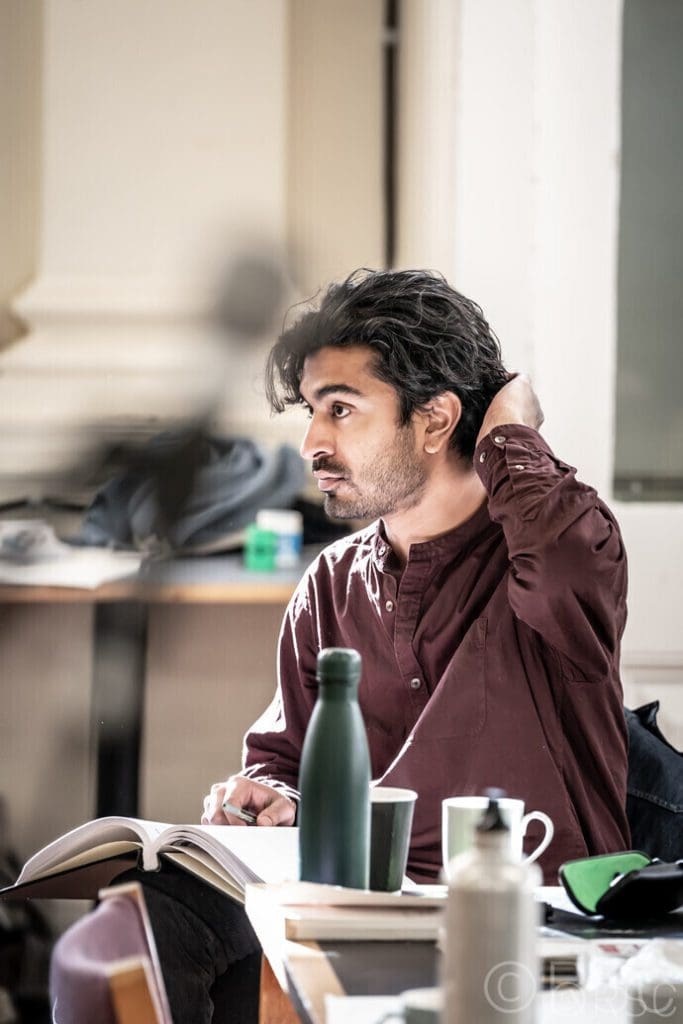
ATRI Banerjee directs Shakespeare’s fast-paced political thriller Julius Caesar on the Royal Shakespeare Company’s return to York Theatre Royal from tonight (13/6/2023) to Saturday.
Concerned that divisive leader Julius Caesar (Nigel Barrett) poses a threat to democracy, revolutionaries take the violent decision to murder him but without a plan for what happens next. As the world spins out of control, chaos, horror and superstition rush in to fill the void. Civil war erupts and a new leader must rise, but at what cost?
This production asks: how far would we go for our principles? “We know it’s a political play, a play that speaks to our politics, speaks to who gets to be a leader, and asks us to think about what you do when you don’t agree with the people in power,” says Atri, who is directing his first Shakespeare production for the RSC through the Open Hire scheme, set up Josh Roche and Derek Bond to encourage a more transparent application process within the theatre industry to stop it feeling like a closed shop.
Atri had first studied Julius Caesar at university. “I really felt, when coming to the play this time last year when I got this job, that this was a play that speaks about power, who holds it, who challenges it, and the gulf between politicians and the people they are meant to be leading.
“It speaks not only to the Ukraine situation but to the idea of governance in this age of Covid and Partygate. What I find interesting is that Shakespeare does not make either the leader or the conspirators the hero.”
Atri reflects on the prevailing political environment wherein Shakespeare penned Julius Caesar. “He was writing the play at a time when Elizabeth I was coming to the end of her reign. There had been plots against her, and there was a question of who would succeed her,” he says. “So even in Shakespeare’s day he was using this Roman story to talk about Elizabethan England and what happens when there is a possible power vacuum.”
Atri wanted to make a production that “felt like it could speak about today”. “I think we live in a world where a series of crises have happened, particularly over the last seven years, from Brexit, to Trump, the war in Ukraine, the pandemic, events that have revealed the massive rifts we have in our society between class, gender, race, disability, across every intersection of power,” he says.
“The questions I was asking myself were, ‘when you feel like the world is in a bad place, what steps do you actually take to make the world a better place? What are the limits of peaceful activism? How do we react, for example, to the likes of Extinction Rebellion, or the two young women who threw tomato soup at the Van Gogh painting?’.
“I’m also very aware that it’s easy to put Julius Caesar in a Donald Trump wig and cast him as the baddie in a way that’s quite black and white. But I’m more interested in creating a production that makes an audience feel the conspirators were both totally right to kill Julius Caesar, and totally wrong to kill Julius Caesar at the same time.
Nigel Barrett’s Julius Caesar in Atri Banerjee’s production. Picture: Marc Brenner
“I wanted to capture that ambivalence that’s central to what Shakespeare has written. Shakespeare isn’t offering any solutions. I don’t think he is saying one way is good and one way is wrong. Because the actions the conspirators take to assassinate Julius Caesar plunges Rome and the world into even more chaos.
“So, what appealed to me about directing Julius Caesar is that it felt like a play that could think about these huge moral grey areas that we exist in without trying to draw any easy conclusions.”
Consequently, we can always ask questions of our own society. “Cassius and Brutus were called liberators and saw themselves as trying to enact political change, seeing what might be possible through an act of radical violence,” says Atri.
“It’s about people just putting one foot in front of the other, rather than thinking about the devastating consequence for the nation, plunging people into a civil war, even though Brutus and Cassius came from a position of wanting to do the right thing, stopping autocracy by dramatic action.”
Atri continues: “I think theatre is the space for nuance; theatre can be a place for political change; not the play itself, so much as people in the audience contemplating the play afterwards, having conversations in the bar or on the way home.
“Whether it’s Novak Djokovic speaking about the Serbia-Kosovo conflict; Israel and Palestine; Stop The Boats, there is nuance in every case, and we should try to be alive to as many nuances as possible in any theatre production we do.
“The reason we keep coming back to these classics is we know Julius Caesar will be assassinated but Shakespeare’s play gives you a vessel within which you can think about things in a safe environment and look at them in a new way.”
Atri hopes audiences will come away from his production asking the questions, “What would I do? Would I go as far as to kill someone who is my best friend if I really thought that was going to make the world a better place?”
“The answer is probably no to murder(!), that’s the extremist version of it. But at what point do you glue yourself to Downing Street; at what point do you put yourself in front of a horse like the suffragettes did?” he ponders.
Jimena Larraguive’s Calpurnia. Picture: Marc Brenner
“We live through waves of political crisis, and activism tries to combat the crisis, but at what point do we resort to violence?”
As for the setting of his Julius Caesar, “it’s not in Westminster, but neither is it in ancient Rome,” Atri says. “It draws on elements of the modern and the ancient world to create our own world really.
“Taking influences from impressionist theatre, from choreographers like Pina Bausch, and from German theatre to make a world that feels quite stylised and heightened.
“I’m also very keen to convey a sense of the supernatural and time running out. The play has ghosts, omens and prophecies. The Soothsayer famously tells Caesar to beware the Ides of March. Characters are always worried about the time, and time running out.
“That relates to the climate crisis we face: if we don’t act now, we will reach the unmanageable temperature for living. It feels to me that Julius Caesar, like the world we live in today, is a play that’s set in a place of emergency. The threat of apocalypse feels very close.”
Atri’s fresh interpretation casts a female Brutus (Thalissa Teixeira) and non-binary Cassius (Annabel Baldwin). “Along with several other parts across the company, we’ve re-imagined the roles of Brutus and Cassius to tell a story about power today: who holds it, who wields it, and who gets to challenge it,” he says.
“Julius Caesar is the perfect play for our age of emergency, asking uncomfortable questions about today. When asked to imagine a better future for us all, what resources do we have left? What are the limits of peaceful activism? How far would you, personally, go to make the world a better place?
“By thinking of the roles in this play across intersectional lines – gender, race, class, disability, among others – we’re inviting audience members to think of their own place within the status quo and what might be at stake for each of us within it.”
Atri adds: “With the way we have cast it, we’ve not pitched the struggle between Caesar and Brutus and Cassius entirely on gender, but it brings different associations to that dynamic and asks us to look at the changing dynamics of power now.
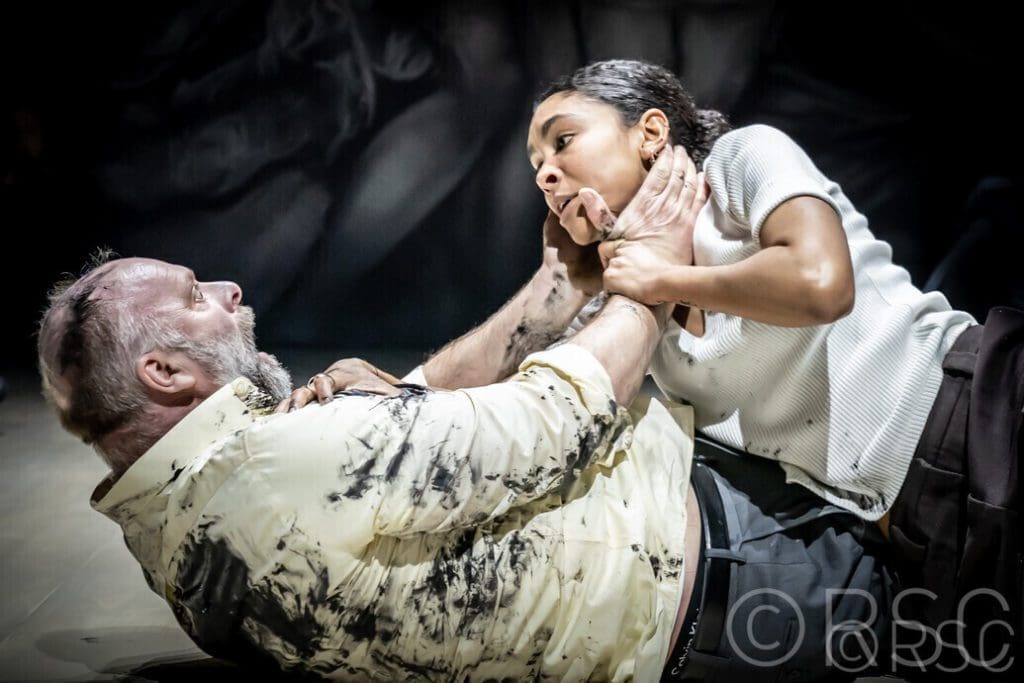
Stranglehold on power: Nigel Barrett’s Julius Caesar and Thalissa Teixeira’s Brutus. Picture: Marc Brenner
“Both Thalissa and Annabel are young actors, and that means that young audiences, though not only young audiences, can identify with these characters, whereas men in togas might have felt more foreign. If people see people that look like themselves on stage, which is a question of representation, then they can identify with their situation and the question of: ‘if you were in this situation, what would you do?’.
“We have undergone seismic changes, from the Brexit vote, the election of Trump as president, Covid, Black Lives Matter, the legacy of slavery and the British Empire, all sorts of historical pressures, and that means that within the space of the arts and culture, there is such an increased awareness of gender identity and the so-called culture wars that prevail now.
“I would encourage anyone who is making the judgement, ‘oh, they are casting Brutus as a black woman’, to slow down and reflect, and I speak as someone of South Asian origin taking on directing this play.”
History repeats itself down the years. “There will always be dictators, always be politicians, tyrants and non-tyrants,” says Atri. “The idea of democracy will rise and fall, rise and fall, with the passing of time, and Shakespeare was very aware of that. Shakespeare has that meta-reality that this play will resonate through time, through the ages, and will speak to different generations.”
Was working for the RSC always on Atri’s radar? “I come from Oxford, so the RSC was somewhere I used to visit as a teenager as it’s only an hour away [in Stratford-upon-Avon],” he says. “I saw productions like Rupert Goold’s The Merchant Of Venice and Maria Aberg’s As You Like It.
“I directed a community production for the RSC at the Marlowe Theatre in Canterbury in Autumn 2021 called Error, Error, Error. Over half the company was made up of people affiliated with Canterbury Umbrella; adults with mental health or learning disabilities and those who are isolated in the community.
“It was an extraordinary experience to work on a show that gave this group of people the opportunity to experience what theatre making is.”
Now he is directing his first professional Shakespeare production.“It feels like a homecoming,” he says.
“It’ll be my first show to play York too. The Theatre Royal is a very beautiful space.”
Royal Shakespeare Company in Julius Caesar, York Theatre Royal, June 13 to 17, 7.30pm plus 2pm Thursday and Saturday matinees. Box office: 01904 623568 or yorktheatreroyal.co.uk.
Atri Banerjee: back story
Director Atri Banerjee in rehearsals for the Royal Shakespeare Company’s touring production of Julius Caesar. Picture: Marc Brenner
WON The Stage Debut Award for Best Director and a UK Theatre Award nomination for his production of Hobson’s Choice at Royal Exchange Theatre, Manchester.
Other credits include: The Glass Menagerie (Royal Exchange, Manchester); Britannicus (Lyric Hammersmith); Kes (Octagon Theatre,Bolton/Theatre By The Lake, Keswick); Harm (Bush Theatre, London, also broadcast on BBC Four) and Utopia (Royal Exchange Theatre).
Named in The Stage 25 list of theatre-makers to look out for in 2022 and beyond.
In November 2022, along with Rachel Bagshaw, he was awarded a Peter Hall bursary by the National Theatre to support him in developing work for the NT’s stages.
Recruited for role as director of Royal Shakespeare Company’s Julius Caesar through Open Hire, a new initiative to improve transparency and access to freelance creative jobs in theatre.
“I got into directing when I was still at school,” says Atri. “I wrote a version of Macbeth with two of my friends, set in 1950s’ Hollywood and called Big Mac. I didn’t really know I wanted to be a director as a teenager, but I saw lots of shows – at places like the Oxford Playhouse, where I grew up – so regional theatre and touring theatre are really important to me.
“I went to university to study English and then did a Masters in Medieval and Renaissance Literature, and throughout that time I did a lot of shows with my student drama society, including quite a bit of Shakespeare.
“When I left university, I still didn’t know if I wanted to be a director, partly because of the freelance struggle of it all, so I got a job as the press assistant at the National Theatre, where I met lots of amazing creatives and artists, and I decided that directing was the thing I wanted to do.
“I did a Masters in directing at Birkbeck [University of London], where the first year is training and the second year is a placement. I was at the Royal Exchange Theatre in Manchester, where I stayed for a couple more years.
“Some of my career highlights to date include Hobson’s Choice, my first big show at the RoyalExchange, which was a South Asian version of [Harold] Brighouse’s play; Harm at the Bush Theatre, and more recently, Kes at the Bolton Octagon; Britannicus at the Lyric Hammersmith; and The Glass Menagerie, again at the Royal Exchange. The Glass Menagerie had been cancelled by the pandemic, so it was amazing to finally bring it to the stage.”
“I got into directing when I was still at school,” says Atri Banerjee. Picture: The Other Richard
Tony Froud: Directing York Shakespeare Project’s rehearsed reading of the rarely performed Edward III
PHASE Two of York Shakespeare Project begins with a staged rehearsed reading of Edward III upstairs at the Black Swan Inn, Peasholme Green, York, on February 7.
This rarely performed 1592 history play is now widely accepted as a collaboration between William Shakespeare and Thomas Kyd, replete with its celebration of Edward’s victories over the French, satirical digs at the Scots and depiction of the Black Prince.
Rehearsed February readings will be a regular part of YSP’s broadened remit to include work by the best of Shakespeare’s contemporaries, alongside a second staging of all his works, over the next 25 years.
Tony Froud’s cast will be led by Pick Me Up Theatre luminary Mark Hird in the title role. “At short notice, I’ve been able to bring together a strong cast that mixes YSP stalwarts, such as Liz Elsworth and Emma Scott, with new faces to us, such as Mark,” says Tony.
Hird’s King Edward will be joined by Elsworth’s Derby and Queen Philippa; Scott’s Gobin de Grey, Villiers, Frenchman 3 and Captain; Ben Thorburn’s Prince Edward; Nell Frampton’s Warwick and Salisbury; Bill Laverick’s Audley and Messenger and Stuart Lindsay’s Lodowick, Frenchman 4 and King David.
Mark Hird: Cast as King Edward in Edward II, his York Shakespeare Project debut
In the company too are: Sally Mitcham’s William Montague, Jon Copland, Herald 1, Frenchman 2 and Earl Douglas; Joy Warner’s Squire, Artois and Frenchman 1; Tom Jennings’s Herald 2 and Prince Charles; Jodie Fletcher’s Herald 3, Lorraine, Mariner and Messenger 2; Harry Summers’ King John and Lara Stafford’s Prince Philip and Countess Salisbury.
“It will be a one-night-only show, following the pattern of Ben Prusiner’s season of John Fletcher comedies and Jim Paterson’s A Midsummer Night’s Dream, which showed the impressive quality of performance that can be achieved in a short time by a good cast,” says Tony.
“The rehearsed reading puts a great emphasis on the language, so do come along to meet some colourful characters and hear some fabulous language in a plot that will take you from London to Calais via Northumberland and Crecy.”
Tickets for the 7.30pm performance cost £5 on the door or at eventbrite.com/e/edward-iii-tickets-518511741577.
Meanwhile, preparations are well under way for Dr Daniel Roy Connelly’s debut YSP production of Richard III at Friargate Theatre, Lower Friargate, York, from April 26 to 29. Auditions are in their “final phase”.