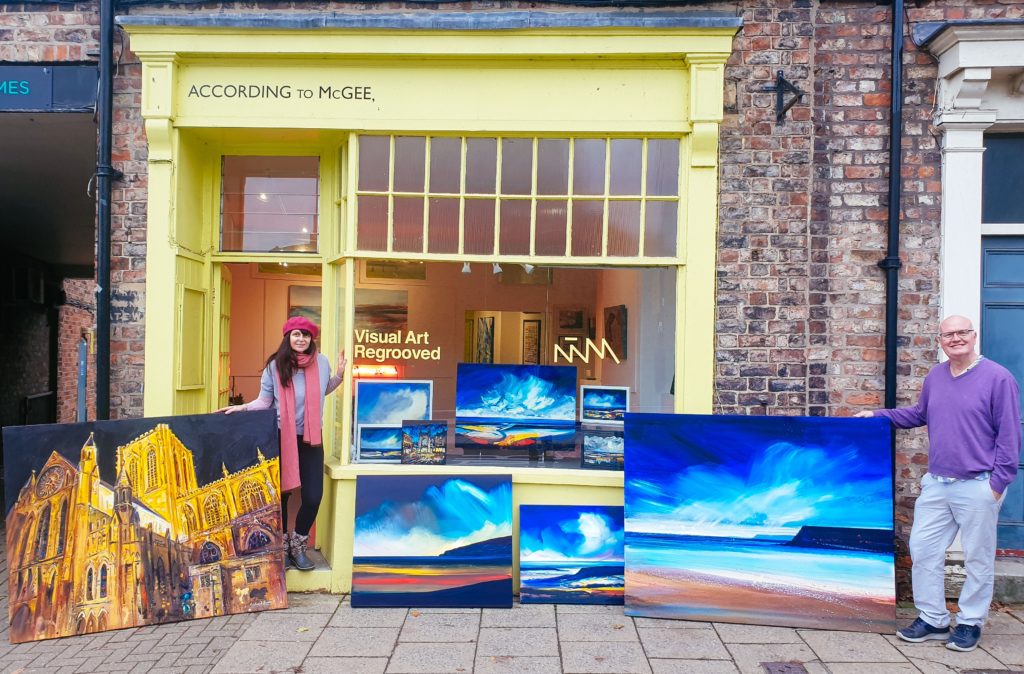
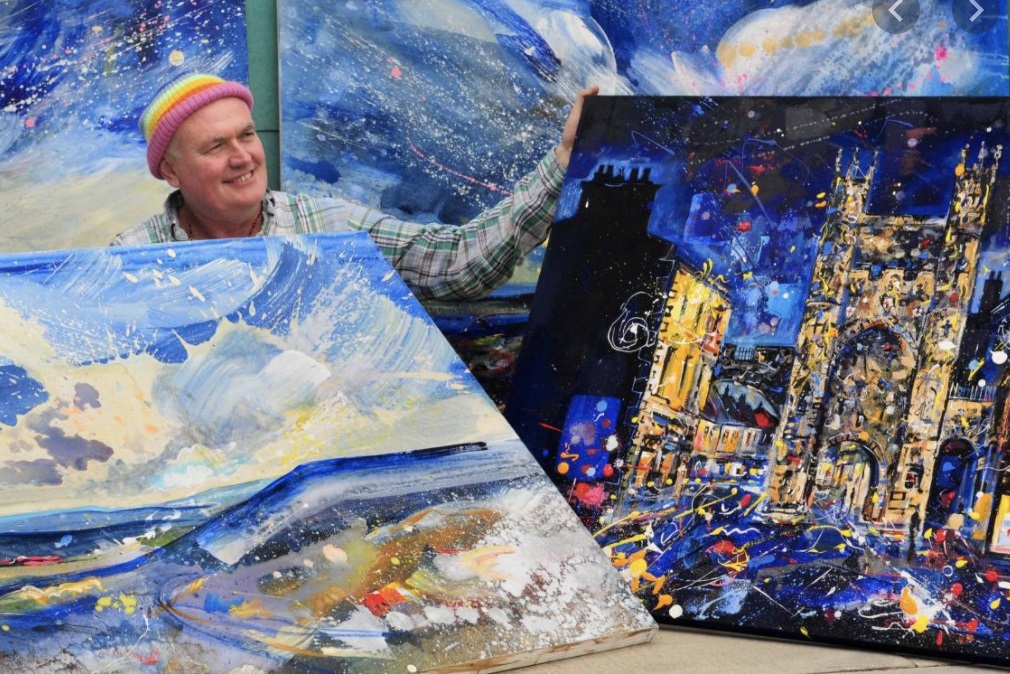
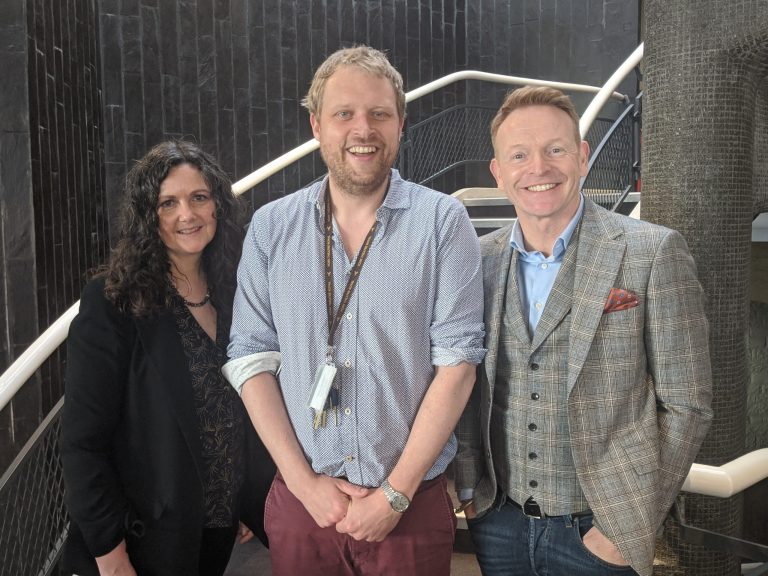
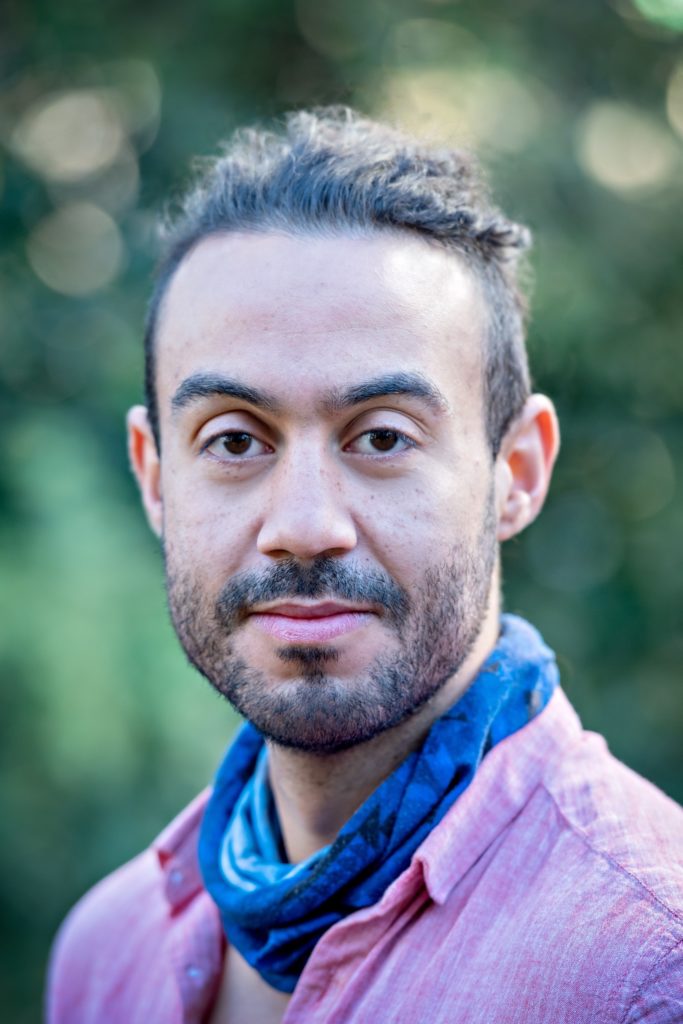
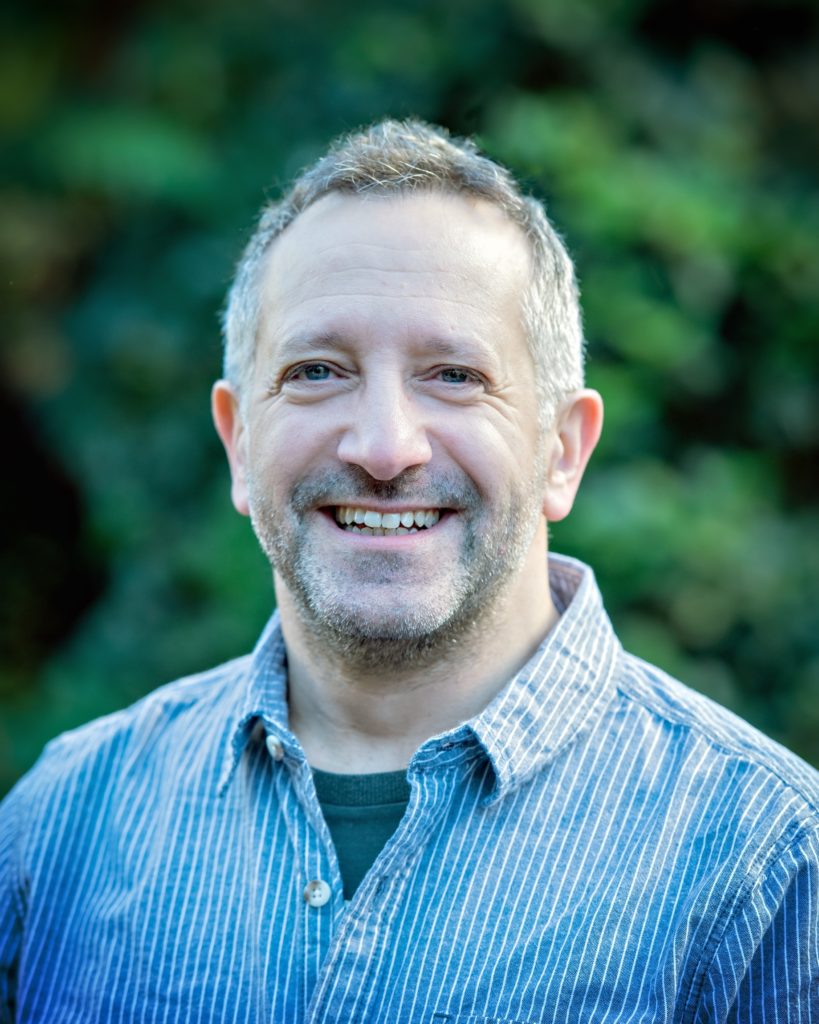
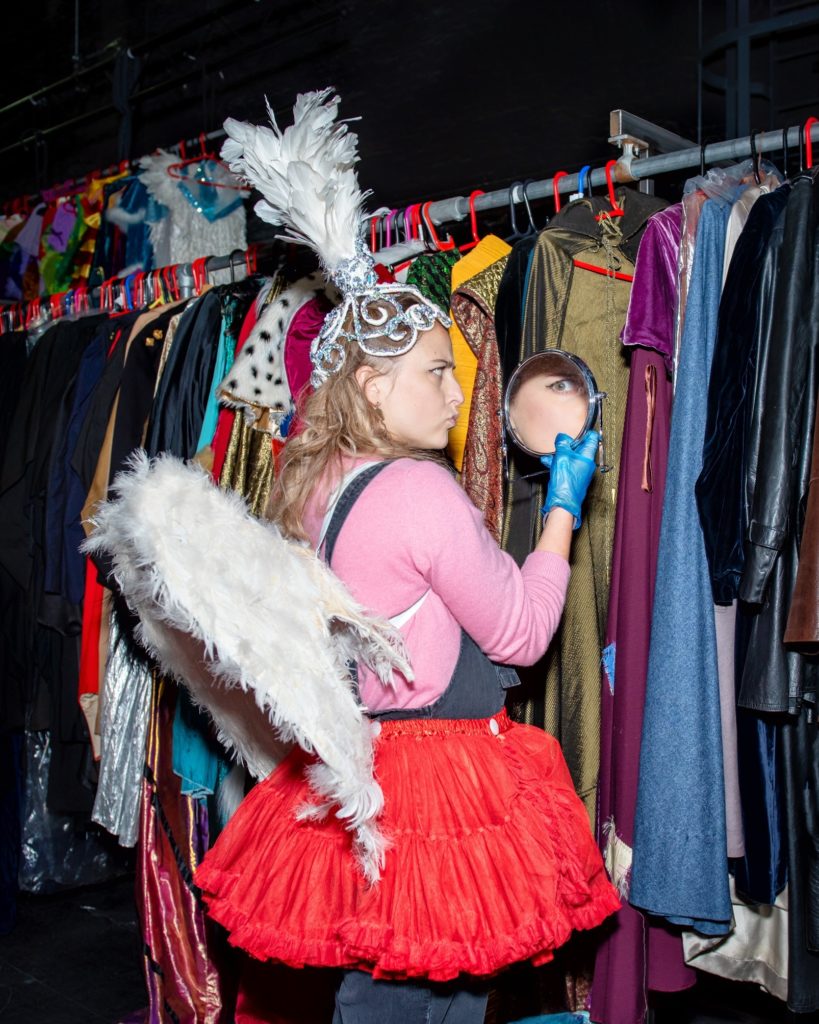
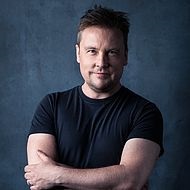
York artist Richard Barnes making his socially distanced delivery of his new York and North York Moors works to According To McGee. Standing in the doorway is gallery co-director Ails McGee
ACCORDING To McGee is still putting art in the shop window despite the here-we-go-again impact of Lockdown 2.
“Culture is in quarantine, but collecting great art continues,” says Greg McGee, co-director of the distinctive yellow-fronted gallery in Tower Street, York.
”And if the doors have to close then we’ll use our window to sell our paintings. It’s opposite Clifford’s Tower – we get a lot of footfall – and it’s huge.”
Lockdown: The Sequel has prompted Greg and co-director Ails McGee to launch the Window Shopping series of exhibitions, kicking off with According To McGee’s biggest-selling artist, Richard Barnes, former head of art at Bootham School.
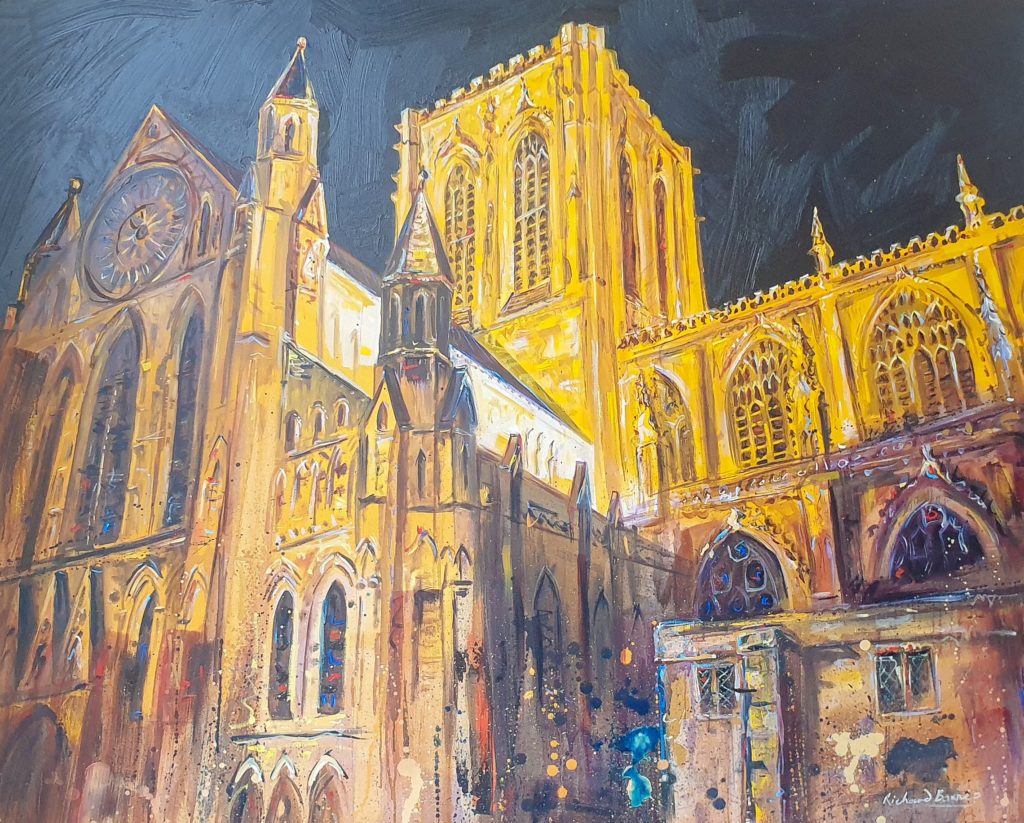
York Minster: A perennial subject matter for York artist Richard Barnes, featuring once more in his Window Shopping exhibition
“Famed for his man-sized portraits of York, Richard’s latest collection, York And God’s Own County, has some of the largest cityscapes and landmarks he has ever produced,” says a delighted Greg.
Window Shopping’s modus operandi addresses the necessity of locked-down galleries displaying their wares explicitly in the window space and making as much use of the wall space viewable from that vantage point as possible.
“I don’t think it’s a skill taught in curatorial lessons at art college, but these are strange times. ” says co-director Ails. “I organised with Richard a socially distanced drop-off of 15 new paintings, created at his garden studio.
“I was blown away by the quality of the new collection. He has always had a muscular, mischievous approach to composition and colour schemes, but these are stand-out works that show him at the top of his game.
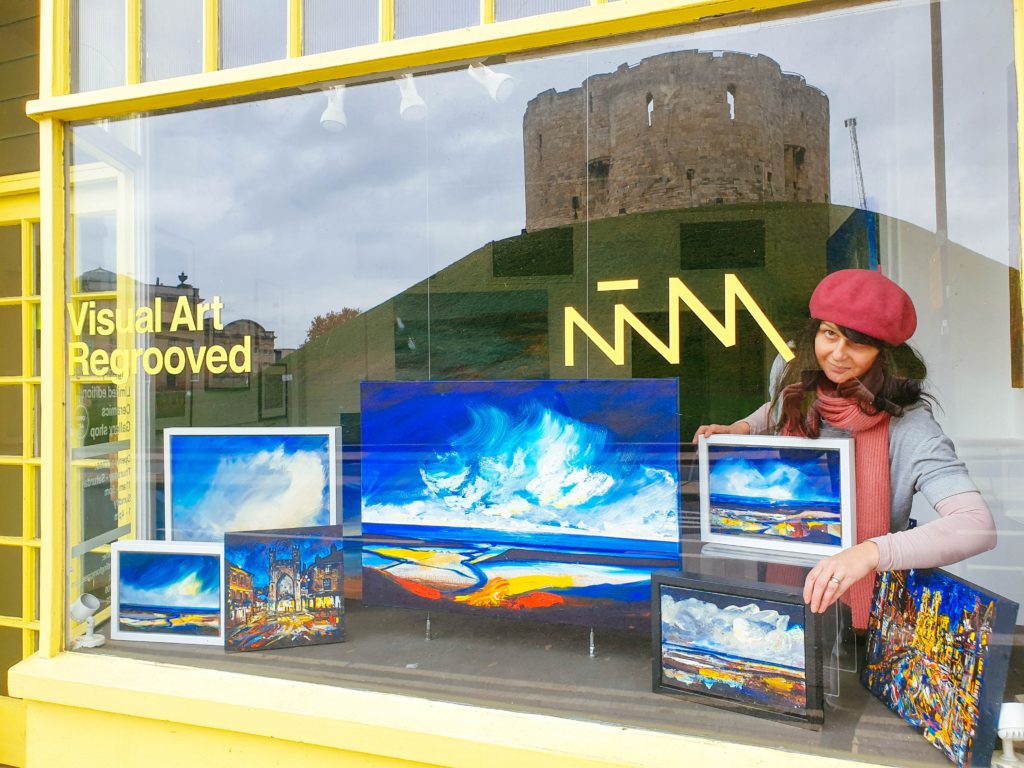
According To McGee co-director Ails McGee with a panoply of new Richard Barnes paintings on display in the Tower Street gallery window opposite the reflected Clifford’s Tower, York
“I have filled the front gallery with his work, from floor to ceiling, and we have already made pre-exhibition sales. Not very minimal or a traditional art gallery approach, but the energy is unmistakable. Window shopping works.”
Richard, who lives in Huntington Road, had done some “window showmanship” of his own in the lead-up to this show. “The paintings I love most hit me in the gut and hit me in my soul,” he says.
“During [the first] lockdown, I exhibited the paintings I was making on the back of my studio, so people using the river path opposite could see them. Somehow the job of making paintings that might hit someone somewhere, or even just give them a bit of pleasure, seemed very worthwhile.
“The new set of paintings at According To McGee are those that people commented on most during those tense lockdown months.”
York artist Richard Barnes, caught up in a riot of colour in his paintings for an earlier show at According To McGee
Richard also became involved in a project to create a huge painting for the new mental health hospital for York being built a little further along the Foss river path [the now opened Foss Bank Hospital in Haxby Road].
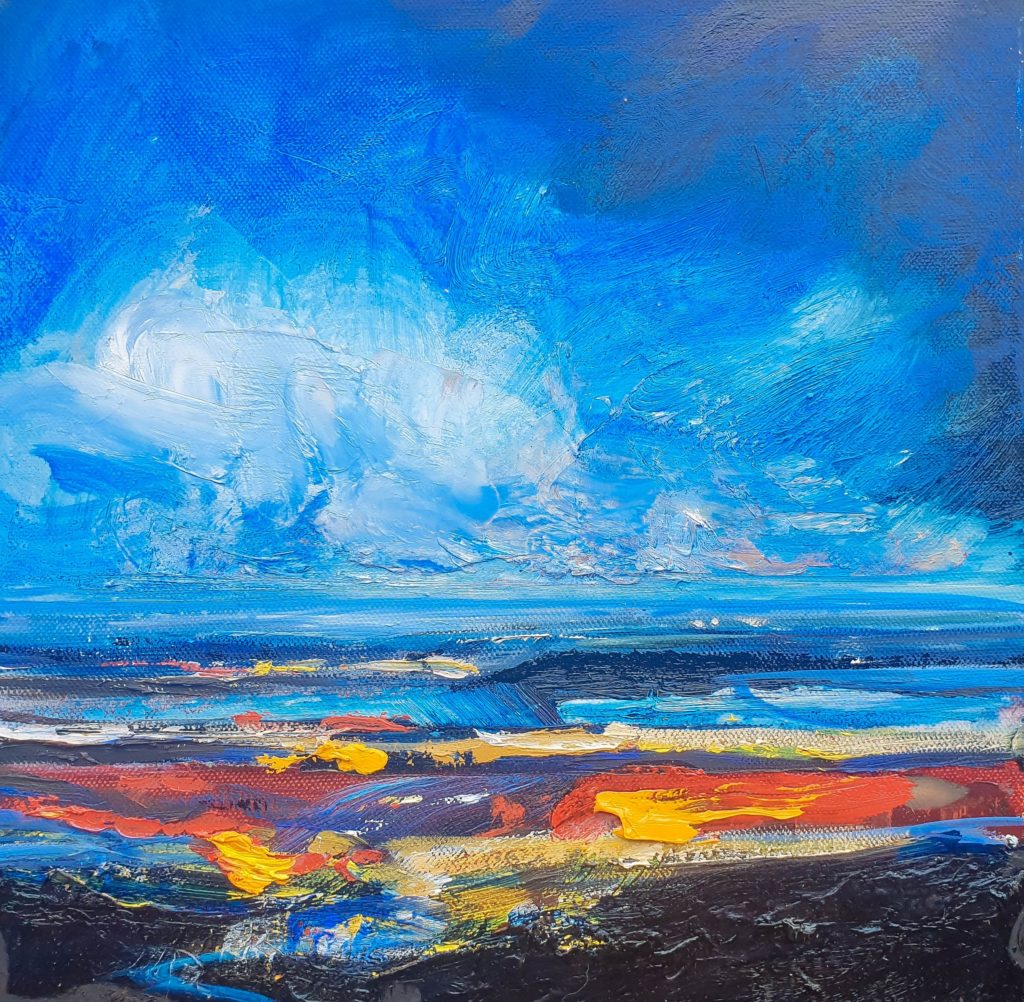
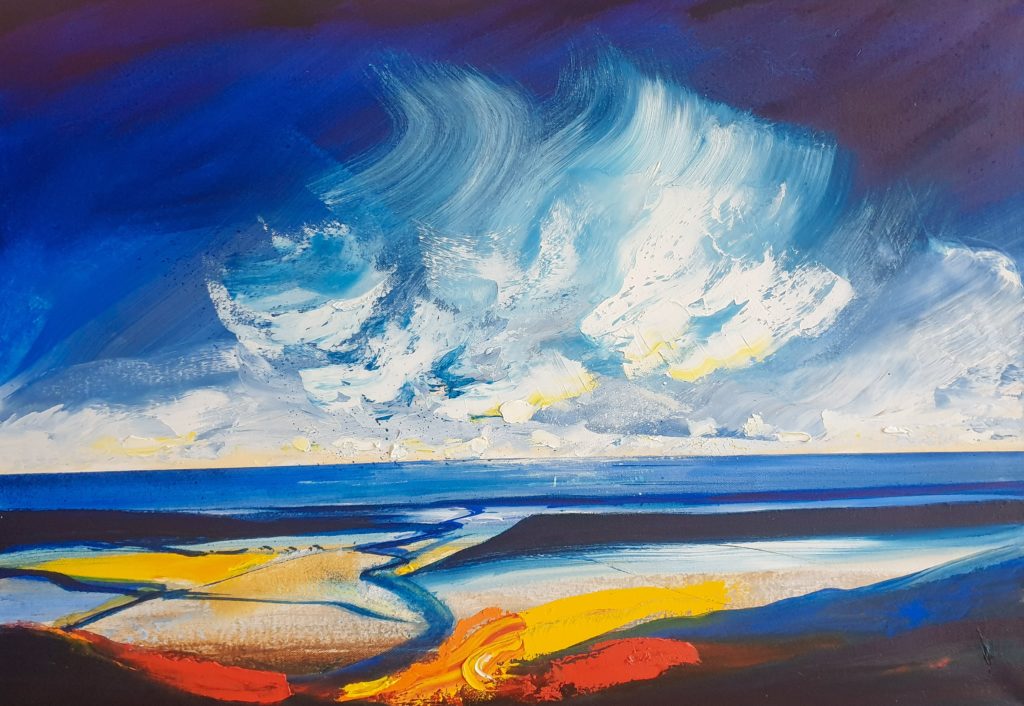
“The smaller landscapes in the new exhibition are experiments with light and space that I used to inspire the largest landscape I have ever painted and am still working on,” he says.
Barnes’s work has been a building block of According To McGee ever since the gallery launched 16 years ago. “It is especially pertinent this winter,” says Greg. “I’m honoured to act as the art advisor for the internationally well-regarded poetry zine, Dream Catcher, whose December issue features the art of Richard Barnes exclusively, so this show chimes with that nicely.”
Casting an eye over the new works, Ails says: “Richard has always painted with the risk-taking energy of an excellent painter in his 20s, but there’s a stronger, fiercer element to this collection.
North Yorks Moors, as portrayed by Richard Barnes in his new God’s Own County series
“Maybe he has rediscovered a latent aggression, or mischief, or maybe it’s Lockdown. Either way, these paintings depict York as a modern city and the North York Moors as a location for contemporary landscapes better than any collection on the market. Come look through our gallery window and see for yourself.”
It is no secret that Richard, who has painted ceaselessly since the 1980s, will be bidding farewell York in the months ahead, selling both his studio and house. “Although I am leaving York and Yorkshire, I really hope I will continue my relationship with painting York and According To McGee,” he says.
“I want to thank Greg and Ails for supporting me and many other northern artists. What I have loved most about working with them is their attitude of ‘Why not?’.”
Watch out for news of his York Farewell Show at According To McGee in 2021. In the meantime, whether out exercising or shopping, take a breather in Tower Street to peruse Window Shopping: Richard Barnes, York and God’s Own County; expansive, bold and inviting eye contact behind glass until December 1.
More, more Moor: How do you like it? Another of Richard Barnes’s moorland Yorkshire paintings on sale in According To McGee’s debut Window Shopping show
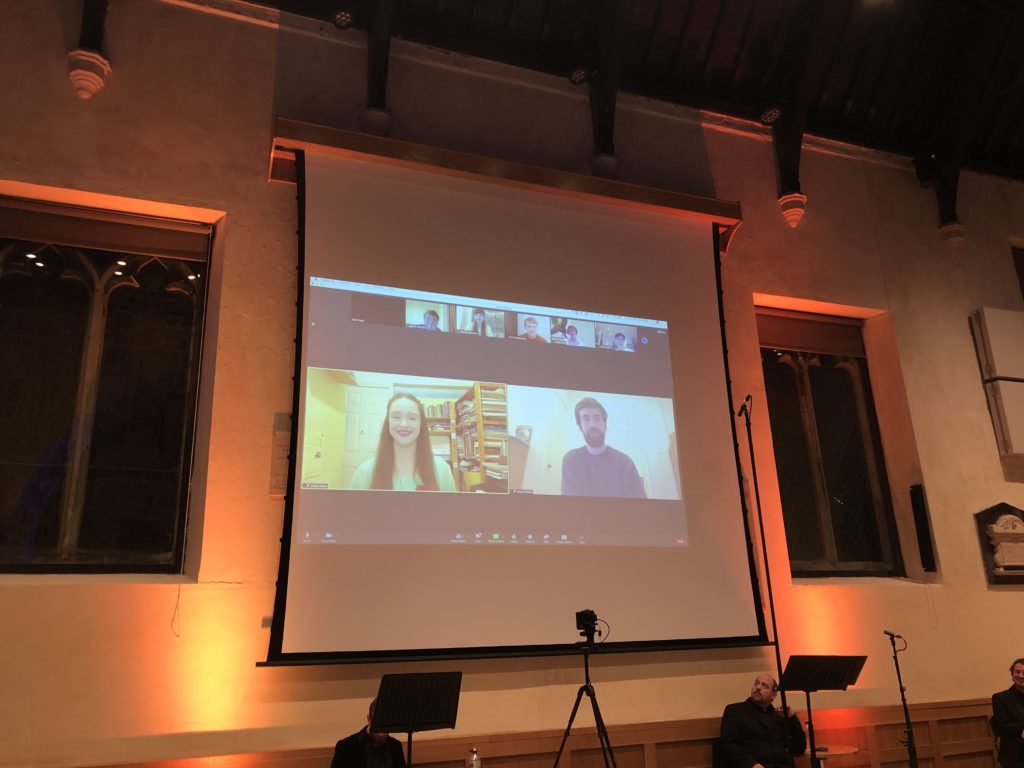
On screen: National Centre for Early Music Young Composers Award winners Eilidh Owen and Finton O’Hare, with their fellow competitors on Zoom , at last night’s live-streamed final
FINTON O’Hare and Eilidh Owen have won the National Centre for Early Music Young Composers Award prizes in York.
O’Hare emerged as the victor in the 19 to 25 age group, Owen likewise in the 18 and under category, at last night’s final live-streamed from the NCEM, St Margaret’s Church, Walmgate.
Presented in association with BBC Radio 3, the 13th iteration of the NCEM award invited young composers living in the UK to create a new polyphonic work for unaccompanied choir, setting either the Our Father (Pater Noster) prayer from St Matthew’s Gospel or the first and last verses of George Herbert’s poem The Flower.
The eight finalists’ compositions were performed by York musicians Ex Corde Vocal Ensemble, the consort of the Ebor Singers.
Seeking the prize in the 18 to 25 final were Fintan O’Hare’s composition Come Passing Rain, Noah Bray’s Our Father, Sam Gooderham’s Late-Past, Caitlin Harrison’s The Flower and James Mitchell’s The Lord’s Prayer.
Competing for the 18 years and under award were Eilidh Owen’s As If There Were No Such Cold Thing, Ethan Lieber’s The Flower and Emily Pedersen’s Pater Noster.
The evening also featured performances of works by Owain Park and Alexander Campkin, winners in 2010 when Owain took home the 18 and under prize. Both have become well established composers, providing good examples and inspiration for the 2020 entrants. Music by Alec Roth and Ben Parry was performed too.
“This year has been very different, moving the final and the workshop online, but we’re sure that the composers enjoyed this exciting experience,” said NCEM director Dr Delma Tomlin
Last night’s final followed a day-long online workshop from the NCEM, where composer Christopher Fox, professor of music at Brunel University, and Ex Corde Vocal Ensemble were joined virtually by the young composers.
The 2020 panel of judges were BBC Radio 3 producer Les Pratt, The Tallis Scholars’ director, Peter Phillips, and NCEM director Dr Delma Tomlin.
Reflecting on the 2020 competition, played out against the backdrop of the Covid-19 pandemic, Delma said: “The NCEM Young Composers Award continues to attract composers of the highest calibre from all over the UK.
“This year has been very different, moving the final and the workshop online, but we’re sure that the composers enjoyed this exciting experience. We’re looking forward to the concert at the Cadogan Hall next year with the wonderful Tallis Scholars performing the winning pieces.”
Next March’s London premiere of O’Hare and Owen’s compositions will be recorded for broadcast on BBC Radio 3’s Early Music Show.
Delma concluded: “Congratulations to our talented young composers and a special thank-you to the Ex Corde Vocal Ensemble, who helped make the award possible. I’d also like to say a big thank-you to my fellow judges and, last but not least, BBC Radio 3 for their invaluable support
“We look forward to meeting in person for the 2021 award. Details will be announced on BBC Radio 3’s Early Music Show on November 29.”
Last night’s live-streamed performance can be viewed at ncem.co.uk/composersaward.
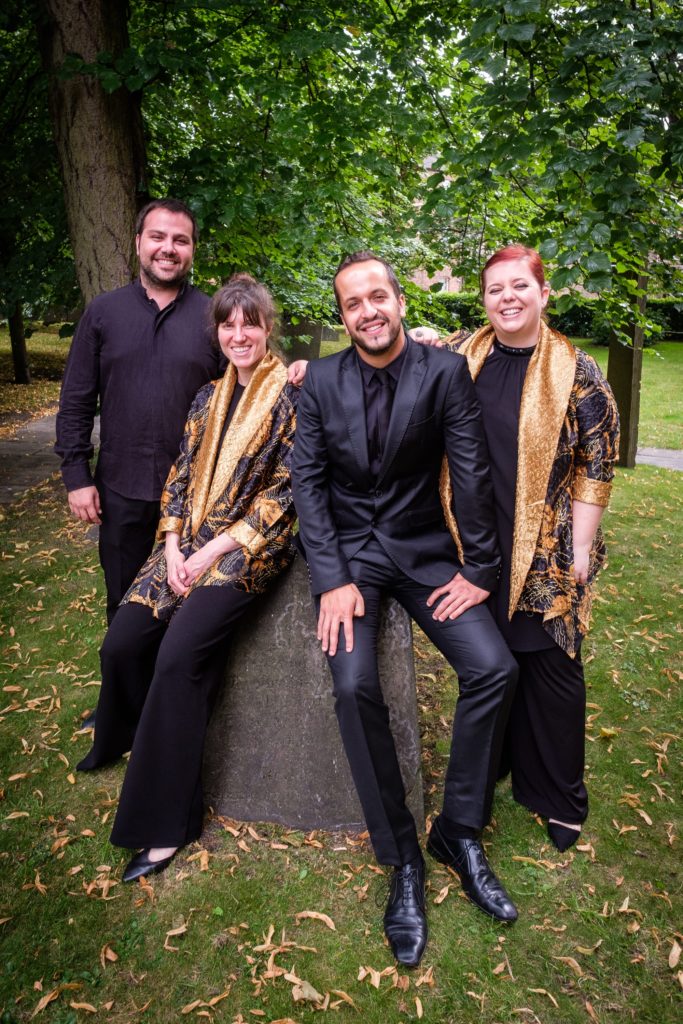
Winners: L’Apothéose in the grounds of the National Centre for Early Music after their success in the 2019 York International Young Artists Competition. Picture: Jim Poyner Photography
THE 2021 York International Young Artists Competition is to be postponed for a year.
In response to the Covid-19 pandemic, the prestigious classical music event will take place on July 13 to 16 2022 instead and subsequently will be staged every two years.
The competition is open to Early Music ensembles with a minimum of three members, who must have an average age of 32 years or under with a maximum age of 36.
The ensembles must demonstrate historically informed performance practice and play repertory from any period, spanning the Middle Ages to the 19th century, on period instruments.
This longstanding competition for young ensembles takes place at the National Centre for Early Music, St Margaret’s Church, Walmgate, as part of York Early Music Festival.
Recognised as an international platform for emerging talent in the world of Early Music, the competition attracts musicians across the globe, offering a boost to young professional careers with opportunities for performance, recording and broadcasting and international exposure.
“Every year, we are overwhelmed by the superb quality of the performances from these fantastically talented young artists,” says NCEM director Delma Tomlin
The 2019 competition final included ten ensembles with artists from 14 different countries. Winners L’Apothéose, from Spain, received a professional recording contract from Linn Records, a £1,000 prize and chances to work with BBC Radio 3 and the NCEM.
NCEM director Dr Delma Tomlin says:“The competition brings together young musicians of the highest calibre and is one of the highlights of the York Early Music Festival. With the competition attracting artists from all over the world, in the current climate we decided to move it to 2022.
“Every year, we are overwhelmed by the superb quality of the performances from these fantastically talented young artists and we hope that up-and-coming ensembles will take the opportunity to enter this world-renowned competition.”
2019 winners L’Apothéose say: “Winning the York competition was an extremely important and prestigious recognition of our career, and taking part was an immensely joyful experience.”
Fellow former winners Sollazzo Ensemble say: “Winning the competition was a turning point in our career, bringing us to the attention of both a wider audience and professionals throughout Europe.”
For details of how to apply, ensembles should go to ncem.co.uk or send an email to yorkcomp@ncem.co.uk.
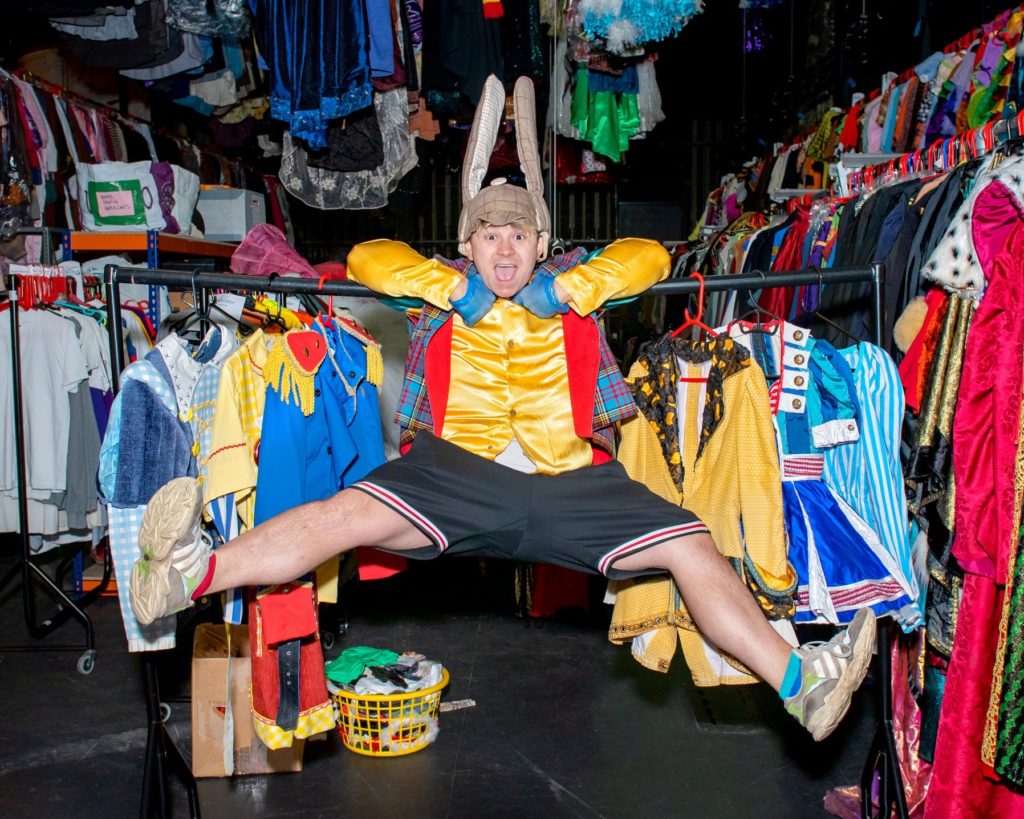
Just Joshing: York entertainer and magician Josh Benson larks around on the York Theatre Royal stage as rehearsals begin forThe Travelling Pantomime. Picture: Anthony Robling
REHEARSALS are underway for York Theatre Royal’s Travelling Pantomime, the neighbourhood show that will tour to all 21 wards in York.
Culture Secretary Oliver Dowden’s confirmation that theatre rehearsals could continue behind closed doors during Lockdown 2, despite all entertainment venues being closed from November 5, has facilitated director Juliet Forster bringing the cast together for sessions in the Covid-secure billiards room in the De Grey Rooms.
“It was a huge relief,” says Juliet, the Theatre Royal’s associate director. “We anticipated he would because he’d said film and TV rehearsals wouldn’t stop, but he hadn’t mentioned theatre at that time, so there was that awful feeling of not knowing, but it was great when the news came out at 9pm that night.”
Welcoming the cast of Robin Simpson, entertainer and magician Josh Benson, actor-musician Anna Soden, Reuben Johnson and Faye Campbell, chief executive Tom Bird says: “We’ve put Covid safety measures in place and will be carefully following Government guidelines over the weeks ahead, but we’re thrilled that we can carry on with our plans to take our pantomime out to the people of York this year.”
Revised dates – moved to a later start after Lockdown 2 was announced – are now in place for a run from December 3, with more to be added. The preview night on a pop-up theatre on York Theatre Royal’s main stage on December 3 will be filmed for broadcast so anyone who misses out on a ticket can still enjoy the show, co-produced by York Theatre Royal and new pantomime partners Evolution Productions.
“Be assured, one way or another, York Theatre Royal’s Travelling Pantomime will be coming to you,” says Tom.
“Panto really benefits from the input of the live audience, so that’s why it was always our intention to do the recording in front of an audience,” says Juliet.
York Theatre Royal associate director Juliet Forster and chief executive Tom Bird with Paul Hendy, producer of pantomime partners Evolution Productions
Joined in the production team by Pop-Up On The Patio designer Hannah Sibai, choreographer Hayley Del Harrison and musical director James Harrison, Juliet will be working on not one, but three 70-minute pantomimes written by Evolution producer Paul Hendy for each audience to vote whether to see Jack And The Beanstalk, Dick Whittington or Snow White.
Three pantomimes? Plenty to rehearse there, Juliet?! “It’s do-able, and thanks to the Government, we have a bit more rehearsal time now,” she says.
A cast of only five will help too. “Because we’re working on a small touring stage, it wouldn’t have made sense to do a big-sized show with a dance ensemble,” says Juliet. “You may lose some spectacle, but in terms of story-telling, chatting with Paul [writer Paul Hendy], we decided that having just the five key characters intensifies the story, investing in each character’s journey.”
Actor and writer Reuben Johnson will play Fleshcreep and Ratticus Flinch, the villain’s roles, after working previously with Juliet last year, appearing as the thoroughly decent Marco in the Theatre Royal’s autumn production of Arthur Miller’s A View From The Bridge.
“It was quite a different show from doing a panto!” he says. “We met on Skype to talk about it, and it’s a perfect chance to work on something fun in such dark times.”
“Reuben has such comedic funny bones, which you wouldn’t have seen in A View From The Bridge, but even there he mined a few comic moments,” says Juliet. “Sometimes you get someone in your head when you read a script, and they keep coming back into your head, like Reuben did, even though I think of him as a very serious actor. Some of my best casting has come that way.”
“I’m trying to find the humour and likeability of the villain, which really contradicts the audience’s thoughts and expectations,” says Reuben Johnson as he prepares to play Fleshcreep and Ratticus Flinch. Picture: Anthony Robling
Reuben may be a pantomime debutant but says: “I’m a theatre fan in general. I love Shakespeare, new plays, physical comedy, pantomime. Panto wouldn’t normally be number one, but I enjoy all theatre and we do need some big fun right now.”
Reflecting on taking on the villain’s role, he says: “I’ve played baddies quite a bit, and what I like to think I can bring to them, when playing stereotypical villains, is trying to find the humour and likeability of that character, which really contradicts the audience’s thoughts and expectations about that person.
“When I watched them as a child, I often thought that bad guys were hilarious to be around, very rowdy, exciting. Now I’ve got the chance to go to town with it in pantomime.”
One rule of acting asserts that you do not have to sympathise with the characters you play, but you should at least empathise with them. “As long as you know your motivation, it’s how you then go about playing the villain,” says Reuben.
“In pantomime, you’ll want to hear people both laughing at you and with you. It’s that love/hate thing.”
Robin Simpson was last seen on the Theatre Royal stage in Northern Broadsides’ Much Ado About Nothing in May 2019 and has Theatre Royal credits to his name in The Railway Children, The Wind In The Willows, Pinocchio and Pygmalion.
This winter he returns in the juiciest of all pantomime parts, the Dame, a role he has played for the past three years at the Lawrence Batley Theatre, Huddersfield. “This time feels very different because of the current situation and the nature of the show,” says Robin, who played Dame Dolly in Jack And The Beanstalk, Widow Twankey in Aladdin and Nanny Fanny in Sleeping Beauty.
“We didn’t mine that name for any humour, I can assure you! We were all very grown up about it, weren’t we!”
“It’s like being the best kind of party host,” says Robin Simpson, summing up the joy of playing the dame in York Theatre Royal’s Travelling Pantomime. Picture: Anthony Robling
Defining the dame’s importance to pantomime, Robin says: “It’s like being the best kind of party host, being welcoming, over the top, ebullient, everyone’s friend, which is so nice to play.”
In dame tradition, from Dan Leno to Berwick Kaler, he has settled on his distinctive persona. “If you’ve got something that works, if it ain’t broke, don’t fix it,” Robin says of the upcoming prospect of playing three variations on Dame Dolly next month.
“My dame is like Bugs Bunny, Elmer Fudd and Daffy Duck rolled into one! There won’t be any variation, except trying to remember who I’m playing each time, with the different frocks denoting the character.
“It’s very much a case of the dame generally being a working-class single mother, with numerous children; hard working, straight talking and funny. I’m sort of basing it loosely on northern women when I was growing up. That Ena Sharples character [in Coronation Street], gossiping over the wall; that matriarch; that Les Dawson send-up with Roy Barraclough.
“There’s lots of love there, but she’s also as hard as nails, and you don’t see that much anymore, but hopefully it’s still recognisable. But ultimately with the dame, she comes on stage as a bloke in a dress who tells jokes.”
Lockdown in March turned the lights out on stages across the country but both Johnson and Simpson have sought to keep busy. “I’ve done OK,” says Reuben. “Fortuitously for me, I write as well, doing spoken-word, so I’ve got by on that, with a few little acting jobs as well, but I’ve been craving getting back to work on a stage and that’s not been possible until now. Returning to the rehearsal room has been like a dream.”
Robin, who is also a storyteller, working in schools, libraries and museums all over the country, says: “I don’t want to complain too much because I know people have been going through worse. I’ve worked online, recording stories, learning skills like how to record and creating little films and kids’ stories on Facebook Live for Oldham Libraries,” he says.
York actor-musician Anna Soden, who will play Fairy and Sea Captain and a multitude of musical instruments in The Travelling Pantomime. Picture: Anthony Robling
“I think there’s merit in recording shows as I can reach places I couldn’t do with live performances for the library service, though you’ll never beat the ‘liveness’ of a show.”
Juliet rejoins: “It all comes back to the shared experience.” “That’s what we’re all desperate for,” says Robin.
“That’s why we couldn’t let go of the need to do a Theatre Royal pantomime this Christmas, even when we knew we weren’t going to be able to open the theatre,” says Juliet. “The prospect of not doing a panto felt wrong.
“We’d talked about community touring and rural touring, and our research told us that audiences would feel more comfortable going to a show locally with their neighbours, rather than coming to the theatre with people from all over the place.
“That’s why we decided to take something so synonymous with Christmas out of the theatre into York’s community centres, church halls and schools for families to have some festive fun with Paul’s shows that are really warm, funny for all ages, packed full of good characters and not innuendo.”
For tickets, dates and more details for The Travelling Pantomime, go to yorktheatreroyal.co.uk.
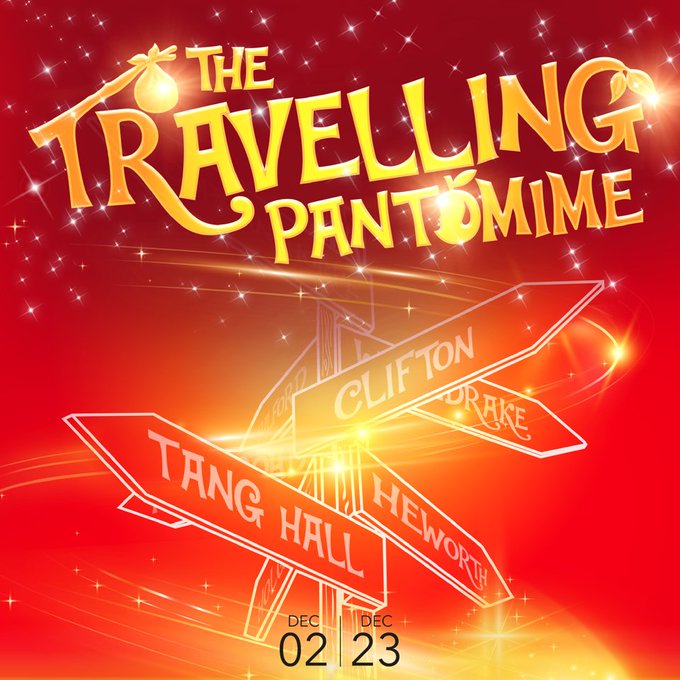
Here, there and everywhere: York Theatre Royal’s poster for The Travelling Pantomime
YORK THEATRE ROYAL’S TRAVELLING PANTOMIME schedule of performances. Confirmed so far:
December 2: Members-only preview, York Theatre Royal (pop-up theatre on main stage).
December 3: Preview, York Theatre Royal (pop-up theatre on main stage).
December 4: Tang Hall Community Centre, 4.30pm and 7pm.
December 5: New Earswick Folk Hall, 4.30pm and 7pm.
December 8: The Reading Room, Dunnington, 7pm.
December 9: Wiggington Recreation Hall, 7pm.
December 10: St Barnabas Primary School, Holgate. Afternoon school performance; public
Performance, 6pm.
December 11: Clifton Church Hall, 4.30pm and 7pm.
December 12: Elvington Village Hall, Wheldrake, 4.30pm and 7pm.
December 13: The Poppleton Centre, 4.30pm and 7pm.
December 15: Acomb Parish Hall, 7pm.
December 16: Carr Junior School. Afternoon school performance; public performance, 6pm.
December 18: Copmanthorpe Methodist Church Hall, 4.30pm and 7pm.
December 19: Clifton Green Primary School, 4.30pm and 7pm.
December 20: York Pavilion Hotel, 4.30pm and 7pm.
December 22: Heworth Christ Church, 4.30pm and 7pm.
December 23: Archbishop Holgate’s School, 4.30pm and 7pm.
Additional venues to be confirmed.
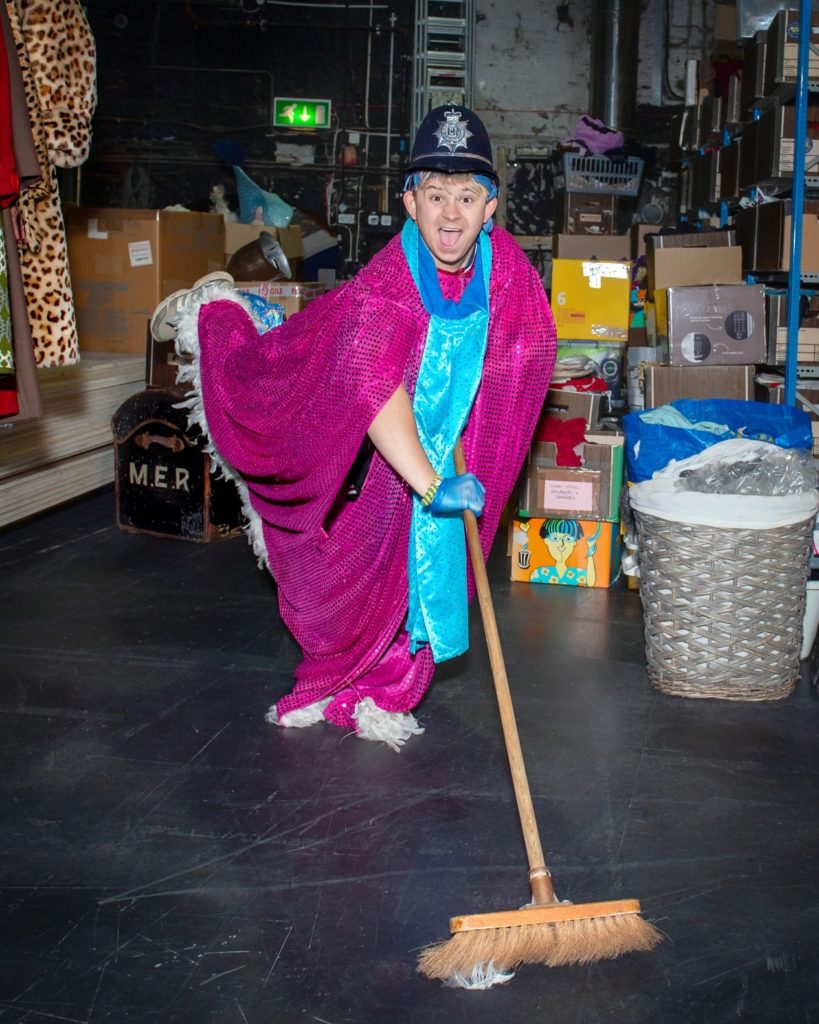
Brushing up on his role: Josh Benson goes to work at York Theatre Royal
Tickets cost £10 for adults, £5 for children, with a maximum party size of six people in a household or support bubble.
Up to 25 per cent of tickets will be made free of charge to families in need this Christmas.
Capacity at some venues is small. Tickets are available on a first-come, first-served basis to anyone living in a York city ward.
Did you know?
TRAVELLING Pantomime musical director James Harrison was musical supervisor/director for Evolution Productions’ award-winning 2019-2020 pantomime, Cinderella, at Sheffield Lyceum Theatre. He was awarded the Best Music prize at the Great British Pantomime Awards.
Please note: York Theatre Royal’s planned 2020/21 pantomime, Cinderella, will not go to the ball until next winter.
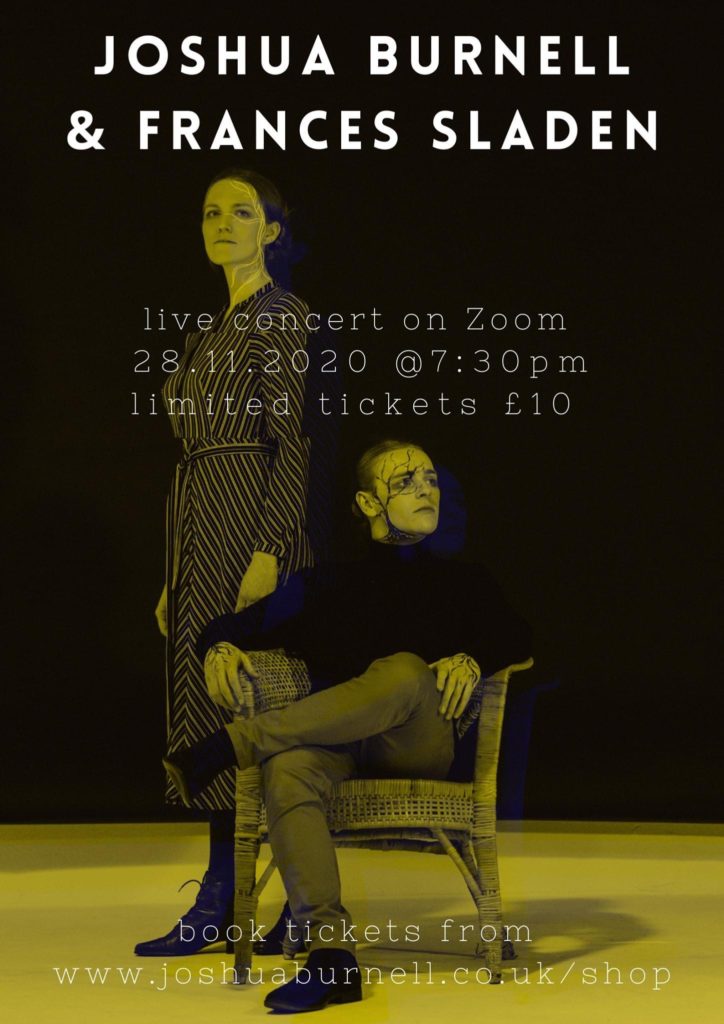
JOSHUA Burnell and Frances Sladen’s online Zoom concert on November 28 at 7.30pm has sold out.
“We are aiming to create a relaxed, house-concert atmosphere, so there’ll be opportunities to have a chat with us, if you choose,” says York folk-fused baroque’n’roll musician Joshua, who released his latest album, Flowers Where The Horses Sleep, in September.
“Contact us if you are interested in the concert but missed out. If more tickets are released, we will get in touch.” To be on that list, go to: joshuaburnell.co.uk.
Future of folk multi-instrumentalist, singer and composer Burnell and vocalist partner Sladen played an earlier online gig, organised by the East Riding Theatre, Beverley, on October 17, when they performed acoustic versions of songs old and new.
“Pantomime is the perfect way to end the working year,” says choreographer Gary Lloyd. Picture: Michael Wharley
GARY Lloyd, choreographer to the stars and hit musicals galore, is to work his magic on the York Stage pantomime, Jack And The Beanstalk, at Theatre @41 Monkgate, York.
Further buoyed by Culture Secretary Oliver Dowden’s affirmation that theatre rehearsals can continue during Lockdown 2, artistic director, writer and producer Nik Briggs says: “I’m ecstatic that the incomparable Gary Lloyd is joining us.
“To have a world-renowned choreographer like Gary coming to work with us really is something special. I’m such a fan of his work; the way he tells a story on stage really is something to behold.
“For those people who have seen Thriller Live, either in the West End or as part of its world tour, you will know how high energy and dynamic his dances are. He really does know how to stage a show-stopping number,” says Nik.
Lloyd has made his mark as director/choreographer of such shows as the aforementioned Thriller Live, the Michael Jackson tribute, and 20th Century Boy, the Marc Bolan jukebox musical, bringing both to the Grand Opera House, York, along with his production of Fame, The Musical and more besides.
Aside from musicals and theatre, his credits cover everything from choreographing American Idol, The X Factor, the Eurovision Song Contest and a Victoria Beckham commercial, to working with Sir Paul McCartney, Giorgio Moroder, Robbie Williams, Dame Shirley Bassey, P!nk and Sir Tom Jones.
Based down south, Grimsby-born Gary is no stranger to York. “My father Geoff [York Stage’s set builder Geoff Theaker] and my sister Jo [York Stage regular principal Joanne Theaker] live there,” he says. “Jo’s worked with Nik, on stage and at York Stage School too, and coming to the shows, I’ve seen the company grow and do wonderful things.”
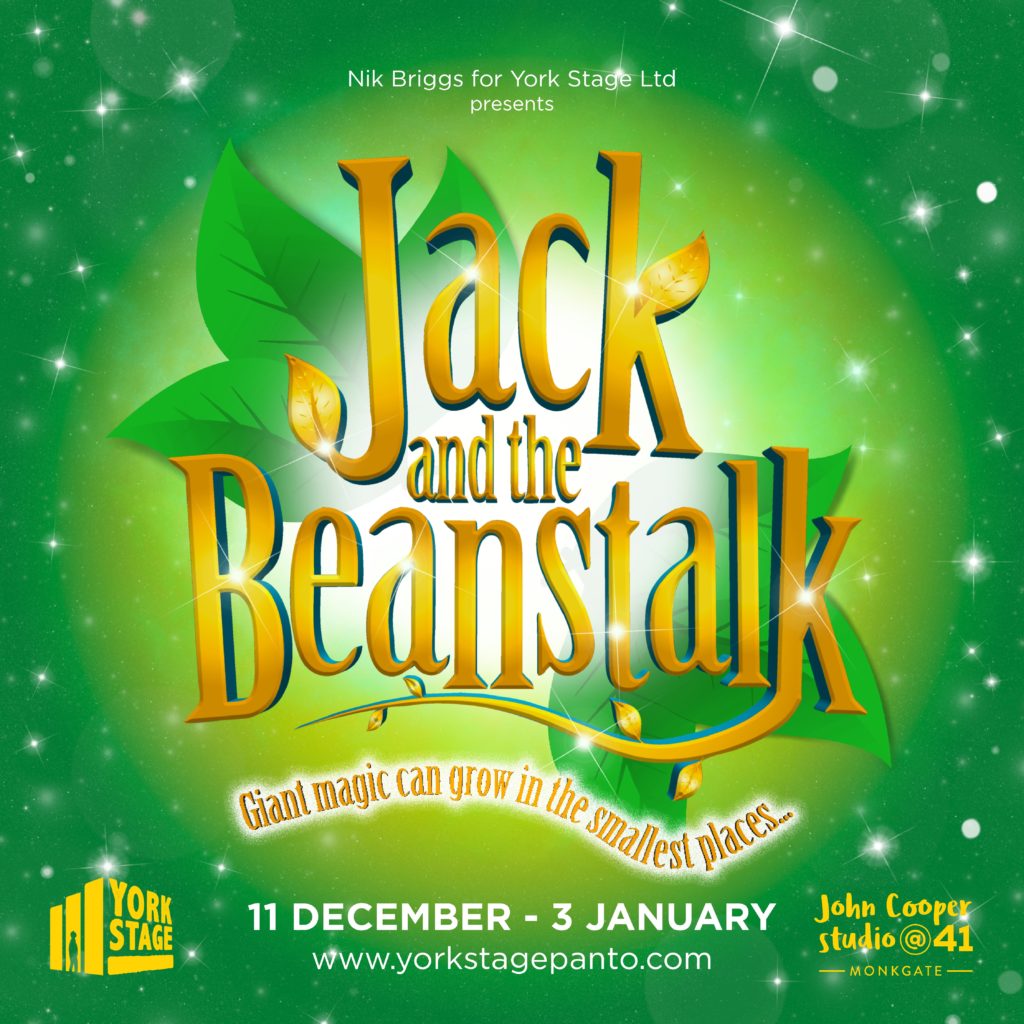
The York Stage poster for Jack And The Beanstalk
Gary’s own shows are “all on this conveyor belt waiting to come out of hiding,” he says. “My biggest fear is that producers will want them all to re-open at the same time.” Under the never-ending Covid cloud, it would nevertheless be a nice problem to have.
Given the stasis inflicted on so many theatres and touring shows by the pandemic, Nik saw the opportunity to bring Lloyd north for Jack And The Beanstalk. “He approached me about a month ago, saying ‘would you like to come up and do our pantomime if you have nothing else on?’,” says Gary.
“I would normally have been doing panto as choreographer and director for Jonathan Kiley’s pantomimes, but then came the shutdown, which was a big blow. So, for any of us who can grab hold of one, like me doing Nik’s show, it’s a thing of joy at what will otherwise be a really dark time.”
Gary is a pantomime devotee. “I love it for many reasons,” he says. “I love it primarily because, for me, it is the perfect way to end the working year, walking into the rehearsal room to work very quickly on making a show where everyone is at the top of their game, resulting in pure joy for four generations of audiences.
“It’s pure entertainment, put on by people who really know what they’re doing, especially the comedians, putting together lavish shows with such wonderful content. When panto is done well, like QDOS spending all year on their scripts, getting the topical gags in there, it’s such a joy with big rewards.”
Gary attended a couple of socially distanced London shows once theatres reopened: Fanny And Stella at the Garden Theatre and his friend Jason Robert Brown’s The Last Five Years at Southwark Playhouse, where Perspex screens protected audience members, just as they will at Theatre @41.
“Once the lights go down, you forget all of what’s going on outside, or being crammed in between Perspex screens, you forget all that, because the magic of theatre takes over,” says Gary.
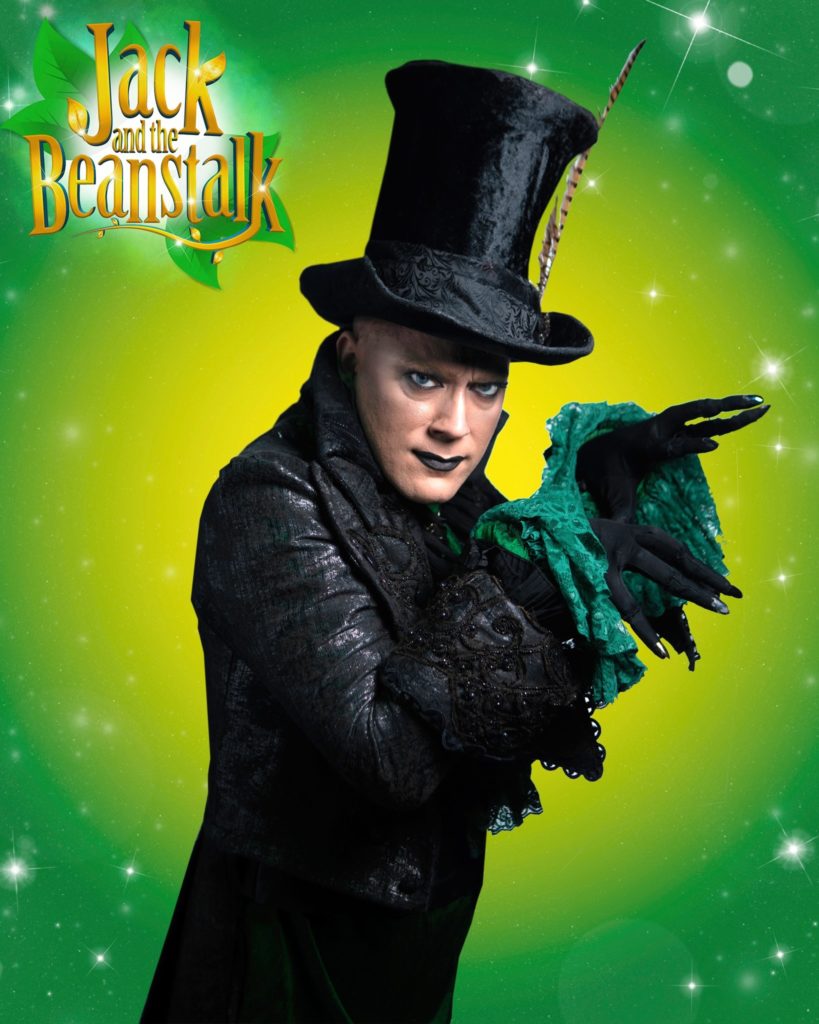
Ian Stroughair, creator of drag diva cabaret sensation Velma Celli, will turn to the dark side to play Flesh Creep in Jack And The Beanstalk. He has worked previously with choreographer Gary Lloyd. Picture: Charlie Kirkpatrick
“Right now, we need that escape, that entertainment, and that won’t be any different with Nik’s show.
“I’m looking forward to working on a more immersive show, where we’ll really be able to pick on someone in the crowd, which will give panto a new life this year, when there’ll only be a comparative handful of people there [80 maximum], and they’ll have to play their part in creating a good atmosphere at each show.”
Broadening his thoughts, Gary says: “It’s a chance to show the Government that theatres can be a safe environment, and we need to be able to open theatres as soon as possible when we can show it’s safe.
“I don’t want to get political, but you go past pubs bursting with people, whereas theatres are places where people do behave and go there for more sophisticated reasons. Theatre managers and owners are the ones who know how theatre could work in this present environment.”
Working in the arts in Covid-19 2020 with ever-changing Government strictures has been a “daily one step forward, two steps back,” says Gary. “But we’re all in the same boat together. I’ve made it my mission to work with young people coming out of college, training for an industry that they may never be able to work in.
“I’ve been doing that on Zoom, as well as teaching a bit of choreography once a week at a studio, always having a chat, because taking care of your mental health is so important.”
Gary was last on a stage in March in London. “Before Lockdown, I was working on Heathers, The Musical; we’d had had three weeks of face-to-face rehearsals on the Thriller Live stage in the West End, but then it all came to a halt,” he says of a production that had been scheduled to run at Leeds Grand Theatre from November 3 to 7.
“Working for producer Bill Kenwright has been a saving grace at this time; he’s been very optimistic about getting back to work, not paying attention to the media circus, but building a very positive attitude.
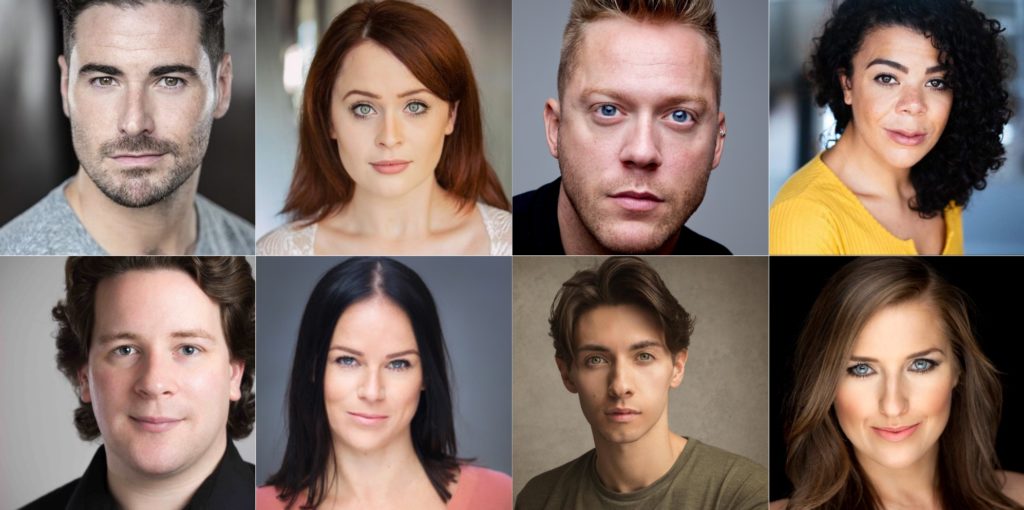
Bean team: York Stage’s cast for Jack And The Beanstalk; back row, from left, Jordan Fox, May Tether, Ian Stroughair, Livvy Evans; front row, Alex Weatherhill, Emily Taylor, Matthew Ives and Danielle Mullan
“The Leeds Grand performances were a definite until they got wind that the second lockdown could happen, so we’re now waiting for the next bit of news. It’s a daily one step forward, two steps back.”
In his Zoom training sessions and choreography teaching, Gary has stressed the importance of keeping up the highest standards. “The industry will come back, and it will come back with a bang, and these kids don’t have any excuses not to keep up with their fitness, their CV, their singing,” he says. “They need to be disciplined as individuals, not just in a class, so that’s the tough love I’ve been giving out.”
Lockdown may have imposed a hiatus on the theatre world, but reflecting on a career crammed with so many shows, Gary says: “I don’t stop…and I’ve been very lucky. I started out training to go into the theatre; that was my passion; my first job was Cats at 18, for two years, and then I show-hopped for ten years.
“I was always the dance captain, I always did extra choreography and then stepped through the door to do the assistant directing for Kim Gavin’s original production for Oh! What A Night. That’s where my choreography and directing started.”
Plenty of television work ensued. “But after a while it all became very samey.The money’s fantastic but you end up doing the same thing over and over, and I found I really missed theatre,” says Gary.
“I was approached to direct The Genius Of Ray Charles, took it to Las Vegas and then the West End, and I’ve since been able to move between two mediums, theatre and musicals, by refusing to let the industry put a label on me…because there was a time when you couldn’t work with a pop artist. But Thriller Live was a perfect vehicle for me: part theatre show, part concert.”
Now, Gary is preparing to work with the York Stage company of Jordan Fox, May Tether, Ian Stroughair, Livvy Evans, Alex Weatherhill, Emily Taylor, Matthew Ives and Danielle Mullan, who begin rehearsals for Jack And The Beanstalk at Theatre @41 on November 23.
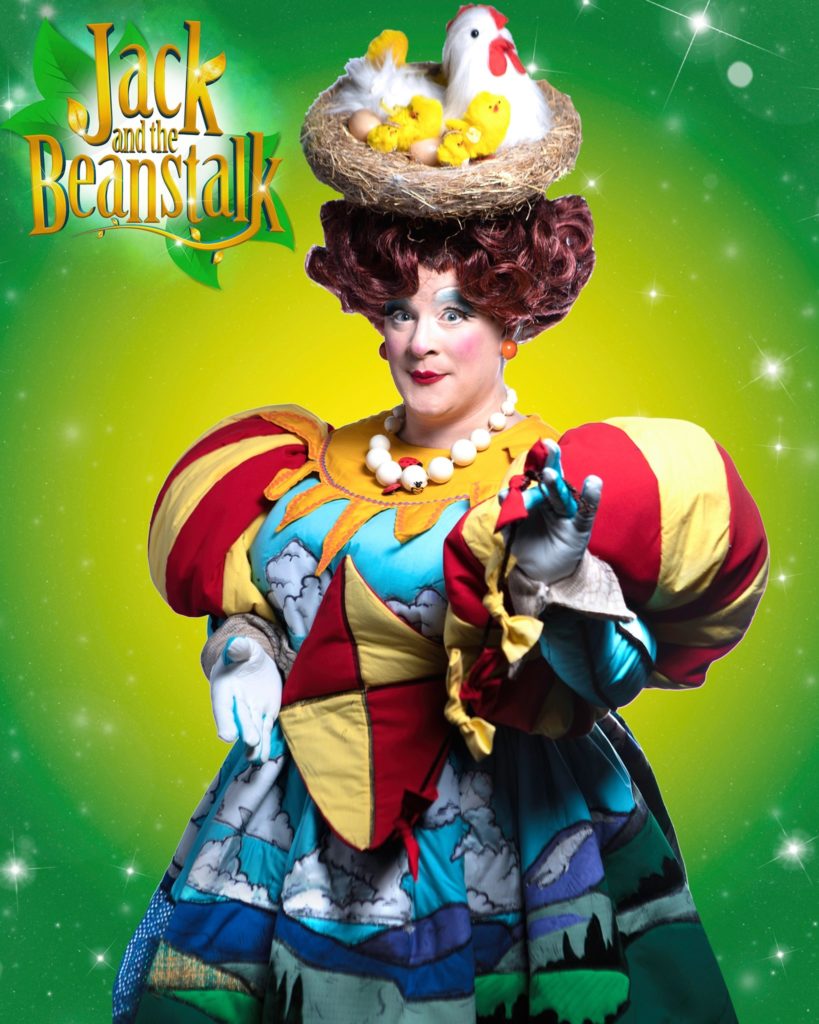
Alex Weatherhill as Dame Trott in York Stage’s upcoming pantomime Jack And The Beanstalk. Picture: Charlie Kirkpatrick
“Nik’s put together a fantastic cast and I’m really looking forward to working with these guys,” he says. “I know this pantomime is going to be an explosion of joy.”
Nik eagerly awaits Gary’s impact on his company and on audiences too. “The chance to see his work up close at Theatre @41 really is going to be a once-in-a-lifetime opportunity for York,” he says. “We’re taking our West End-worthy panto to the next level with the addition of Gary to our company.”
York Stage present Jack And The Beanstalk at the John Cooper Studio, Theatre @41 Monkgate, York, from December 11 2020 to January 3 2021. Box office: online at yorkstagepanto.com.
Show times will be Monday to Saturday, 2pm and 7pm; Sundays, 1pm and 6pm; Christmas Eve, 12 noon and 5pm; New Year’s Eve, 12 noon. Tickets for the 40 performances range from £20 to £27 and are on sale online only at yorkstagepanto.com. Please note, audiences will be seated in household/support bubble groupings only.
WHO IS GARY LLOYD? Award-winning director/choreographer Gary Lloyd is known for his crossover from music to theatre.
He has worked as creative director with some of the world’s biggest artists on their live performances and arena tours, bringing his wealth of experience in the latest technology and sound, as well as his innate creative vision, to the theatrical stage.
Gary Lloyd: director, choreographer, author
Theatre REFLECTIONS, The Holland-Dozier-Holland Story, Stage West, Calgary.
HEATHERS, The Musical, associate director and choreographer, The Other Palace and Theatre Royal, Haymarket. Winner, Best New Musical, WOS Awards 2018; Best Off West End Production, West End Wilma Awards 2018.
JNH 3 Decades of Music for Hollywood, James Newton Howard In Concert, European tour.
ONE NIGHT OF TINA, European tour.
WAR DANCE, workshop, Ventura, Carnival Cruise Lines.
THE KNIGHTS OF MUSIC, UK Tour.
CARRIE, The Musical, Southwark Playhouse. Winner, Best Off West End Production, WOS Awards 2016; Off West End Award nominee, Best Director, Best Choreographer.
THRILLER LIVE!, Lyric Theatre, West End. 2012/2013 Olivier Audience Award nominee and 2010 What’s On Stage Nominee, Best New Musical and Best Choreographer). Also UK Tours and World Tour.
Warren Sollars as Marc Bolan in Gary Lloyd’s production of 20th Century Boy at the Grand Opera House, York, in May 2014. Picture: Robert Day
20TH CENTURY BOY, The Story of Marc Bolan, UK Tour. Broadway World winner for Best New Touring Musical and nominee for Best Choreographer and Best Actor in a Musical.
HAIR The Musical, Piccadilly Theatre, in support of Help For Heroes; Ahoy Arena, Rotterdam, and European Tour.
20th CENTURY BOY, New Wolsey Theatre, Ipswich, 2011 What’s On Stage nominee for Best Regional Production.
THE GENIUS OF RAY CHARLES, Theatre Royal Haymarket, UK and North American tours.
JESUS CHRIST SUPERSTAR, Scandinavian Tour.
SPIRIT OF CHRISTMAS, Kodak Theatre Los Angeles.
WHAT A FEELING! , 2006 UK Tour.
As Choreographer/Movement Director CRUEL INTENTIONS, Palais du Varieté, Edinburgh Fringe Festival. Winner, Best Fringe Production, Broadway World Awards 2019.
JOSEPH AND THE AMAZING TECHNICOLOR DREAMCOAT, 50th Anniversary Touring Production.
THE LIFE, English Theatre, Frankfurt, Germany.
FAME THE MUSICAL, Grand Canal Theatre, Dublin, and Ireland Tour.
“ZIP”, Giant Olive Theatre, London.
ASPECTS OF LOVE, UK Tour starring David Essex.
AMADEUS, Sheffield Crucible Theatre.
ANIMAL FARM, West Yorkshire Playhouse, Leeds.
MY FAIR LADY, Larnaca Festival and South East Asia Tour.
CITY OF ANGELS, English Theatre, Frankfurt, Germany.
ZORRO The Musical, workshop.
OH! WHAT A NIGHT, associate director/choreographer;
TV, Film & Music Gary has worked with: Giorgio Moroder; Kelly Clarkson; Leona Lewis; Robbie Williams; Pink; Anastasia; John Barrowman; Peter Andre; Stooshe; Macy Gray; NeYo; Joe McElderry; Victoria Beckham; Jennifer Hudson…
Sir Paul McCartney; Sir Cliff Richard; Dame Shirley Bassey; Sir Tom Jones; Robin Gibb; Ray Quinn; G4; Will Young; Gareth Gates; Emma Bunton; Lemar; Rachel Stevens; Natasha and Daniel Bedingfield; Girls Aloud…
Liberty X; Dani Harmer; All Angels, RyanDan; Blake; Faryl Smith; Ordinary Boys; Blue; Atomic Kitten; Basement Jaxx; ABC; Soul II Soul and S Club 8.
Gary has acted as creative director and choreographer for these acts on international tours, single and album launches and music videos.
Television credits
Elizabeth, Michael And Marlon, movement coaching for Joseph Fiennes; American Idol, Seasons 1 to 3; Disney’s My Camp Rock; The X Factor, BBC’s Skate Nation and Jump Nation and The One And Only, all as choreographic expert and mentor.
Ant And Dec’s Saturday Night Take Away; Brits 25; The Classical Brit Awards; The Royal Variety Performance; I DREAM; Eurovision Song Contest; Bump N Grind (Trouble TV); Comic Relief; ITV’s Avenue Of The Stars.
Commercials
Victoria Beckham VB Denim Range; Wispa, For The Love Of Wispa; Daz , I’m Too Sexy; Debenhams, Styling The Nation.
Anything else?
Two Royal Gala Performances at the London Palladium and Theatre Royal, Drury Lane.
Artistic director for the BAFTA Awards.
The Queen’s Golden Jubilee Concert at Buckingham Palace.
Stage director and choreographer on the 2005 Royal Variety Performance in the presence of Her Majesty the Queen at the Wales Millennium Centre.
Gary’s first book, My Life With Michael, Ten Years Of Thriller Live, was published by The Book Guild in paperback in October 2019.
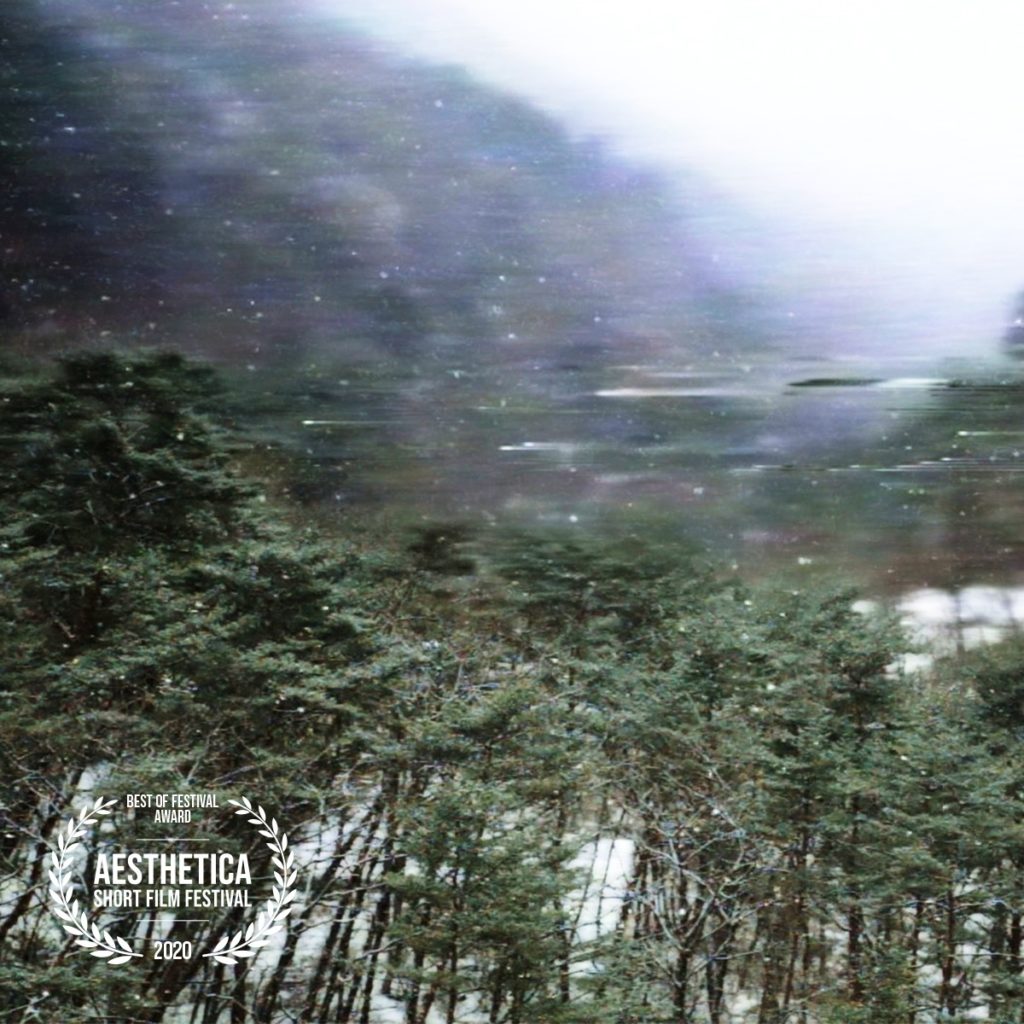
Double winner: Maija Blåfield’s The Fantastic won both the Best Of Fest and Best Documentary awards on Sunday at the 2020 Aesthetica Short Film Festival
MAIJA Blåfield’s aptly named The Fantastic has won the Best of Fest at the 2020 tenth anniversary online edition of the Aesthetica Short Film Festival.
More than 300 films competed for the awards in the BAFTA Recognised festival in York, ranging from poignant documentaries that tap into the climate crisis to touching dramas about loss and forgiveness.
At Sunday evening’s close of the six-day festival, the live-streamed awards ceremony was hosted by regular master of ceremonies Greg McGee, following the judging by experts from Film4, BFI Network, ICA London and Nowness.
Winning awards at ASFF can bolster the success of the stand-out films, as shown by past winners going to receive Oscars, such as Chris Overton’s sweet-natured The Silent Child and Benjamin Cleary’s Stutterer.
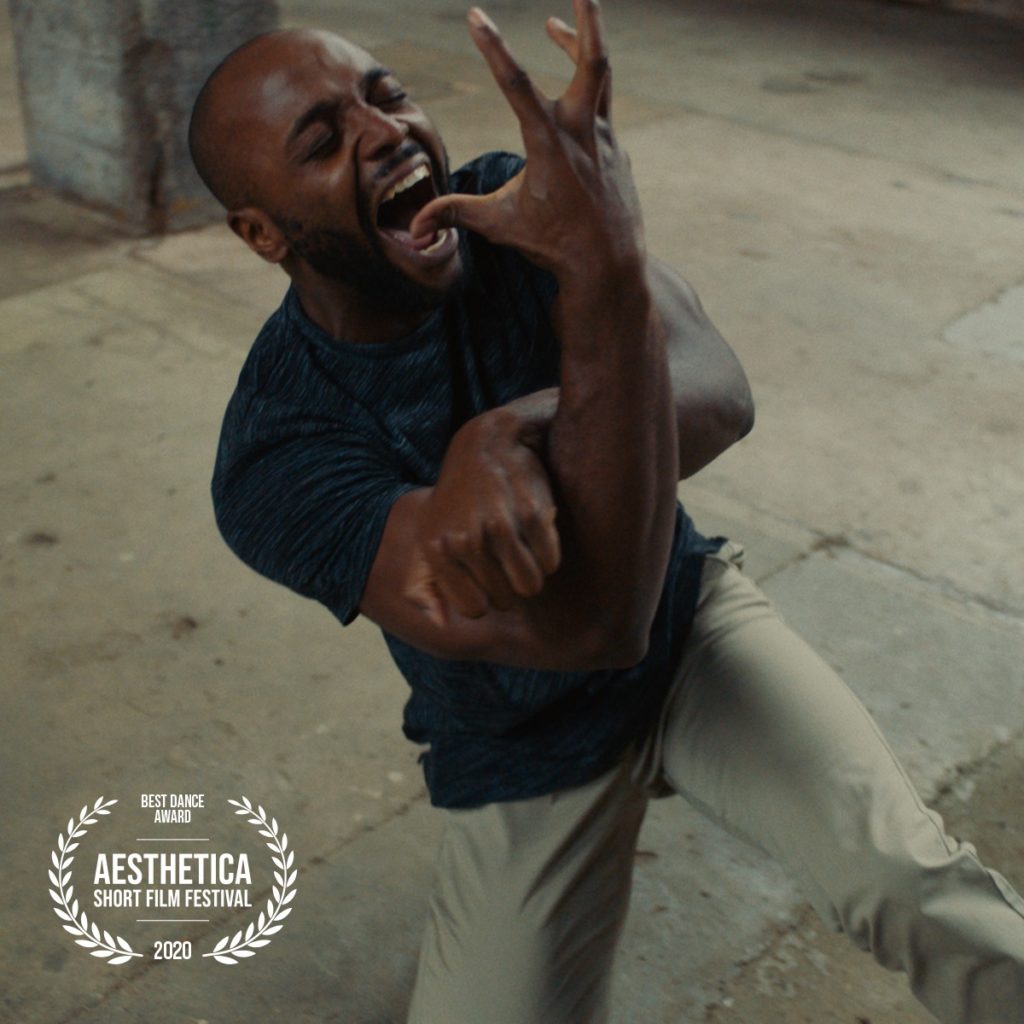
The Conversation: Winner of the Best Dance award
Keep an eye out for The Fantastic after Maija Blåfield’s film garnered both the Best of Fest and Best Documentary awards. In this short, eight former North Koreans discuss illegal foreign movies they watched in their homeland. How did they imagine the reality based on fictional films? The Fantastic is not about North Korea, Blåfield says.
Further awards went to:
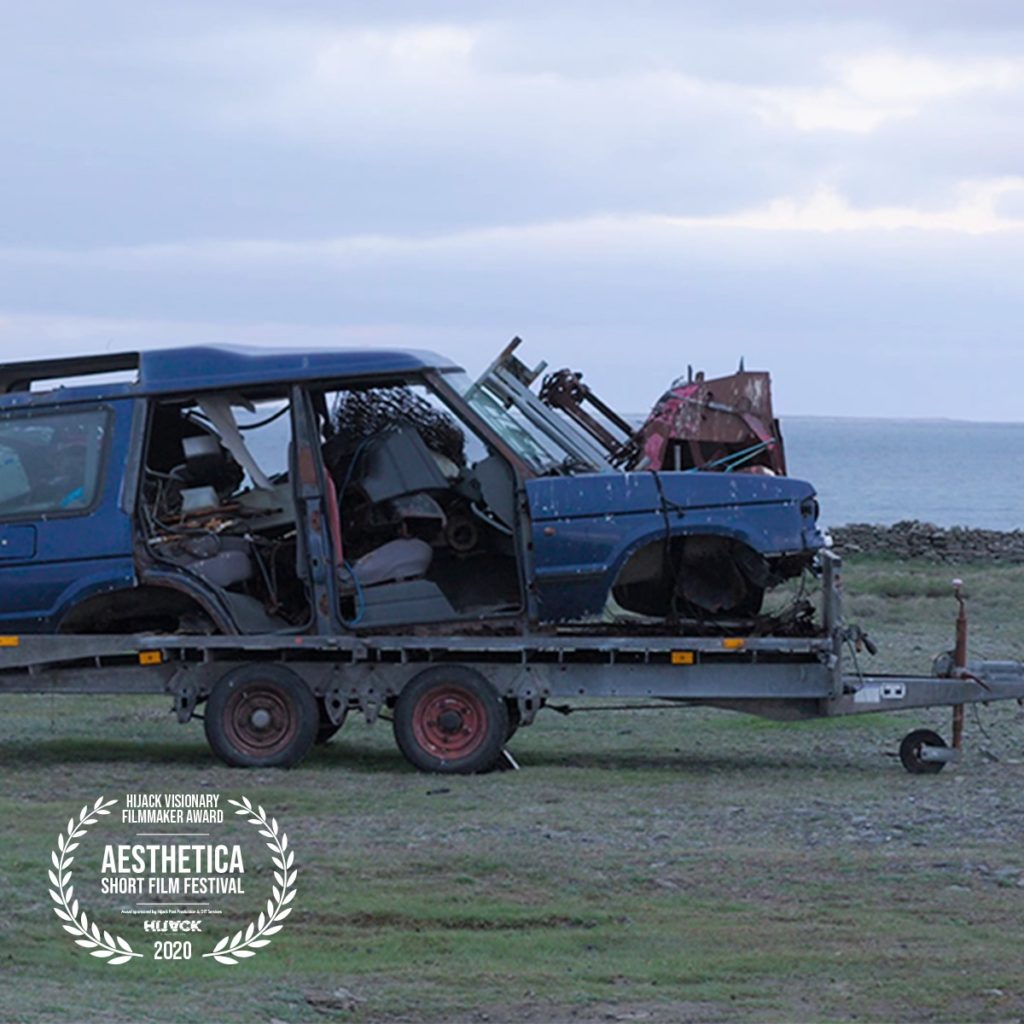
Hijack Visionary Filmmaker Award
Thinking About The Weather, directed by Gardar Thor Thorkelsson
DESPERATE to resolve his anxieties about the looming climate apocalypse, the filmmaker embarks on an odyssey around Britain, speaking to coastal inhabitants resting on a rising coastline, as well as Extinction Rebellion protestors.
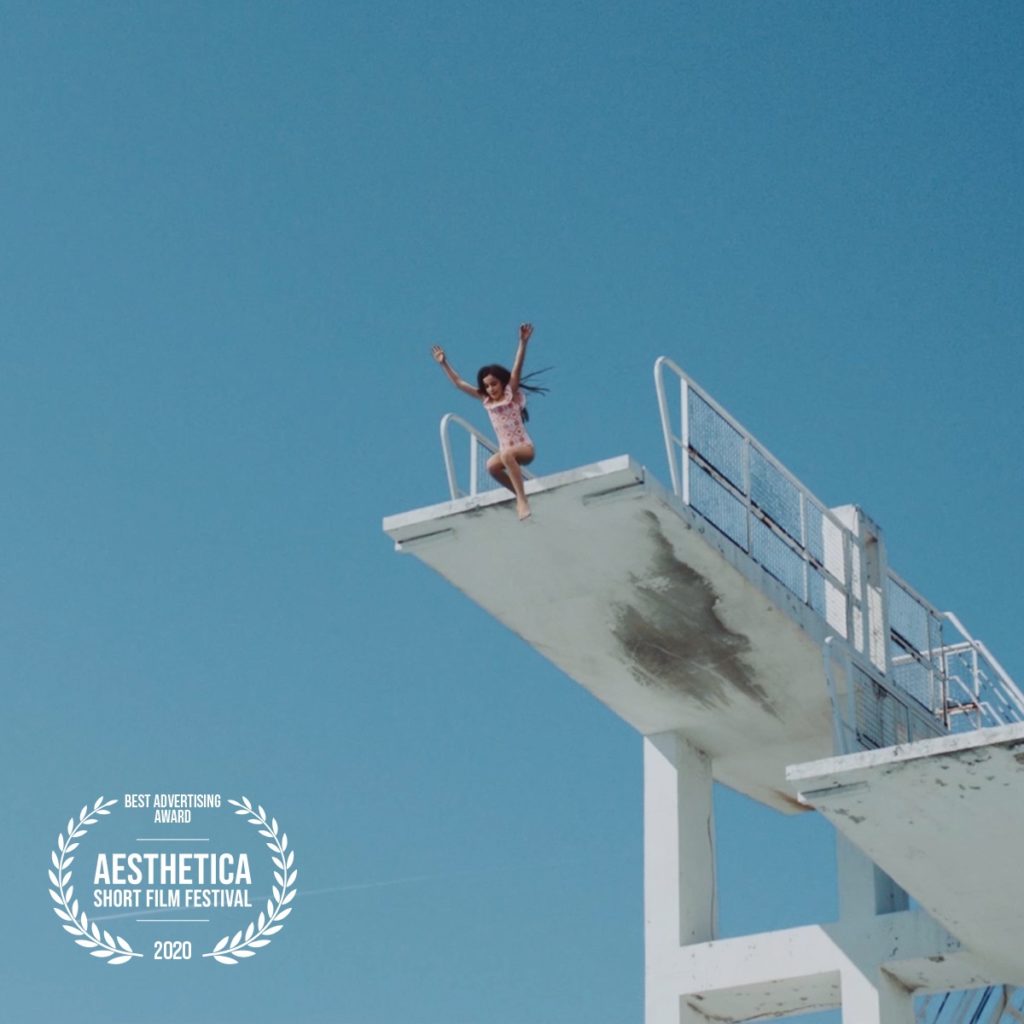
Safe Water: Winner of the Best Advertising Award
Best Advertising
Safe Water, directed by Mario Dahl
A GIRLl walks right to the edge of the board, breathing deeply, ready to make the biggest jump of her life, but what awaits her down there? Safe water is more important than ever.
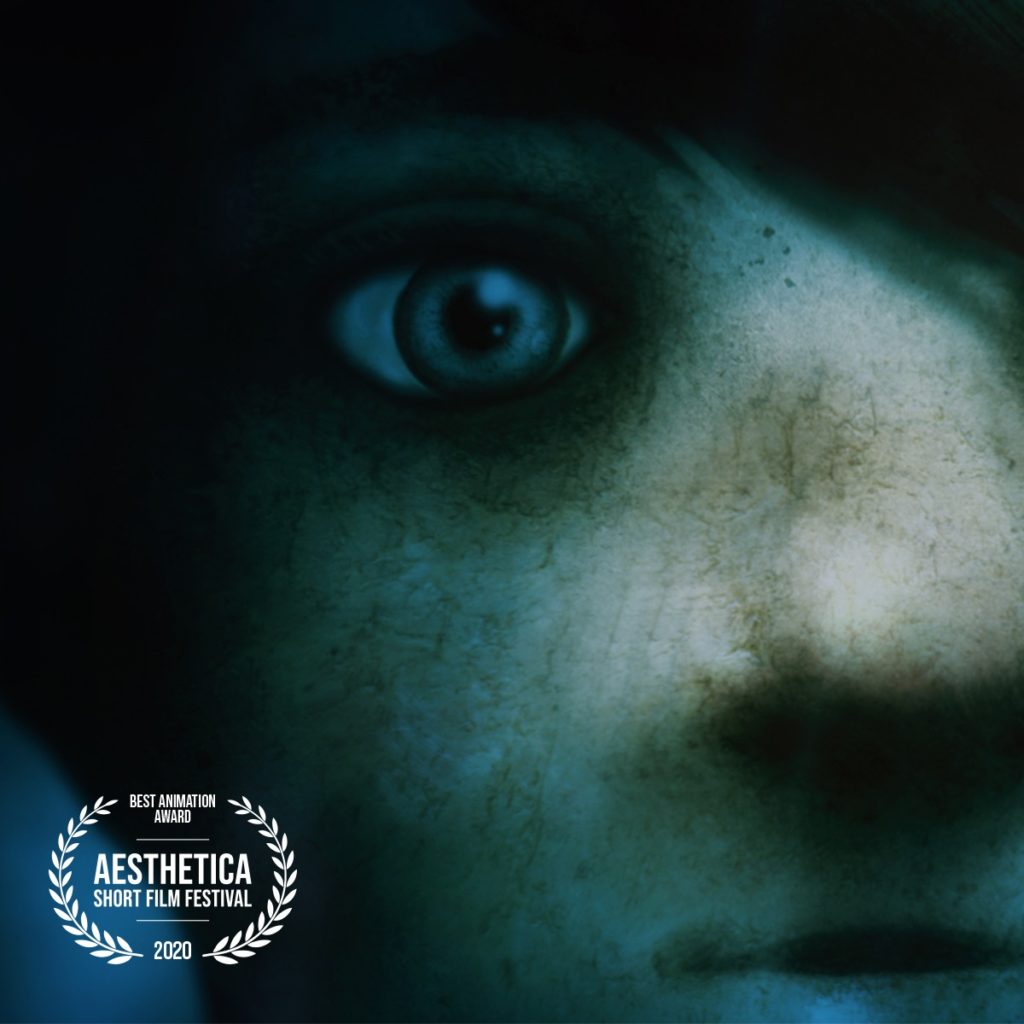
Best Animation
The Passerby, directed by Pieter Coudyzer
ON a summer’s day, the paths of two boys cross unexpectedly. The Passerby considers what happens when two lives become intertwined and the possibilities emerge of a new journey together.
The Passerby: Winner of the Best Animation award
Best Artists’ Film
Factory Talk, directed by Lucie Rachel and Chrissie Hyde
FACTORY Talk is an intergenerational conversation about identity, sexuality and masculinity. Through the clanging of metal, they make small talk, but the dialogue turns away from mere nostalgia.
Best Comedy
Maradona’s Legs, directed by Firas Khoury
DURING the 1990 World Cup, two Palestinian boys are looking for Maradona’s Legs: the last missing sticker they need to complete their World Cup album and win a free Atari.
Maradona’s Legs: Winner of the Best Comedy award
Best Dance
The Conversation, directed by Lanre Malaolu
THROUGH a dynamic fusion of movement and dialogue, The Conversation explores the challenges black people experience when communicating their racial experience to white partners.
Best Drama
The Present, directed by Farah Nabulsi
ON his wedding anniversary, Yusef and his daughter Yasmine set out to the West Bank to buy a gift. Between the soldiers, roads and checkpoints, how easy is it really to go shopping?
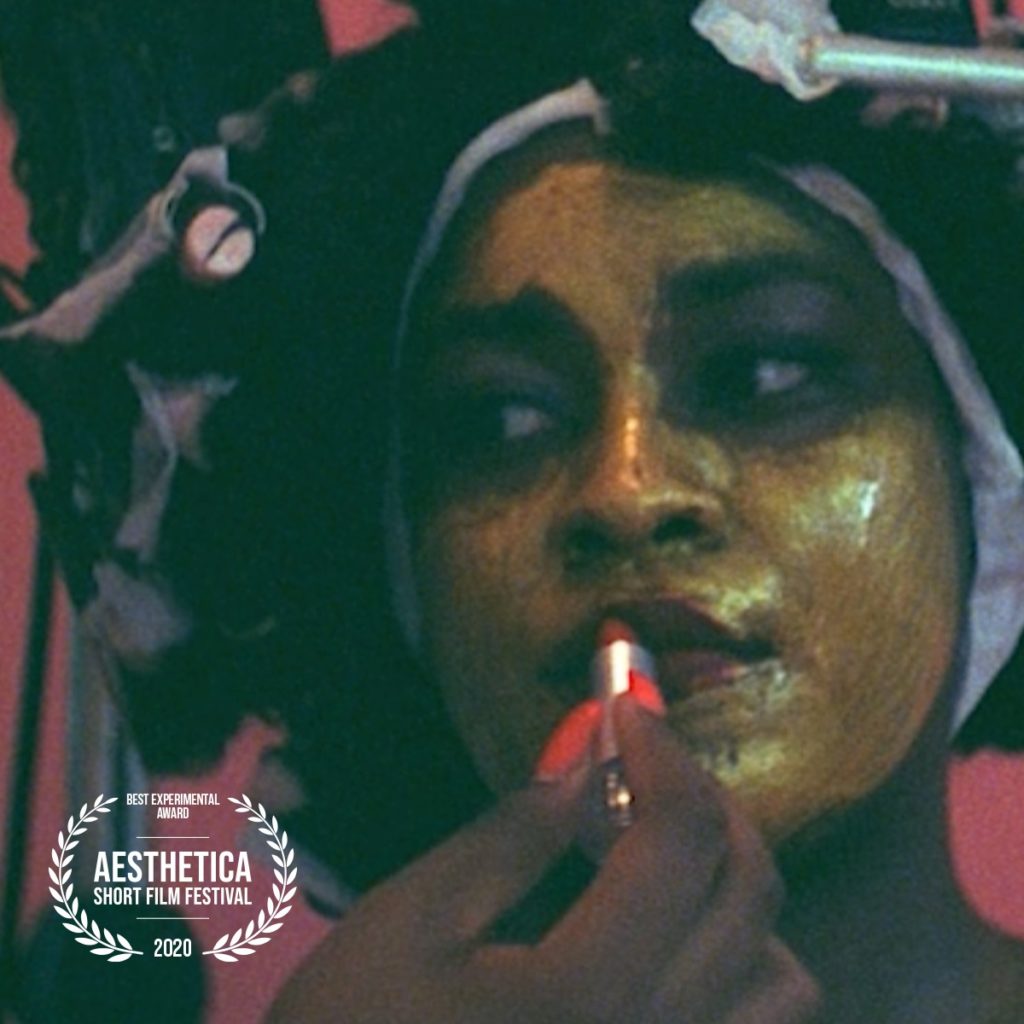
Softer: Winner of the Best Experimental award
Best Experimental
Softer, directed by Ayanna Dozier
DOZIER examines the demands that black women’s bodies be made “softer” – be that in their voice, manners, or, critically, their hair. This experimental short plays on grooming rituals.
Best Fashion
Baba, directed by Sarah Blok and Lisa Konno
A COMBINATION of design and documentary, blending elements of truth, fiction and constructed narrative. Baba provides a surreal but nonetheless light-hearted portrait of a Turkish immigrant.
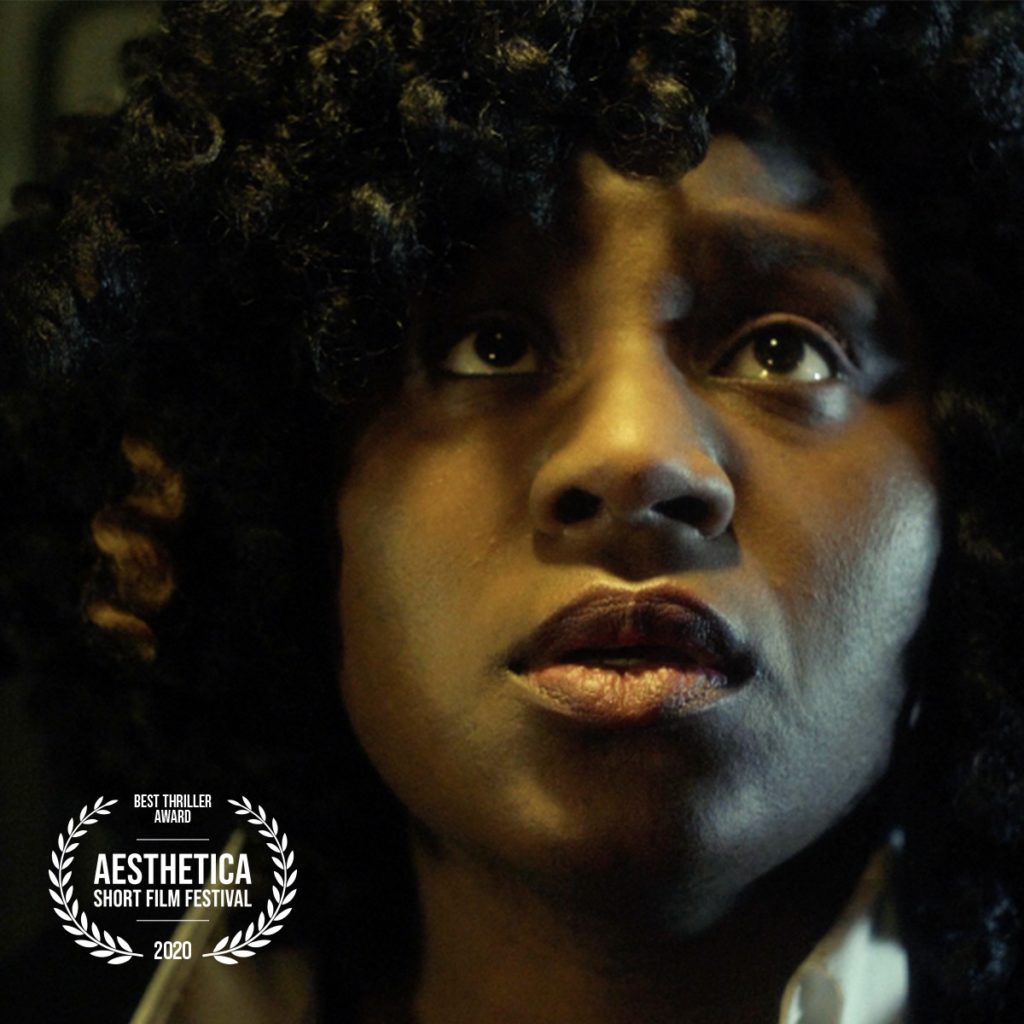
Night Bus: Winner of the Best Thriller award
Best Music Video
Adventure, directed by Zak Marx
ADVENTURE explores the world of competitive moto-racing in finely textured, surreal miniature. It follows the #2 rider as he ruminates in the shadows of world champion Jammin’ Jackie Hudson.
Best Thriller
Night Bus, directed by Jessica Ashworth and Henrietta Ashworth
DRIVING through the nocturnal streets of London on the eve of her 30th birthday, a night-bus driver discovers a supernatural entity who has boarded her vehicle and threatens to stay.
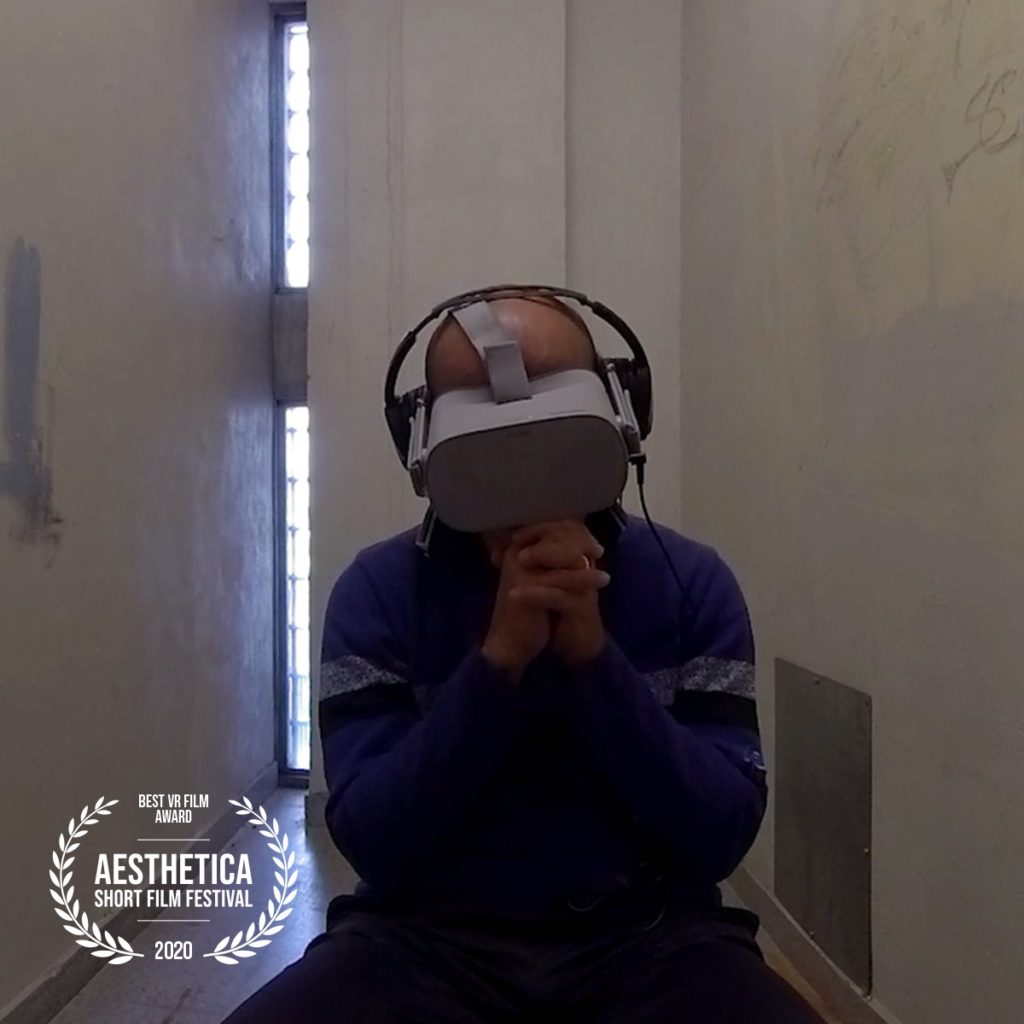
VR Free: Winner of the Best 360 Film award
Best 360 Film
VR Free, directed by Milad Tangshir
VR Free explores the nature of incarceration while capturing the intimate reactions of inmates as they encounter virtual reality and immersive videos of life outside of prison.
Best Feature – Documentary
Neighbors, directed by Tomislav Zaja
AN observational documentary about people who experience mental illness but are leaving their institution after decades spent in isolation. Zaja’s film follows the individuals as they venture out into the big unknown.
Neighbors: Winner of the Best Feature – Documentary award
Best Feature – Narrative
How To Stop A Recurring Dream, directed by Edward Morris
FACED with a split custody break up, a family’s older daughter kidnaps her hostile sister in order to embark on a journey and reconnect before they are forced to part. Shot in and around locations pertinent to the director’s childhood.
York Youth Award
Talia, directed by Cara Bamford
TALIA loves nature. She’s always looking for new ways to slip out of the house, exploring the world beyond her front garden. But after being caught, her father forbids her to leave without permission.
One award is yet to decided: Festival Pass Holders can vote for the People’s Choice Award until November 30. To do so, they must choose their favourite film by clicking the “Vote Now” button within each ASFF programme.
“So pleased with the films this year”: Aesthetica Short Film Festival director Cherie Federico
In her closing speech on Sunday, ASFF director Cherie Federico said: “I am so pleased with the films this year: they are talking about topics that are so important to me, as a person, a mother, a friend…a festival director.
“Equality. It’s just one word but, for me, it is the most important word in all languages. It means that the world has equilibrium and that we are joined rather than divided.
“There is only one future and one way out of this pandemic and that is it: we just break down all barriers and remember we are one. This is our time, right now on Planet Earth. It’s incredibly powerful when you digest it.”
American Cherie, a New Yorker who crossed the Big Pond to study at York St John University and never left York, turned her thoughts to the fractious US election. “I didn’t realise how much Trump’s presidency affected me until Biden won. I cried. It was an overwhelming sense of relief that we could turn a corner, we could end a fascist regime masquerading as a democracy.
The Present: Winner of the Best Drama award
“We could overcome all the injustices, racism and prejudice. I am be proud of who I am and where I come from again.”
Cherie continued: “I cannot even begin to explain how this makes me feel. We were heading somewhere that mirrored 1930s’ Europe and I found it terrifying. It would keep me awake at night.
“I am so very grateful that the hate will now end. I know it’s just the beginning because you can’t undo some of that which has been done, but we can try and that gives me hope.”
Returning to matters ASFF, Cherie had wanted to host a street party in York to mark the tenth anniversary. “Instead, it’s me in my office by myself, but I know that you are there and have been enjoying our masterclasses, film programmes and everything that is on offer,” she said after Covid-19 enforced the online edition. All of those session are On Demand until the end of the month.”
Thinking About The Weather: Winner of the Hijack Visionary Filmmaker Award
Looking ahead to ASFF 11, Cherie signed off: “Until 2021, when we can hug, kiss, dance and laugh in the streets! We must all come together in person and celebrate equality, creativity and diversity.”
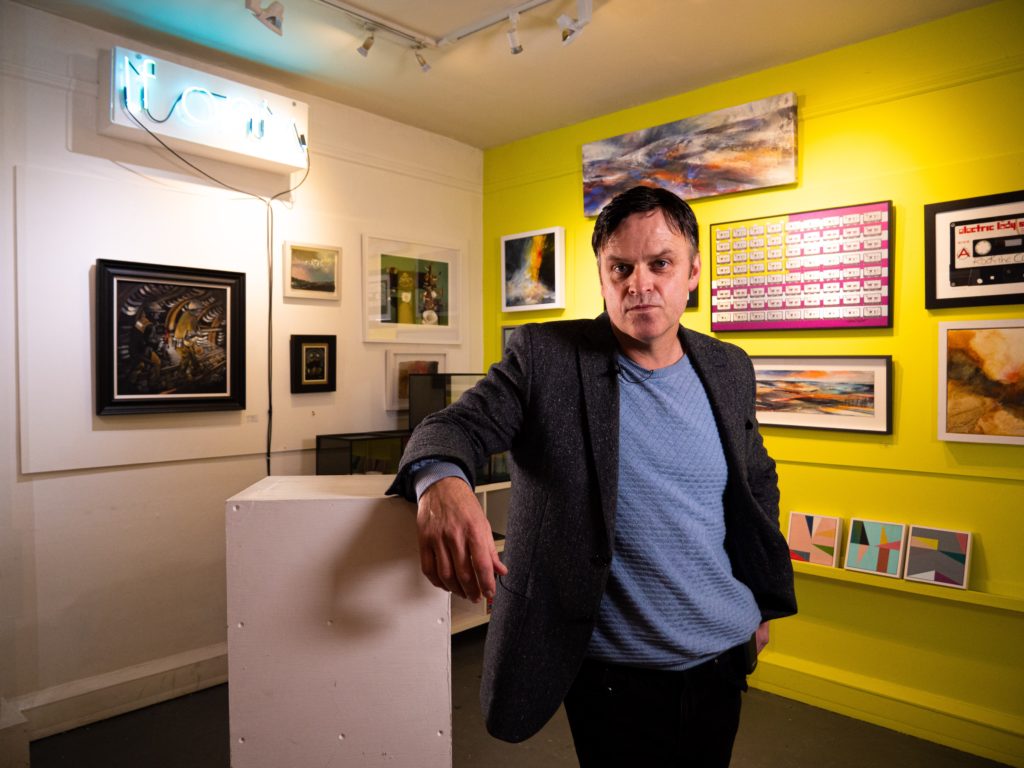
Greg McGee, ever lyrical co-owner of According To McGee, hosted the live-streamed awards ceremony from his Tower Street gallery.
Introducing the event, he said: “This year, the pandemic has subordinated everything in its path. Most of the consequences have been dreadful. Some have been tentatively positive and conversely more human.
“Nowhere else has that been more explicit than cinema. It’s your creativity and new narratives that are making life in Lockdown bearable. In terms of quality, this has been the best ASFF yet, and never has it been more crucial or vital.”
Greg McGee: Hosting the live-streamed Aesthetica Short Film Festival awards ceremony from his gallery, According To McGee on Sunday evening
Greg continued: “The tenth-year anniversary is not the Great Gatsby party we would have liked, but the films themselves vindicate what has been a decade of evolving, striving quality. “One of the most sensitive litmus tests of any genre is how well it exports. There are approximately 50 countries represented in this year’s ASFF, such as USA, Canada, Australia, Israel, Lebanon, France, Spain, Denmark, China.
“Every one of the films have connected and have lost none of their power through the intimacy of being watched at home. This year’s festival has really shown us the power of modern film, and how it can sensitise us, change us, enhance us, or quicken the beat of your heart, and I have to say nowhere is that more elegantly distilled than in Aesthetica Short Film Festival. Here’s to the next 10 years.”
Addressing the online audience of film-makers and film industry personnel, Greg concluded: “If anyone is going to successfully bequeath a multi-faceted celebration of culture, cinema and, ultimately, optimism, it’s ASFF, and it’s you, of course, with your hard work and your vision that provides the building blocks upon which this global event can continue to thrive.
“Here’s to ASFF21. The 11th one will be the biggest one. Slainte! Salute! And ba-da-bing.”
“Lieder singing is not normally associated with countertenors,” says Martin Dreyer. “Iestyn Davies (pictured) is bidding to change all that. Why not?”
LEEDS Lieder, scheduled for April, refused to be cowed by Covid and courageously got in under the wire at Leeds Town Hall, five days before total lockdown returned.
The format was necessarily compacted, with each of the three evenings having an established star and a younger talent in a warm-up role. Not that the newer names were in any way lesser lights.
For the record, the situation in the hall was far from normal. An audience of some 150 – about a tenth of normal capacity – was seated in singles and pairs, socially distanced and fully masked. There was neither interval nor refreshments.
Yet no-one was in the slightest mood to complain, partly due to exemplary stewarding, but mainly because it was sheer delight to hear singers in the flesh again after so long.
The tenor Ian Bostridge and York countertenor Iestyn Davies began and ended the festival, with Schubert’s big cycles, Winterreise (Winter Journey) and Die schöne Müllerin (The Fair Maid Of The Mill) respectively, with soprano Louise Alder between, in a colourful medley of Grieg, Rachmaninov and Strauss. All were ably supported by Joseph Middleton’s piano. (Although all songs were in German, their titles are given here in English only).
Bostridge had a less than perfect start to his day. Finding all trains from London to Leeds cancelled, he had to hire a car and arrived a mere 30 minutes before the recital began. But we would not have guessed, apart from slight stiffness in his walk to the platform.
He has chalked up more than a century of Winterreises, but his approach was never jaded; eccentric, perhaps, but never hackneyed. For Bostridge rarely stands still; he is a peripatetic performer, propelled by the depth and urgency of his emotions. That we could easily forgive – although the online audience might have experienced some to-ing and fro-ing as he veered in and out of microphone range. This was so much more than mere travelogue: here was a loner searching for consolation in nature while at the edge of sanity.
The traveller’s early hopes began to dissipate in the baritonal timbre that Bostridge conjured for Frozen Tears, with traces of derangement apparent in an internalised Numbness. The brief solace of friendship with the linden tree turned to anger in Flood.
When he rested his head on the piano for several seconds after On The River, we could not tell whether the traveller’s mental balance or the singer’s personal fatigue was the cause. It mattered not: by now, we were with both of them every step of the way. A moment of lucidity came in the middle of Backward Glance and the final arching phrase of Will-o’-the-Wisp was memorably intense.
Thereafter, the traveller’s stability became more erratic. An eerie pianissimo at the heart of Dream Of Spring belied its rather jaunty opening; the determination in Loneliness was undermined by the vain hopes dashed in The Post.
Voice and piano alike turned even more manic in Last Hope, and The Stormy Morning said more about the wanderer than the weather. There was hopelessness in The Signpost, all sense of direction disappearing, and even the warmth of The Inn was made to seem illusionary by a fortissimo postlude.
Thereafter, all that was left was hallucination in The Mock Suns and total despair in The Hurdy-gurdy Man, which was a prayerful recitative. Bostridge’s tone reflected all these moods. But in the face of the stupendous drama he generated, the technicalities of his sounds became strangely unimportant.
Louise Alder’s recital came almost as light relief the following evening. She opened with the six songs of Grieg’s Op 48, settings of unrelated German poets. Her fresh soprano and expressive features were at once engaging, as was her ability to conjure different moods in a trice.
Witty and streetwise in Uhland’s Way Of The World, she conversely found an innocent wonder for The Discreet Nightingale, to a troubadour text. Romantic yearning suffused Goethe’s The Time Of Roses, whereas Bodenstedt’s A Dream was gripping, almost nightmarish, before a triumphal end.
“Louise Alder is a singing actress of immense talent, never less than delightful here,” says reviewer Martin Dreyer
There was a childlike naivety to Rachmaninov’s six songs, Op 38, notably in the nostalgia of Daisies and the mounting excitement of Pied Piper. In Strauss’s Four Last Songs (Ernst Roth’s title, not the composer’s), she raised her game still further.
There was admirable control in the high, arching lines of Spring and an autumnal warmth in September. But the peak of her achievement came in Going To Bed, floated effortlessly, distilling Hesse’s lyric into a glimpse of eternity. It was a pin-drop moment.
The long phrases of Eichendorff’s At Sunset offered a complementary, earthy glow, with Alder smiling through the evocative postlude. She is a singing actress of immense talent, never less than delightful here.
Lieder singing is not normally associated with countertenors. Iestyn Davies is bidding to change all that. Why not? He appeared for Schubert’s Die Schöne Müllerin looking the part, in a Bohemian collarless jacket, as if ready for a ramble.
His wide range is a decided asset in this music. He also preferred the straight-line focus that we might expect in a Dowland lute-song to the relaxed tone more familiar in this music. Sometimes these two sorts of resonance appeared side by side in the same song.
After a vocally insistent Halt!, for example, with the piano depicting a particularly angry stream, Davies’s delivery in Thanksgiving To The Brook veered back and forth between the two. The little dramatic scena that was After Work made its successor The Inquisitive One all the more plaintive by comparison.
Three of the central songs needed to be a touch broader: Impatience, so that the refrain “Yours is my heart” might gain in importance; Mine!, with its angry instructions to nature, which were all but garbled, although composure was regained in Pause and To Accompany The Lute’s Green Ribbon, which was excessively impatient. But the huntsman galloped impressively and the jealousy and pride he provoked was properly emotional.
Davies showed his ability to turn a phrase neatly in The Beloved Colour and he made a lovely lament of Withered Flowers. The final exchanges with the brook were just right, prayerful on one side, friendly and reassuring on the other.
Both singer and pianist were quite assertive in their approach throughout, so that Schubert’s natural emphasis was not always allowed to speak for itself. But there was no denying their depth of feeling, which was impressive.
The up-and-coming singers heard by way of introduction to the three stars above all acquitted themselves admirably. Harriet Burns was a model of composure and confidence in Schubert’s settings of Ellen’s three songs from Scott’s Lady Of The Lake, D.837-9.
Her injunctions to warrior and huntsman to rest from their labours reached their target at once – no mean feat after months of lockdown – and were warm-hearted without sentimentality. The familiar Ave Maria came up fresh but prayerful, phrased smoothly and easily.
Benson Wilson opened nobly with Howells’s King David, his baritone finding a glorious legato, with only marginal loss of resonance in his sotto voce. Three songs from Finzi’s Shakespeare cycle, Let Us Garlands Bring, had an idiomatic feel, helped by excellent diction. It Was A Lover And His Lass was especially jaunty. And there were fireworks in a setting of the Maori haka, reflecting Wilson’s Polynesian roots.
After a poised account of Liszt’s Oh, Quand Je Dors, Nardus Williams returned us to Lieder with two Brahms settings. A gentleMaiden’s Song (Op 107 No 5), which appropriately speaks of isolation, was well balanced by a buoyant My Love Is Green. She revealed the power of her soprano in Wolf’s setting of Do You Know The Country?, which was notably forthright.
Leeds Lieder is to be congratulated for persevering with these recitals under extremely difficult conditions and for mounting events of such quality. Let us hope that normal service may be resumed next April. Fortune favours the brave.
Call-out to independent York artists and craft makers to take part in York River Art Market’s virtual winter markets at home in November and December
YORK River Art Market is going virtual in the lead-up to Christmas at #yramathome.
The series of Virtual Winter Art Markets will run from 10am to 5pm each Sunday from November 22 to December 20, plus the last Saturday before Christmas Day, December 19.
Online shoppers can browse and buy artworks from a selection of 20-plus different “indie makers” at each market day via Instagram.
Information on each weekend’s makers, along with instructions on how to shop, will be shared via the York River Art Market (YRAM) Facebook page, both in the run-up to the events and during them.
On market days, the artists will be set up via their own Instagram accounts to showcase live videos of their stall and individual images of each item for sale, with details on medium, size and price.
Artists and craft makers seeking to sell artworks from the comfort of their own home under the YRAM umbrella should contact yorkriverart@gmail.com for details. The cost will be £10 per day to cover administration, advertising and the chance to promote and sell work via Instagram.
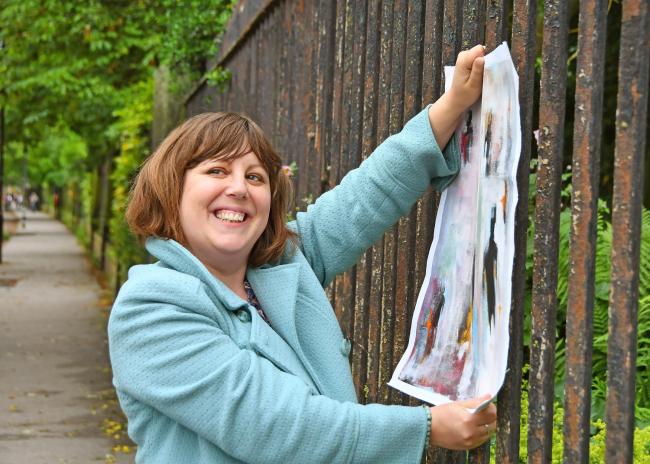
“I do hope York River Art Market At Home can give support to indie makers and also offer a different and fun experience for shoppers, where they can connect directly with the artists,” says organiser Charlotte Dawson. Picture: David Harrison
Looking ahead to the markets, organiser Charlotte Dawson says: “Shoppers can simply find details of each artist attending the up-and-coming market day via the YRAM Facebook page, which will guide them to each artist’s own Instagram page.
“Here, shoppers may browse the images of each indie maker’s artworks for sale and follow the maker’s simple instructions of how to claim/buy each handcrafted item.”
Charlotte foresees the Virtual Winter Art Markets being welcomed by makers and shoppers alike. “So many physical arts and craft events have been cancelled this year due to Covid-19, such as the York River Art Market’s fifth summer besides the River Ouse,” she says.
“I realise that a Virtual Art Market is a completely different experience to being besides the river, with art exhibited all along the railings down Dame Judi Dench Walk by Lendal Bridge.
“However, I do hope that this version can give support to indie makers and also offer a different and fun experience for shoppers, where they can connect directly with the artist and browse the virtual market place, via Instagram, at their leisure and from their own home.”
#yramathome dates for the diary are: November 22 and 29; December 6, 13, 19 and 20, 10am to 5pm. For information and updates, follow YRAM at @yorkriverart on Instagram and at @yorkriverartmarket on Facebook.
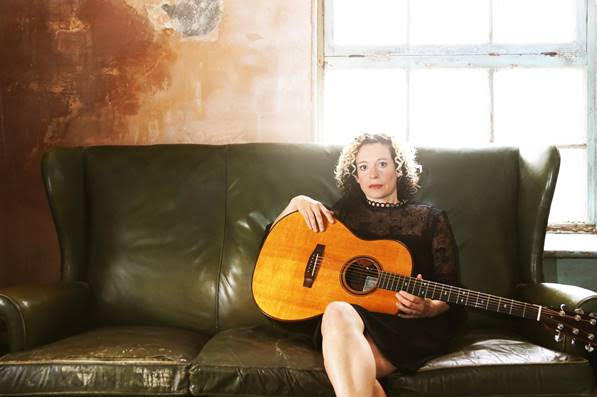
“As a folk singer, it’s what I do: reinterpret existing songs,” says Kate Rusby, after recording an album of covers
Kate Rusby, Hand Me Down (Pure Records) ****
SUDDENLY, 2020 has brought a spurt of cover-version albums.
Throwing Muses’ Tanya Donnelly in tandem with fellow New Englanders The Parkington Sisters, for one. Gillian Welch & David Rawlings’ All The Good Times, for another. Molly Tuttle’s quarantine collection, …But I’d Rather Be With You, for a third.
On November 13, Marika Harkman will release Covers, her collection of “songs she is obsessed with”, while Lambchop will uncover Trip. Meanwhile, mask-dismissing Noel Gallagher wants to make an album of Burt Bacharach and The Smiths covers…definitely, maybe, wait and see, after a career of paying tribute to The Beatles and Slade in Oasis and beyond.
Most successful in the UK charts has been Kate Rusby’s home-made delight, Hand Me Down, peaking at number 12, the highest placing of her 25-year career at the forefront of folk.
Folk musicians have always handed songs down the generations, blowing the dust off the songbooks of yore to revive past works, but you would not call those restorations ‘covers’, whether in the work of Sam Lee or indeed Rusby.
In 2011, North Easterners The Unthanks reinterpreted the left-field songs of Robert Wyatt and Antony & The Johnsons on Diversions Vol 1, but folk loyalist Rusby has gone to the heart of pop, rock, even reggae, for her Lockdown DIY recordings.
This is not as radical a step as you might first think, and nor is it a novelty. Barnsley nightingale Kate covered The Kinks’ Village Green Preservation Society for the theme tune to Jennifer Saunders’ Jam & Jerusalem sitcom and duetted with Ronan Keating on the 2006 top ten hit All Over Again.
After performing Don’t Go Away on Jo Whiley’s BBC Radio 2 show, Kate’s wistful ballad take on Oasis featured on last year’s Philosophers, Poets And Kings and became a concert favourite. A return visit to Whiley’s studio elicited a mournful reading of The Cure’s Friday I’m In Love, now one of the stand-outs on Hand Me Down.
“As a folk singer, it’s what I do: reinterpret existing songs,” explains Rusby. “The only difference is that usually the songs are much older.”
Not only very old songs are handed down through the generations, however, so too are favourite songs of any age, of any generation, she says. “Songs are precious for many different reasons.”
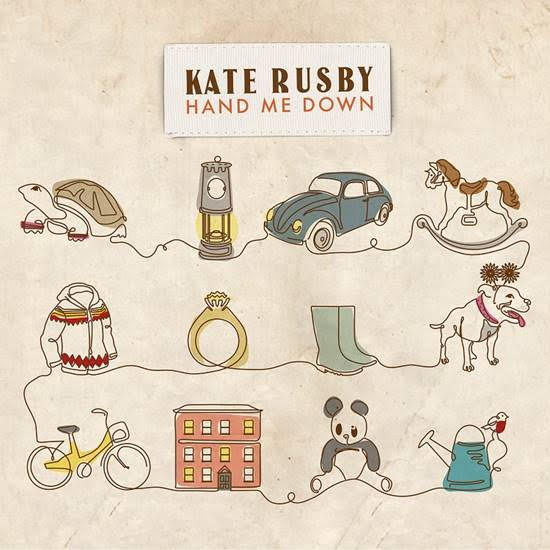
The album artwork for Kate Rusby’s Hand Me Down
Those reasons are outlined in Rusby’s detailed sleeve notes to her intimate home studio recordings with guitar and banjo-playing producer-husband Damien O’Kane and daughters Daisy Delia and Phoebe Summer on sporadic backing vocals in between home-schooling sessions.
Some are chosen from childhood or teenage memories (The Kinks’ Days, but from Kirsty MacColl’s sublime version; Cyndi Lauper’s True Colours), two much-covered songs you might have predicted, rather more than Maybe Tomorrow (The Littlest Hobo theme song) or The Show, from family friend Willy Russell’s musical Connie.
Covering a song is as much about what you uncover as you cover, prime examples here being Coldplay’s Everglow, Lyle Lovett’s If I Had A Boat and in particular “role model to her children” Taylor Swift’s Shake It Off, newly revelling in O’Kane’s swing-time banjo.
Nothing evokes Lockdown more than the opening Manic Monday, Prince’s song for Kate’s teen favourites The Bangles, slowed and turned to acoustic melancholia for not-so-manic days of longing at home, away from the city buzz. Add South Yorkshire vowels, and who can resist.
Covers albums have an erratic history, more often a dangerous minefield rather than an orchard full of fruit ripe for picking. Kate joins the latter list, ending with a ray of perennial summer sunshine, Bob Marley’s Three Little Birds, as Hand Me Down becomes balm for fretful, fearful pandemic times.
“I’ve always had overwhelming urges to cheer people up at times of sadness,” she says. “I don’t know if it’s a blessing or a curse, but it’s always been part of my genetic make-up.”
Kate, it is a blessing, “singin’ sweet songs of melodies pure and true,” as Marley put it.
Win signed copies of Kate Rusby’s Hand Me Down
COURTESY of Kate Rusby and Pure Records, CharlesHutchPress has five Hand Me Down CDs, signed by Kate, to be won.
Question: Who wrote Manic Monday, the opening track on Hand Me Down?