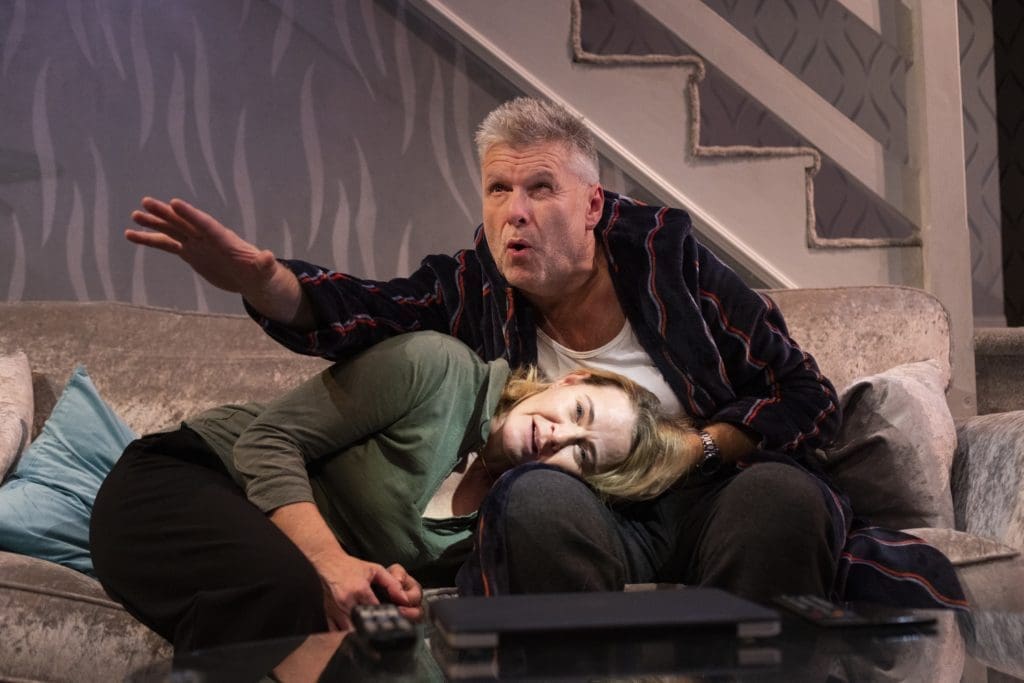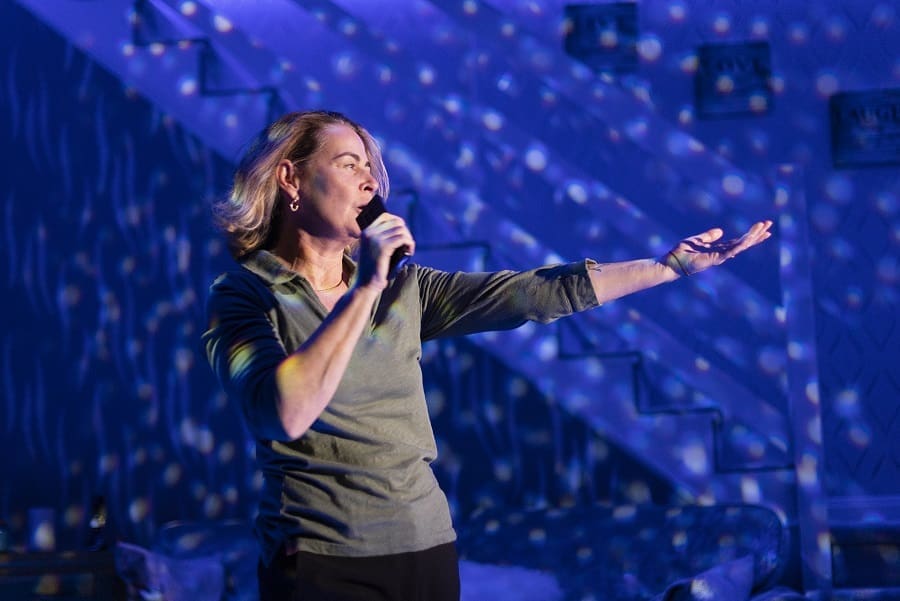

Victoria Delaney’s Kat, left, Beryl Nairn’s Ma and Clare Halliday’s Maudie in York Actors Collective’s The Strongbox
YORK Actors Collective returns to York Theatre Royal Studio next week to stage the York premiere of The Strongbox, Stephanie Jacob’s powerful study of freedom, control and servitude.
First performed in 2018 at the VAULT18 Festival at Charing Cross, London, where it won the Origins Award for Outstanding New Work, was Pick of the Festival and Jacob played the role of Kat, this 75-minute three-hander charts the changing dynamics of a mother and daughter keeping a homeless woman as a slave in their London home. Power starts to shift when the daughter becomes distracted by business and the mother falls ill.
In her sixth production since setting up York Actors Collective in 2023, Angie Millard directs a highly experienced York cast of Beryl Nairn as Ma, Victoria Delaney as daughter Kat and Clare Halliday as Maudie.
“Three women learn how to live and survive by making their own rules, but at what cost?” ponders Angie. “As Ma says, ‘if you do and do and do and do to someone, can it be undone?’ That’s the question the play explores with honesty and some humour.”
In keeping with presenting Alexander Zeldin’s Beyond Caring in 2024, Nina Raine’s Tiger Country in 2025 and Beth Steel’s Till The Stars Come Down at Theatre@41, Monkgate, in April 2026, Angie has picked a play new to York audiences.
“That’s my bag. That’s one of the things I try to do,” she says. “If there are plays you haven’t seen or by new writers, when there are too many productions of shows you already know, I want to do works that make people think, and as long as you choose carefully…”
Describing the play, Angie says: “This one is a chamber piece, about a relationship between three women with a lot of cruelty in it, but with a sad acknowledgement that that’s what life can be about.

Beryl Nairn, left, Clare Halliday and Victoria Delaney in rehearsal for Stephanie Jacob’s three-hander The Strongbox
“It’s an intense drama – 75 minutes where there’s no breathing space – and the cast really understands the intensity of their characters. They’re three very talented actresses who are very much up for the job. It would be impossible to have an interval because the intensity of the emotions wouldn’t tolerate it.”
Angie homed in on The Strongbox after researching Stephanie Jacob’s work. “I read a couple of things she’d written and loved her style. I wrote to her to ask, ‘why can’t I get a script for The Strongbox?’, and she explained it was out of circulation as a festival play in London, but she said I could have the script rights for £10 as she’s pleased that someone wants to have a go at it.
“I’ve since had phone conversations with her, though not recently, because the author, I think she would agree, needs to butt out!”
One significant change Angie has made is to change Maudie from a teenager [aged 17] to an older woman in her 30s. “I think the play is richer for that, because Maudie’s lived through a lot, and I feel an older character suits that better,” she says. “I’m sure Stephanie would not object to that change.”
After making that alteration, “one of the things I’ve been working on with the cast since we started rehearsals in early September is the ‘status’ of the characters, thinking about where I should place them on stage, which is as important as in a Harold Pinter play,” says Angie. “There’s this constant jostling for power, where it’s a life and death struggle for them.”
The set design will play into that power struggle. “There’s a bed, a table and two chairs – minimal – which will be great for Studio where there’s not much room!”
Introducing her character of Maudie, Clare says: “She’s a northerner who’s been through the care system and is used to living on the streets. She’s basically ‘rescued’ by Ma and Kat and she’s just trying to survive.”
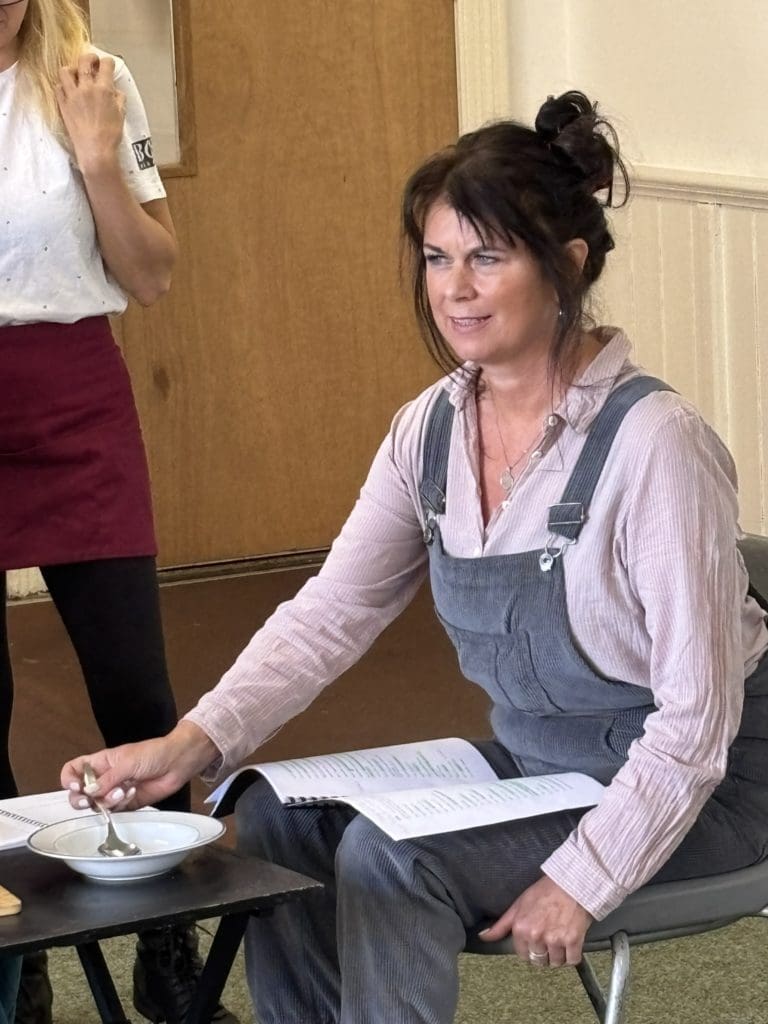
Victoria Delaney rehearsing her role as “power-hungry” Kat in The Strongbox
“Kat is really tough,” says Victoria, “I’m going to play her as quite androgynous, but also a woman of the world who is power hungry.”
Beryl comments: “To say Ma and Kat are not close would be an understatement, yet they’re welded together. Ma is top dog…at the moment…but she’s being very closely followed her daughter, who want to be top dog. There are lots of dark secrets that are then shockingly revealed – with the odd laugh too.”
Whereupon Victoria chips in: “Every spine-chilling play has to have an element of horror. There are some disturbing things in the play and one of them is modern-day slavery, which is not often explored in contemporary dramas.”
Playing the 80-year-old Ma, Beryl notes: “One of the other important aspects is that it’s a play about women. Tough women. Ma and Kat have this empire in chauffeur-driven cars and want to accumulate more business.”
Clare says: “Maudie is the ‘victim’ at their house but she’s waiting for her chance.” “There’s no lead role here; they each come to the fore as the dynamic changes,” says Victoria. “They’re all fighting for power in a battle of wills, and it’s fair to say Ma and Kat hate each other but need each other.”
“There’s no trust but there is co-dependency,” says Beryl. “Everything is transactional, including the relationships.”
York Actors Collective presents The Strongbox, York Theatre Royal Studio, October 29, 2.30pm & 7.45pm; October 30, 7.45pm; October 31, 2pm. Box office: 01904 623568 or yorktheatreroyal.co.uk. Age guidance: 14 plus.