
York actress Frances Marshall in rehearsal for Alan Ayckbourn’s The Trial Of Romeo Oscar. Picture: Tony Bartholomew
REHEARSALS are into tech week for Alan Ayckbourn’s 92nd play, the groundbreaking The Trial Of Romeo Oscar, whose premiere will run at the Stephen Joseph Theatre, Scarborough, from September 4 to October 3.
Directed by Sir Alan, Elizabeth Boag, Frances Marshall, Russell Richardson, Richard Stacey, Leigh Symonds, Hayden Wood and Olivia Woolhouse will be performing his first courtroom drama.
No ordinary courtroom drama at that, but one set in the year 2194, with the undercurrent of a detective story too, when “humanity is scattered around the solar system and day-to-day life on Earth looks very different”.
“Preparations are underway for a landmark legal case,” reveals Sir Alan. “Romeo Oscar, a military issue android, is on trial for murder: the first non-human to be tried in a court of law. The circumstances surrounding the incident are unclear, the evidence is polarising, and selecting an impartial jury is proving to be a challenge.”
Introduced by Ayckbourn’s observation that “in space, no-one can hear you dream”, The Trial Of Romeo Oscar asks a question that artists have been positing for centuries: what makes us human?
“When you reach my age, you really only have the choice as a writer of either looking back or moving forward,” says Sir Alan, now 87. “At the moment, I’m sort of swinging between past and future with each play. But where we’re going, particularly with AI, is always interesting. I don’t think it’s a bad thing. Look at Shakespeare, he went into complete fantasy and was none the worse for that!”
Why has Sir Alan not written a courtroom drama until now? “They all required big casts,” he says. “You could use the audience as the jury, which is a gimmick many theatre directors have used, or you could have 12 actors sitting around for a long time before doing anything.

“The advantage of me doing the play set in 2194 is that most of the cast can be virtual, invisible to the audience, so we only hear their voices.
“It’s set so far in the future that you would think that by then they would be bringing in witnesses by video or hologram.”
The Trial Of Romeo Oscar nevertheless ends up with a cast of seven: “That’s still quite big for the SJT,” says Sir Alan. “The play is still within the tradition of a courtroom drama with a judge, defendant, prosecution and defence lawyers and witnesses, but it’s a very different world.
“Firstly, because the defendant is an android, and secondly, because it’s a world no longer ruled by politicians but now run by huge corporations, in this case the Citrus organisation in London. It’s a post-holocaust world after a World War of some description, and it’s the first play of mine to be set entirely underground but still on Earth – and it features my first replicant.
“The war has been over for 20 years and was fought by frontline troops that were all androids, where humans had very little involvement, except remotely. Like now, with drone controllers sitting safely in their bunkers.”
Sir Alan continues: “In a sense, the androids return home as war heroes and are one step closer to being independent citizens, after being prescribed as a different class of being for so long.
“They are sentient, although they are made on work benches, so people argue that they have no soul, but it was increasingly apparent in my last android play [2023’s Constant Companions, featuring an android building janitor named Jan Sixty and an auto-domestic maid named ED] that they were seeking independence at the end.
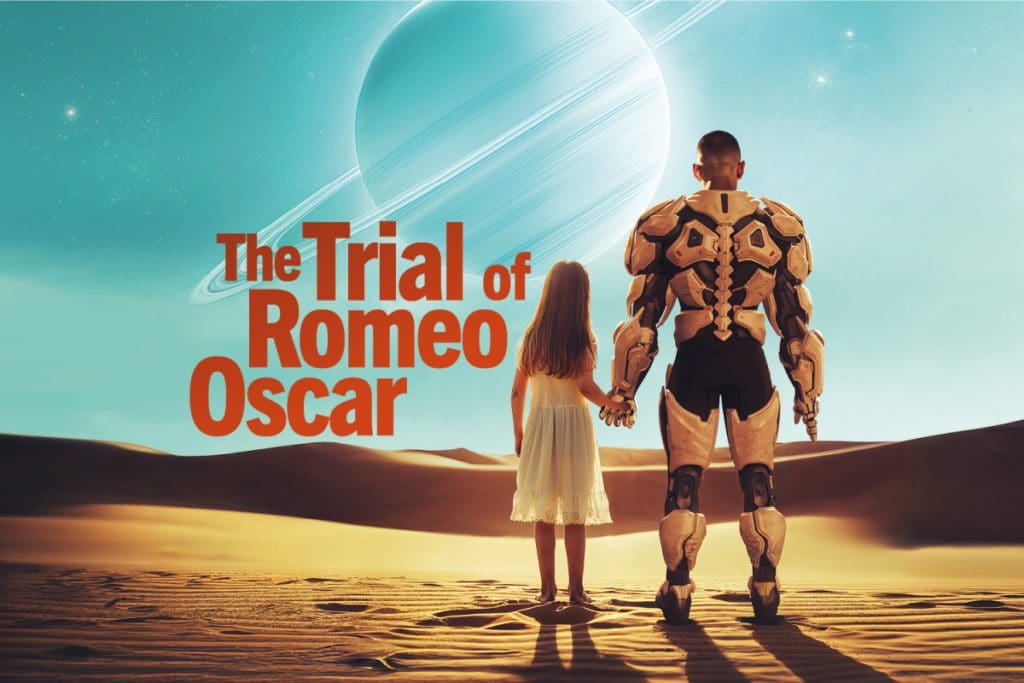
The poster for Alan Ayckbourn’s courtroom drama The Trial Of Romeo Oscar
“Now, in The Trial Of Romeo Oscar, they have been granted responsibilities and acknowledged as having independence, and as a result, they also become liable to be prosecuted. This trial is the first case because previously it was impossible to think of an android killing a human, but this looks a slam-dunk case.
“Into this mix we bring an outsider, a defence counsel shipped in from an Earth colony, Titan, Saturn’s largest satellite.”
Ayckbourn’s play may be set in the future, but one too close for comfort. “If politicians keep mucking up in the way they are, someone is going to grab the reins of power in the way that Trump has. Only one step from a businessman, where that gap is growing smaller, and now what I’ve done is to extend that possibility to infinity,” he says.
“In my youth, I used to read so much sci-fi literature, and the thing that I latched on to was how they presented conundrums and made them into parables for today.”
Drawing parallels with the rise in racism and right-wing intolerance today, Sir Alan says: “If you then introduce another race, in other words the androids, where do they fit in? They’re the next victims of racism, seen as a threat, ‘taking our jobs away’. All that racism and sexism starts all over again.”
Ayckbourn’s world in 2194 is one where the arts have virtually disappeared. “After the war, humanity vowed that anything that was created before that should not be encouraged,” he says. “It is a dark premise, but all the better for producing laughter as we will recognize some of it as being close to where we are now. It’s what I call ‘oh my God’ laughter.”
What makes us human, Sir Alan? The arts, music, Shakespeare, this play’s message, he would no doubt reply.
Alan Ayckbourn’s The Trial Of Romeo Oscar, Stephen Joseph Theatre, Scarborough, September 4 to October 3. Box office: 01723 370541 or sjt.uk.com.