
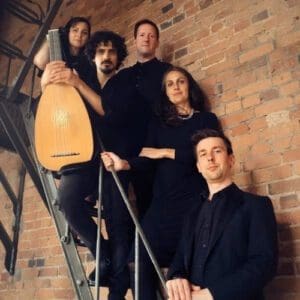
Dowland’s Foundry. Picture: Ryedale Festival
OUR first great songwriter, John Dowland, is normally experienced today with a single voice singing to lute or viol accompaniment, but this is not necessarily how his contemporaries heard him.
The secret lies in the subtitle of his First Book of Songs (1597), “or Airs of Four Parts” (in modernised spelling). This simple revelation lies behind what Dowland’s Foundry does with his music. As a vocal quartet, accompanied by the lute of Sam Brown, they tend to sing all four parts, thereby obviating the need for viols.
The songs in this book are all strophic (with tunes repeated for each verse), so variety depends on performers enlivening the texts. This ensemble was also adept at adjusting to Dowland’s many moods, by no means all of them as melancholic as his reputation.
At times we heard only two voices, or conversational-style exchanges, rather than straight four-part delivery. Dowland’s songs are an amalgam of madrigals, consort songs, broadside ballads and even dance music, which largely accounts for their enduring popularity. Dowland’s Foundry were attuned to these styles and able to draw in their audience very quickly through the enthusiasm of their approach. Brown’s eloquent lute added further colour.

Pianist Lukas Sternath performing at St John The Baptist, Easingwold, at Ryedale Festival. Picture: Jonas Cradock
That evening, five players from among the current BBC Radio 3 New Generation Artists brought Schubert and Dvořák to the generous acoustic of Easingwold parish church. The pianist Lukas Sternath is an accomplished technician who was unashamedly forthright in his approach to Schubert’s Sonata in G major, D.894 (‘Fantasie’), which dates from October 1826.
All but one of its four movements begins either piano or pianissimo; only the minuet (effectively a scherzo) starts forte, but its trio sets out pianissimo and quickly moves into triple piano.
You would rightly surmise that Schubert had in mind an intimate work. Sadly Sternath had other ideas. He played as if in a hall ten times the size. He used every excuse to move directly from relative quietness to fortissimo, hammering out accents at every opportunity.
He was not oblivious to Schubert’s melodic possibilities and spiced his phrases with rubato, robbing the tempo in the name of musicality. But such a move has to be compensated. He rarely moved back into his original tempo, so that the overall effect was that he couldn’t see the wood for the trees.

Aris Quartet playing at St John The Baptist, Easingwold, at Ryedale Festival. Picture: Jonas Cradock
Perhaps he was misled by the work’s nickname, ‘Fantasie’, which would possibly allow some latitude in interpretation, but this was a publisher’s idea, not Schubert’s. What we lacked was serenity. Nevertheless the closing rondo was exciting, if rather more rumbustious than the composer intended.
An entirely different side to Sternath’s musical personality emerged when he returned to collaborate with the Aris Quartet in Dvořák’s Second Piano Quintet. Where some pianists are inclined to treat the work as a piano concerto, leaving the strings trailing in their wake, Sternath was a model of restraint throughout. The work is very much built around dance rhythms and the pianistic underlay here was at the heart of all these.
The Aris are a beautifully balanced group. There was a strong contrast between the two themes of the opening Allegro, and the eloquent viola of Caspar Vinzens was positively soulful in the slow movement’s Dumka.
The lively Furiant in the scherzo was partnered by a much more intimate trio, while the polka-based finale was again bursting with high spirits, but even here Sternath was relatively subdued. The overall ensemble, however, was never less than engaging.
Review by Martin Dreyer