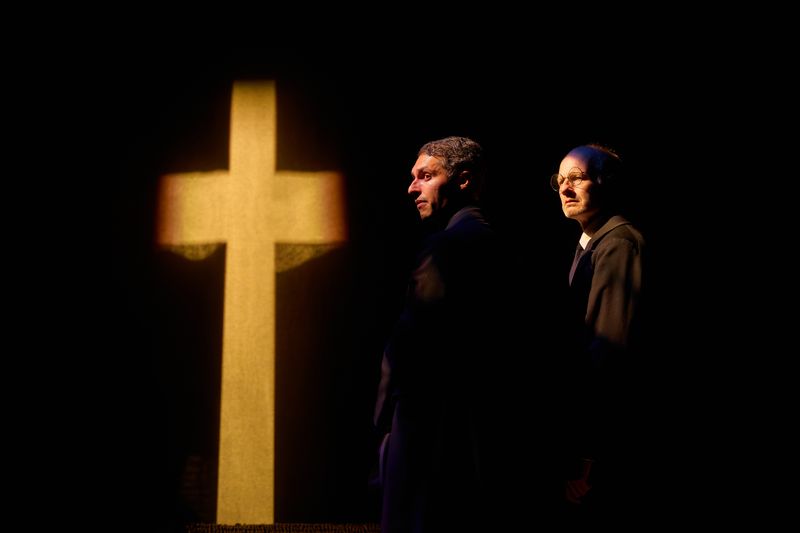
Daniel Burke, left, and John Mackay in the funeral scene in The Woman In Black. Picture: Mark Douet
IN the Dress Circle at Tuesday’s press night were assembled rows of Year 9 pupils, all studying The Woman In Black. They talked with bravado of not screaming, albeit some with more conviction than others.
Your reviewer, a veteran with many years’ service to watching Stephen Mallatratt’s meta-theatrical adaptation of Scarborough novelist Susan Hill’s ghost story, struck up conversation with the excited students, predicting that boisterous ghost bluster would make way for shrieks by the fright night’s denouement.
Sure enough, their reactions would alter once the early humour faded away, consumed by the gravest, ghostly, ghastly deeds in the fog and murk of Eel Marsh House, the remote mansion haunted by the hollow-faced spectral figure of the title.
No matter how often The Woman In Black plays its cards, it can still surprise, startle, jolt and, yes, scare beyond shredded nerves, such is the adroit sleight of hand of Robin Herford, still directing the show, as he first did in a pub setting at the Stephen Joseph Theatre, Scarborough, in December 1987.
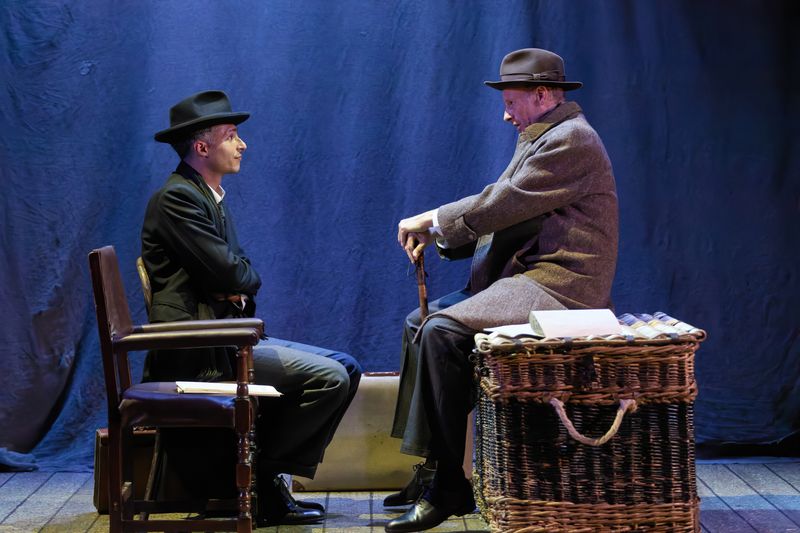
Train of thought: Daniel Burke and John Mackay in a travelling scene in The Woman In Black. Picture: Mark Douet
Returning once more to the Grand Opera House – home to its own story of a resident ghost who greets new members of staff by name on first acquaintance in the auditorium – The Woman In Black is a celebration of the unrivalled power of theatrical storytelling, invention and the imagination, as much as the British love of chills, thrills and spills.
Like buses on a good day, another one will be coming around the corner soon in the form of Danny Robins’s 2:22 A Ghost Story from March 30 to April 4, a smart invader from modern-day London wrapped inside a state-of-the-nation character study that first played York in May 2024.
The Woman In Black is of an earlier vintage, a place of hats and overcoats, a pony and trap, worn briefcases, piles of faded papers and a rocking chair, where, as ever, “the action takes place in this theatre in the early 1950s”.
The Grand Opera House’s plush velvet design is ideal for Mallatratt’s theatrical conceit of a play within a play staged in a disused theatre within a theatre, in which Michael Holt’s gauze set enables the stealthy revelation of a shadowy, creaking stairwell, deathly cold dark passages, a large locked door and, most disturbingly, a child’s bedroom with toys and clothes untouched from 50 years ago.

Rod Mead’s sound design, orchestrated on tour again by Sebastian Frost, wraps itself around all corners of the auditorium to keep the audience on alert, aided by the ironically named Kevin Sleep’s light design that cranks up the tension, changing suddenly to leave you wondering restlessly where the Woman In Black might next appear, with no escape from her cape.
As ever, the casting for what is essentially a two-hander (save for the ghostly Jennet Humphrey’s interventions) is as key to the time-honoured production’s success as all the theatrical effects.
John Mackay, as stultified, haunted lawyer Arthur Kipps, and Daniel Burke, as The Actor he hires to tell his story, are a double act in theatre’s best traditions, as adept at storytelling as light humour and then darkening horror as Kipps seeks to exorcise the fear that has burdened his soul for so long, to end the curse on his family.
“For my health, for reason”, his story must be told, he says, and with the help of Burke’s boundlessly enthusiastic Actor, on the wings of imagination, his rambling book of notes will become a play so powerful that it no longer feels like a play, but an all-consuming reality destined to play out forever.
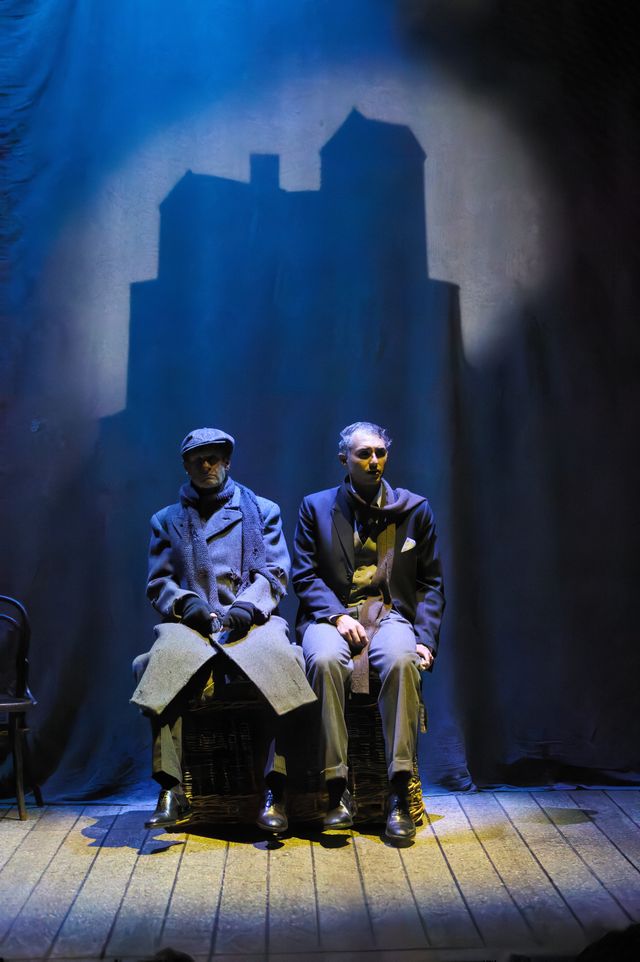
In the gloom of Eel Marsh House, John Mackay, left, and Daniel Burke play out a scene on a pony and trap. Picture: Mark Douet
The Actor becomes Kipps, the young solicitor sent to attend to the isolated, wretched English marshland estate of the newly dead Alice Drablow, while Mackay’s Scottish-toned Kipps, once he sheds his stage novice reserve, takes on all manner of roles, from narrator, hotel host and taciturn pony-and-trap driver, to an even more haunted old solicitor and wary landowner.
All the while, Kipps is ever more traumatised by his fears rising anew, and likewise Mallatratt applies the cunning skills of of a magician as the drama within takes over from the act of making it, while simultaneously glorying in theatre, dapper acting skills and the abiding appeal of a ghost story (especially in York, with its multitude of ghost walks) .
No need for high-tech special effects, this is old-fashioned theatre-making, where the terrifying theatrical re-enactment is applied with only two chairs, a stool, a trunk of papers, a hanging rail of costume props, dust sheets over the stage apron and a theatre curtain as frayed as everyone’s nerves by the end, an ending full of eternal foreboding. Welcome back, The Woman In Black.
PW Productions in The Woman In Black, Grand Opera House, York, until Saturday, 7.30pm plus 2.30pm Thursday and Saturday matinees. Box office: atgtickets.com/york.