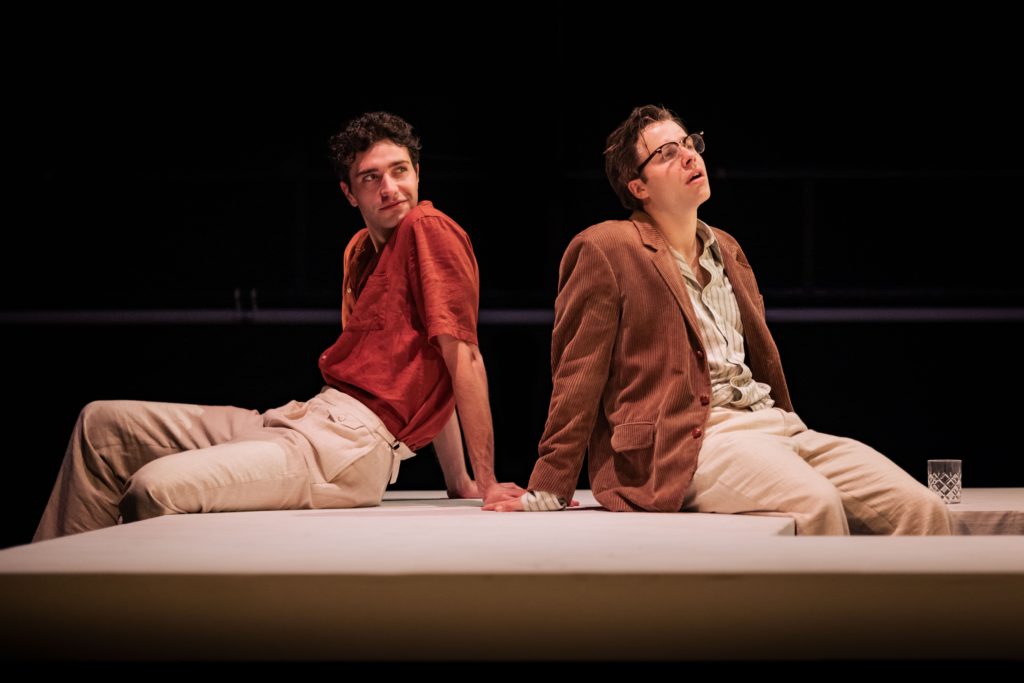
Bruce Herbelin-Earle’s Dickie Greenleaf, left, and Ed McVey’s Tom Riley in The Talented Mr Ripley. Picture: Mark Senior
“HAVE you ever thought you are being watched,” asks Ed McVey’s Tom Ripley, the nobody who wants to be someone else, someone more, at the outset of director Mark Leipacher’s new stage adaptation of The Talented Mr Ripley.
As it turns out, the obsessive, evasive, elusive chameleon Ripley is being watched by everyone: not only the audience and the Italian police, but also by Leipacher’s interpretation of novelist Patricia Highsmith’s Eumenides (the Furies of Greek mythology): imaginary figures in pursuit of the haunted Ripley in the book’s closing pages that here become the physical manifestation of his fears, paranoia, guilt and conscience.
Leipacher, however, does not leave their entry to the latter stages of Highsmith’s psycho-drama on the Amalfi Coast in 1950s’ Italy. Instead, from the off, they become a crew filming, editing and interjecting into Ripley’s writing, re-writing and telling of his story as a film, as truth, alternative truth and lies elide. Amid the restless flow, they transform into Italian denizens and the paparazzi too, flashing their cameras in trilby and raincoat tradition.
What’s more, they don’t make conventional stage entries, but appear as if by sleight of hand as Leipacher maximises the deceptive impact of Holly Pigott’s raised set, behind which Leipacher’s players can “hide” and suddenly pop up.
In its centre is a hole, from which myriad characters appear and disappear, as well as evoking a swimming pool or a boat on the sea. Such is the minimalist theatrical flair of a postmodern production that places faith in imagination – always one of theatre’s prime assets – while still using such utilitarian props as a typewriter and reading light, cocktail glasses and shaker, a huge fridge, suitcases and Ripley’s improvised weaponry of an oar and an ashtray.
The raised stage’s white frame can be transformed by Zeynep Kepekli’s superb tubular neon light design into differing shades to mirror a scene’s mood, or indeed Ripley’s state of mind, while the shiny black flooring suggests both wealth and Italian elegance, but sinister murkiness too.
Leipacher’s sleek stage version emerges in the wake of Highsmith’s 1955 novel being transferred to the silver screen by University of Hull drama graduate, tutor and playwright Anthony Minghella in 1999 and to Netflix streaming in Steven Zaillian’s eight-part monochrome series starring Andrew Scott in 2024.
Both left an indelible impression, built on glamour, close-ups, exotic locations, erotic charge. Far from intimidated, Leipacher brings brio and bravura confidence to a meta-theatrical telling that echoes Greek tragedy, serves up both eloquence and elegance, pumps up the homo-erotica, nods to the rival world of cinema and revels in the mind games, even turning the fridge into a surprising mode of entry for Maisie Smith’s Marge Sherwood.
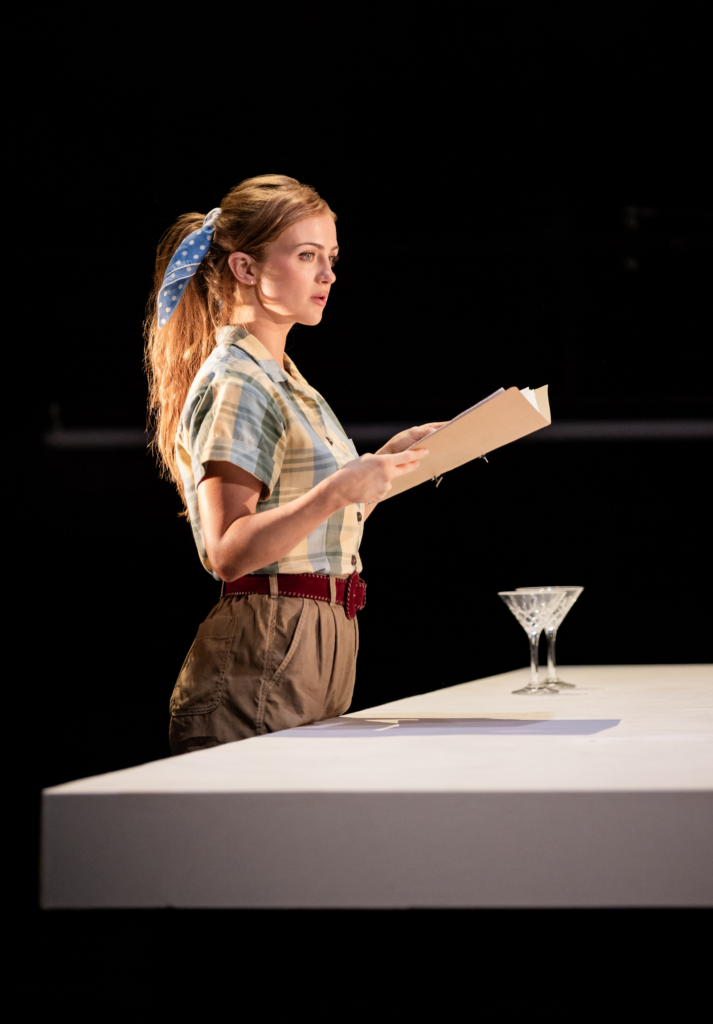
Maisie Smith’s Marge Sherwood: “More of a watercolour than an oil painting” in Mark Leipacher’s adaptation of The Talented Mr Ripley. Picture: Mark Senior
Aided by Pigott’s exquisite costume design, an air of dandy decadence yet desolation and destruction pervades Leipacher’s West End-bound account that is as seductive as McVey’s Ripley finds the freewheeling world of trust-fund wastrel charmer Dickie Greenleaf (Bruce Herbelin-Earle), a stylish but empty vessel idling his days away with a paintbrush and casual friendship with Smith’s writer-photographer Marge (a smaller role in every sense here).
Sent by New York shipbuilding magnate Herbert Greenleaf (Christopher Bianchi) to bring home his wayward son, instead McVey’s Ripley inveigles his way into the supremely assured social circuit of Dickie, Marge and writer Freddie Miles (Cary Crankson).
In Andrew Scott’s performance, you found yourself wanting him to get away with his games of identity theft and murder amid the surfeit of insufferable smugness; McVey, by comparison, is more pitiful than pitiable in this liar’s psychopathic pursuits. Yet there is amusement too in his unguarded asides, a form of disdainful running commentary that recalls Shakespeare’s Richard III in its bravado and is a particular delight of Leipacher’s arch script, heard by the audience but not those around him, adding to his facility for deceit.
Like Banquo or Hamlet’s father, the departed do not exit stage left in Leipacher’s play, and so we see rather more of Herbelin-Earle’s handsome, lithe Dickie than might be expected, appearing on occasion as the deeper-voiced double to Ripley in adopted Dickie guise to haunt him all the more directly. The shadow of death, as it were, in an echo of Act Two opening with Ripley replicating the prone position and clothing of the dead Dickie at Act One’s close: a witty touch typical of Leipacher’s smart direction.
Best known for his Prince William in The Crown, McVey delivers a more complex characterisation here in an outstanding lead performance, ever present yet ever distant, while Herbelin-Earle, entitled yet still charming, is Dickie to the privileged New York manner born.
In her first American stage role, Strictly Come Dancing finalist and EastEnders’ soap star Smith’s smart, intuitive, independent Marge is not so well served by Leipacher’s balance of focus, more of a watercolour than an oil painting, when the role warrants a weightier significance.
Overall, however, after book, film and TV series, The Talented Mr Ripley finds its voice and style anew on stage in Leipacher’s sly, visually alluring, mentally agitated, verbally adroit coup de theatre.
The Talented Mr Ripley, Grand Opera House, York, until Saturday, 7.30pm plus 2.30pm Wednesday and Saturday matinees. Box office: atgtickets.com/york.
This review is excellent. I haven’t seen the production yet but I’ll definitely be going now..